
Melting Point of Bronze
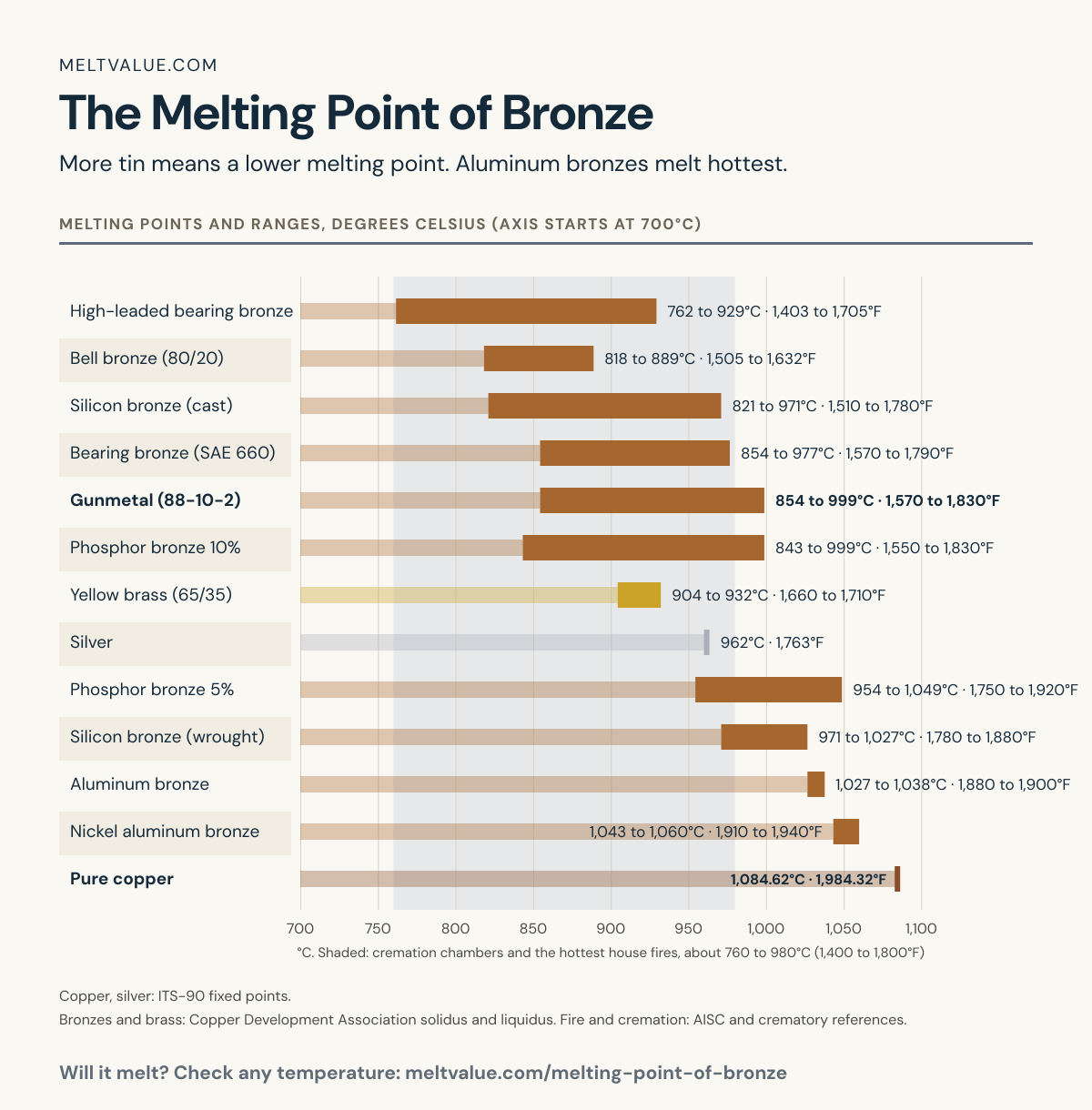
Most bronzes melt between about 850°C and 1,050°C (1,560 to 1,920°F). Classic tin bronze starts melting at about 854°C and is fully liquid near 1,000°C. The full family runs wider, from 762°C for high-leaded bearing bronze to 1,077°C for low-tin phosphor bronze. More tin means a lower melting point, and aluminum bronzes melt hottest.
Will It Melt? Check Any Temperature
Enter a temperature or tap a preset to see which bronzes would melt.
At 1,800°F (982°C)
- High-leaded bearing bronze (1,403 to 1,705°F)Melts
- Bell bronze (80/20) (1,505 to 1,632°F)Melts
- Bearing bronze (SAE 660) (1,570 to 1,790°F)Melts
- Gunmetal (88-10-2) (1,570 to 1,830°F)Starts to melt
- Silicon bronze (C65500) (1,780 to 1,880°F)Starts to melt
- Phosphor bronze (5% tin) (1,750 to 1,920°F)Starts to melt
- Aluminum bronze (C95400) (1,880 to 1,900°F)Stays solid
- Pure copper (1,984.32°F)Stays solid
Ranges are Copper Development Association values; each batch melts a little differently. "Starts to melt" means the alloy has passed its solidus, the point where the first liquid forms.
Melting Point of Bronze by Alloy
Every bronze melts over a range. It starts to liquefy at the lower number (the solidus) and is fully liquid at the higher one (the liquidus). Many charts lump bronze in with brass at about 870 to 905°C, or quote a single 950°C. Real bronzes spread across more than 300°C, and the family matters more than any one number.
| Tin and phosphor bronze (wrought) | Melting range |
|---|---|
| Phosphor bronze 1.25% E (C50500)About 98.7% copper, 1.3% tin, trace phosphorus. | 1,038 to 1,077°C1,900 to 1,970°F |
| Phosphor bronze 5% A (C51000)About 95% copper, 5% tin, trace phosphorus. | 954 to 1,049°C1,750 to 1,920°F |
| Phosphor bronze 8% C (C52100)About 92% copper, 8% tin, trace phosphorus. | 882 to 1,027°C1,620 to 1,880°F |
| Phosphor bronze B-2 (C54400)About 88% copper, 4% tin, 4% lead, 4% zinc. | 927 to 999°C1,700 to 1,830°F |
| Phosphor bronze 10% D (C52400)About 90% copper, 10% tin, trace phosphorus. | 843 to 999°C1,550 to 1,830°F |
| Tin and leaded bronze (cast) | Melting range |
|---|---|
| Tin bronze (C90300)About 88% copper, 8% tin, 4% zinc. | 854 to 1,000°C1,570 to 1,832°F |
| Gunmetal (C90500)About 88% copper, 10% tin, 2% zinc. | 854 to 999°C1,570 to 1,830°F |
| Gear bronze (89/11) (C90700)About 89% copper, 11% tin. | 831 to 999°C1,528 to 1,830°F |
| Navy M bronze (C92200)About 88% copper, 6% tin, 1.5% lead, 4.5% zinc. | 826 to 988°C1,518 to 1,810°F |
| Leaded tin bronze (C92700)About 88% copper, 10% tin, 2% lead. | 843 to 982°C1,550 to 1,800°F |
| Bearing bronze (SAE 660) (C93200)About 83% copper, 7% tin, 7% lead, 3% zinc. | 854 to 977°C1,570 to 1,790°F |
| High-tin bronze (C91100)About 84% copper, 16% tin. | 818 to 950°C1,505 to 1,742°F |
| High-leaded bearing bronze (C93700)About 80% copper, 10% tin, 10% lead. | 762 to 929°C1,403 to 1,705°F |
| Bell bronze (C91300)About 81% copper, 19% tin. | 818 to 889°C1,505 to 1,632°F |
| Aluminum bronze | Melting range |
|---|---|
| Nickel aluminum bronze (cast) (C95800)About 81% copper, 9% aluminum, 4.5% nickel, 4% iron, 1% manganese. | 1,043 to 1,060°C1,910 to 1,940°F |
| Nickel aluminum bronze (cast) (C95500)About 81% copper, 11% aluminum, 4% iron, 4% nickel. | 1,038 to 1,054°C1,900 to 1,930°F |
| Nickel aluminum bronze (wrought) (C63000)About 82% copper, 10% aluminum, 5% nickel, 3% iron. | 1,035 to 1,054°C1,895 to 1,930°F |
| Aluminum bronze D (C61400)About 91% copper, 7% aluminum, 2% iron. | 1,041 to 1,046°C1,905 to 1,915°F |
| Aluminum bronze 9% (C62300)About 87% copper, 10% aluminum, 3% iron. | 1,041 to 1,046°C1,905 to 1,915°F |
| Aluminum bronze (cast) (C95200)About 88% copper, 9% aluminum, 3% iron. | 1,042 to 1,045°C1,907 to 1,913°F |
| Aluminum bronze (cast) (C95400)About 85% copper, 11% aluminum, 4% iron. | 1,027 to 1,038°C1,880 to 1,900°F |
| Silicon bronze | Melting range |
|---|---|
| Low-silicon bronze B (C65100)About 98% copper, 1.5% silicon. | 1,032 to 1,060°C1,890 to 1,940°F |
| High-silicon bronze A (C65500)About 97% copper, 3% silicon, 1% manganese. | 971 to 1,027°C1,780 to 1,880°F |
| Silicon bronze (cast) (C87300)About 95% copper, 4% silicon, 1% manganese. | 821 to 971°C1,510 to 1,780°F |
| Copper-silicon alloy (cast) (C87600)About 90% copper, 5% zinc, 4.5% silicon. | 860 to 971°C1,580 to 1,780°F |
Solidus and liquidus from the Copper Development Association, published in °F; Celsius converted and rounded. Mixes are approximate midpoints of each alloy’s specification. Each table runs roughly from highest to lowest melting.
Tin Sets the Melting Point
Tin melts at just 232°C, so every percent added to copper (1,084.62°C) pulls the melting point down. The phosphor bronzes show it step by step. The 1.25% tin grade is fully liquid at 1,077°C, the 5% grade at 1,049°C, the 8% grade at 1,027°C and the 10% grade at 999°C. Bell bronze, with about 19% tin, is fully liquid by 889°C. The Getty Conservation Institute’s bronze guidelines give the same picture: about 1,000°C at 10% tin and as low as 900°C at 20% tin.
Tin bronzes also melt over a wide range. Gunmetal starts to melt at 854°C but is not fully liquid until 999°C, and 10% phosphor bronze spans 156°C. Through that range the metal is a slush of solid crystals and liquid. Aluminum bronzes behave differently: they melt within about 3 to 20°C, between roughly 1,030 and 1,060°C.
Lead pulls the start of melting lower still. High-leaded bearing bronze, with about 10% lead, starts to melt at 762°C. Founders accept that because lead makes bronze much easier to cast, and it gives bearing bronze its low friction.
Bronze vs. Brass: Which Melts First?
Brass, in most cases. Common yellow brass is fully liquid at 932°C, while gunmetal finishes melting at 999°C and 5% phosphor bronze at 1,049°C. The exceptions are bell bronze and high-leaded bearing bronze, which are fully liquid by 889°C and 929°C. Both alloys melt below pure copper. See the melting point of brass for 21 brasses side by side.
Bronze is the cleaner melt. Brass fumes because zinc boils at 907°C, inside its melting range. Tin does not boil until 2,602°C, so a straight tin bronze gives off far less smoke. Gunmetal and leaded bronzes still carry some zinc or lead, so ventilation still matters.
"Bronzes" That Are Really Brass
Several alloys sold as bronze contain no tin, or only a trace, and melt like brass. These names come from color and tradition, not chemistry.
| Named bronze, made like brass | Melting range |
|---|---|
| Commercial bronze (C22000)90% copper, 10% zinc. | 1,021 to 1,043°C1,870 to 1,910°F |
| Manganese bronze (C86300)About 63% copper, 25% zinc with aluminum, iron and manganese. | 885 to 923°C1,625 to 1,693°F |
| Architectural bronze (C38500)About 57% copper, 40% zinc, 3% lead. | 877 to 888°C1,610 to 1,630°F |
| Manganese bronze (C86500)About 58% copper, 39% zinc with iron, aluminum and manganese. | 862 to 880°C1,583 to 1,616°F |
Olympic bronze medals often fall in the same group. London 2012 bronze medals were 97% copper, 2.5% zinc and 0.5% tin. Tokyo’s were 95% copper and 5% zinc, a brass. See what a medal’s metal is worth on the Olympic medal value page.
Casting Bronze
Bronze has been cast for more than 5,000 years. Before tin bronze, early smiths made arsenical bronze, which melted lower than pure copper. Tin bronze won out because its mix was easier to control. Common bronzes also expand slightly just before they set, which pushes the metal into the finest details of a mold. Then they shrink a little as they cool, which makes the casting easier to free.
Today, silicon bronze is the main alloy for statues. Many sculptors prefer it because they can repair casting flaws with color-matched silicon bronze brazing rod. Founders pour well above the melting range so the metal stays fluid as it fills the mold. Sculpture students at Virginia Commonwealth University pour silicon bronze at about 2,000°F (1,093°C), roughly 120°C above the 971°C at which cast silicon bronze is fully liquid.
Does Bronze Melt in a Fire?
Rarely all the way. The American Institute of Steel Construction says fully developed building fires rarely top 1,800°F (982°C), with average gas temperatures below 1,500°F (816°C). At 1,500°F only high-leaded bearing bronze has started to melt. Near 1,800°F, bell bronze and the bearing bronzes melt fully, and most other tin and silicon bronzes turn partly liquid, since they start melting below that. Aluminum bronzes stay solid. Cremation chambers run at about 760 to 980°C, the same band.
Will Bronze Rust?
No. Rust is iron oxide, and most bronzes contain no iron; aluminum bronzes hold only a few percent. Bronze oxidizes only at the surface, and once that copper oxide layer forms it protects the metal underneath. The real threat is bronze disease: if copper chlorides form, the corrosion keeps going and can eventually destroy the piece.
Bronze vs. Copper and Other Metals
Every bronze on this page is fully liquid before pure copper melts. Classic tin bronze finishes melting near 1,000°C, just above silver’s 961.78°C. For copper itself, copper wire and cupronickel, see the melting point of copper.
| Metal | °C | °F |
|---|---|---|
| TinITS-90 fixed point; boils at 2,602°C | 231.928 | 449.5 |
| LeadIn leaded and bearing bronzes | 327.462 | 621.4 |
| ZincITS-90 fixed point; boils at 907°C | 419.527 | 787.1 |
| AluminumITS-90 fixed point | 660.323 | 1,220.6 |
| SilverITS-90 fixed point | 961.78 | 1,763.2 |
| GoldITS-90 fixed point | 1,064.18 | 1,947.5 |
| CopperITS-90 fixed point | 1,084.62 | 1,984.3 |
| IronSteel melts lower, depending on carbon | 1,538 | 2,800.4 |
Royal Society of Chemistry and ITS-90 values. See the melting points of aluminum, silver and gold.
What the Metal in Bronze Is Worth
Metal value at spot prices of $5.56 per pound for copper and $17.23 for tin, updated November 28, 2026 at 4:45 PM EST. Scrap yards pay well below metal value, and many grade bronze castings with red brass. See scrap copper prices, the brass price per pound and the tin price per pound.
Sources
- Copper Development Association: Copper alloys advanced search: compositions and solidus and liquidus for C50500, C51000, C52100, C52400, C54400, C90300, C90500, C90700, C91100, C91300, C92200, C92700, C93200, C93700, C61400, C62300, C63000, C95200, C95400, C95500, C95800, C65100, C65500, C87300, C87600, C22000, C38500, C86300 and C86500
- Getty Conservation Institute: Guidelines for the Technical Examination of Bronze Sculpture, metals and alloys: copper alloys melting from 1,084°C for pure copper to about 1,000°C at 10% tin and as low as 900°C at 20% tin, lead improving castability, and low melting points helping casting
- Wikipedia: Bronze: bronze as copper with about 12% tin, the commonly quoted melting point of about 950°C, bell bronze at 20% tin, bearing bronze at 6 to 8% lead, silicon bronze as the main contemporary statuary alloy, bronze expanding slightly before it sets, superficial oxidation and bronze disease, arsenical bronze and the Bronze Age
- Wikipedia: Olympic medal: Tokyo bronze medals at 95% copper and 5% zinc
- Olympics.com: London 2012 medal design: London 2012 bronze medals at 97% copper, 2.5% zinc and 0.5% tin
- VCU Magazine: All you can heat: sculpture students pouring silicon bronze heated to 2,000°F into sand molds
- Royal Society of Chemistry: Tin: tin melting at 231.928°C and boiling at 2,602°C
- Royal Society of Chemistry: Zinc: zinc boiling at 907°C
- Royal Society of Chemistry: Copper: copper melting at 1,084.62°C (1,984.32°F)
- AISC: General fire science: fully developed building fires rarely above 1,800°F, with average gas temperatures below 1,500°F
- Wikipedia: Crematory: main cremation chambers at 760 to 980°C (1,400 to 1,800°F)
- Royal Society of Chemistry: Periodic table: melting points of lead, aluminum and iron