
Melting Point of Gold
Pure gold melts at 1,064.18°C (1,947.52°F). That is 1,337.33 kelvins, and it is precise enough to serve as a fixed point on the international temperature scale. Jewelry gold is different: 14k and 18k yellow gold start melting around 830 to 850°C, while some white golds melt hotter than pure gold.
Gold $3,570.25 per troy ounce, updated November 26, 2026 at 8:47 AM EST.
Will It Melt? Check Any Temperature
Enter a temperature or tap a preset to see which golds and metals would melt.
At 1,800°F (982°C)
- Gold solder (1,148 to 1,512°F)Melts
- 14k yellow gold (1,526 to 1,688°F)Melts
- 18k yellow gold (1,553 to 1,607°F)Melts
- Silver (1,763°F)Melts
- 14k nickel white gold (1,796 to 1,985°F)Starts to melt
- Pure 24k gold (1,947.52°F)Stays solid
- Copper (1,984°F)Stays solid
- Platinum (3,215°F)Stays solid
Alloy ranges are typical; each recipe melts a little differently. "Starts to melt" means the alloy has passed the point where it begins to soften and liquefy.
Melting Point of Gold by Karat
Only pure gold melts at one exact temperature. Karat golds are alloys, so they melt across a range: they start to liquefy at the lower number and turn fully liquid at the higher one. The silver and copper in yellow gold pull the range well below pure gold. Nickel and palladium in white gold push it up.
| Gold | Melting range |
|---|---|
| 24k pure gold99.9%+ gold. One exact point: 1,064.18°C, 1,947.52°F | 1,064.18°C1,947.52°F |
| 18k yellow75% gold. Gold, silver and copper | 845 to 875°C1,553 to 1,607°F |
| 14k yellow58.3% gold. The most common US jewelry gold | 830 to 920°C1,526 to 1,688°F |
| 10k yellow41.7% gold. Typical casting alloy | 830 to 895°C1,526 to 1,643°F |
| 9k yellow37.5% gold. Common in Europe | 880 to 900°C1,616 to 1,652°F |
| 14k rose or red58.3% gold. Extra copper | 945 to 1,015°C1,733 to 1,859°F |
| 18k nickel white75% gold. Nickel raises the melting range | 940 to 1,030°C1,724 to 1,886°F |
| 14k nickel white58.3% gold. Can melt higher than pure gold | 980 to 1,085°C1,796 to 1,985°F |
| 14k palladium white58.3% gold. Needs a hotter flame | 990 to 1,200°C1,814 to 2,192°F |
| Gold solders38% to 75% gold. Made to melt first | 620 to 822°C1,148 to 1,512°F |
Yellow 9k, 10k and 18k ranges and solders from Ganoksin; other alloys from manufacturer casting datasheets. Ranges vary by recipe.
Two results surprise people. First, 14k yellow gold melts more than 140°C below pure gold, even though it is mostly gold by weight. Second, a 14k nickel white gold ring can need more heat than a pure gold bar. Jewelers use this behavior on purpose: gold solders melt at 620 to 822°C, and a solder must melt at least 20°C below the gold it joins, so a repair can flow without melting the piece.
Want to know how much gold your karat holds? See the gold karat chart.
Gold vs. Other Metals
Gold melts below copper but above silver. Platinum needs about 700°C more heat.
| Metal | °C | °F |
|---|---|---|
| TinITS-90 fixed point | 231.928 | 449.47 |
| ZincITS-90 fixed point | 419.527 | 787.15 |
| AluminumITS-90 fixed point | 660.323 | 1,220.58 |
| SilverITS-90 fixed point | 961.78 | 1,763.2 |
| GoldITS-90 fixed point | 1,064.18 | 1,947.52 |
| CopperITS-90 fixed point | 1,084.62 | 1,984.32 |
| IronSteel melts lower, depending on carbon | 1,538 | 2,800.4 |
| PalladiumUsed in white gold | 1,554.8 | 2,830.64 |
| PlatinumAbout 700°C hotter than gold | 1,768.3 | 3,214.94 |
Does Gold Melt in a House Fire?
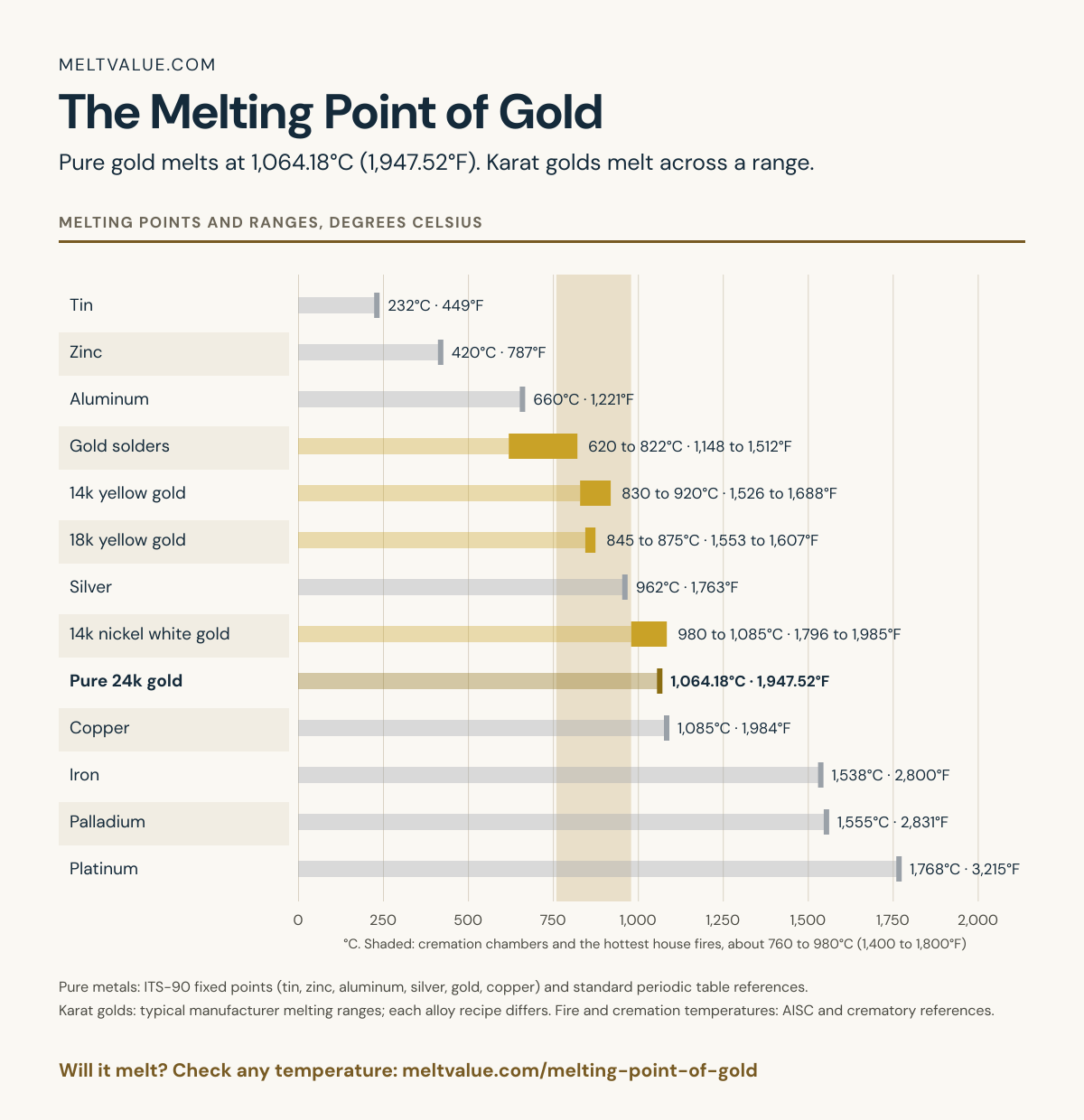
Usually not completely. A room fire reaches flashover once the hot gases pass about 600°C (1,112°F). According to the American Institute of Steel Construction, a fully developed building fire rarely tops 1,800°F (982°C), and its average gas temperature rarely reaches 1,500°F (816°C).
Pure gold, at 1,947.52°F, survives that. Yellow 14k and 18k gold start melting at roughly 1,526 to 1,553°F, so pieces in the hottest spot of a fire can slump or melt. Solder joints in chains, clasps and prong settings go first, so fire-damaged jewelry can come apart at the seams. Melted or not, the gold is still there and still worth its gold content.
Does Gold Melt During Cremation?
Cremation chambers typically run at 760 to 980°C (1,400 to 1,800°F). Pure gold stays solid at those temperatures. Yellow 14k and 18k gold fall inside that range, so a wedding ring or a gold crown can melt, deform or fuse with other metal, depending on the alloy and how hot the chamber runs. Families who want jewelry back should ask for it to be removed before cremation.
Boiling Point of Gold
References disagree on gold’s boiling point. The Royal Society of Chemistry lists 2,836°C (5,137°F), WebElements 2,856°C and Los Alamos National Laboratory 2,970°C. All three put it far above the melting point, so liquid gold stays liquid across a range of roughly 1,800°C before it boils. Melting pure gold also takes energy beyond reaching the temperature: 12.5 kilojoules per mole to turn solid into liquid.
Why Scientists Use Gold’s Melting Point
The International Temperature Scale of 1990, the standard that thermometers worldwide are calibrated to, rests on 17 reference points. Gold is one of them: its freezing point is fixed at 1,337.33 K (1,064.18°C). Above the freezing point of silver, the scale defines temperature using light emitted at a fixed point plus Planck’s radiation law, and silver, gold and copper are the three metals allowed as that reference. NIST realizes the gold point in special furnaces to calibrate high-temperature thermocouples.
Tiny Gold Melts at Lower Temperatures
The 1,064.18°C figure applies to ordinary pieces of gold. In 1976 physicists Philippe Buffat and Jean-Pierre Borel at EPFL in Switzerland showed that gold’s melting temperature falls as particles shrink, with Buffat measuring crystals from about 15 down to 2.5 nanometers across. Nanoparticles have so many surface atoms that they need less heat to come apart. This matters in electronics and medicine, not in jewelry.
How Gold Is Melted
- Heat source. A butane torch with a large burner nozzle is enough for yellow gold. Palladium white gold and platinum need an oxygen-fed torch. Electric melting furnaces give the steadiest heat.
- Crucible. Graphite or ceramic, kept separate for yellow and white golds so the alloys do not mix.
- Flux. A sprinkle of borax limits oxidation and lowers the melting point slightly.
- Safety. Work outdoors or under ventilation, wear eye protection and heat-resistant gloves, and pour only into dry, preheated molds, since moisture makes molten metal spit.
Melting does not purify gold. The other metals in a 14k ring stay in the melted button; separating them takes chemical or electrolytic refining. It also does not raise the value. Buyers pay for pure gold content, which you can estimate with our gold melt value calculator or the live gold price per gram. Melting coins or signed jewelry can destroy collector value worth far more than the metal.
Sources
- Royal Society of Chemistry: Gold: melting point 1,064.18°C (1,947.52°F, 1,337.33 K) and boiling point 2,836°C
- NIST: Kelvin and the ITS-90: molten gold turning solid at 1,337 K and the 17 reference points of the scale
- BIPM: Guide to the ITS-90, fixed points for radiation thermometry: silver (961.78°C), gold (1,064.18°C) and copper (1,084.62°C) as defining fixed points
- NIST: Four-zone furnace for silver and gold freezing points: how NIST realizes the gold point at 1,064.18°C
- Omega Engineering: The International Temperature Scale of 1990: the tin, zinc and aluminum fixed points
- WebElements: Gold thermochemistry: boiling point 2,856°C and enthalpy of fusion 12.5 kJ per mole
- Los Alamos National Laboratory: Gold: boiling point 2,970°C and refining by electrolysis
- Royal Society of Chemistry: Palladium: melting point 1,554.8°C and its use in white gold
- Wikipedia: Platinum: melting point 1,768.3°C
- Lenntech: Chemical elements listed by melting point: iron at 1,538°C
- Ganoksin: Carat gold solders for jewellery making: melting ranges for 9k, 10k and 18k casting alloys and for gold solders
- Ganoksin: Hard 22 carat gold alloy: 8, 9, 14 and 18 carat as the common European golds and 14 carat in the United States
- Ganoksin: Precious metal alloys, part 1: butane torches for gold, oxygen for palladium white gold and platinum, separate crucibles and borax flux
- AISC: General fire science: fully developed building fires rarely above 1,800°F, with average gas temperatures below 1,500°F
- NIST: Fire fighter temperature and heat flux facts: flashover once fire gases pass about 600°C
- Wikipedia: Crematory: main cremation chambers at 760 to 980°C (1,400 to 1,800°F)
- EPFL: Buffat and Borel, Size effect on the melting temperature of gold particles (1976): the lower melting point of tiny gold particles
- EPFL: Buffat, Lowering of the melting temperature of small gold crystals (1976): gold crystals from 15 down to 2.5 nanometers across