
Brass Price Per Pound Today
Scrap yards pay about $2.70 to $3.35 a pound for clean yellow brass today, and $2.97 to $4.16 for red brass. Brass has no exchange price of its own. Yards set it as a share of the copper price, which is $5.40 a pound right now. The copper and zinc in a pound of yellow brass are worth $4.05, so even a good yard offer lands under the metal value.
Copper $5.40 and zinc $1.55 a pound, updated November 25, 2026 at 6:40 PM EST. Yard prices are the usual range at US scrap yards, worked out from live copper. They are estimates, not quotes.
Brass Scrap Calculator
Enter a weight and pick the grade to see the metal value and what most yards pay. Add a yard’s offer to see how it stacks up.
| Weight in pounds | 10 lb |
|---|---|
| Metal value (65% copper, 35% zinc) | $40.53 |
| Usual yard price per pound | $2.70 to $3.35 |
| Usual payout for this weight | $27.00 to $33.48 |
Metal value is the copper, zinc, lead and tin at today’s exchange prices. Yard ranges are estimates from posted US yard prices. Your yard sets its own price.
Scrap Brass Prices by Grade
| Grade | Share of copper | Price per lb |
|---|---|---|
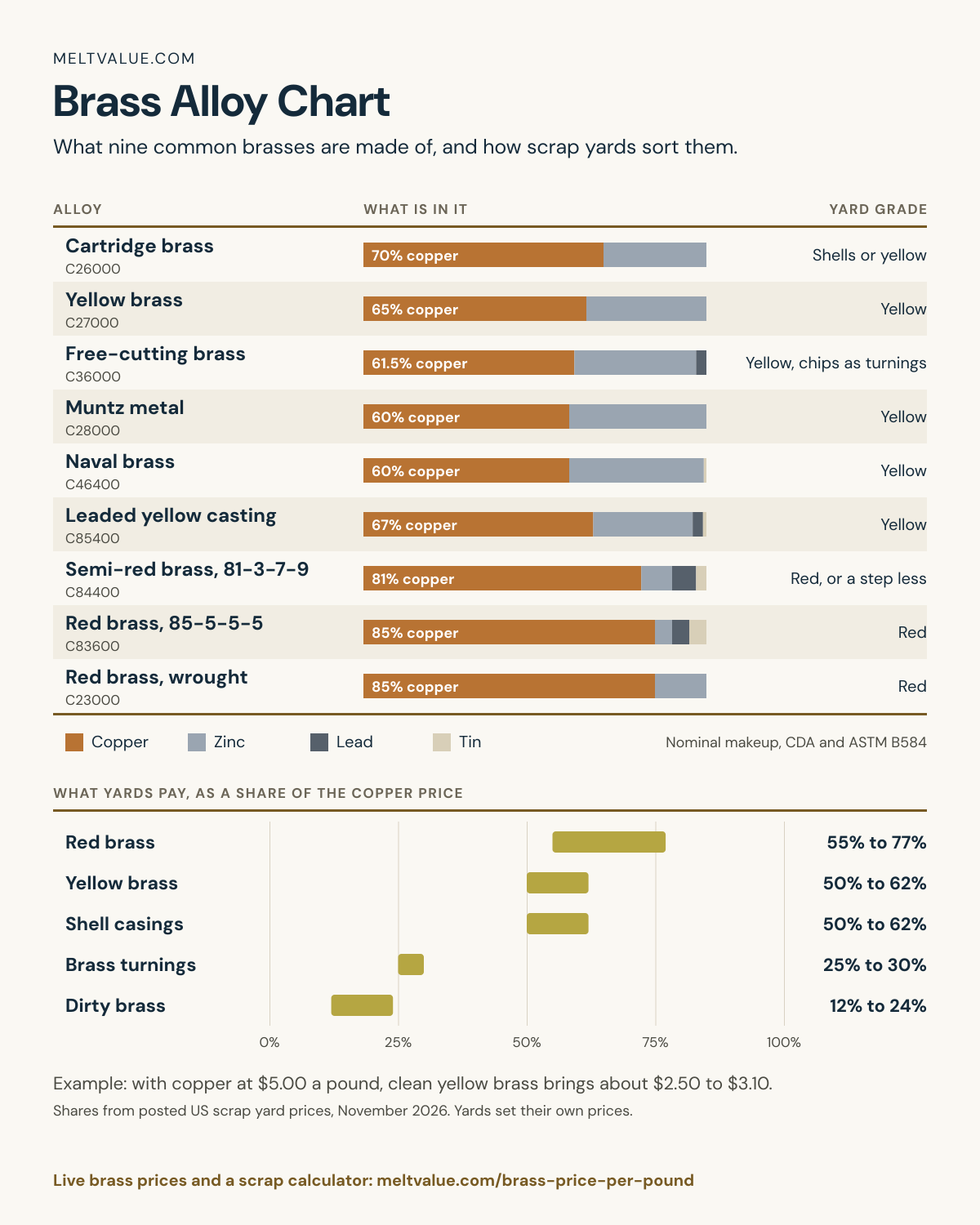
| Yellow brassReMA code: HoneyClean fittings, valves, pipe, rod, sheet and castings, including plated brass with no steel or plastic | 50% to 62% | $2.70to $3.35 |
| Red brassReMA code: EbonyValve bodies, pump housings, old red brass pipe and other high-copper castings | 55% to 77% | $2.97to $4.16 |
| Shell casingsReMA code: LakeFired brass cases only, with no live rounds and no steel or aluminum cases | 50% to 62% | $2.70to $3.35 |
| Brass turningsReMA code: Nomad (yellow), Enerv (red)Clean, dry chips and shavings from machine shops | 25% to 30% | $1.35to $1.62 |
| Dirty brassBrass with steel, plastic, rubber or heavy dirt still attached | 12% to 24% | $0.65to $1.30 |
Shares come from prices posted by US scrap yards from November 18 to 25, 2026, each divided by COMEX copper on the day it was posted. The dollar figures follow live copper.
Most yards post two brass prices, yellow and red. Bigger yards add shell casings, turnings, radiators and dirty brass. The code names come from ReMA’s Scrap Specifications Circular, the grading guide scrap buyers and sellers use around the world. Honey, the yellow brass code, covers castings, rolled brass, rod, tubing and plated brass, as long as the pile is free of iron, unsweated radiators, and manganese or aluminum bronze.
What the Metal in a Pound of Brass Is Worth
Every brass alloy has a set recipe. Multiply each metal’s share by its live price and you get the metal value of one pound. No yard pays that much, but it is the ceiling every brass price sits under.
| Alloy | Metal value per lb |
|---|---|
| Cartridge brassC2600070% copper, 30% zinc | $4.25 |
| Yellow brassC2700065% copper, 35% zinc | $4.05 |
| Free-cutting brassC3600061.5% copper, 35.5% zinc, 3% lead | $3.90 |
| Muntz metalC2800060% copper, 40% zinc | $3.86 |
| Naval brassC4640060% copper, 39.25% zinc, 0.75% tin | $3.98 |
| Leaded yellow brass castingC8540067% copper, 29% zinc, 3% lead, 1% tin | $4.27 |
| Semi-red brassC84400, known as 81-3-7-981% copper, 9% zinc, 7% lead, 3% tin | $5.11 |
| Leaded red brassC83600, known as 85-5-5-585% copper, 5% tin, 5% lead, 5% zinc | $5.61 |
| Red brass, wroughtC2300085% copper, 15% zinc | $4.82 |
Nominal compositions from the Copper Development Association and ASTM B584. Real castings can vary by a point or two. Lead $0.83 and tin $17.93 a pound today.
Copper makes up 87% of the metal value of yellow brass, so a 10 cent move in copper shifts yellow brass by about 6.5 cents. Red brass carries 5% tin as well, which adds $0.90 a pound to its metal value at today’s tin price.
Brass Price Per Ounce, Kilo and Ton
| Amount | Yellow brass at a yard | Red brass at a yard | Yellow brass metal value |
|---|---|---|---|
| 1 ounce | $0.19 | $0.22 | $0.25 |
| 1 pound | $3.02 | $3.56 | $4.05 |
| 1 kilogram | $6.67 | $7.86 | $8.93 |
| 100 pounds | $302.40 | $356.40 | $405.25 |
| 1 ton (2,000 lb) | $6,048.00 | $7,128.00 | $8,105.00 |
Yard figures use the middle of the usual range for each grade. A ton here is a US short ton of 2,000 pounds.
Yellow Brass Metal Value, Last 30 Trading Days
Daily price per pound, Oct 15, 2026 to Nov 25, 2026, down 16.8% over the period. Touch or hover the chart to read any date.
- High: $4.95 on Oct 28, 2026
- Low: $4.05 on Nov 25, 2026
The copper and zinc in a pound of 65/35 yellow brass at each day’s closing prices. Yard prices move with it. For longer charts, see the copper price per pound and zinc price per pound.
How Scrap Yards Price Brass
A yard sells its brass on to brass mills and foundries, which buy by alloy and pay against the COMEX copper price. So the yard posts its own brass prices as a share of copper too, and moves them when copper moves. After a fast swing in copper, a posted board can run a few days behind.
That share sits well under the metal value. Brass melts at about the temperature zinc boils: cartridge brass melts between 916 and 954°C (1,680 and 1,750°F), and zinc boils at 907°C (1,665°F), so some zinc fumes off in every melt. The mill also has to sort, test and blend scrap to hit an exact recipe. On top of that, the yard pays freight, keeps a margin and carries the risk that copper drops before it sells.
Red brass pays more than yellow because it holds about 85% copper against 60 to 70%. At the yards checked for this page, red brass paid 7 to 30% more than yellow brass at the same yard.
Over the long run, brass follows copper. The Bureau of Labor Statistics producer price index for yellow brass scrap stood at 948 in July 2026, against a base of 100 in December 1986. Yellow brass scrap sells for about nine and a half times what it did then.
Yellow Brass vs Red Brass
Yellow brass is 60 to 70% copper with most of the rest zinc. It has a bright, lemony gold color and makes up most household brass: plumbing fittings, valves, hose ends, sheet, rod and hardware.
Red brass is 80 to 90% copper. It looks pinker and darker, closer to copper, and turns up as valve bodies, pump housings and old red brass water pipe. Bronze castings, which swap most of the zinc for tin, go in with red brass at many yards.
Tarnish hides the color, so file or grind a small spot to bright metal before you sort. Semi-red brass, the 81-3-7-9 alloy that the Copper Development Association calls the most common plumbing brass, sits between the two. Many yards take it as red brass, and some pay a step less.
Is It Brass? Four Quick Checks
Try a magnet. Brass isn’t magnetic. If a magnet grabs the piece, it is brass-plated steel, or there is a steel part inside. Lamp bases, door hardware and cheap fixtures are often plated steel.
Feel the weight. Brass weighs about 8.5 grams per cubic centimeter, roughly three times as much as aluminum. A brass-colored part that feels light for its size is likely plated zinc or aluminum.
Scratch a hidden spot. Brass is yellow all the way through. Gray metal under the scratch means zinc die cast. Silver gray that a magnet pulls means steel.
Compare it with copper. Copper is orange red and bends easily. Brass is yellow and harder. Chrome-plated brass, common on faucet spouts and drain parts, is still brass: ReMA’s yellow brass grade includes plated brass, and many yards pay the yellow price for clean chrome pieces. Some pay a little less.
Common Brass Items and How Yards Sort Them
| Item | Usually sorts as |
|---|---|
| Plumbing fittings, unions, valves | Yellow brass, or red brass if the casting looks pinkCut off steel pipe stubs and handles |
| Valve bodies, pump housings | Red brassTake out steel bolts and stems |
| Water meters | Often their own priceAsk first, since many have plastic or glass inside |
| Faucets and shower valves | Dirty brass until strippedPull plastic cartridges, steel screws and rubber |
| Shell casings | Shell casingsFired only; pick out steel and aluminum cases |
| Hose fittings, sprinkler heads | Yellow brassCut off the hose and plastic |
| Lamp parts, door knobs, hinges | Test firstOften brass-plated steel or zinc |
| Keys | Yellow brass at many yardsSome are nickel silver, which may pay less |
| Machine shop chips | Brass turningsKeep dry and drain off cutting oil |
| Old car and truck radiators | Their own gradeAsk for the radiator price |
Yards differ, so ask how yours grades anything on the borderline before you unload.
Leaded and Lead-Free Brass
Plumbing brass used to carry lead, which makes castings pressure tight and easy to machine. The 85-5-5-5 red brass is 5% lead, and the 81-3-7-9 semi-red brass is about 7%.
Since January 4, 2014, federal law has required pipes, fittings and fixtures for drinking water to average no more than 0.25% lead across the surfaces that touch water. Makers moved to lead-free brasses that use bismuth or silicon in place of lead.
Leaded and lead-free brass look the same, but mills keep them apart, since leaded scrap would spoil a lead-free melt. ReMA added a separate grade for lead-free bismuth brass solids, called Ebulent, in 2016. Ask your yard whether it buys lead-free brass on its own.
How to Get More for Your Brass
- Keep yellow, red, shells and turnings in separate buckets. A mixed bucket is paid at the lowest grade in it.
- Cut off steel, plastic and rubber. One steel stem can drop a valve to the dirty brass price.
- Don’t polish or acid-clean it. Yards pay for weight and alloy, and shine adds nothing.
- Drain cutting oil and water from turnings before you weigh in. Wet or oily chips get docked.
- Call two or three yards. Yellow brass boards checked for this page ran from $2.80 to $3.45 a pound in the same week.
- Bring a bigger load if you can. Some yards pay more above 100 pounds, and one checked for this page paid 10 cents a pound more.
- Bring a photo ID. All 50 states have laws on scrap metal sales, and most require the yard to record who sold it copper and brass.
Selling more than brass? Pull the copper out first, since it pays the most per pound. The copper price per pound page has scrap prices by grade, and the aluminum price per pound page covers cans, sheet and cast. For gold or silver jewelry, use the scrap gold calculator instead, because brass costume jewelry and gold-filled pieces look alike until you read the stamp.
About the Numbers
Metal values multiply each alloy’s nominal makeup by live exchange prices for copper, zinc, lead and tin, refreshed every minute. Yard prices are shares of COMEX copper taken from prices posted by US scrap yards and national yard averages from November 18 to 25, 2026, trimmed of the highest and lowest boards. They are a guide to what yards pay, not a quote from any yard.
Sources
- Copper Development Association, Wrought copper alloys: brasses: the copper ranges of cartridge, yellow, Muntz, red, free-cutting and naval brass.
- Copper Development Association, Non-leaded red and yellow brass casting alloys: C84400 as the most common plumbing brass and the lead in 85-5-5-5 and 81-3-7-9.
- Copper Development Association, C26000 alloy data: the 1,680 to 1,750°F melting range of cartridge brass.
- Los Alamos National Laboratory, Zinc: the 907°C boiling point of zinc.
- ReMA, The story on specs: Honey as the code name for yellow brass scrap.
- Recycling Today, Nonferrous scrap terminology: the ReMA codes for red brass, shell cases, turnings, faucets and radiators.
- ReMA, Updates to nonferrous specs in the 2016 circular: the Ebulent grade for lead-free bismuth brass.
- US EPA, Use of lead free pipes, fittings, fixtures, solder and flux: the 0.25% weighted average lead limit for drinking water plumbing.
- US Bureau of Labor Statistics via FRED, PPI for yellow brass scrap: the index level of 948 in July 2026 (December 1986 = 100).
- Recycling Today, State metal theft study: that all 50 states regulate scrap metal sales.