
How Much Do US Coins Weigh?
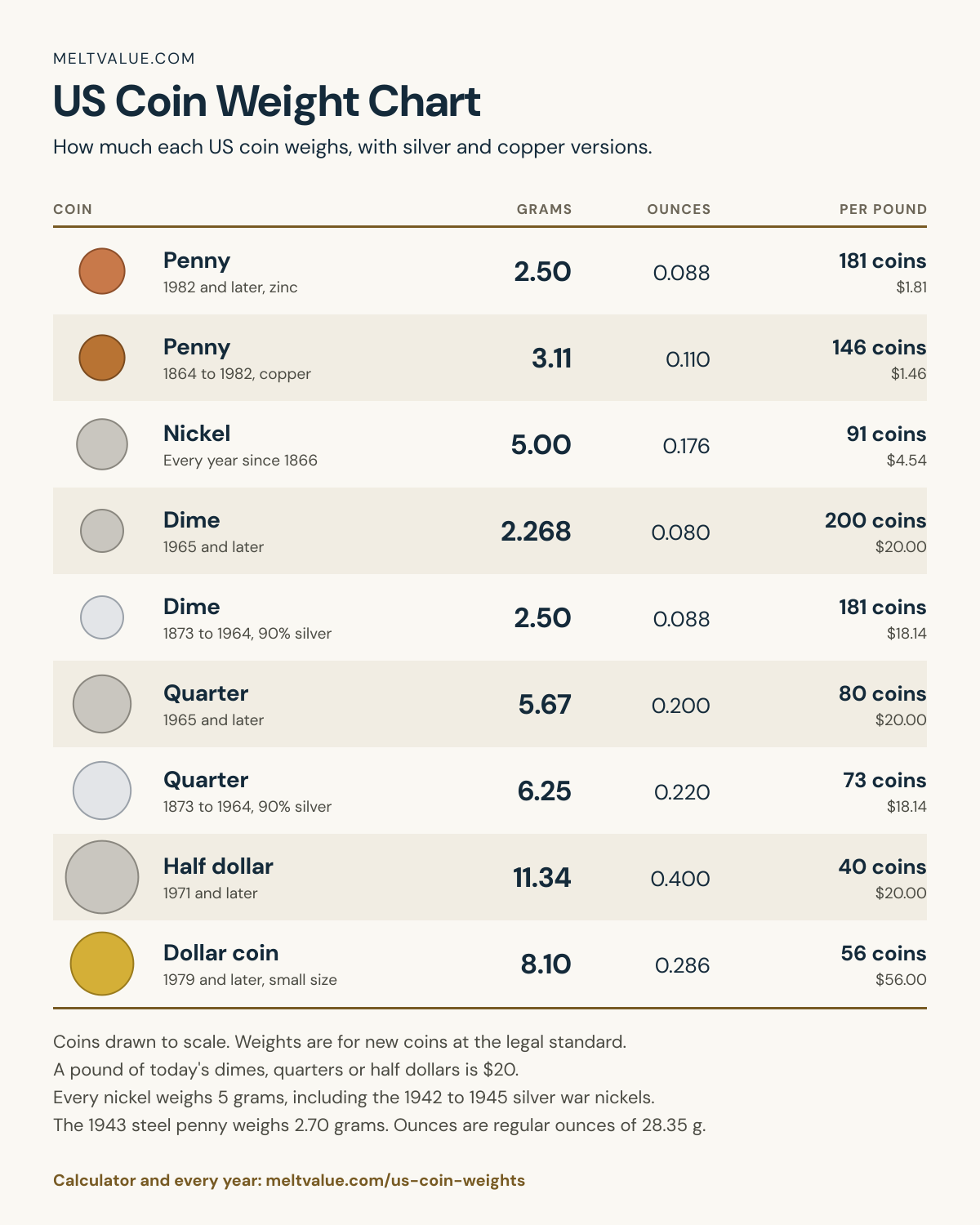
A penny weighs 2.5 grams, a nickel 5 grams, a dime 2.268 grams and a quarter 5.67 grams. A half dollar weighs 11.34 grams and a dollar coin 8.1 grams. Those are the coins made today. Silver dimes, quarters and halves from 1873 to 1964 weigh more, and so do copper pennies from 1864 to 1982. The chart below covers both.
US Coin Weight Chart
| Coin | Grams | Ounces | Per pound |
|---|---|---|---|
| Zinc penny1982 and later | 2.50 | 0.088 | 181 coins$1.81 |
| Copper penny1864 to 1982, except 1943 | 3.11 | 0.110 | 146 coins$1.46 |
| NickelEvery year since 1866 | 5.00 | 0.176 | 90.7 coins$4.54 |
| Dime1965 and later | 2.268 | 0.080 | 200 coins$20.00 |
| Silver dime1873 to 1964 | 2.50 | 0.088 | 181 coins$18.14 |
| Quarter1965 and later | 5.67 | 0.200 | 80.0 coins$20.00 |
| Silver quarter1873 to 1964 | 6.25 | 0.220 | 72.6 coins$18.14 |
| Half dollar1971 and later | 11.34 | 0.400 | 40.0 coins$20.00 |
| 40% silver half1965 to 1970 | 11.50 | 0.406 | 39.4 coins$19.72 |
| Silver half1873 to 1964 | 12.50 | 0.441 | 36.3 coins$18.14 |
| Dollar coin1979 and later, small size | 8.10 | 0.286 | 56.0 coins$56.00 |
New coins at the legal weight. Ounces are regular ounces of 28.35 grams. Small dollar coins include the Susan B. Anthony dollar as well as the golden dollars.
Coin Weight Calculator
Based on 5.67 grams per quarter (1965 and later). Worn coins weigh a little less, so a count by weight can come out a few coins short. Metal value is melt value at today's prices, not what a buyer pays.
Why a Pound of Dimes, Quarters or Halves Is $20
Today's dimes, quarters and half dollars are weighted in step with their face value. Every $1 of them weighs 22.68 grams, so 20 dollars' worth weighs 453.6 grams, which is one pound. That works out to 200 dimes, 80 quarters or 40 half dollars to the pound, and ten dimes weigh exactly as much as four quarters or two halves. The 90% silver coins of 1873 to 1964 follow the same rule at 25 grams per dollar, so a pound of them is $18.14 in face value.
Nickels and pennies don't follow the rule. A nickel outweighs two dimes and is worth a quarter as much, so a pound of nickels is worth about $4.54. The Mint used the same weight math in 2017 when it set rates for redeeming bent and partial coins:
| Coins | Rate per pound |
|---|---|
| Dimes, quarters and half dollars | $20.00 |
| Dollar coins (small size) | $56.00 |
| Dollar coins dated before 1979 | $20.00 |
| Nickels | $4.5359 |
| Zinc pennies, unmixed | $1.81 |
| Copper or mixed pennies | $1.4585 |
Rates from the Mint's December 2017 rule on exchanging bent and partial coins. The rate for dollar coins dated before 1979 fits the large 22.68 gram Eisenhower dollar.
How Much Money Weighs in Coins
| Coin | $100 | $1,000 | $1 million |
|---|---|---|---|
| Zinc pennies | 55.1 lb | 551.2 lb | 551,160 lb |
| Nickels | 22.0 lb | 220.5 lb | 220,460 lb |
| Dimes | 5.0 lb | 50.0 lb | 50,000 lb |
| Quarters | 5.0 lb | 50.0 lb | 50,000 lb |
| Half dollars | 5.0 lb | 50.0 lb | 50,000 lb |
| Dollar coins | 1.8 lb | 17.9 lb | 17,860 lb |
Pennies are the zinc kind made since 1982. Dollar coins are the small 8.1 gram size.
Weighing Coins to Find Silver and Copper
Silver dimes, quarters and halves and copper pennies all weigh more than the coins that replaced them, so a scale sorts them faster than reading dates:
| Coin | Today's coin | Older coin | Difference |
|---|---|---|---|
| Penny, zinc vs. copper | 2.50 g | 3.11 g | +0.61 g |
| Dime, clad vs. 90% silver | 2.268 g | 2.50 g | +0.232 g |
| Quarter, clad vs. 90% silver | 5.67 g | 6.25 g | +0.58 g |
| Half dollar, clad vs. 90% silver | 11.34 g | 12.50 g | +1.16 g |
| Half dollar, clad vs. 40% silver | 11.34 g | 11.50 g | +0.16 g |
A scale that reads to 0.1 gram handles pennies, quarters and 90% halves. For dimes and 40% halves the gap is small, so use a 0.01 gram scale or weigh ten coins at once. Nickels are the exception: the silver war nickels of 1942 to 1945 weigh 5 grams like every other nickel, so you find them by their large mint mark above Monticello. Silver coins are worth far more than face value; the junk silver calculator prices them by face value.
Half Dollar and Dollar Coin Weights by Year
| Years | Coin and metal | Weight |
|---|---|---|
| 1873 to 1964 | Seated, Barber, Walking Liberty, Franklin, Kennedy90% silver | 12.50 g0.441 oz |
| 1965 to 1970 | Kennedy40% silver clad | 11.50 g0.406 oz |
| 1971 to today | Kennedy and laterCopper-nickel clad | 11.34 g0.400 oz |
| 1878 to 1935 | Morgan and Peace silver dollars90% silver | 26.73 g0.943 oz |
| 1971 to 1978 | Eisenhower dollarCopper-nickel clad | 22.68 g0.800 oz |
| 1979 to 1981, 1999 | Susan B. Anthony dollarCopper-nickel clad | 8.10 g0.286 oz |
| 2000 to today | Golden dollarsManganese brass | 8.10 g0.286 oz |
Older pennies, nickels, dimes and quarters each have a year-by-year table on their own page: penny, nickel, dime and quarter. Silver dollar melt values are on the Morgan dollar page.
How Much a Coin's Weight Can Vary
Federal law sets the weight of each circulating coin except the penny, whose 3.11 gram figure the Common Cents Act removed in 2026, and it sets how far a coin may stray. The nickel may vary by no more than 0.194 gram and the penny by no more than 0.13 gram, both written into the statute. For dimes, quarters, halves and dollar coins, the law lets the Treasury set reasonable manufacturing tolerances. Coins in circulation also lose a little metal to wear, so a reading slightly under the standard is normal.
US Coin Sizes
| Coin | Diameter | Thickness |
|---|---|---|
| Penny | 19.05 mm0.750 in | 1.52 mm0.060 in |
| Nickel | 21.21 mm0.835 in | 1.95 mm0.077 in |
| Dime | 17.91 mm0.705 in | 1.35 mm0.053 in |
| Quarter | 24.26 mm0.955 in | 1.75 mm0.069 in |
| Half dollar | 30.61 mm1.205 in | 2.15 mm0.085 in |
| Dollar coin | 26.49 mm1.043 in | 2.00 mm0.079 in |
Coins made today, from the US Mint's specifications. Coins per roll and roll weights are on the coin roll page.
About the Numbers
Weights, sizes and metal for today's coins come from the US Mint's coin specifications, and the legal weights and tolerances from Title 31 of the US Code. Older weights are the legal standard set for each era. Conversions use 28.3495 grams per ounce, 0.0648 grams per grain and 453.592 grams per pound.
Sources
- United States Mint, Coin Specifications: weight, diameter, thickness, edge and alloy of each coin made today.
- Cornell Law School, 31 U.S. Code § 5112: the legal weight and diameter of each circulating coin.
- Cornell Law School, 31 U.S. Code § 5113: the weight tolerances for nickels and pennies, and the Treasury's authority for the rest.
- Federal Register, Exchange of Coin (December 20, 2017): the per-pound rates for redeeming bent and partial coins.
- United States Mint, Historic Coin Production: changes to the metal in pennies and silver coins over time.