
How Many Coins Are in a Roll?
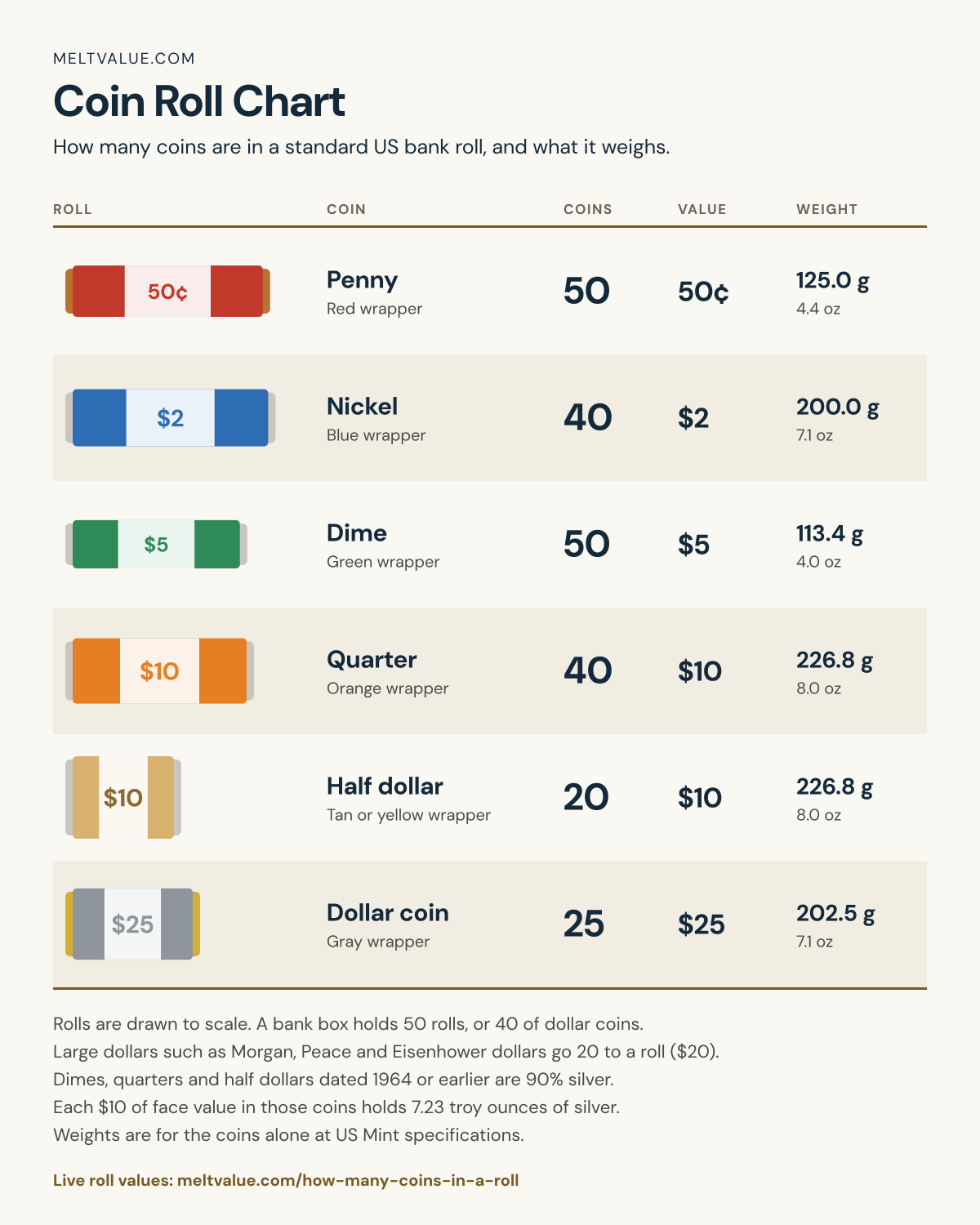
A standard US coin roll holds 40 quarters ($10), 50 dimes ($5), 40 nickels ($2) or 50 pennies (50 cents). Half dollars come 20 to a roll ($10) and dollar coins 25 to a roll ($25). Banks, coin machines and store-bought wrappers all use these counts, so a full roll of quarters is always $10 in face value. Quarters dated 1964 or earlier are silver, and a roll of 90% silver quarters holds 7.23 troy ounces of silver, worth $295 today.
Silver $40.80 an ounce. Copper $5.39, nickel $6.95 and zinc $1.55 a pound. Updated November 25, 2026 at 2:23 PM EST.
Coin Roll Chart
| Coin | Coins | Value | Roll weight |
|---|---|---|---|
| PennyRed wrapper | 50 | 50¢ | 125.0 g4.4 oz |
| NickelBlue wrapper | 40 | $2 | 200.0 g7.1 oz |
| DimeGreen wrapper | 50 | $5 | 113.4 g4.0 oz |
| QuarterOrange wrapper | 40 | $10 | 226.8 g8.0 oz |
| Half dollarTan or yellow wrapper | 20 | $10 | 226.8 g8.0 oz |
| Dollar coinGray wrapper | 25 | $25 | 202.5 g7.1 oz |
Weights are for the coins alone at US Mint specifications, in grams and regular ounces. Length is the height of the stack before the wrapper ends are folded. Large dollars such as the Eisenhower, Morgan and Peace dollar go 20 to a roll ($20), but few banks keep them on hand.
Coin Roll Value Calculator
Enter how many rolls you have of each kind. The totals show the coin count, face value, weight and what the metal is worth at today's prices.
Metal value is melt value at spot prices, not a dealer's offer. Silver coins count their silver only. Melting pennies, and nickels other than the silver war nickels, is illegal in the United States, so their metal value is a comparison, not money you can collect.
What Each Roll Is Worth in Metal Today
At today's prices, copper Lincoln cents dated 1981 and earlier and nickels are worth more in metal than their face value. A roll of today's quarters holds $2.76 of copper and nickel against its $10 face value.
| Roll | Face | Metal value |
|---|---|---|
| 50 pennies1982 and later, zinc with copper plating | $0.50 | $0.45 |
| 50 copper penniesLincoln cents, 1909 to 1981, 95% copper | $0.50 | $1.78 |
| 40 nickelsAll but the silver war nickels, copper and nickel | $2.00 | $2.55 |
| 40 war nickels1942 to 1945, large mint mark, 35% silver | $2.00 | $91.82 |
| 50 dimes1965 to today, copper and nickel | $5.00 | $1.38 |
| 50 silver dimes1964 and earlier, 90% silver | $5.00 | $147.57 |
| 40 quarters1965 to today, copper and nickel | $10.00 | $2.76 |
| 40 silver quarters1964 and earlier, 90% silver | $10.00 | $295.14 |
| 20 half dollars1971 to today, copper and nickel | $10.00 | $2.76 |
| 20 Kennedy halves, 40% silver1965 to 1970, 40% silver | $10.00 | $120.68 |
| 20 silver half dollars1964 and earlier, 90% silver | $10.00 | $295.14 |
| 25 dollar coinsGolden dollars, 2000 to today, manganese brass | $25.00 | $2.23 |
| 20 silver dollarsMorgan and Peace, 1878 to 1935, 90% silver | $20.00 | $631.14 |
Silver coins count their silver only. Golden dollars are 3.5% manganese, and the price feed has no manganese price, so that part is left out. Pennies dated 1982 can be copper or zinc, and 1943 pennies are steel.
What a Roll of Silver Coins Is Worth
| Roll | Face | Silver | Melt value |
|---|---|---|---|
| 40 war nickels1942 to 1945, large mint mark | $2 | 2.25 oz | $91.82 |
| 50 silver dimes1964 and earlier | $5 | 3.62 oz | $147.57 |
| 40 silver quarters1964 and earlier | $10 | 7.23 oz | $295.14 |
| 20 Kennedy halves, 40% silver1965 to 1970 | $10 | 2.96 oz | $120.68 |
| 20 silver half dollars1964 and earlier | $10 | 7.23 oz | $295.14 |
| 20 silver dollarsMorgan and Peace, 1878 to 1935 | $20 | 15.47 oz | $631.14 |
Troy ounces of pure silver in coins as minted, at the coin weights used since 1873.
US dimes, quarters and half dollars were struck in 90% silver from 1837 through 1964. Their weights move in step with face value. Under the 2.5, 6.25 and 12.5 gram standard used from 1873 on, every $1 of face holds 0.7234 troy ounces of silver when new. A $10 roll of quarters and a $10 roll of halves hold the same 7.23 ounces, and a $5 roll of dimes holds half that.
Circulated coins have lost a little metal to wear, so dealers figure them at 0.715 ounces per $1 of face, about 1% less than the table shows. Dealers also buy a little under melt and sell a little over it. To price a mixed lot by face value, use the junk silver calculator. Each coin has its own page too: silver dimes, silver quarters, Kennedy halves, war nickels and Morgan dollars.
How to Tell a Silver Roll From a Clad Roll
Start with the dates. A roll with crimped ends shows the coin at each end, but the coins in between can be any year, so a 1964 quarter on the end does not make the roll silver.
Then look at the edges. Copper-nickel dimes and quarters from 1965 on, and half dollars from 1971 on, show a copper stripe along the edge. Coins of 90% silver have a solid silver-white edge. Last, weigh the roll. Silver rolls are heavier:
| Roll | Clad | Silver | Difference |
|---|---|---|---|
| 50 dimes | 113.4 g | 125.0 g | +11.6 g |
| 40 quarters | 226.8 g | 250.0 g | +23.2 g |
| 20 half dollars, 90% | 226.8 g | 250.0 g | +23.2 g |
| 20 half dollars, 40% | 226.8 g | 230.0 g | +3.2 g |
| 50 pennies, zinc vs copper | 125.0 g | 155.5 g | +30.5 g |
A roll of 40% halves weighs only 3.2 grams more than clad halves, so check those by date (1965 to 1970) instead. For pennies, the second column is copper Lincoln cents dated 1981 and earlier.
Is the Roll Full? Check It by Weight
A roll that is one or two coins short looks the same from the outside. A kitchen scale that reads in grams will catch it. Weigh an empty wrapper of the same kind first and subtract it, then compare:
| Roll | Full | One coin short |
|---|---|---|
| 50 pennies | 125.0 g | 122.5 g |
| 40 nickels | 200.0 g | 195.0 g |
| 50 dimes | 113.4 g | 111.1 g |
| 40 quarters | 226.8 g | 221.1 g |
| 20 half dollars | 226.8 g | 215.5 g |
| 25 dollar coins | 202.5 g | 194.4 g |
Penny rolls are the exception. A roll that mixes copper and zinc cents can weigh anywhere from 125 to 155.5 grams, so weight cannot confirm the count.
Rolls in a Bank Box, and How Many You Need
Wrapped coin moves in standard boxes: 50 rolls for pennies through half dollars, and 40 rolls for dollar coins. A box of quarters holds 2,000 coins worth $500 and weighs 25 pounds.
| Bank box | Coins | Value | Weight |
|---|---|---|---|
| Pennies | 2,500 | $25 | 13.8 lb |
| Nickels | 2,000 | $100 | 22.0 lb |
| Dimes | 2,500 | $250 | 12.5 lb |
| Quarters | 2,000 | $500 | 25.0 lb |
| Half dollars | 1,000 | $500 | 25.0 lb |
| Dollar coins | 1,000 | $1,000 | 17.9 lb |
To reach $100 you need 10 rolls of quarters or half dollars, 20 of dimes, 50 of nickels, 200 of pennies or 4 of dollar coins.
Banks and credit unions also order loose coin from the Federal Reserve in standard bags: $50 of pennies (5,000 coins), $200 of nickels (4,000 coins), $1,000 of dimes (10,000 coins), $1,000 of quarters (4,000 coins), $1,000 of half dollars (2,000 coins), and $2,000 of small dollar coins (2,000 coins). The Fed does not sell coin to the public, so a bank or credit union is where you buy rolls at face value.
What to Look For When You Search Rolls
Pennies. Lincoln cents dated 1981 and earlier, apart from the 1943 steel cent, are 95% copper and worth about 3.6 cents each in metal, against 0.9 cents for a zinc cent from 1982 on. You can collect them, but federal rules first issued in 2006 ban melting pennies. No new pennies are coming for circulation. The Mint struck its last circulating penny on November 12, 2025, and the Federal Reserve has received its final shipment of new pennies, so every penny roll now holds coins made before production ended. The copper calculator prices copper cents by weight.
Nickels. Silver war nickels, struck from 1942 through 1945, have a large P, D or S mint mark above the dome of Monticello on the back. Not every 1942 nickel is silver, so go by that mint mark. Each war nickel holds 0.0563 troy ounces of silver, worth $2.30 today, and the federal melting ban exempts them. The nickel calculator prices ordinary nickels by their copper and nickel.
Dimes and quarters. Dimes and quarters dated 1964 or earlier are silver, and those from 1837 on are 90% silver: $2.95 for a dime and $7.38 for a quarter at today's price.
Half dollars. Since 2002 the Mint has made half dollars mainly for collector sets, so few circulate and older coins can still turn up in rolls. Halves dated 1837 through 1964 are 90% silver ($14.76), and halves dated 1965 to 1970 are 40% silver ($6.03).
Dollar coins. Golden dollars have no silver. The 40% silver Eisenhower dollars of 1971 to 1976 were sold to collectors and carry an S mint mark. The Eisenhower dollars that turned up in change are copper and nickel.
A roll of new coins holds only new coins. A roll that a customer wrapped holds whatever that person saved. Collectors also look for original bank-wrapped rolls, or OBW rolls. The name dates to the early days of the Federal Reserve, when each branch wrapped bags of coins from the Mint in paper with tightly sealed ends.
Gold Coin Rolls Before 1933
Banks once rolled gold coins too. Those rolls ended in 1933, when the United States stopped making gold coins and called in the ones in circulation. Here is what the gold in each roll would be worth today:
| Roll | Face | Gold | Melt value |
|---|---|---|---|
| 40 $2.50 quarter eagles | $100 | 4.84 oz | $17,185 |
| 40 $5 half eagles | $200 | 9.68 oz | $34,369 |
| 50 $10 eagles | $500 | 24.19 oz | $85,923 |
| 25 $20 double eagles | $500 | 24.19 oz | $85,923 |
Melt value only, at $3,552.37 an ounce. Nearly all of these coins sell to collectors for more than their gold. See US gold coin melt values.
Coin Wrapper Colors
Paper coin wrappers follow the American Bankers Association color code: red for pennies, blue for nickels, green for dimes and orange for quarters. Half dollar wrappers are tan or yellow, and dollar coin wrappers are gray. The Federal Reserve requires the same ABA colors on the tags of canvas coin bags that banks deposit, and it calls the half dollar color buff. Most wrappers also print the dollar amount, so a teller can tell a $10 roll of quarters from a $5 roll of dimes at a glance.
About the Numbers
Weights, sizes and alloys of today's coins come from the US Mint's coin specifications. Older coins use their legal standards: 3.11 grams of 95% copper for Lincoln cents dated 1981 and earlier; 2.5, 6.25 and 12.5 grams of 90% silver for dimes, quarters and halves, the standard from 1873 through 1964; 11.5 grams of 40% silver for the 1965 to 1970 half; 5 grams of 35% silver for war nickels; and 26.73 grams of 90% silver for Morgan and Peace dollars. Metal values use live market prices for silver, gold, copper, nickel and zinc.
Sources
- United States Mint, Coin Specifications: weight, diameter, thickness and alloy of the penny, nickel, dime, quarter, half dollar and dollar coin, and half dollars made mainly for collector sets since 2002.
- United States Mint, final circulating penny: the last penny struck for circulation on November 12, 2025.
- Federal Reserve Financial Services, coin depositing and ordering: standard coin bag amounts and the ABA bag tag color for each denomination.
- Federal Reserve Financial Services, penny order and deposit information: the final shipment of new pennies and how penny orders are filled.
- Cornell Law School, 31 CFR Part 82: the federal ban on melting and exporting pennies and nickels, and the exemption for silver war nickels.
- United States Mint, Historic Coin Production: the change to 90% silver in 1837 and the end of silver in circulating coins in 1971.
- Wikipedia, Coin wrapper: standard roll counts, wrapper colors, original bank-wrapped rolls and the old gold coin rolls.
- Wikipedia, Penny (United States coin): weight and alloy of copper cents.