
Karat tells you how much of a piece is gold. The scale runs to 24, so 24K is pure gold, 18K is 18 parts gold out of 24 (75%), and 14K is 14 parts out of 24 (58.3%). The chart below lists every karat you are likely to find, the stamp that goes with it, and what a gram is worth today.
Prices use the live gold spot price of $3,535.44 per troy ounce, as of November 21, 2026 at 6:42 PM EST.
| Karat | Pure Gold | Stamp | Per Gram | Per Dwt | Where You See It |
|---|---|---|---|---|---|
| 24K | 99.9% | 999 | $113.67 | Bullion bars and coins | |
| 23K | 95.8% | 958 | $108.93 | Some Asian jewelry | |
| 22K | 91.7% | 916 or 917 | $104.20 | Indian jewelry, Gold Eagles, Krugerrands | |
| 21K | 87.5% | 875 | $99.46 | Middle Eastern jewelry | |
| 20K | 83.3% | 833 | $94.72 | Some Asian and antique pieces | |
| 18K | 75.0% | 750 | $85.25 | Fine jewelry worldwide | |
| 15K | 62.5% | 625 | $71.04 | British antiques made before 1932 | |
| 14K | 58.3% | 585 or 583 | $66.30 | Most US jewelry | |
| 12K | 50.0% | 500 | $56.83 | Older pieces and gold filled layers | |
| 10K | 41.7% | 417 | $47.37 | Class rings and budget jewelry | |
| 9K | 37.5% | 375 | $42.63 | UK and Australian jewelry | |
| 8K | 33.3% | 333 | $37.89 | German and Danish jewelry |
These are melt values: the worth of the gold itself at the spot price. To price a piece you own, enter its weight in the gold calculator.
Gold Purity by Karat
Each bar shows the share of a piece that is gold. The rest is alloy, usually copper, silver, or zinc, added to make the metal harder.
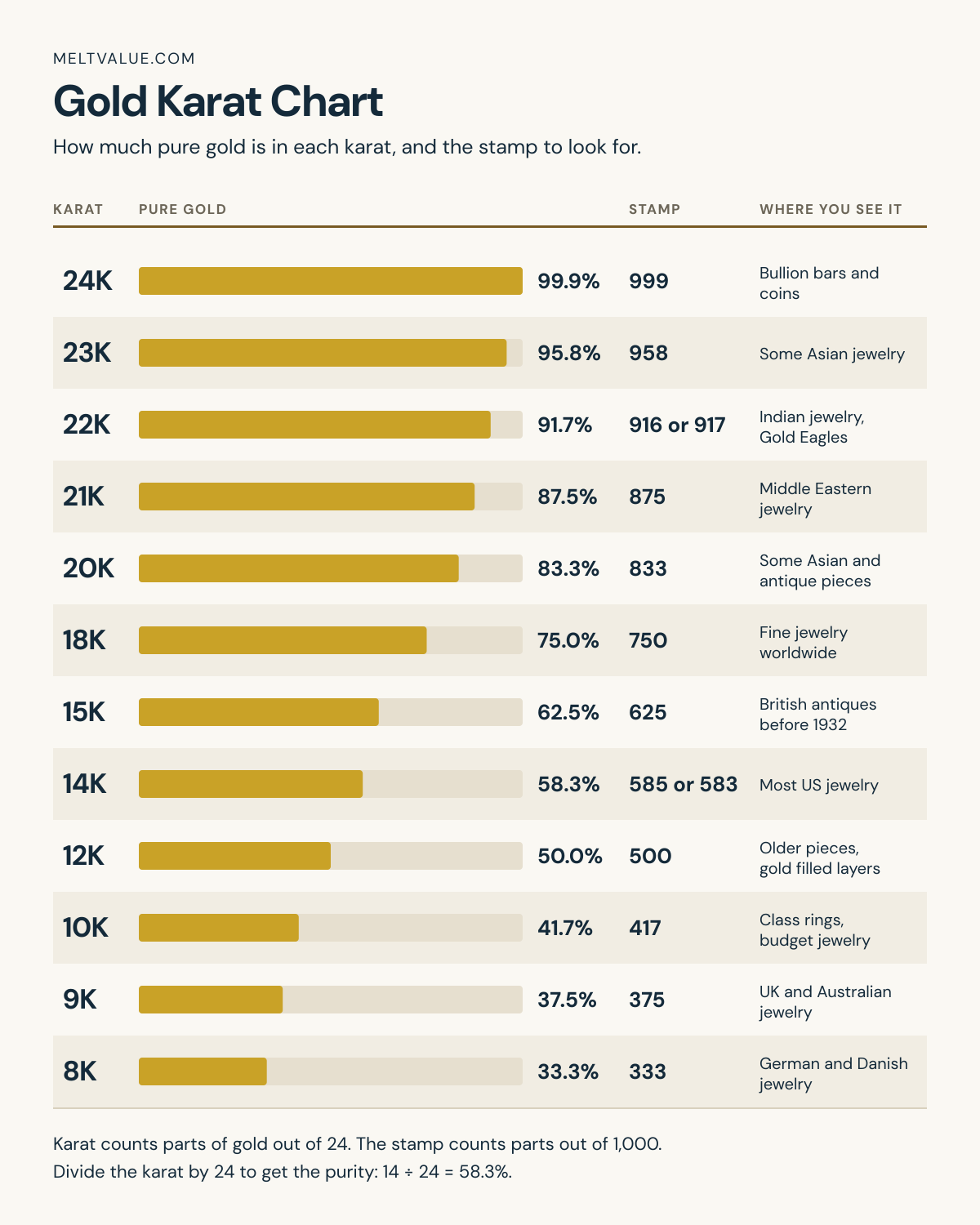
How the Karat Scale Works
One karat is 1/24 of the whole. To turn a karat into a percentage, divide by 24.
Karat ÷ 24 = Gold Purity. Example: 14 ÷ 24 = 0.583, or 58.3%
Much of the world skips karats and stamps fineness instead. Fineness counts parts of gold per 1,000, so 750 means 750 parts gold in 1,000, the same 75% as 18K. A ring marked 585 and a ring marked 14K hold the same share of gold.
Karat is a different word from carat. In the US, carat measures gemstone weight (one carat is 0.2 grams). British and Australian jewelers spell the gold measure "carat" too and abbreviate it ct, so a 9ct stamp means 9 karat gold.
Gold Stamps and What They Mean
Look inside ring bands, on clasps, and on the back of pendants. A loupe or a phone camera on zoom helps with small marks.
| Stamp | Karat | What It Means |
|---|---|---|
| 999 or 9999 | 24K | 99.9% or 99.99% gold. Bars and bullion coins. |
| 958 | 23K | 95.8% gold. |
| 916 or 917 | 22K | 91.6% to 91.7% gold. The usual mark on Indian and Gulf jewelry. |
| 875 | 21K | 87.5% gold. |
| 833 | 20K | 83.3% gold. |
| 750 | 18K | 75% gold. |
| 625 | 15K | 62.5% gold. A British standard that ended in 1932. |
| 585 or 583 | 14K | 58.3% to 58.5% gold. |
| 500 | 12K | 50% gold. |
| 417 | 10K | 41.7% gold. |
| 375 | 9K | 37.5% gold. |
| 333 | 8K | 33.3% gold. |
US pieces usually spell the karat out as 14K or 14KT. A "P" after the karat, as in 14KP, stands for plumb, meaning the gold content is at least the stated karat. It does not mean plated.
Stamps That Are Not Solid Gold
Some marks include a karat number but describe a gold layer over another metal. These pieces contain very little gold and do not sell at karat gold prices. The FTC Jewelry Guides set out how each term may be used in the US.
| Mark | Name | What It Means |
|---|---|---|
| GF | Gold filled | A layer of karat gold bonded to base metal. The gold layer is at least 1/20 of the total weight, so a mark reads like "1/20 12K GF". |
| RGP | Rolled gold plate | The same bonded construction with a thinner layer, often marked with its fraction, like "1/40 14K RGP". |
| GP | Gold plated | A thin coating of gold over base metal. |
| GE or GEP | Gold electroplate | A gold coating applied with electric current. Thinner than gold filled. |
| HGE | Heavy gold electroplate | A thicker electroplated coating. Still a coating over base metal. |
| Vermeil | Vermeil | Gold over sterling silver. The silver has melt value. The gold layer adds almost none. |
A stamp is a claim, and stamps can be wrong or faked. If a piece is heavy or the stamp is worn, have a jeweler test it before you rely on the number.
Which Karats Are Sold Where
The karat on a piece often tells you where it was made. The World Gold Council lists these national standards:
- United States: 14K is the most popular karat, and 10K is the lowest most jewelers sell.
- UK, France, Austria, Portugal, and Ireland: 9 carat is the lowest karat that can be sold as gold.
- Denmark and Greece: 8 carat is the legal minimum.
- China: Chuk Kam jewelry is at least 99% gold.
For decades, US guidance reserved the word "gold" for 10K and above. The FTC removed that floor in 2018, and sellers may now describe lower karats as gold as long as they state the karat. In practice 10K is still the lowest karat on most US jewelry counters.
22K is the standard for jewelry in India and much of the Gulf, and 21K is common across the Middle East. If you inherited bangles or a bridal set from family abroad, check for a 916 or 875 stamp before you assume 14K.
What the Karat Means When You Sell
Buyers price gold by the gold in it. Two chains that weigh the same can differ in value by a wide margin because of the karat alone. Here is what 10 grams is worth at today's spot price:
| 10 Grams Of | Pure Gold Inside | Melt Value Today |
|---|---|---|
| 10K | 4.17 g | $473.65 |
| 14K | 5.83 g | $663.02 |
| 18K | 7.50 g | $852.50 |
| 22K | 9.17 g | $1,041.98 |
Sort your pieces by karat before you get a quote. A buyer who weighs 10K and 18K together will price the whole pile at the lower karat. Our guide on how to weigh gold at home covers the steps.
Melt value is the ceiling. Pawn shops pay around 50% of melt value at best, and often well below, because precious metals are a sideline next to tools and electronics and the offer has to cover overhead that has nothing to do with metal. Specialist and mail-in gold buyers, where precious metals are the whole business, pay the most for ordinary scrap: roughly 70 to 80% of melt, and 80% is a strong offer rather than a midpoint. See what gold buyers pay against melt value for the full breakdown.