
How Much Does It Cost to Make a Penny?
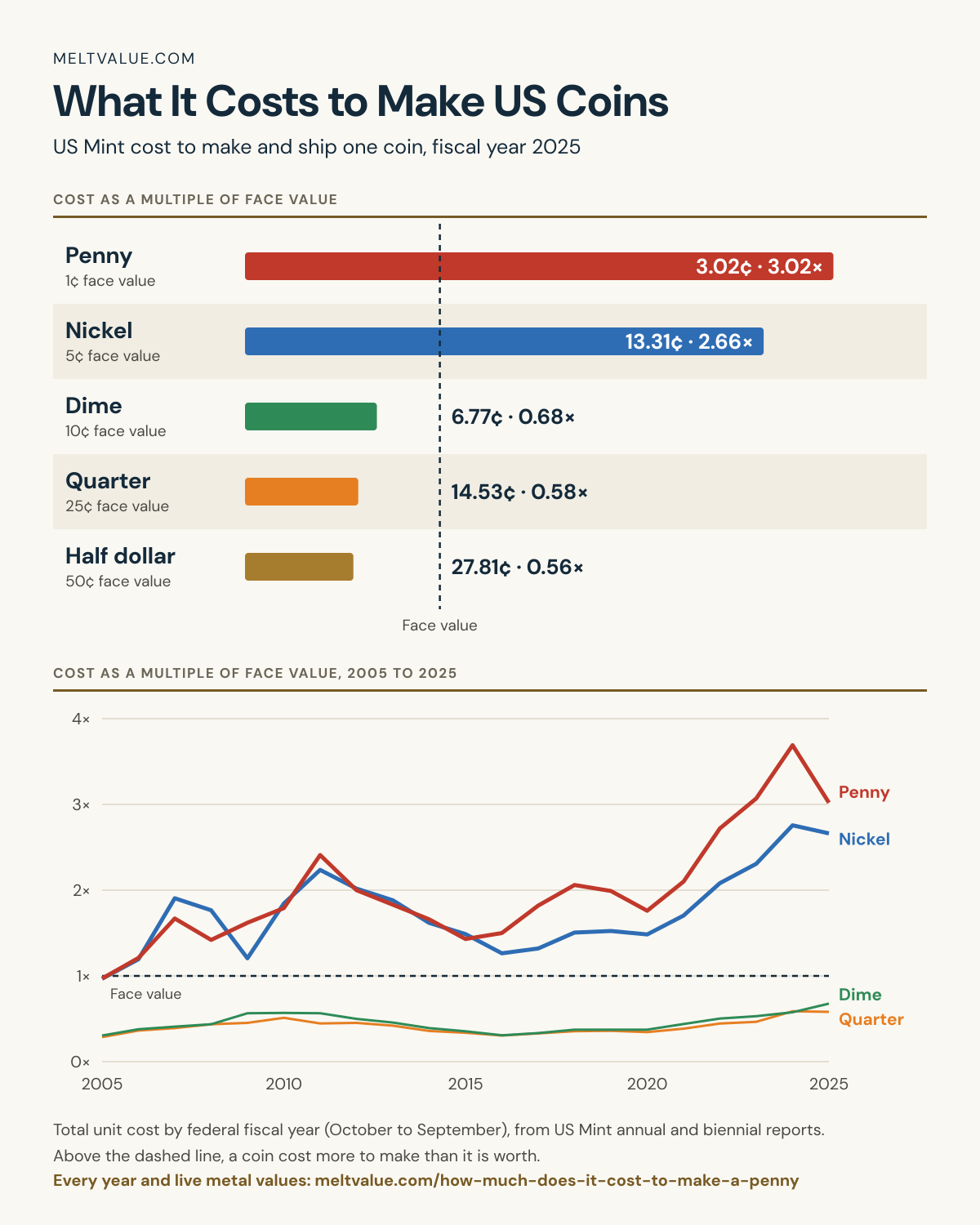
It cost the US Mint 3.02 cents to make and ship each penny in fiscal year 2025, three times its face value. The penny has cost more than a cent every year since 2006. A nickel cost 13.31 cents, while dimes, quarters and half dollars still cost less than they are worth. The Mint struck its last penny for circulation on November 12, 2025, and the Common Cents Act, signed on November 20, 2026, makes that permanent.
Costs are the Mint's total unit cost: making the coin, its share of Mint overhead and shipping it to the Federal Reserve. Fiscal year 2025 ran from October 1, 2024, to September 30, 2025.
What Each US Coin Costs to Make
| Coin | FY2025 cost | Of face value | Per coin |
|---|---|---|---|
| Penny1¢ face value | 3.02¢ | 302% | Loses 2.02¢ |
| Nickel5¢ face value | 13.31¢ | 266% | Loses 8.31¢ |
| Dime10¢ face value | 6.77¢ | 68% | Earns 3.23¢ |
| Quarter25¢ face value | 14.53¢ | 58% | Earns 10.47¢ |
| Half dollar50¢ face value | 27.81¢ | 56% | Earns 22.19¢ |
Source: US Mint 2025 Annual Report. The Mint reports no circulating cost for the dollar coin, so it is not listed.
The Mint sells new coins to the Federal Reserve Banks at face value. That price covers a dime, quarter or half dollar with room to spare, and falls short on the penny and nickel. In fiscal 2025 the Mint lost about 2.02 cents on every penny and 8.31 cents on every nickel, and it earned 10.47 cents on every quarter. The quarter's margin is what keeps the circulating coin business in the black.
Each coin's cost moves with metal prices and with how many coins the Federal Reserve orders. The Mint's report doesn't say why the penny got cheaper in 2025. One likely reason is volume: the Mint shipped 4.77 billion pennies that year, up from 3.17 billion in 2024, so its plant costs were spread over more coins. The dime went the other way. It cost 6.77 cents, its highest in the 21 years on this page.
Cost Compared With Face Value, 2005 to 2025
The penny and the nickel both crossed face value in fiscal 2006 and have stayed above it since. Both hit their highest cost in this data in 2024: 3.69 cents for the penny and 13.78 cents for the nickel. Dimes and quarters stayed under face value the whole time, but their costs climbed too: a dime that cost 3.05 cents in 2005 cost 6.77 cents in 2025.
Where the Money Goes
The Mint splits each coin's cost into three parts. Cost of goods sold is the cost of making the coin, from the metal blank to the finished piece. Selling, general and administrative is the coin's share of the Mint's overhead. Distribution is the cost of shipping coins to the Federal Reserve Banks. Making the coin is 77% to 82% of the total for every denomination.
| FY2025 | Making the coin | Overhead | Shipping | Total |
|---|---|---|---|---|
| Penny | 2.32¢ | 0.67¢ | 0.03¢ | 3.02¢ |
| Nickel | 10.97¢ | 2.24¢ | 0.10¢ | 13.31¢ |
| Dime | 5.58¢ | 1.14¢ | 0.05¢ | 6.77¢ |
| Quarter | 11.96¢ | 2.47¢ | 0.10¢ | 14.53¢ |
| Half dollar | 22.19¢ | 5.34¢ | 0.28¢ | 27.81¢ |
Making the coin is the Mint's cost of goods sold, and overhead is selling, general and administrative cost. Source: US Mint 2025 Annual Report.
Metal Is Only Part of the Cost
Using the Mint's own average metal prices for fiscal 2025, the zinc and copper in a penny were worth about 0.75 cent, a quarter of its 3.02 cent cost. Most of a penny's cost is in turning cheap metal into finished coins.
The nickel is the opposite case. Its copper and nickel were worth about 5.48 cents at those same prices, more than the coin's face value before the Mint spent anything on making it. No amount of extra volume brings a coin like that under 5 cents at those prices. The new law lets the Treasury change the metal.
| Coin | Face | Cost to make | Metal, FY2025 prices | Metal today |
|---|---|---|---|---|
| Pennycopper-plated zinc | 1¢ | 3.02¢ | 0.75¢ | 0.91¢ |
| Nickelcopper and nickel | 5¢ | 13.31¢ | 5.48¢ | 6.37¢ |
| Dimecopper-nickel clad | 10¢ | 6.77¢ | 2.26¢ | 2.76¢ |
| Quartercopper-nickel clad | 25¢ | 14.53¢ | 5.64¢ | 6.90¢ |
| Half dollarcopper-nickel clad | 50¢ | 27.81¢ | 11.29¢ | 13.80¢ |
Metal value is the copper, nickel and zinc in one new coin at its legal weight, before any cost to make it. Fiscal 2025 average prices from the Mint's annual report: copper $9,453.50, nickel $15,441.57 and zinc $2,839.69 a tonne. Today: copper $5.39, nickel $6.95 and zinc $1.55 a pound, updated November 25, 2026 at 3:53 PM EST.
At today's prices the metal in a nickel is worth 6.37¢, still more than its face value, and the metal in a zinc penny 0.91¢. The nickel calculator and copper calculator price coins by weight, and the coin melt value history tracks metal against face value back to 1960.
The Nickel Is Now the Problem Coin
With the penny out of production, the nickel is the one circulating coin the Mint still makes at a loss. It cost 13.31 cents in fiscal 2025, 2.66 times its face value. The Mint shipped 615 million nickels that year and lost $50.9 million on them. Nickel production is climbing, too: the Mint struck 1.04 billion nickels in calendar 2025, up from 112.8 million in 2024.
The Common Cents Act gives the Treasury a way out. A nickel may now be made with an inner layer of zinc and an outer layer of nickel, at any weight from 4 to 6 grams, as long as testing shows the new coin costs less to make and causes as little trouble as possible for coin machines. Copper-nickel nickels stay at 5 grams. The law sets no deadline, so for now every new nickel is still 75% copper and 25% nickel. See how much a nickel weighs.
How the Mint Makes Money on Coins
The gap between a coin's face value and its cost is called seigniorage. The Mint books it as profit and sends it to the Treasury's general fund. Dimes, quarters and half dollars earn it, and pennies and nickels lose it. For years the quarter covered the penny, but the margin has shrunk: circulating coins earned $310.2 million in seigniorage in fiscal 2022 and $34.2 million in 2025.
| Fiscal year | Penny | Nickel | Dime | Quarter | All coins |
|---|---|---|---|---|---|
| 2025 | −$95.6M | −$50.9M | $42.7M | $130.5M | $34.2M |
| 2024 | −$85.3M | −$17.7M | $35.6M | $165.6M | $99.5M |
| 2023 | −$86.0M | −$92.6M | $125.5M | $304.0M | $249.0M |
| 2022 | −$93.0M | −$78.0M | $141.6M | $337.1M | $310.2M |
Seigniorage in millions of dollars. The all coins column includes the Mint's adjustment for mutilated and other coins. Source: US Mint annual reports.
Add up the losses and the penny and nickel together cost about $1.96 billion more to make than their face value from fiscal 2006 through 2025. The worst year was 2023, at $178.6 million.
Cost to Make Each Coin, Every Year Since 2005
| FY | Penny | Nickel | Dime | Quarter | 1¢ + 5¢ loss |
|---|---|---|---|---|---|
| 2025 | 3.02 | 13.31 | 6.77 | 14.53 | −$146.5M |
| 2024 | 3.69 | 13.78 | 5.76 | 14.68 | −$103.0M |
| 2023 | 3.07 | 11.54 | 5.30 | 11.63 | −$178.6M |
| 2022 | 2.72 | 10.41 | 5.03 | 11.11 | −$171.0M |
| 2021 | 2.10 | 8.52 | 4.39 | 9.63 | −$144.6M |
| 2020 | 1.76 | 7.42 | 3.73 | 8.62 | −$101.0M |
| 2019 | 1.99 | 7.62 | 3.73 | 9.01 | −$102.9M |
| 2018 | 2.06 | 7.53 | 3.73 | 8.87 | −$119.0M |
| 2017 | 1.82 | 6.60 | 3.33 | 8.24 | −$89.8M |
| 2016 | 1.50 | 6.32 | 3.08 | 7.63 | −$66.8M |
| 2015 | 1.43 | 7.44 | 3.54 | 8.44 | −$74.4M |
| 2014 | 1.66 | 8.09 | 3.91 | 8.95 | −$90.5M |
| 2013 | 1.83 | 9.41 | 4.56 | 10.50 | −$104.5M |
| 2012 | 2.00 | 10.09 | 4.99 | 11.30 | −$109.2M |
| 2011 | 2.41 | 11.18 | 5.65 | 11.14 | −$116.7M |
| 2010 | 1.79 | 9.22 | 5.69 | 12.78 | −$42.6M |
| 2009 | 1.62 | 6.03 | 5.65 | 11.31 | −$22.0M |
| 2008 | 1.42 | 8.83 | 4.36 | 10.90 | −$47.0M |
| 2007 | 1.67 | 9.53 | 4.09 | 9.78 | −$98.6M |
| 2006 | 1.21 | 5.97 | 3.78 | 9.07 | −$32.9M |
| 2005 | 0.97 | 4.84 | 3.05 | 7.17 | +$4.4M |
Cents per coin, total unit cost by federal fiscal year. Red marks a coin that cost more than its face value. The last column is the seigniorage on pennies and nickels combined, in millions of dollars; a minus sign means a loss. Fiscal 2005 was the last year both coins cost less than face value.
The End of the Penny
| February 2025 | President Trump directs the Treasury to stop making new pennies. |
|---|---|
| May 2025 | The Mint places its final order for penny blanks and plans to stop once they run out. |
| November 12, 2025 | The Philadelphia Mint strikes the last penny for circulation, ending 232 years of penny production. |
| September 2026 | Congress passes the Common Cents Act. The Senate approves it by unanimous consent on September 28. |
| November 20, 2026 | President Trump signs the Common Cents Act into law. |
The Common Cents Act does five things:
- It ends penny production for general circulation. The Mint may still make pennies to sell to collectors.
- It keeps every penny already made as legal tender.
- It lets businesses round a cash total to the nearest 5 cents when they can't make exact change. Totals ending in 1, 2, 6 or 7 cents round down, and totals ending in 3, 4, 8 or 9 round up. Rounding is optional, and it doesn't apply to card, check or electronic payments.
- It allows a lower-cost nickel with zinc inside, weighing 4 to 6 grams.
- It requires the Treasury to tell Congress at least 60 days before it stops making any circulating coin.
The Mint expected the end of penny production to save about $56 million a year in material costs. See how much a penny weighs and how many coins are in a roll.
About the Numbers
Every cost on this page is the Mint's total unit cost for circulating coins, as printed in its annual reports and its biennial reports to Congress. The federal fiscal year runs from October 1 to September 30, so fiscal 2025 ended on September 30, 2025. Seigniorage is the Mint's reported figure for coins shipped to the Federal Reserve Banks. The $1.96 billion total adds the reported penny and nickel seigniorage for fiscal 2006 through 2025. Metal values use each coin's legal weight and alloy from the Mint's coin specifications.
Sources
- US Mint 2025 Annual Report, in Treasury Inspector General audit OIG-26-021: fiscal 2025 and 2024 unit costs and their breakdown, seigniorage, shipments, average metal prices and the 20th straight year of penny and nickel costs above face value.
- US Mint 2024 Annual Report (FRASER, Federal Reserve Bank of St. Louis): fiscal 2024 costs, shipments and seigniorage.
- US Mint 2020 Biennial Report to Congress: unit costs for fiscal 2018 through 2020.
- US Mint 2014 Biennial Report to Congress (FRASER): unit costs for fiscal 2011 through 2014.
- US Mint 2010 Annual Report, in Treasury Inspector General audit OIG-11-042: unit costs and penny and nickel seigniorage for fiscal 2009 and 2010.
- US Mint 2008 Annual Report, in Treasury Inspector General audit OIG-09-015: unit costs and penny and nickel seigniorage for fiscal 2007 and 2008.
- US Mint 2006 Annual Report (FRASER): unit costs for fiscal 2005 and 2006.
- CoinNews, US Mint cost reports: Mint unit costs and penny and nickel seigniorage by year from 2005, including fiscal 2015 to 2017 and 2021 to 2023.
- Coin World, U.S. Mint reveals production costs for 2024: seigniorage by coin for fiscal 2022 through 2024.
- CoinNews, US Mint coin production in 2025: calendar 2025 nickel production.
- Associated Press via KSAT, the Mint's final order of penny blanks: the final order of penny blanks in May 2025 and fiscal 2024 shipments.
- CoinNews, Trump Signs Law Ending Circulating Penny Production: the November 20, 2026 signing and the February 2025 directive.
- Common Cents Act, H.R. 10167, enrolled bill (GovInfo): the end of circulating penny production, legal tender, cash rounding, the 4 to 6 gram zinc nickel and the 60 day notice rule.
- United States Mint, final circulating penny: the last penny struck for circulation on November 12, 2025.
- Federal Reserve Bank of St. Louis, When a Penny Costs More Than a Penny: seigniorage, the fiscal 2024 penny loss and the $56 million a year in expected savings.
- Cornell Law School, 31 CFR Part 82: the ban on melting and exporting pennies and nickels.
- United States Mint, Coin Specifications: weight and alloy of each coin, used for the metal values.