
Penny Melt Value: How Much Copper Is in a Penny?
A copper penny, the kind made from 1864 through 1982, holds 2.95 grams of copper, worth 3.56¢ today. A zinc penny, made from 1982 on, has about 0.06 gram of copper, and its metal is worth 0.91¢. The copper penny is 95% copper by weight, so its metal value rises and falls with the copper price. Federal rules ban melting pennies, which means melt value tells you what the metal is worth, not what a buyer will pay.
Copper $5.39 and zinc $1.55 a pound. Updated November 25, 2026 at 4:39 PM EST.
Penny Melt Value Today
| Amount | Copper pennies1864 to 1982 | Zinc pennies1982 and later |
|---|---|---|
| One penny1¢ face | 3.56¢ | 0.91¢ |
| A roll of 5050¢ face | $1.78 | 45.36¢ |
| 100 pennies$1 face | $3.56 | 90.72¢ |
| One pound146 or 181 coins | $5.20 | $1.65 |
| A box of 50 rolls$25 face, 2,500 coins | $89.10 | $22.68 |
| A Federal Reserve bag$50 face, 5,000 coins | $178.20 | $45.36 |
| $100 in pennies10,000 coins | $356.39 | $90.72 |
Melt value of new coins at their legal weight: 3.11 grams of 95% copper and 5% zinc, or 2.5 grams of 97.5% zinc and 2.5% copper. Worn coins hold slightly less. The 1943 steel cent has no copper and is not included.
Penny Melt Value Calculator
- Pennies
- 146
- Face value
- $1.46
- Weight
- 1.00 lb
- Copper inside
- 0.95 lb
- Melt value
- $5.20
- Melt ÷ face
- 3.56×
How Much Copper Is in a Penny, by Year
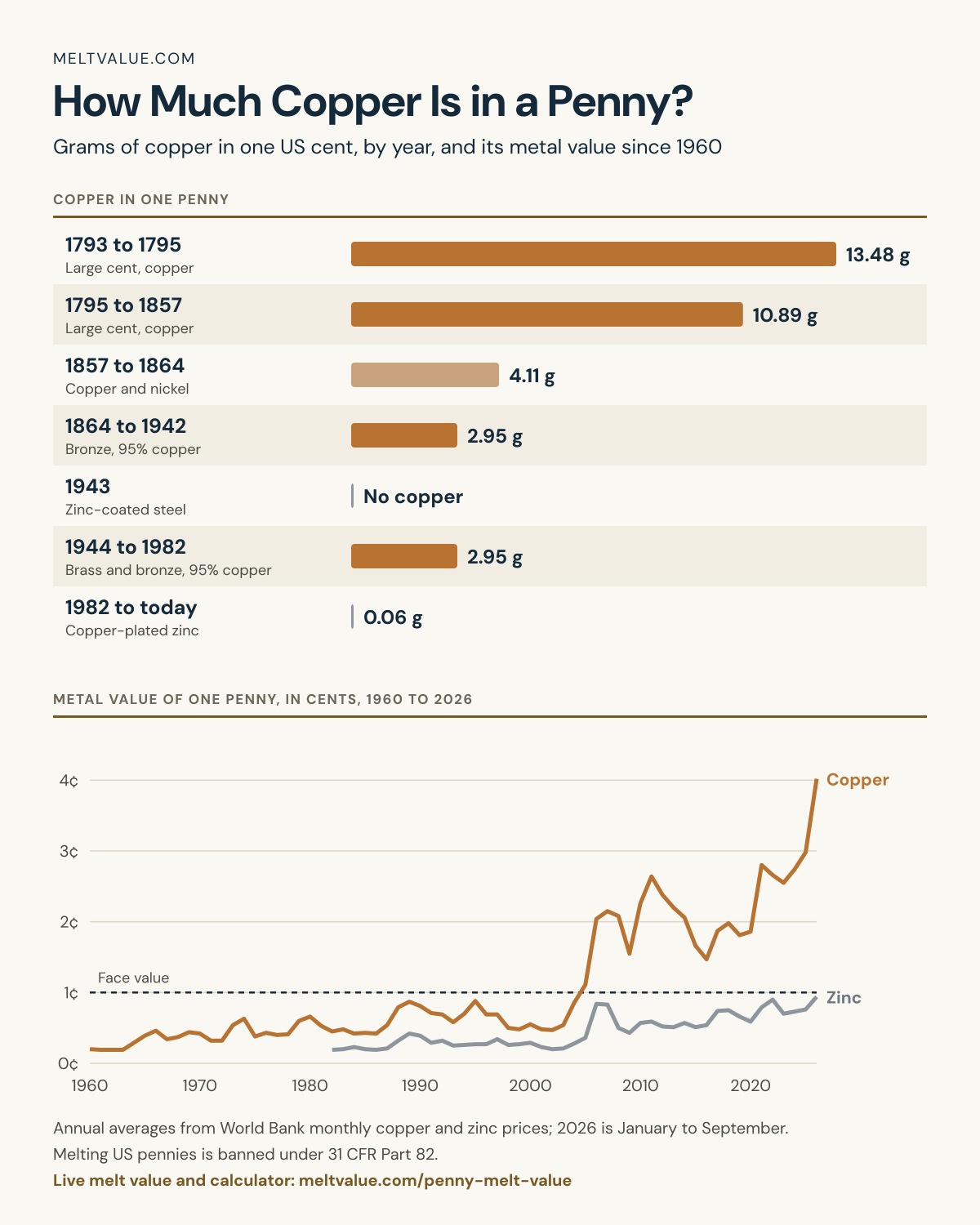
Pennies were nearly pure copper until 1857, then copper with nickel, then bronze or brass at 95% copper from 1864 until 1982, with a one-year break for steel in 1943. In 1982 the Mint switched to copper-plated zinc, which cut the copper in each new penny from 2.95 grams to about 0.06 gram.
| Years | Metal | Weight | Copper | Melt today |
|---|---|---|---|---|
| 1793 to 1795Large cent | Copper | 13.48 g | 13.48 g | 16.02¢ |
| 1795 to 1857Large cent | Copper | 10.89 g | 10.89 g | 12.94¢ |
| 1857 to 1864Flying Eagle and Indian Head | 88% copper, 12% nickel | 4.67 g | 4.11 g | 5.74¢ |
| 1864 to 1942Indian Head and Lincoln wheat | Bronze: 95% copper, 5% tin and zinc | 3.11 g | 2.95 g | 3.56¢ |
| 1943Steel cent | Zinc-coated steel | 2.70 g | None | — |
| 1944 to 1946Lincoln wheat | Brass: 95% copper, 5% zinc | 3.11 g | 2.95 g | 3.56¢ |
| 1947 to 1962Lincoln wheat and Memorial | Bronze: 95% copper, 5% tin and zinc | 3.11 g | 2.95 g | 3.56¢ |
| 1962 to 1982Lincoln Memorial | Brass: 95% copper, 5% zinc | 3.11 g | 2.95 g | 3.56¢ |
| 1982 to todayLincoln, zinc | Copper-plated zinc: 97.5% zinc | 2.50 g | 0.06 g | 0.91¢ |
Weights are the legal standard for each period. Bronze cents hold some tin in their 5%, which this table prices as zinc, so their metal is worth slightly more. The 1943 steel cent has no copper. Coins before 1909 sell to collectors for far more than their metal.
Copper or Zinc? How to Tell
Check the date. Lincoln cents dated 1981 or earlier are 95% copper, except the 1943 steel cent. Pennies dated 1983 or later are zinc. Only 1982 needs a closer look, because the Mint made both kinds that year.
Weigh the 1982s. A copper penny weighs 3.11 grams and a zinc penny 2.5 grams, so any kitchen scale that reads to 0.1 gram sorts them. Ten copper pennies weigh 31.1 grams and ten zinc ones 25 grams. See how much a penny weighs for the full weight test.
Watch for 1943 and 1944. A 1943 penny should be steel and stick to a magnet. A 1943 penny that weighs 3.11 grams and ignores a magnet could be one of the copper errors struck by mistake that year. A few 1944 pennies were struck on steel blanks by mistake, too. Both errors are rare and worth having a grading service check.
Some people drop a coin on a hard surface and listen: copper rings, zinc thuds. It works with practice, but a scale is faster and settles it.
Is It Illegal to Melt Pennies?
Yes. Treasury rules at 31 CFR Part 82 ban melting, treating or exporting pennies and nickels. The Mint first issued them in December 2006, when rising metal prices raised the risk that people would melt the coins and cause a shortage. The penalty is a fine of up to $10,000, up to five years in prison, or both.
The rules make a few exceptions:
- Jewelry, novelty, educational and amusement uses, such as souvenir penny presses, as long as the point isn't profit from the metal.
- Coins carried out of the country worth up to $5 in face value, or up to $25 for personal collecting or amusement.
- Shipments of up to $100 in face value to be used as money or for collecting.
- Pennies melted by accident while recycling other materials, when separating them isn't practical.
- Uses the Mint approves with a written license.
The rules don't stop you from saving, sorting, buying or selling pennies. The Common Cents Act of 2026 ended penny production for circulation but left the melting rules in place. Pennies remain legal tender.
What Copper Pennies Actually Sell For
Since no one can legally melt them, there is no scrap market for pennies. Sorted copper pennies trade between collectors and people who stack them as a copper bet, usually by the pound or in $50 bags. Dealers who buy them often pay less than melt value, since they can't melt them either, and some coin shops pay nothing over face.
Hunting rolls is the cheap way in. Where a bank still has pennies, a $25 box costs face value, and copper cents still turn up mixed in with zinc ones. Keep an eye out for errors and scarce dates while you sort: a few Lincoln cents are worth far more to collectors than any amount of copper.
Copper Penny Melt Value Since 1960
A copper penny's metal first topped one cent in November 1988 and has stayed above it every month since March 2009, based on World Bank monthly average prices. It reached a record 4.34 cents in September 2026, when copper hit an all-time high.
Zinc pennies first held more than a cent of metal in November 2006, peaked at 1.13 cents in April 2022 and moved back above face in August 2026, at 1.07 cents in September 2026. At today's prices a zinc penny holds 0.91¢ of metal. With copper at today's price, zinc would need to reach about $1.72 a pound for that to equal one cent.
| Year | Copper penny | Zinc penny |
|---|---|---|
| 2026 (Jan to Sep) | 4.02¢ | 0.94¢ |
| 2025 | 2.98¢ | 0.76¢ |
| 2024 | 2.74¢ | 0.73¢ |
| 2023 | 2.55¢ | 0.70¢ |
| 2022 | 2.66¢ | 0.90¢ |
| 2021 | 2.80¢ | 0.79¢ |
| 2020 | 1.86¢ | 0.59¢ |
| 2015 | 1.66¢ | 0.51¢ |
| 2011 | 2.64¢ | 0.59¢ |
| 2008 | 2.08¢ | 0.50¢ |
| 2006 | 2.04¢ | 0.84¢ |
| 2005 | 1.11¢ | 0.36¢ |
| 2000 | 0.55¢ | 0.29¢ |
| 1995 | 0.88¢ | 0.27¢ |
| 1990 | 0.81¢ | 0.39¢ |
| 1985 | 0.43¢ | 0.20¢ |
| 1980 | 0.66¢ | — |
| 1974 | 0.63¢ | — |
| 1970 | 0.42¢ | — |
| 1965 | 0.39¢ | — |
| 1960 | 0.20¢ | — |
Annual averages of monthly values, in cents. Every year and every month back to 1960 is in the US coin melt value history dataset, free to download.
Your Quarters Hold More Copper Than a Copper Penny
Dimes, quarters, half dollars, nickels and dollar coins are all mostly copper. A quarter holds 5.20 grams of copper, more than the 2.95 grams in a copper penny, and a half dollar holds over three times as much.
| Coin | Metal | Copper |
|---|---|---|
| Zinc penny | copper-plated zinc | 0.06 g |
| Dime | copper-nickel clad | 2.08 g |
| Copper penny | 95% copper | 2.95 g |
| Nickel | copper and nickel | 3.75 g |
| Quarter | copper-nickel clad | 5.20 g |
| Dollar coin | manganese brass (golden dollars) | 7.17 g |
| Half dollar | copper-nickel clad | 10.40 g |
Copper in one new coin at the US Mint's specifications. See US coin weights and the nickel calculator.
No New Pennies Are Coming
The Mint struck its last penny for circulation on November 12, 2025, and the Common Cents Act, signed on November 20, 2026, ends circulating penny production by law. The Mint may still make pennies to sell to collectors. Each penny cost the Mint 3.02 cents to make in fiscal 2025; see how much it costs to make a penny.
Pennies already in circulation stay legal tender, and stores may round cash totals to the nearest 5 cents when they can't make exact change. The copper calculator prices other copper by weight, and how many coins are in a roll covers roll and bag counts.
About the Numbers
Live melt values use the copper and zinc prices shown at the top of the page and each coin's legal weight and alloy. A copper penny is 3.11 grams of 95% copper and 5% zinc; a zinc penny is 2.5 grams of 97.5% zinc and 2.5% copper. Historical values come from MeltValue's coin melt value dataset, which uses World Bank monthly average prices, so they can differ from the live price on any given day.
Sources
- United States Mint, Coin Specifications: weight and alloy of the penny and the other coins made today.
- United States Mint, Penny: the 1943 steel cent and the copper cents struck by mistake that year.
- United States Mint, Historic Coin Production: the switch to copper and nickel in 1857, bronze in 1864 and steel in 1943.
- Wikipedia, Large cent: large cents of 1793 to 1857 made of nearly pure copper with no added alloy.
- PCGS CoinFacts, 1943 Lincoln cent: the 2.70 gram weight of the 1943 steel cent and the steel error coins struck in the transition.
- Wikipedia, Penny (United States coin): weight and metal of the cent in each period, and the 1944 steel errors.
- Cornell Law School, 31 CFR 82.2: the exceptions to the ban on melting and exporting pennies and nickels.
- Cornell Law School, 31 CFR 82.4: the penalties for melting or exporting pennies and nickels.
- United States Mint, limits on melting and exporting coins (2006): the December 2006 melting rules and the coin shortage they were meant to prevent.
- Common Cents Act, H.R. 10167, enrolled bill (GovInfo): the end of circulating penny production, legal tender and cash rounding.
- United States Mint, final circulating penny: the last penny struck for circulation on November 12, 2025.
- Federal Reserve Financial Services, coin depositing and ordering: the $50 standard bag of pennies.
- World Bank, Commodity Price Data (Pink Sheet): monthly copper and zinc prices behind the historical values.