
925 Silver Meaning: What the 925 Stamp on Jewelry Means
925 on jewelry means sterling silver: 925 parts of pure silver in every 1,000, or 92.5%. The other 7.5% is usually copper, which makes the metal hard enough to wear. At today’s price, a gram of 925 silver holds $1.23 of silver. The stamp is the maker’s promise of that content, and US law requires the maker’s trademark beside it.
Melt value of the silver in sterling at $41.38 an ounce. Updated November 25, 2026 at 5:45 PM EST.
Silver Stamp Decoder
Type the stamp from your piece and its weight. The decoder reads sterling and the other silver standards, silver plated and nickel silver marks, and gold marks that turn up on silver.
Sterling silver: 925 parts silver in 1,000, usually alloyed with copper. US rules reserve "sterling" for silver at least this pure.
- Pure silver
- 92.5%
- Melt value per gram
- $1.23
- Silver in 5 g
- 4.63 g
- Melt value of 5 g
- $6.15
A stamp states the minimum the maker promises. It is not a test, and stamps can be faked or worn away. Melt value is the metal at today’s spot price, before any buyer’s margin.
What Does 925 Mean on Silver?
The number is the silver content in parts per thousand. Pure silver is too soft for most jewelry, so makers alloy it, and sterling’s 925 standard has been the British norm for centuries. Copper is the usual addition because it hardens silver without changing its color much.
Under the FTC Jewelry Guides, only silver that is at least 925 fine should be called sterling, sterling silver, solid silver or Ster. The Stamping Act lets a soldered piece run 10 parts per thousand short and an unsoldered one 4 parts short, so a 925 stamp means the metal should test at 921 or better, or 915 for a piece with solder.
925 Silver Value Calculator
- Pure silver
- 18.5 g
- Troy ounces
- 0.595
- Melt value
- $24.61
- Strong offer, 80%
- $19.69
Weigh the silver only. Stones and steel clasp springs don’t count, and sterling knives usually have steel blades and filled handles, so most of their weight isn’t silver.
Common 925 Stamps and Extra Letters
| Stamp | Meaning |
|---|---|
| 925, .925, 925/1000 | Sterling silver, written as parts per thousand. |
| S925, 925S, AG925 | Sterling silver. S stands for silver and Ag is its chemical symbol. |
| STERLING, STER, STG | Sterling silver spelled out or shortened. US rules reserve these words for silver at least 925 fine. |
| 925 ITALY, 925 THAILAND, 925 MEXICO | Sterling silver plus the country where it was made. |
| 925 CZ | Sterling silver set with cubic zirconia, a man-made stone. |
| 925 with letters or a logo | The letters are the maker’s trademark. US law requires one beside any silver quality mark. |
| 925 with a karat mark, or 925 on gold | Sterling silver with a gold coat, sold as vermeil when the coat is at least 2.5 microns of 10K or better. |
| TA-16, TS-09 and similar | A Mexican silversmith registration code used since about 1980. T is for Taxco. |
| Lion passant or lion rampant | The traditional British sterling mark, from an English assay office or from Edinburgh. |
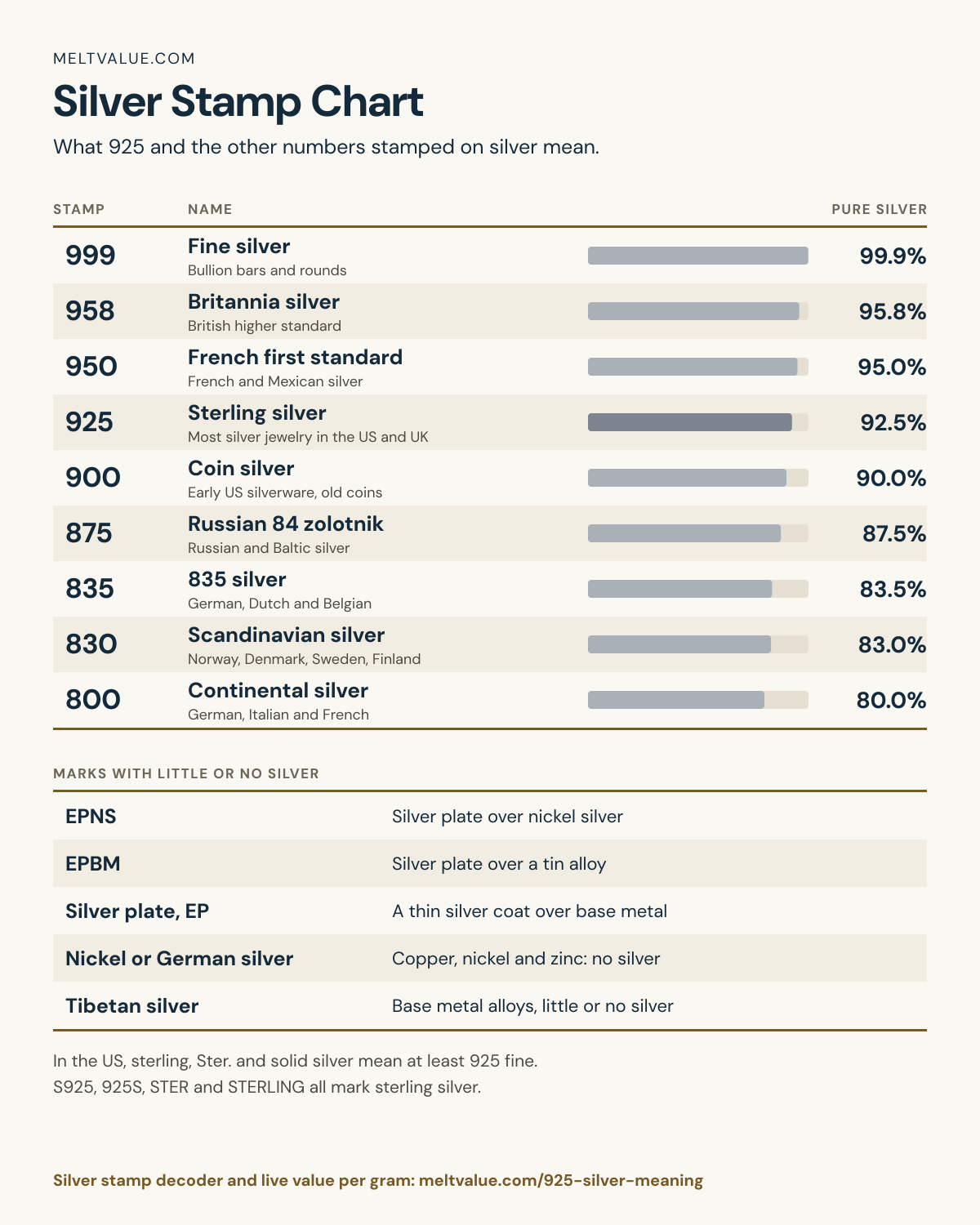
Silver Stamp Chart
| Stamp | Silver | Per gram | Per troy oz |
|---|---|---|---|
| Fine silver999, .999, FS. Bullion bars and rounds, some handmade jewelry | 99.9% | $1.33 | $41.34 |
| Mexican 980980. Mexican silver from the 1930s and 1940s | 98.0% | $1.30 | $40.55 |
| Britannia silver958, Britannia figure. British silver made to the higher standard | 95.8% | $1.27 | $39.64 |
| French first standard950. French and Mexican silver | 95.0% | $1.26 | $39.31 |
| Sterling silver925, .925, S925, STER, STERLING. Most silver jewelry sold in the US and UK | 92.5% | $1.23 | $38.28 |
| Coin silver900, COIN. US silverware made before about 1870 and old coins | 90.0% | $1.20 | $37.24 |
| Russian 84 zolotnik875, 84. Russian and Baltic silver | 87.5% | $1.16 | $36.21 |
| 835 silver835. German, Dutch and Belgian silver | 83.5% | $1.11 | $34.55 |
| Scandinavian silver830. Norwegian, Danish, Swedish and Finnish silver | 83.0% | $1.10 | $34.35 |
| Continental silver800. German, Italian and French silver | 80.0% | $1.06 | $33.10 |
Melt value of the silver in each alloy at today’s spot price. A troy ounce is 31.1 grams, the unit silver buyers quote.
Pure silver share by weight for the most common standards.
Stamps That Mean Little or No Silver
| Mark | What it is |
|---|---|
| EPNS | Electroplated nickel silver: a thin silver coat over a copper, nickel and zinc alloy. |
| EPBM | Electroplated Britannia metal: a silver coat over a tin alloy. |
| Silver plate, silverplate, EP | A silver coating over base metal. The coat weighs very little. |
| Nickel silver, German silver, alpaca | Copper, nickel and zinc. Despite the name, no silver at all. |
| Tibetan silver | A trade name for silver-colored base metal alloys. Modern pieces usually hold little or no silver. |
| Silver tone | A color, not a metal. |
Under the Stamping Act, silver plated articles can’t be marked sterling or coin, alone or with other words.
US Rules for Sterling and Silver Stamps
Sterling means 925. The FTC Guides reserve sterling, sterling silver, solid silver and Ster. for silver at least 925 fine, and coin or coin silver for at least 900 fine. Silver below 925 can still be called silver if the fineness is shown just as clearly, as in 800 silver.
The trademark rule. Anyone who stamps a silver quality mark must also stamp a registered trademark or name, in letters at least as large as the quality mark and as close to it as possible. Look for those letters or a logo beside the 925.
Coated pieces need a qualifier. The 2018 revision of the Guides advises sellers not to call a coated product silver unless they make clear it has only a surface layer. Rhodium plating on silver should be disclosed too.
No stamp is required. Like gold, US silver doesn’t have to be marked at all. An unmarked piece can be sterling, but a buyer will test it before paying.
British Hallmarks on Silver
In the UK, silver over 7.78 grams, a quarter of a troy ounce, can’t be sold as silver without an assay office hallmark. The hallmark always includes the sponsor’s mark, the fineness number and the assay office mark. The UK hallmarks four silver standards: 800, 925, 958 and 999.
Older British silver uses pictures instead of numbers. A lion passant, a lion walking with one paw raised, means sterling assayed in England. Edinburgh has used a lion rampant, standing on its hind legs, since 1975. A seated figure of Britannia marks the 958 Britannia standard. These traditional marks are optional on new pieces, which carry the number.
Mexican Silver Marks
Mexican silver from the 1930s and 1940s was usually stamped silver or sterling with a fineness, often 925, 950 or 980, and Mexico or a town such as Taxco. From 1948 until about 1980, Mexican silver was marked with an eagle head and a number, which stood for an assay city or a registered maker: eagle 1 was Mexico City and eagle 3 was Taxco.
Since about 1980, Mexican silver carries a letter and number code instead. In TA-16, the T stands for Taxco and the A for the first letter of the silversmith’s name. The 16 means the 16th silversmith with that letter to register in that city.
Is Your 925 Silver Real?
Try a magnet. Silver isn’t magnetic, so a piece that grabs a strong magnet is steel or iron under the surface. Copper and brass fakes don’t react either, so passing this test proves little.
Look for the trademark and the wear. Real sterling from a reputable maker carries a maker’s mark beside the 925. Copper or brass color showing through at the edges means plating.
Have it tested. Buyers use acid tests and electronic testers. Since sterling is the same all the way through, a test on a small file mark in a hidden spot gives a clear answer, and a reputable buyer will test in front of you.
Does 925 Silver Tarnish?
Yes. Silver reacts with sulfur compounds in the air and forms silver sulfide, the dark film you see on old flatware. The copper in sterling can darken too. Tarnish polishes off and doesn’t change the silver content or melt value. Store pieces in sealed bags, away from rubber and wool, to slow it down. Some sterling pieces sold today carry a rhodium coat, which keeps them bright until it wears through.
What 925 Silver Sells For
Melt value is the silver content times the spot price, and no buyer pays all of it. The strongest buyers pay around 70 to 80% of melt on sterling scrap. Small lots do worse, since testing and shipping costs don’t shrink with the lot, and pawn shops pay least. Signed designer pieces and antique Mexican and Scandinavian silver can sell for well above melt, so check before you scrap them.
The silver calculator prices scrap by weight and purity, and the silver price per gram page has the live rate for every standard. For gold marks, see the gold jewelry stamps guide; for vermeil and gold plating, see gold filled vs gold plated.
About the Numbers
Values multiply the stamped fineness by the live silver spot price shown at the top of the page. A strong offer is shown at 80% of melt, the top of what specialist buyers pay for sterling scrap.
Sources
- Cornell Law School, 16 CFR 23.5: FTC guidance on sterling, solid silver, coin silver, silver below 925 and silver plated products.
- Federal Register, 2018 revision of the Jewelry Guides: the 925 and 900 thresholds, silver below 925 and coated products.
- GovInfo, 15 U.S.C. 295 and 296: Stamping Act tolerances for silver: 4 parts per thousand, or 10 with solder.
- Cornell Law School, 15 U.S.C. 297: the trademark beside a quality mark, and the ban on marking plated articles sterling or coin.
- GOV.UK, Hallmarking is the law: the compulsory UK marks and the 7.78 gram threshold for silver.
- legislation.gov.uk, Hallmarking Act 1973, Schedule 2: UK silver standards, the lion passant, the lion rampant and the Britannia figure.
- Wikipedia, Silver standards: Britannia, coin, Scandinavian, German and continental silver standards.
- Wikipedia, Nickel silver: nickel silver, German silver and alpaca contain no silver.
- Wikipedia, Tibetan silver: testing of modern Tibetan silver pieces sold online.
- 925-1000.com, Mexican silver marks: the 1948 eagle marks and the letter and number codes that replaced them.