
Gold Filled vs Gold Plated: How Much Gold Each One Holds
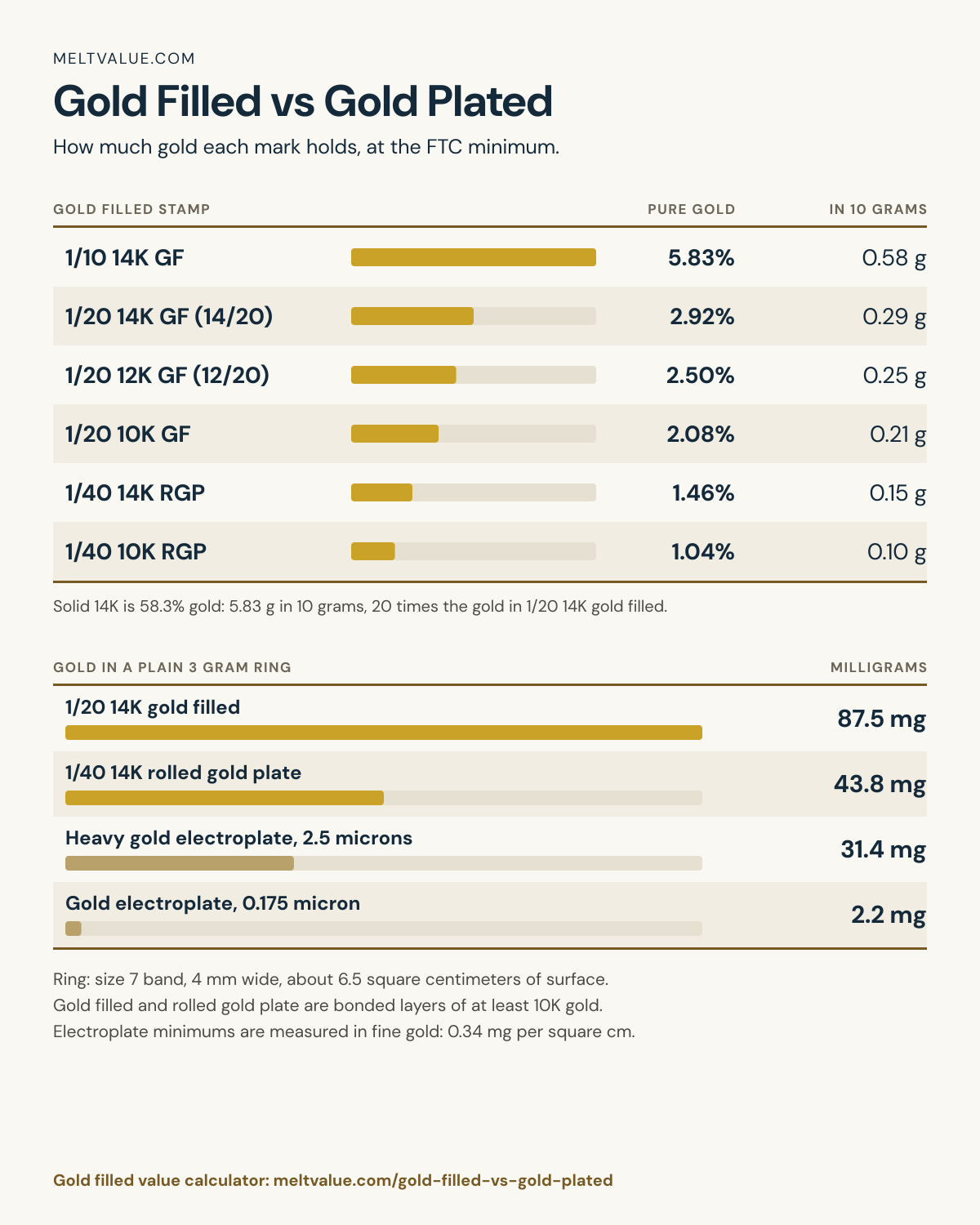
Gold filled jewelry has a sheet of karat gold bonded over brass, and to be sold as gold filled, the gold has to make up at least 1/20 of the metal weight. Gold plated jewelry has a coat measured in millionths of an inch. A 1/20 14K gold filled chain is at least 2.92% pure gold, so a 10 gram chain holds about 0.29 gram. A ring plated to the FTC minimum holds about 2 milligrams.
Gold at $3,589.49 an ounce, updated November 25, 2026 at 5:46 PM EST. The comparison uses a plain 3 gram band, worked out below.
Gold Filled vs Gold Plated at a Glance
| Type | How it’s made | FTC minimum |
|---|---|---|
| Gold filledGF, 1/20 14K GF, 14/20 | A karat gold sheet bonded over brass with heat and pressure, then rolled or drawn | At least 10K and 1/20 of the metal weight |
| Rolled gold plateRGP, 1/40 12K RGP, gold overlay | The same bonded construction with a thinner layer | At least 10K and 1/40 of the weight, fraction stamped below 1/20 |
| Gold electroplateGP, GE, GEP, EP | Gold deposited in a plating bath with electric current | At least 10K and 0.175 micron of fine gold |
| Heavy gold electroplateHGE, HGP | A thicker electroplated coat | At least 10K and 2.5 microns of fine gold |
| Gold vermeilVermeil, 925 with a karat mark | Electroplated gold over sterling silver | Sterling base, 10K and 2.5 microns of fine gold |
Minimums from the FTC Jewelry Guides as revised in 2018. Electroplate thickness is measured as fine gold, so 0.175 micron of 24K counts the same as 0.35 micron of 12K.
Gold Filled Value Calculator
- Karat gold layer
- 0.500 g
- Pure gold
- 0.292 g
- Melt value
- $33.66
- Per gram of item
- $3.37
Weigh the metal only: remove stones, beads and cords first. Results use the minimum gold the stamp promises, so a piece can hold slightly more.
How Much Gold Is in Gold Filled?
Multiply the fraction by the karat. A 1/20 14K piece is 1/20 karat gold, and 14K is 14/24 gold, so the piece is 1/20 × 14/24 = 2.92% pure gold. A 1/10 layer doubles that, and a 12K or 10K layer brings it down.
| Stamp | Pure gold | Per gram | Per pound |
|---|---|---|---|
| 1/10 14K GFGold filled | 5.83%26.5 g per lb | $6.73 | $3,054 |
| 1/10 12K GFGold filled | 5.00%22.7 g per lb | $5.77 | $2,617 |
| 1/20 18K GFGold filled | 3.75%17.0 g per lb | $4.33 | $1,963 |
| 1/20 14K GF (14/20)Gold filled | 2.92%13.2 g per lb | $3.37 | $1,527 |
| 1/20 12K GF (12/20)Gold filled | 2.50%11.3 g per lb | $2.89 | $1,309 |
| 1/20 10K GFGold filled | 2.08%9.4 g per lb | $2.40 | $1,091 |
| 1/40 14K RGPRolled gold plate | 1.46%6.6 g per lb | $1.68 | $763 |
| 1/40 12K RGPRolled gold plate | 1.25%5.7 g per lb | $1.44 | $654 |
| 1/40 10K RGPRolled gold plate | 1.04%4.7 g per lb | $1.20 | $545 |
Melt value of the gold at today’s spot price, using the FTC minimum for each stamp. 1/40 marks are rolled gold plate. Older rolled gold plate can carry fractions like 1/30 or 1/100; use the custom option in the calculator for those.
How Much Gold Is in Gold Plating?
Plating is measured by thickness, not weight. The FTC minimum for gold electroplate is 0.175 micron of fine gold, about 7 millionths of an inch, which comes to 0.34 milligram of gold per square centimeter of surface. Heavy gold electroplate and vermeil need 2.5 microns, or 4.8 milligrams per square centimeter.
Take a plain band 4 mm wide in ring size 7. Inside, outside and edges, it has about 6.5 square centimeters of surface, and in brass it weighs about 3 grams. Here is how much gold that band holds under each mark:
Milligrams of pure gold at each FTC minimum, worth $10.10, $5.05, $3.62 and 25.4¢ at today’s price. Fine gold weighs 19.32 grams per cubic centimeter. Real coatings vary from piece to piece.
A chain has more surface for its weight than a ring, so a heavy electroplated chain can hold a tenth of a gram or more. Standard plating stays in the milligrams. Below the 0.175 micron minimum, sellers used to say gold flashed or gold washed. The FTC dropped those terms from its guidance in 2018, so it no longer treats them as a fair way to sell a coat that thin.
Which Lasts Longer?
Gold filled, by a wide margin. On the band above, a 1/20 layer works out to more than 10 microns of 14K gold even when spread over every surface, against 0.175 micron for standard plating, so it takes far more wear to reach the brass. Vintage gold filled watch cases and lockets often still look gold after decades.
Plating wears through first where a piece rubs: the bottom of a ring, the edges of links, clasps and the backs of pendants. When the FTC set a 1/40 minimum for bonded plate in 2018, it cited testing showing that layer gives the durability buyers expect.
Double clad gold filled sheet splits the gold between the two faces, so 1/20 double clad has 1/40 on each side. It holds the same gold overall but wears through sooner than single clad, where the whole layer is on the side that shows.
Karat gold doesn’t tarnish the way brass does, so both types look fine until the gold wears through. After that the base metal shows, darkens and can mark skin. Some plated jewelry has a nickel layer under the gold, so ask before you buy if nickel bothers you.
How to Tell Gold Filled From Gold Plated
Read the stamp. GF, a fraction like 1/20 or 1/10, shorthand like 14/20 or 12/20, RGP or gold overlay means a bonded layer you can sell by weight. GP, GE, GEP, EP, HGE and HGP mean plating. A karat number alone, like 14K or 585, claims solid gold, and US law bars stamping a karat on filled or plated goods without the term that says so. The gold jewelry stamps decoder reads any mark.
Check the wear spots. Brass or copper color at the edges of links, on clasps or under a ring means a layer has worn through. Gold filled rarely shows it; plating often does.
Be careful with surface tests. An acid scratch test or an electronic tester reads the outside of the piece, and a thick gold filled layer can pass as karat gold. Buyers who suspect it file a small notch in a hidden spot to see what is under the gold, or compare weight to size, since 14K gold is roughly half again as dense as brass.
Gold Filled, Vermeil and Solid Gold
Vermeil is sterling silver with at least 2.5 microns of gold. Its gold layer is thinner than gold filled, but its base is silver, so a vermeil piece has scrap value in the silver itself. Gram for gram, gold filled still holds more metal value whenever gold costs more than about 32 times as much as silver: today 10 grams of 1/20 14K gold filled holds $33.66 of gold and 10 grams of vermeil holds $12.31 of silver. See what 925 means for silver melt values.
Solid gold is karat gold all the way through. A solid 14K piece is 58.3% gold, twenty times the gold in 1/20 14K gold filled of the same weight, and it never wears through to another metal. The 14K gold price and gold calculator value solid pieces.
Selling Gold Filled and Plated Jewelry
Gold filled sells by weight, at a deep discount to its melt value. Recovering 3 grams of gold from every 100 grams of brass costs a refiner far more per gram of gold than melting a 14K chain, and many shops that buy karat gold won’t take gold filled at all. It sells best in larger lots, sorted from karat gold, with the stamps visible.
Plated jewelry has no scrap value worth selling. Gold filled watch cases, pens and eyeglass frames can be heavy enough to be worth sorting out. A vintage designer piece can still sell for its style, so check before you scrap anything signed.
About the Numbers
Gold filled values multiply the item weight by the stamped fraction and the karat over 24, then by the live gold price. Plating figures convert the FTC minimum thickness of fine gold to milligrams at 19.32 grams per cubic centimeter. The ring example is a plain band 4 mm wide and 1.5 mm thick, size 7, which has about 6.5 square centimeters of surface and weighs about 3 grams in brass.
Sources
- eCFR, 16 CFR Part 23, FTC Jewelry Guides: definitions and minimums for gold filled, rolled gold plate, gold electroplate, heavy electroplate and vermeil.
- Federal Register, 2018 revision of the Jewelry Guides: the 1/40 minimum for bonded plate, the 0.175 micron standard measured as fine gold, and dropping "gold flashed" and "gold washed".
- Cornell Law School, 15 U.S.C. 297: the ban on karat marks on filled and plated articles without words saying so.
- FTC, Facts for Consumers: All That Glitters (GovInfo): gold filled, gold overlay, rolled gold plate and the fraction marking.
- Jewelers Vigilance Committee, To Stamp or Not (PDF): gold percentages for 1/10 and 1/20 gold filled and 1/40 rolled gold plate.
- Wikipedia, Gold-filled jewelry: how gold filled is made and double clad sheet.
- Wikipedia, Gold: the density of gold, 19.3 grams per cubic centimeter.
- Wikipedia, Brass: the density of brass, about 8.4 to 8.7 grams per cubic centimeter.