
Gold Jewelry Stamps: What 585, 750, 14K and Other Marks Mean
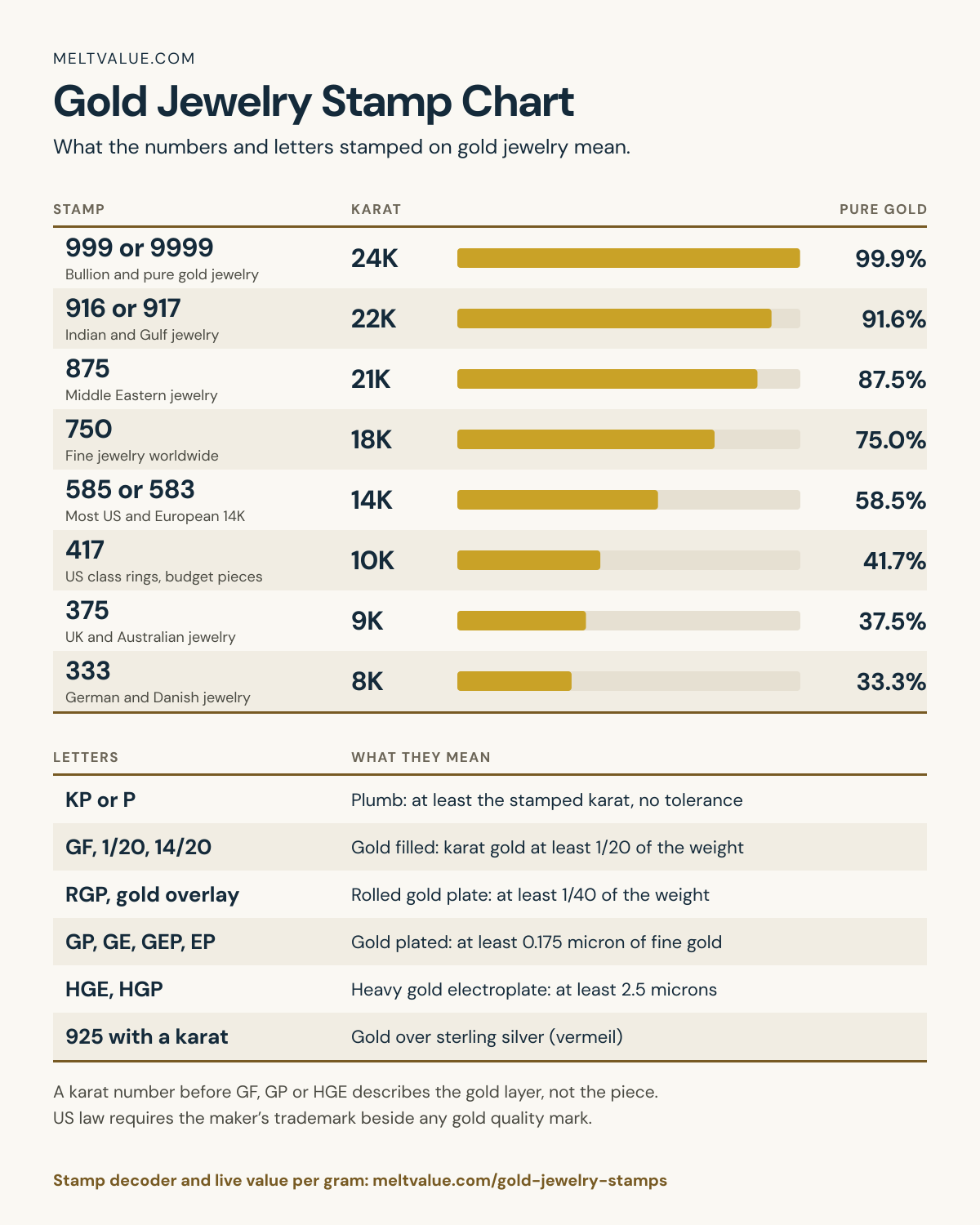
A gold stamp tells you how much of the metal is pure gold. 585 means 58.5% gold, which is 14K. 750 means 75% gold, or 18K, and 375 means 37.5%, or 9K. Letters after a karat number change the meaning. 14K GF and 18K HGE mark base metal with a gold layer, and a KP means the maker guarantees the full karat.
Melt value of the gold in one gram of each alloy, at $3,589.49 an ounce. Updated November 25, 2026 at 5:46 PM EST.
Gold Stamp Decoder
Type the stamp from your ring, chain or clasp, the way it reads, and the weight of the piece. The decoder covers karat and fineness marks, plumb, gold filled and plated marks, and the silver, platinum and palladium numbers that turn up on gold-colored pieces.
Solid 14K gold: 585 parts gold in 1,000, mixed throughout with harder metals.
- Pure gold
- 58.5%
- Melt value per gram
- $67.51
- Gold in 5 g
- 2.93 g
- Melt value of 5 g
- $337.56
A stamp states the minimum the maker promises. It is not a test, and stamps can be faked or worn away. Melt value is the metal at today’s spot price, before any buyer’s margin.
What Does 585 Mean on Gold?
585 is 14K gold. The number is parts per thousand, so a 585 ring is 585 parts gold and 415 parts other metals, mixed together all the way through. At today’s price, one gram of 585 holds $67.51 of gold, and a 5 gram chain holds $337.56.
Fourteen parts in 24 works out to 58.33%, so a few makers stamp 583 instead. 585 is the international standard for 14K and promises slightly more gold. In the US you will see 14K, 14KT and 585 used for the same alloy, sometimes all on one piece. The 14K gold price page has the live price per gram, pennyweight and ounce.
Gold Stamp Chart
| Stamp | Karat | Gold | Per gram |
|---|---|---|---|
| 999 or 9999Bullion bars, coins and pure gold jewelry | 24K | 99.9% | $115.29 |
| 990One of the six UK gold standards (99% gold) | 24K | 99.0% | $114.25 |
| 958Some Asian jewelry | 23K | 95.8% | $110.56 |
| 916 or 917Indian and Gulf jewelry, British 22 carat | 22K | 91.6% | $105.71 |
| 875Middle Eastern jewelry | 21K | 87.5% | $100.98 |
| 833Some Asian and antique pieces | 20K | 83.3% | $96.13 |
| 750Fine jewelry in Italy, France and most of the world | 18K | 75.0% | $86.55 |
| 625British gold made before 1932 | 15K | 62.5% | $72.13 |
| 585European 14K and much US 14K | 14K | 58.5% | $67.51 |
| 58314 ÷ 24 rounded, used by some makers | 14K | 58.3% | $67.28 |
| 500Older pieces and the gold layer in gold filled | 12K | 50.0% | $57.70 |
| 417US class rings and budget jewelry | 10K | 41.7% | $48.12 |
| 375UK and Australian jewelry | 9K | 37.5% | $43.28 |
| 333German and Danish jewelry | 8K | 33.3% | $38.43 |
Melt value of the gold in one gram of each alloy at the stamped fineness. A piece with stones weighs more than its metal, so weigh or estimate the metal alone. The gold karat chart lists every karat with prices per pennyweight and ounce.
How Much Gold Each Stamp Holds
Share of the piece’s metal weight that is pure gold. Gold filled and rolled gold plate figures are the FTC minimums. Electroplated pieces hold far less and don’t fit on this scale.
Karat Marks: K, KT, CT and KP
K and KT both mean karat, a measure out of 24. 14K is 14 parts gold in 24. CT, as in 9ct or 18ct, is the British spelling, carat. The same word measures diamond weight, but a carat stamp on metal always means gold purity.
KP or P means plumb, as in 14KP or 10KP. Plumb gold is guaranteed to meet the stamped karat with no tolerance taken. The mark caught on because US law once let a karat stamp run half a karat short, or a full karat on soldered pieces, so a 14K ring could legally assay closer to 13.5K. The Gold Labeling Act of 1976 tightened that to 3 parts per thousand, or 7 on soldered pieces, starting October 1, 1981. A 14K stamp today has to assay at about 580 or better, or about 576 for a soldered piece, which leaves little room between 14K and 14KP.
Two karat numbers, like 14K/18K, usually mark a piece that combines two alloys, such as an 18K head on a 14K ring. Each part carries its own mark. A karat number beside 925 is different: that piece is sterling silver with gold on top.
Gold Filled and Gold Plated Marks
A karat number followed by GF, RGP, GP, GE or HGE describes a gold layer over base metal, usually brass. These marks follow the FTC Jewelry Guides, revised in 2018. The layer’s karat goes first, so 18K HGE is a heavy electroplated coat of 18K gold, and 1/20 12K GF is gold filled with a 12K layer making up 1/20 of the weight.
| Mark | What it is | FTC minimum |
|---|---|---|
| Gold filledGF, G.F., 1/20 12K GF, 14/20 | A sheet of karat gold bonded over base metal with heat and pressure | At least 10K, and at least 1/20 of the metal weight |
| Rolled gold plate or gold overlayRGP, R.G.P., 1/40 14K RGP | The same bonded construction with a thinner gold layer | At least 10K and 1/40 of the weight, with the fraction stamped when it is under 1/20 |
| Gold platedGP, G.P. | A gold coating applied mechanically or with electric current | At least 10K, and 1/40 of the weight (bonded) or 0.175 micron (electroplated) |
| Gold electroplateGE, GEP, EP | Gold deposited on base metal in a plating bath | At least 10K and 0.175 micron of fine gold, about 7 millionths of an inch |
| Heavy gold electroplateHGE, HGP | A thicker electroplated coat | At least 10K and 2.5 microns of fine gold, about 100 millionths of an inch |
| Gold vermeilVermeil, 925 with a karat mark | Gold over sterling silver | Sterling base, at least 10K gold and 2.5 microns of fine gold |
Gold filled is the only one of these with gold you can sell by weight: a 1/20 14K piece is at least 2.92% pure gold. See gold filled vs gold plated for a gold filled value calculator and how little gold plating holds.
What US Law Says About Gold Stamps
No stamp is required. US law does not make jewelers mark gold at all, and plenty of solid gold carries no mark. The rules apply once a maker chooses to stamp a quality mark.
A trademark has to sit next to the karat. Under the National Gold and Silver Stamping Act, anyone who stamps a gold or silver quality mark must also stamp a registered trademark or name, in letters at least as large and as close to the quality mark as possible. That mark tells you who stands behind the karat. A karat stamp with nothing beside it is a warning sign.
The stamp has to be accurate within 3 parts per thousand. Soldered pieces get 7, with the solder tested as part of the piece. A stamp that overstates the gold by more than that breaks the Stamping Act.
Gold below 24K needs its karat shown. The FTC Guides treat the word gold on its own as a claim of 24K. Since the 2018 revision, gold below 10K, like 9K or 8K, can be called gold too, as long as the karat is shown just as clearly. Before 2018, the FTC set 10K as the lowest alloy that could be called gold.
Solid gold means not hollow. In FTC terms, solid gold describes a piece of any karat whose inside isn’t hollow. A solid 10K ring and a solid 18K ring both qualify.
Rhodium plating should be disclosed. White gold is often plated with rhodium, a bright white metal, and the FTC Guides advise sellers to tell you when a piece sold as precious metal has that coat. The coat can wear off and show the slightly warmer color of the gold below.
Hallmarks on British and European Gold
In the UK, gold over 1 gram can’t legally be sold as gold unless an assay office has tested and hallmarked it. A UK hallmark has three compulsory marks: the sponsor’s mark of the maker or importer, the fineness number, and the mark of the assay office that tested it. A crown for gold and a date letter are optional extra marks.
The UK hallmarks six gold standards: 375, 585, 750, 916, 990 and 999. Countries in the International Hallmarking Convention also strike a Common Control Mark, which member countries accept without testing again. Across most of Europe the fineness number is the main mark, so 18K Italian jewelry reads 750 and 14K reads 585.
When the Stamp Is Missing or Wrong
A missing stamp doesn’t mean fake. Stamps wear off clasps and ring shanks, jewelers cut them out when they resize a ring, and old or handmade pieces were often never marked. A real-looking stamp doesn’t prove gold either, since plated and counterfeit pieces sometimes carry karat marks with no trademark beside them.
Start with a strong magnet. Gold isn’t magnetic, so a piece that snaps to a magnet has iron or steel in it, though plenty of fakes are brass and pass this test. Buyers settle it with an acid test or an electronic tester. Thick gold filled layers can fool a scratch test on the surface, which is why buyers sometimes file a small notch in a hidden spot. The guide to weighing gold at home covers getting an accurate weight first.
What Stamped Gold Sells For
Melt value is the gold content times the spot price. No buyer pays all of it. Pawn shops pay around 50% of melt value at best, and often well below, because precious metals are a sideline next to tools and electronics and the offer has to cover overhead that has nothing to do with metal. Specialist and mail-in gold buyers, where precious metals are the whole business, pay the most for ordinary scrap: roughly 70 to 80% of melt, and 80% is a strong offer rather than a midpoint. A pawn shop near half of melt is a fast-sale price. A specialist buyer around 80% is a strong offer. An advertised number well above that is usually about the buyer’s marketing, not your gold.
Weigh each karat separately and run the numbers in the gold calculator before you take an offer. Designer pieces, antiques and jewelry with good diamonds can sell for more than melt, so get those looked at by a jeweler first.
About the Numbers
Per gram values multiply the stamped fineness by the live gold spot price shown at the top of the page. Gold filled shares are the FTC minimum: the layer’s share of the metal weight times its karat over 24. Silver stamps are covered on what 925 means.
Sources
- eCFR, 16 CFR Part 23, FTC Jewelry Guides: karat marks, gold filled, rolled gold plate, electroplate, heavy electroplate, vermeil and solid gold.
- Federal Register, 2018 revision of the Jewelry Guides: gold below 10K, the 1/40 minimum for bonded plate, the end of "gold flashed" and the rhodium disclosure.
- Cornell Law School, 16 CFR 23.7: disclosing rhodium plating on products sold as precious metal.
- GovInfo, 15 U.S.C. 295 and 296: Stamping Act tolerances for gold and silver and the 1976 amendment.
- Cornell Law School, 15 U.S.C. 297: the trademark that must accompany a gold or silver quality mark, and plated articles.
- FTC, Facts for Consumers: All That Glitters (GovInfo): karat marks not being required by law and the trademark next to the mark.
- MJSA, U.S. Marking and Stamping Regulations: US law not requiring a quality stamp, and the trademark rule.
- GOV.UK, Hallmarking is the law: the compulsory UK marks and the 1 gram threshold for gold.
- legislation.gov.uk, Hallmarking Act 1973, Schedule 2: UK gold standards and the crown mark.
- International Hallmarking Convention, United Kingdom: UK fineness standards and the Common Control Mark.