
How Much Gold Is in Fort Knox?
Fort Knox holds 147,341,858 troy ounces of gold, about 4,583 metric tonnes. That is a little more than half of all the gold the US government owns, and at today's gold price it is worth about $538 billion. The amount stays the same month after month, so only the value moves.
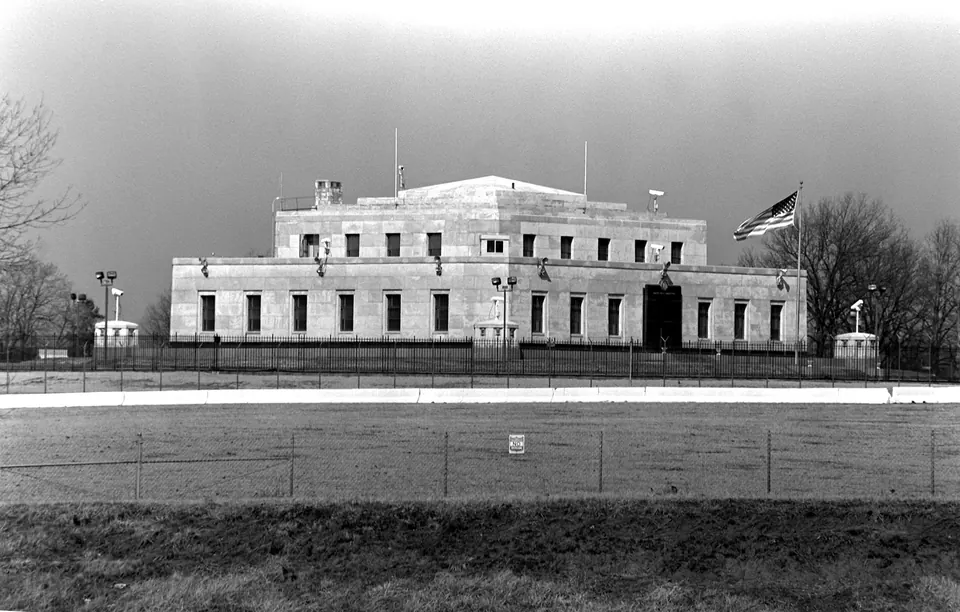
The United States Bullion Depository, known as Fort Knox, is a granite and concrete vault building next to the Army post of Fort Knox, Kentucky. The Treasury built it in 1936 to hold the gold it collected after 1933, and it still holds the largest share of the country's gold. The sections below cover the value, the bar count, the history and the audit record.
01
How much gold is in Fort Knox?
The Treasury publishes the figure every month, down to the thousandth of an ounce: 147,341,858.382 fine troy ounces.
147.3M
Fine troy ounces of gold
US Treasury, Oct. 31, 2026
4,583
Metric tonnes, about 10.1 million pounds
Converted at 32,150.7 oz a tonne
56.3%
Of all US government gold
Out of 261.5 million ounces
"Fine" ounces count only the pure gold. The bars themselves weigh more, because most of them are about 90% gold. The Mint says no gold has gone into or out of the depository for many years, apart from small samples taken to test purity during audits, so the Treasury reports the same figure every month.
02
What the Fort Knox gold is worth
At today's price of $3,654 an ounce, the gold in Fort Knox is worth about $538 billion. On the Treasury's books it is worth far less.
The Treasury values its gold at $42.2222 an ounce, the statutory price Congress set in 1973. At that price Fort Knox is worth $6,221,097,413. The market price is about 87 times higher. The book price is only an accounting figure; nobody can buy or sell gold at it.
The same gold at past prices
The ounce count is the same in every column. Only the gold price changed.
When the vault filled up in 1941, gold was fixed at $35 an ounce, so its roughly 417 million ounces were worth about $14.6 billion. For a single ounce, see the gold spot price page.
04
Fort Knox against whole countries
This one building holds more gold than any country reports owning, apart from the United States itself.
Country totals are official holdings in early 2026, World Gold Council. See the full gold reserves by country ranking.
Germany has the second-largest national reserve, at 3,350 tonnes. Fort Knox holds about 1,230 tonnes more than that. It holds nearly twice as much as Italy, France, Russia or China, and more than four times Switzerland's reserve.
05
How many gold bars are in Fort Knox?
Roughly 420,000 bars, by our estimate. The Treasury does not publish a bar count for Fort Knox alone.
| Fort Knox gold bar | Figure |
|---|---|
| Size | 7 x 3⅝ x 1¾ inches |
| Weight | About 400 troy ounces, or 27.5 pounds |
| Purity | Mostly about 90%; deep storage bars range from 47% to 99.99% |
| Pure gold in an average bar | About 351 troy ounces |
| Value of an average bar today | $1,281,125 |
| Value of 400 oz of pure gold | $1,461,560 |
Size and weight: US Mint. Purity and bar averages: Treasury Inspector General, 2011.
In 2011 the Treasury's Inspector General told Congress that the three deep storage vaults held 699,515 gold bars, with an average purity of 90.06%. Most of that gold came from US gold coins, which were 90% gold, melted down after the government called them in in 1933. Spread over the 245.3 million fine ounces in deep storage, that is about 351 ounces of pure gold per bar. At the same average, Fort Knox's 147.3 million ounces fill about 420,000 bars.
That is an estimate. Fort Knox bars may not match the average across all three vaults. For modern bullion bars, see how much a gold bar weighs and what a gold bar is worth.
06
How Fort Knox filled up, then shrank
Fort Knox once held almost three times as much gold as it does today.
Fine troy ounces. 1937 and 1941 are the amounts shipped in; 1953 is the Treasury's own audit count.
1933 to 1936: a vault for the nation's gold
After 1933 the government required Americans to turn in most of their gold coins, and the Treasury's gold pile grew fast. It needed a safe inland vault. The Army transferred land at Fort Knox in 1935, and the depository was finished in December 1936 for $560,000.
1937: the first gold arrives by mail
From January to June 1937, gold moved from the Philadelphia Mint and the New York Assay Office by registered mail: 39 trains with 215 rail cars, then Army trucks for the last leg. That first wave brought about 157.8 million ounces.
1940 to 1941: the vault fills
A second wave of 45 trains and 337 cars moved another 258.7 million ounces, finishing in March 1941. Fort Knox then held about 417 million ounces, nearly two-thirds of the country's gold.
1950s to 1970s: the gold drains away
After World War II, other countries could swap their dollars for US gold at $35 an ounce, and many did. The US reserve shrank by more than half before President Nixon ended that exchange in 1971. By 1953 Fort Knox was down to 356.7 million ounces, and it now holds 147.3 million. The Mint says no gold has moved in or out for many years.
07
Has the gold been audited?
Yes, many times, but always by government staff and never with every bar counted at once. Critics point to that when they call for a new audit.
| Year | Who checked | What they did |
|---|---|---|
| 1953 | Treasury settlement committee | Opened 3 of 22 sealed compartments, counted about 88,000 bars, weighed about 9,000 and assayed 26. All matched the records. |
| 1974 | GAO, with the Mint | Inventoried 3 of 13 compartments, about 21% of the bars, and observed sample assays. No differences found. |
| 1975 to 1986 | Treasury Committee for Continuing Audit | Audited 97% of the Mint's gold and sealed each compartment it checked with joint seals. |
| 1993 to today | Treasury Office of Inspector General | Annual audit of the Mint's deep storage gold: observes inventories, re-assays random sample bars and inspects the seals. All 42 compartments were sealed by 2008. |
| December 12, 2025 | Treasury Office of Inspector General | Latest annual report: a clean opinion on the Mint's 245.3 million ounces of deep storage gold as of September 30, 2025. |
The 1953 committee wrote that it had no reason to believe a full assay would turn out any differently. Critics say that in recent years the audit has mostly meant checking that compartment seals are intact, and that the auditors work for the same department that holds the gold.
The question flared up again in February 2025, when Elon Musk asked on X who was confirming the gold had not been stolen, and President Trump said he would go and look. Treasury Secretary Scott Bessent answered: We do an audit every year. All the gold is present and accounted for.
In May 2026 Trump posted that it was time to physically audit Fort Knox.
Two bills would require the first full, independent count: the Gold Reserve Transparency Act, introduced in the House by Rep. Thomas Massie as H.R. 3795 on June 6, 2025, and in the Senate by Sen. Mike Lee as S. 3218 on November 19, 2025. Both call for a full assay and inventory of all US government gold, repeated every five years. The House bill went to the Financial Services Committee and has not moved since; the Senate bill went to the Banking Committee.
08
Who has been inside
The Mint permits no visitors, and the depository has never offered a public tour. These are the known exceptions.
| Date | Visitors | What happened |
|---|---|---|
| 1943 | President Franklin Roosevelt | The only sitting president known to have inspected the vault. |
| September 23, 1974 | Members of Congress and reporters, led by Mint Director Mary Brooks | Arranged to answer claims that the vault was empty. |
| August 21, 2017 | Treasury Secretary Steven Mnuchin, Sen. Mitch McConnell and Kentucky Gov. Matt Bevin | The first Treasury Secretary to visit since 1948. |
| August 10, 2026 | Sen. Rand Paul | Went down into the vault and posted afterward: "Yes, the gold is there, all (approximately) 147 million ounces." |
Musk and Trump both talked about going in 2025. Trump told an interviewer in May 2026 that he still wanted to visit someday.
09
How the vault is protected
Few people know the full layout, and the Mint says no single person knows every step needed to open the vault.
The vault door
20 tons
The main door is 21 inches thick and weighs 20 tons. It sits on a time lock, and opening it takes separate combinations dialed by different staff members.
The building
1936
The depository is 105 by 121 feet, built from about 16,500 cubic feet of granite, 4,200 cubic yards of concrete and about 1,420 tons of steel. The two-level vault inside covers less than 4,000 square feet.
Guards and gear
US Mint Police
The US Mint Police guard the site behind fences and razor wire, with night-vision cameras and microphones. The building has its own emergency power and water.
The Army post of Fort Knox sits next door, but the depository belongs to the Treasury, not the Army.
10
What else has been stored there
Fort Knox has guarded more than gold.
| Item | When |
|---|---|
| Declaration of Independence, the Constitution, the Articles of Confederation, a Gutenberg Bible and a Magna Carta copy | December 1941 to 1944, during World War II |
| The Crown of St. Stephen and other Hungarian crown jewels | After World War II until 1978, when they went back to Hungary |
| A national stockpile of opium and morphine | 1955 until the 1990s |
| Ten 1933 Double Eagle gold coins, a 1974-D aluminum cent and twelve gold Sacagawea dollars flown on the Space Shuttle in 1999 | Today |
Frequently Asked Questions
How we work out the figures
We multiply Fort Knox's fine troy ounces from the Treasury's monthly report by the live gold price, refreshed every minute. Tonnes use 32,150.7 troy ounces per metric tonne. The bar count is our estimate from the Inspector General's 2011 bar figures. See the biggest gold heists for gold that really was stolen, and how much gold is in the world for the bigger picture.
Sources
- U.S. Treasury Fiscal Data: Status Report of U.S. Government Gold Reserve: ounces and book value by location, October 31, 2026.
- U.S. Mint: Fort Knox Bullion Depository: bar size and weight, the no-visitors rule and the history timeline.
- Treasury Annual Report, fiscal 1953 (FRASER): the 1953 Fort Knox audit: 22 compartments, 3 opened, about 88,000 bars.
- Treasury Inspector General testimony, June 23, 2011: 699,515 bars, average fineness, the 1974 and 1975 to 1986 audits and how annual audits work.
- GAO testimony GAO-11-768T: the 1974 audit of 3 of 13 Fort Knox compartments.
- Treasury Inspector General report OIG-26-002: the December 12, 2025 audit of the Mint's deep storage gold.
- H.R. 3795, Gold Reserve Transparency Act of 2025: the House bill and its status.
- S. 3218, Gold Reserve Transparency Act: the Senate bill.
- Fortune and the Associated Press, February 21, 2025: the Musk and Trump comments and Bessent's reply.
- TheStreet, May 31, 2026: Trump's post calling to physically audit Fort Knox.
- Benzinga, August 14, 2026: Sen. Rand Paul's August 10, 2026 visit.
- Wikipedia: United States Bullion Depository: construction, shipments, visits and stored items.
- World Gold Council: official gold holdings by country.
Fort Knox holds 147,341,858.382 fine troy ounces of gold (about 4,583 tonnes), 56.3% of US government gold, per the US Treasury. At $3,654 an ounce on November 28, 2026 at 2:55 PM EST, it was worth about $538 billion. Source: MeltValue.