
Melting Point of Brass
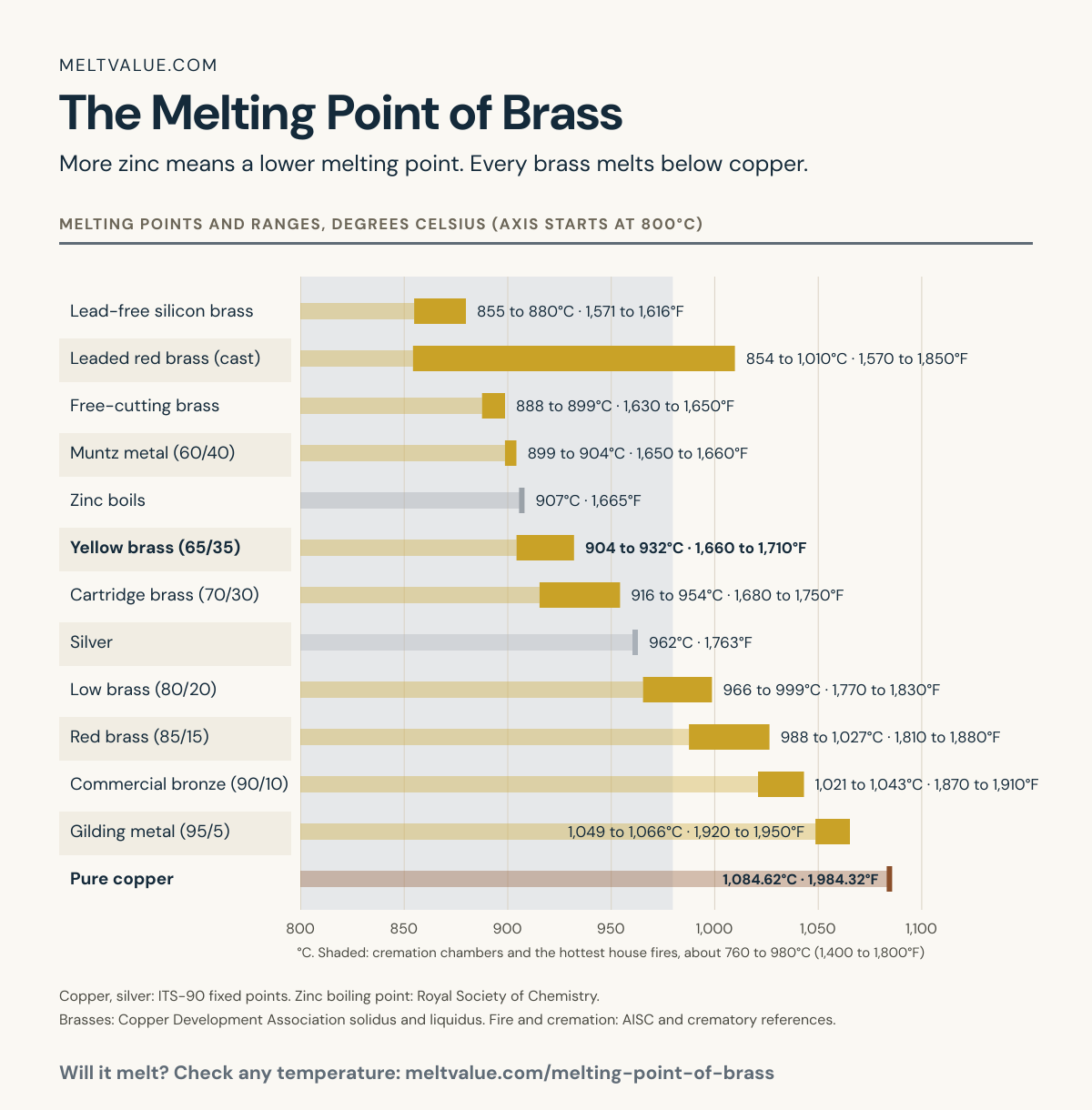
Common yellow brass melts at about 900 to 940°C (1,650 to 1,720°F). Brass as a whole spans a much wider range, from about 855°C for lead-free silicon brass to 1,066°C for 95/5 gilding metal. The rule is simple: the more zinc, the lower the melting point, and every brass melts below pure copper’s 1,084.62°C.
Will It Melt? Check Any Temperature
Enter a temperature or tap a preset to see which brasses would melt.
At 1,700°F (927°C)
- Lead-free silicon brass (1,571 to 1,616°F)Melts
- Free-cutting brass (1,630 to 1,650°F)Melts
- Muntz metal (60/40) (1,650 to 1,660°F)Melts
- Yellow brass (65/35) (1,660 to 1,710°F)Starts to melt
- Cartridge brass (70/30) (1,680 to 1,750°F)Starts to melt
- Red brass (85/15) (1,810 to 1,880°F)Stays solid
- Gilding metal (95/5) (1,920 to 1,950°F)Stays solid
- Pure copper (1,984.32°F)Stays solid
At this temperature zinc is past its 907°C boiling point, so any molten brass is giving off zinc fumes.
Ranges are Copper Development Association values; each batch melts a little differently. "Starts to melt" means the alloy has passed its solidus, the point where the first liquid forms.
Melting Point of Brass by Alloy
Every brass melts over a range: it starts to liquefy at the lower number (the solidus) and is fully liquid at the higher one (the liquidus). The usual "900 to 940°C" fits the yellow brasses with 30 to 40% zinc. Brasses with more copper melt much hotter, and the lead-free silicon brasses now used in plumbing melt lower.
| Wrought brass | Melting range |
|---|---|
| Gilding metal (C21000)95% copper, 5% zinc. | 1,049 to 1,066°C1,920 to 1,950°F |
| Commercial bronze (C22000)90% copper, 10% zinc (a brass, despite the name). | 1,021 to 1,043°C1,870 to 1,910°F |
| Red brass (C23000)85% copper, 15% zinc. | 988 to 1,027°C1,810 to 1,880°F |
| Low brass (C24000)80% copper, 20% zinc. | 966 to 999°C1,770 to 1,830°F |
| Admiralty brass (C44300)About 71% copper, 28% zinc, 1% tin. | 899 to 938°C1,650 to 1,720°F |
| Cartridge brass (C26000)70% copper, 30% zinc. | 916 to 954°C1,680 to 1,750°F |
| Yellow brass (C27000)65% copper, 35% zinc. | 904 to 932°C1,660 to 1,710°F |
| Low-leaded brass (C33000)About 66% copper, 33.5% zinc, 0.5% lead. | 904 to 938°C1,660 to 1,720°F |
| High-leaded brass (C35300)About 62% copper, 36% zinc, 2% lead. | 888 to 910°C1,630 to 1,670°F |
| Free-cutting brass (C36000)About 61.5% copper, 35.5% zinc, 3% lead. | 888 to 899°C1,630 to 1,650°F |
| Muntz metal (C28000)60% copper, 40% zinc. | 899 to 904°C1,650 to 1,660°F |
| Naval brass (C46400)About 60% copper, 39.2% zinc, 0.8% tin. | 888 to 899°C1,630 to 1,650°F |
| Architectural bronze (C38500)About 57% copper, 40% zinc, 3% lead (a brass). | 877 to 888°C1,610 to 1,630°F |
| Lead-free silicon brass (C69300)About 75% copper, 21% zinc, 3% silicon. | 855 to 880°C1,571 to 1,616°F |
| Cast brass | Melting range |
|---|---|
| Leaded red brass (85-5-5-5) (C83600)85% copper, 5% each tin, lead and zinc. | 854 to 1,010°C1,570 to 1,850°F |
| Leaded semi-red brass (81-3-7-9) (C84400)81% copper, 3% tin, 7% lead, 9% zinc. | 843 to 1,004°C1,549 to 1,840°F |
| Leaded yellow brass (C85200)About 72% copper, 24% zinc, 3% lead, 1% tin. | 927 to 941°C1,700 to 1,725°F |
| Leaded naval brass (C85700)About 63% copper, 35% zinc, 1% lead, 1% tin. | 913 to 941°C1,675 to 1,725°F |
| Manganese bronze (high-strength yellow brass) (C86300)About 63% copper, 25% zinc with aluminum, iron and manganese. | 885 to 923°C1,625 to 1,693°F |
| Silicon brass (C87500)About 82% copper, 14% zinc, 4% silicon. | 821 to 916°C1,510 to 1,680°F |
| Lead-free silicon brass (cast) (C87850)About 76% copper, 21% zinc, 3% silicon. | 855 to 880°C1,571 to 1,616°F |
Solidus and liquidus from the Copper Development Association, published in °F; Celsius converted and rounded. Wrought alloys roughly in order of falling copper content.
Zinc Content Sets the Melting Point
Zinc melts at 420°C and copper at 1,084.62°C, so every bit of zinc added to copper pulls the melting point down. The straight copper-zinc brasses show it step by step. Gilding metal (5% zinc) is fully liquid at 1,066°C, red brass (15%) at 1,027°C, low brass (20%) at 999°C, cartridge brass (30%) at 954°C, yellow brass (35%) at 932°C and Muntz metal (40%) at 904°C.
Zinc also changes the metal itself. The Copper Development Association explains that brass with up to about 35% zinc is a single phase, called alpha brass, which is easy to cold work, and its color shifts from red toward golden yellow as zinc rises. Between about 32 and 39% zinc a second, harder beta phase appears, and above 39%, as in Muntz metal, beta dominates. Brasses with more than 15% zinc are also more prone to stress corrosion cracking.
Lead and tin pull the start of melting down further. Cast leaded red brass (85-5-5-5) starts melting at 854°C even though it is fully liquid at 1,010°C, a range of more than 150°C.
Why Molten Brass Fumes
Zinc boils at 907°C, right in the middle of brass’s melting range. As brass melts, zinc evaporates from the surface and burns into a white smoke of zinc oxide. Chemist and author Theodore Gray notes that zinc vapor near brass melting temperatures is about 2,500 times what it is over just-molten zinc, which is why brass fumes and zinc alone at 420°C hardly does. The fumes should not be breathed: melt brass outdoors or under strong ventilation, and avoid overheating it.
Overheating also changes the alloy. Every bit of zinc that boils off leaves the melt richer in copper, which raises its melting point and changes its color. That is why brass founders keep the melt covered. Spon’s Workshop Receipts, a 19th-century trade manual, advises covering molten brass with fine charcoal or borax to keep it from burning and hold zinc loss to a minimum, and in one series of trials two inches of charcoal powder cut the loss to about 1/180 per casting.
Lead-Free Brass
Traditional free-cutting and red brasses contain lead to make them easier to machine and cast. Since 2014, US rules limit drinking-water plumbing to a weighted average of 0.25% lead on wetted surfaces, so faucets and fittings have moved to lead-free brasses. The silicon brasses that replaced them, such as C69300 and C87850, melt lower than most traditional brasses, at about 855 to 880°C.
Does Brass Melt in a Fire?
It depends on the brass and the fire. The American Institute of Steel Construction says fully developed building fires rarely top 1,800°F (982°C), with average gas temperatures below 1,500°F (816°C). That can melt yellow brass, which is fully liquid near 932°C, but usually not red brass or gilding metal. Cremation chambers run at about 760 to 980°C, so yellow brass items can melt there too.
Brass vs. Copper and Other Metals
Common yellow brass melts about 150°C below copper and close to silver, which melts at 961.78°C. Bronze, the copper-tin family, melts in a similar range and is covered on the melting point of copper page, along with copper wire and cupronickel.
| Metal | °C | °F |
|---|---|---|
| TinITS-90 fixed point | 231.928 | 449.5 |
| LeadIn leaded brasses | 327.462 | 621.4 |
| ZincITS-90 fixed point; boils at 907°C | 419.527 | 787.1 |
| AluminumITS-90 fixed point | 660.323 | 1,220.6 |
| SilverITS-90 fixed point | 961.78 | 1,763.2 |
| GoldITS-90 fixed point | 1,064.18 | 1,947.5 |
| CopperITS-90 fixed point | 1,084.62 | 1,984.3 |
| IronSteel melts lower, depending on carbon | 1,538 | 2,800.4 |
Royal Society of Chemistry and ITS-90 values. See the melting points of aluminum, silver and gold.
What the Metal in Brass Is Worth
Metal value at spot prices of $5.55 per pound for copper and $1.61 for zinc, updated November 27, 2026 at 12:57 PM EST. Scrap yards pay well below metal value. See today’s brass price per pound and scrap copper prices.
Sources
- Copper Development Association: Copper alloys advanced search: solidus and liquidus for C21000, C22000, C23000, C24000, C26000, C27000, C28000, C33000, C35300, C36000, C38500, C44300, C46400, C69300, C83600, C84400, C85200, C85700, C86300, C87500 and C87850
- Copper Development Association: Microstructure of brasses: single-phase alpha brass up to about 35% zinc, two-phase alpha-beta brass at 32 to 39% zinc, mostly beta above 39%, color shifting from red to golden yellow with more zinc, and stress corrosion cracking above 15% zinc
- Wikipedia: Brass: the commonly quoted 900 to 940°C (1,650 to 1,720°F) melting range
- Royal Society of Chemistry: Zinc: zinc melting at 419.527°C and boiling at 907°C (1,665°F)
- Royal Society of Chemistry: Copper: copper melting at 1,084.62°C (1,984.32°F)
- Theodore Gray: The Safety of Zinc Casting: melting brass generating large amounts of zinc oxide fumes because brass melts close to zinc’s boiling point, and zinc vapor near brass temperatures being about 2,500 times that of just-molten zinc
- Spon’s Workshop Receipts: Melting brass: a cover of fine charcoal or borax keeping the melt from burning and holding zinc loss to a minimum
- Holtzapffel: Management of the furnace and mixing alloys: Lord Oxmantown’s trials, in which two inches of charcoal powder cut zinc loss to about 1/180 per casting
- US EPA: Use of lead-free pipes, fittings, fixtures, solder and flux for drinking water: the 0.25% weighted-average lead limit on wetted surfaces of drinking-water plumbing
- AISC: General fire science: fully developed building fires rarely above 1,800°F, with average gas temperatures below 1,500°F
- Wikipedia: Crematory: main cremation chambers at 760 to 980°C (1,400 to 1,800°F)
- Royal Society of Chemistry: Periodic table: melting points of tin, lead, aluminum and iron