
Melting Point of Aluminum
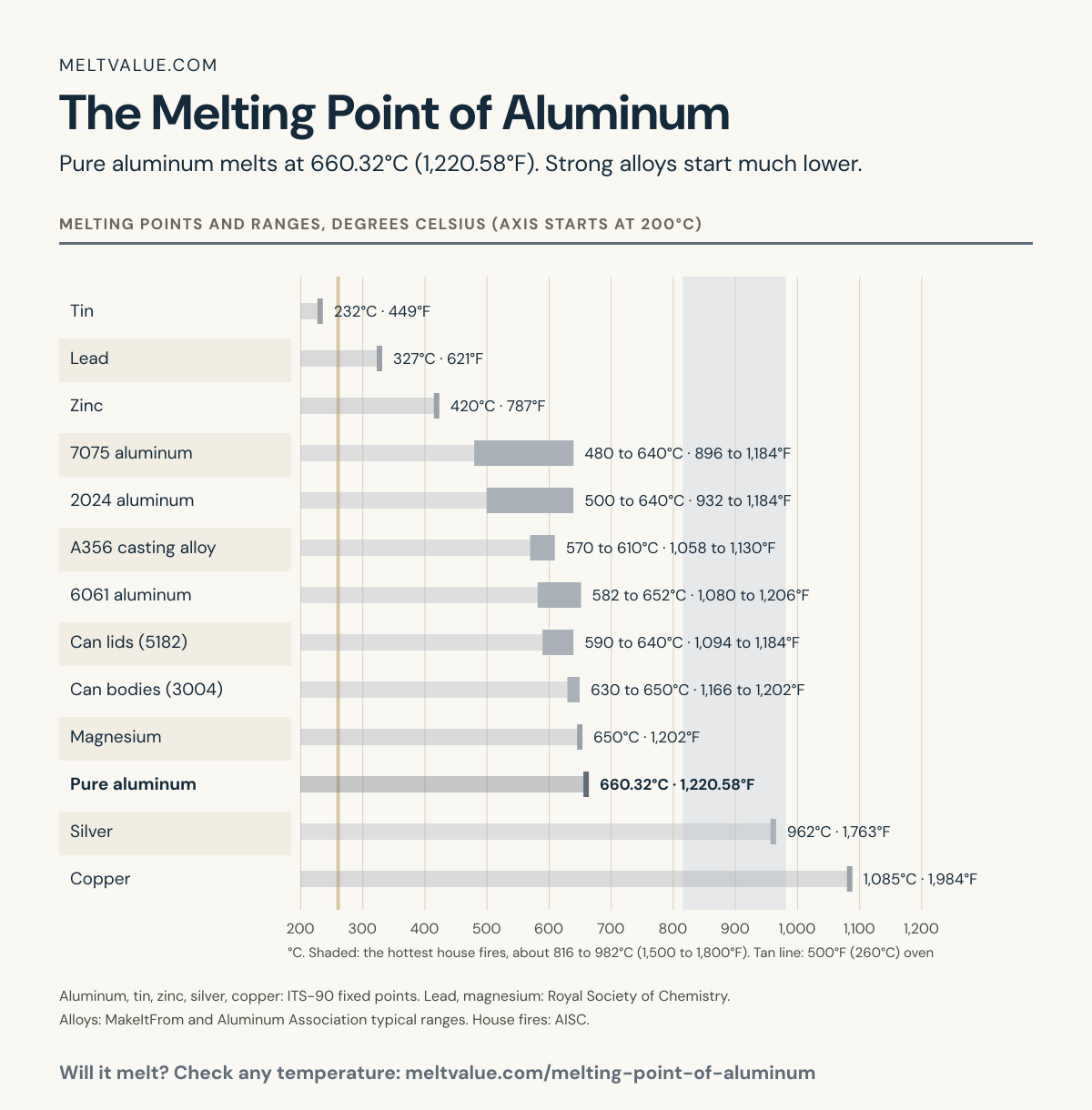
Pure aluminum melts at 660.32°C (1,220.58°F). That is 933.47 kelvins, one of the fixed points thermometers are calibrated to. Aluminum alloys melt over a range: most finish melting between 610 and 660°C, but strong alloys such as 6061 start near 580°C and 7075 near 480°C.
Aluminum $1.26 per pound, updated November 27, 2026 at 12:57 PM EST.
Will It Melt? Check Any Temperature
Enter a temperature or tap a preset to see which aluminum alloys and other metals would melt.
At 1,220.58°F (660°C)
- 7075 aluminum (896 to 1,184°F)Melts
- 2024 aluminum (932 to 1,184°F)Melts
- 6061 aluminum (1,080 to 1,206°F)Melts
- Can lids and tabs (5182) (1,094 to 1,184°F)Melts
- Can bodies (3004) (1,166 to 1,202°F)Melts
- Pure aluminum and foil (1,220.58°F)Melts
- Silver (1,763.20°F)Stays solid
- Copper (1,984.32°F)Stays solid
Alloy ranges are typical; each batch melts a little differently. "Starts to melt" means the alloy has passed its solidus, the point where the first liquid forms.
Melting Point of Aluminum Alloys
Aluminum alloys are named by series: 1000 is nearly pure, 3000 adds manganese, 5000 magnesium, 6000 magnesium and silicon, 2000 copper and 7000 zinc. Every alloy melts over a range, from the solidus, where the first liquid forms, to the liquidus, where it is fully liquid.
| Aluminum | Melting range |
|---|---|
| Pure aluminum99.99%+ aluminum. One exact point, the ITS-90 aluminum point. | 660.32°C1,220.58°F |
| 135099.5% aluminum. Electrical conductor grade. | 650 to 660°C1,202 to 1,220°F |
| 110099% aluminum. Commercially pure. | 640 to 660°C1,184 to 1,220°F |
| 3003Aluminum with about 1.2% manganese. General sheet, cookware. | 640 to 650°C1,184 to 1,202°F |
| 3004Aluminum with manganese and about 1% magnesium. Beverage can bodies. | 630 to 650°C1,166 to 1,202°F |
| 6063Aluminum with magnesium and silicon. Extrusions such as window frames. | 620 to 650°C1,148 to 1,202°F |
| 5052Aluminum with about 2.5% magnesium. Marine and sheet work. | 610 to 650°C1,130 to 1,202°F |
| 6061Aluminum with magnesium and silicon. General structural alloy; the Aluminum Association typical range is 582 to 652°C. | 580 to 650°C1,076 to 1,202°F |
| 5182Aluminum with 4 to 5% magnesium. Beverage can lids and tabs. | 590 to 640°C1,094 to 1,184°F |
| 2024Aluminum with about 4.4% copper. Aircraft structures. | 500 to 640°C932 to 1,184°F |
| 7075Aluminum with zinc, magnesium and copper. High-strength aircraft and sporting parts. | 480 to 640°C896 to 1,184°F |
| 356.0 casting alloyAluminum with about 7% silicon. Sand and permanent-mold castings. | 570 to 620°C1,058 to 1,148°F |
| A356.0 casting alloyAluminum with about 7% silicon, low iron. Cast wheels and structural castings. | 570 to 610°C1,058 to 1,130°F |
Alloy ranges from MakeItFrom, rounded to the nearest 10°C; Fahrenheit converted. Wrought alloys first, then casting alloys.
Look at where melting finishes and the alloys barely differ: almost all are fully liquid between 610 and 660°C. Where melting starts is a different story. Copper in 2024 and zinc in 7075 form low-melting phases between the grains, so those alloys begin to melt around 480 to 500°C, more than 150°C below pure aluminum. That matters for anyone welding, heat treating or melting mixed scrap: the strongest alloys go soft first.
Melting Aluminum Cans
An aluminum drink can is two alloys. The body is 3004, which melts at about 630 to 650°C, and the lid and tab are 5182, a harder alloy with 4 to 5% magnesium that starts melting near 590°C. An empty can weighs about 14 grams, so there are roughly 34 cans in a pound, about $1.26 of aluminum at the spot price, or 3.7¢ a can. Scrap yards pay a fraction of spot.
The real hazard is water, not heat. Any liquid left in a can, or damp scrap dropped into molten aluminum, flashes to steam and expands about 1,600 times. The scrap recycling industry’s association reports steam pockets throwing molten aluminum up to 30 feet. Cans must be empty and bone dry, and molds and tools preheated, before they touch the melt. See the aluminum price per pound for what scrap is worth.
The Oxide Skin That Melts at 2,072°C
Any fresh aluminum surface grows a layer of aluminum oxide about 4 nanometers thick almost instantly, and that oxide melts at 2,072°C, more than three times hotter than the metal under it. It is why molten aluminum wears a dull skin that has to be skimmed off before pouring, and the same layer protects solid aluminum from further corrosion in everyday use.
Does Aluminum Melt in a Fire or an Oven?
In an oven, no. Household foil is generally 99.8 to 99.9% aluminum and melts near 660°C (1,220°F), more than twice the 500°F of a hot kitchen oven. In a house fire, often yes. The American Institute of Steel Construction says fully developed building fires rarely top 1,800°F (982°C), with average gas temperatures below 1,500°F (816°C). Both are well past aluminum’s 1,220°F. Aluminum window frames, wheels, lawn furniture and appliance parts commonly melt where copper and steel survive.
Why Aluminum Is Made With Electricity, Not Smelted
Aluminum melts at a low temperature, but getting it out of its ore is another matter. Aluminum oxide melts at 2,072°C and is impractical to smelt with heat alone, the way iron and copper are made. Until 1886 that made aluminum a semiprecious metal, priced like silver. On February 23, 1886, Charles Martin Hall in Ohio produced aluminum by passing electric current through aluminum oxide dissolved in molten cryolite, and Paul Héroult found the same process in France that year. The Hall-Héroult process cut the cost of aluminum by two orders of magnitude and remains the main way new aluminum is made.
Remelting scrap skips that electricity-hungry step. The Aluminum Association says recycled aluminum takes 95% less energy to make than new aluminum, and recycled metal now makes up 80% of US aluminum production.
Aluminum vs. Other Metals
Aluminum melts about 300°C below silver, 424°C below copper and 878°C below iron, and only about 10°C above magnesium. Zinc, lead and tin melt lower.
| Material | °C | °F |
|---|---|---|
| TinITS-90 fixed point | 231.928 | 449.5 |
| Lead | 327.462 | 621.4 |
| ZincITS-90 fixed point | 419.527 | 787.1 |
| MagnesiumAlloying metal in 5000 and 6000 series | 650 | 1,202 |
| AluminumITS-90 fixed point | 660.323 | 1,220.6 |
| SilverITS-90 fixed point | 961.78 | 1,763.2 |
| GoldITS-90 fixed point | 1,064.18 | 1,947.5 |
| CopperITS-90 fixed point | 1,084.62 | 1,984.3 |
| IronSteel melts lower, depending on carbon | 1,538 | 2,800.4 |
| Aluminum oxide (alumina)The skin on every piece of aluminum | 2,072 | 3,761.6 |
Royal Society of Chemistry and ITS-90 values; aluminum oxide from Wikipedia. See the melting points of copper, silver and gold.
Boiling Point of Aluminum
Aluminum boils at about 2,519°C (4,566°F), according to the Royal Society of Chemistry. Liquid aluminum stays liquid across nearly 1,860°C before it boils.
What Aluminum Is Worth, Solid or Molten
At the aluminum spot price of $1.26 per pound, updated November 27, 2026 at 12:57 PM EST. Scrap yards pay less than spot, and less again for mixed or dirty scrap.
Sources
- Royal Society of Chemistry: Aluminium: melting point 660.323°C (1,220.581°F, 933.473 K), boiling point 2,519°C (4,566°F) and density 2.70 g/cm³
- Omega Engineering: The International Temperature Scale of 1990: the aluminum freezing point as an ITS-90 defining fixed point
- MakeItFrom: Aluminum alloy data: melting onset and completion for 1350, 1100, 3003, 3004, 5052, 5182, 6061, 6063, 2024, 7075, 356.0 and A356.0
- Kaiser Aluminum: Alloy 6061 technical data: 6061 melting range of 582 to 652°C (1,080 to 1,206°F)
- Wikipedia: Drink can: can bodies in 3004 alloy and tops in harder 5182, about 14 grams per empty can and 34 cans to a pound
- European Patent EP 2941491: Aluminum alloys for beverage containers: 3004 for can body stock and 5182, with 4 to 5% magnesium, for end and tab stock
- Wikipedia: Aluminium oxide: melting point 2,072°C and a roughly 4 nm oxide layer forming on exposed aluminum almost instantly
- Encyclopedia.com: Aluminum Foil: foil made from alloys of 92 to 99% aluminum, generally 99.8 or 99.9% pure
- ISRI: Molten Aluminum Safety: water in scrap and beverage containers forming steam pockets that have thrown molten aluminum up to 30 feet
- UK Health and Safety Executive: Molten metal/water explosions: wet scrap as one of the most common causes of molten metal explosions, and keeping scrap dry and checked
- Foundry Management & Technology: Molten metal splash and furnace safety: water expanding to 1,600 times its volume as steam on contact with molten metal
- AISC: General fire science: fully developed building fires rarely above 1,800°F, with average gas temperatures below 1,500°F
- American Chemical Society: Production of Aluminum, the Hall-Héroult Process: Charles Martin Hall producing aluminum on February 23, 1886 from aluminum oxide in molten cryolite, and aluminum’s earlier price, comparable to silver
- Physics Today: Hall-Héroult process: aluminum oxide being impractical to smelt by heat alone, and production cost falling by two orders of magnitude
- EBSCO Research Starters: Charles Martin Hall: the Hall-Héroult process remaining the primary method of aluminum production
- The Aluminum Association: Recycling: recycled aluminum saving 95% of the energy needed to make new aluminum, and making up 80% of US production
- Royal Society of Chemistry: Periodic table: melting points of tin, lead, zinc, magnesium and iron