
Catalytic Converter Scrap Value
A scrap catalytic converter sells for $13 to $510 in November 2026, depending on its grade. Common factory converters list at $40 to $225, and aftermarket replacements at about $14. The money is in a few grams of palladium, rhodium and platinum coated on the ceramic inside. At today’s prices, the metal in an average car’s converters is worth $213 in full, and a buyer pays you part of that.
Grade prices: national reference list, November 19, 2026. Metal: the DOE estimate for an average 2011 gasoline car at today’s prices, updated November 26, 2026 at 8:47 AM EST.
Catalytic Converter Scrap Prices by Type
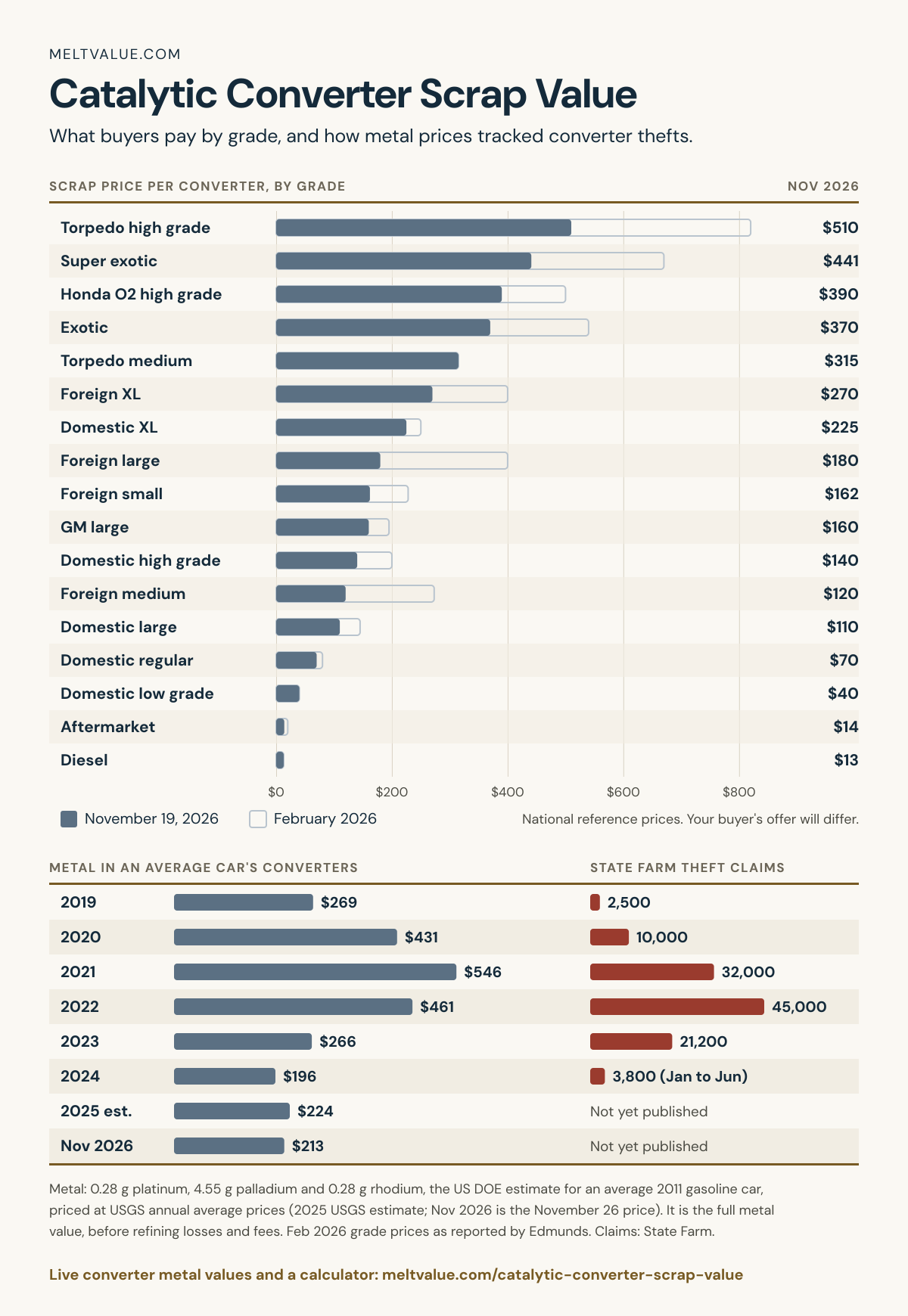
Buyers sort converters into grades by the code stamped on the shell, then pay a set price for each grade. Here is the national reference list for November 19, 2026, next to the same grades in February. Most grades fell over those nine months as rhodium and palladium came off their winter highs.
| Grade | Nov 2026 | Change |
|---|---|---|
| Torpedo high gradeRound, torpedo-shaped units; Edmunds ties this grade to large Ford vehicles | $510 | -38% |
| Super exotic | $441 | -34% |
| Honda O2 high grade | $390 | -22% |
| Exotic | $370 | -31% |
| Torpedo special | $370 | -21% |
| Exotic small | $319 | n/a |
| Torpedo medium | $315 | No change |
| Foreign XL | $270 | -32% |
| Honda O2 regular | $240 | -20% |
| Domestic XL | $225 | -10% |
| Foreign large | $180 | -55% |
| Foreign small | $162 | -29% |
| GM largeGeneral Motors units | $160 | -18% |
| Volvo special | $150 | No change |
| Domestic high grade | $140 | -30% |
| Foreign medium | $120 | -56% |
| GM medium | $120 | -20% |
| CamryToyota Camry units | $115 | n/a |
| Torpedo regular | $115 | -4% |
| Domestic large | $110 | -24% |
| Jeep | $90 | -10% |
| GM regular | $85 | -29% |
| Domestic regular | $70 | -12% |
| Torpedo low grade | $70 | No change |
| Foreign low grade | $65 | -58% |
| GM low grade | $50 | -23% |
| High grade pre-catPre-cats are small converters mounted close to the engine | $45 | -31% |
| Domestic low grade | $40 | No change |
| Ford low grade | $40 | No change |
| Foreign pre-cat | $40 | -66% |
| Regular pre-cat | $35 | -22% |
| Low grade pre-cat | $25 | -62% |
| AftermarketReplacement converters not made by the carmaker | $14 | -30% |
| Diesel | $13 | No change |
Prices per converter. The November list is a national reference compiled from recycler and dealer transactions; February prices as reported by Edmunds. Local buyers set their own prices, so your offer can land above or below these.
Grade names come from the scrap trade, and buyers don’t all use the same ones. A price list can’t tell you which grade yours is. The code on the shell can.
How to Find Your Converter’s Grade
- Find the code. Look for numbers and letters stamped or etched into the metal shell, sometimes on the heat shield. A wire brush clears off rust. Factory units carry the carmaker’s part number, and buyers grade from it.
- Check for an aftermarket label. A legal aftermarket converter carries an EPA label in the format N/XX/YYYY/ZZZZ, with U in place of the N for a used unit and CA for one made for California. A label like that means you have an aftermarket unit at the bottom of the price list.
- Note the vehicle. Year, make, model and engine help a buyer grade a unit whose code has worn off.
- Take photos. Shoot the code and the whole converter, both ends included. Many buyers quote from photos.
Catalytic Converter Metal Value Calculator
Start from an average car, or type the grams yourself. If you have assay results in ppm, switch to assay mode. Prices update live.
| Metal | Grams | Value |
|---|---|---|
| Palladium | 4.55 | $128.50 |
| Rhodium | 0.28 | $72.62 |
| Platinum | 0.28 | $11.72 |
| Full metal value | 5.11 | $212.83 |
What a refiner returns, before fees
$181 to $203
Refiners commonly return 90% to 98% of the platinum and palladium they measure and 75% to 90% of the rhodium, then charge refining fees. A buyer paying per piece offers less than this, since it also covers its margin and the risk that your unit holds less than average.
Platinum $1,301, palladium $878 and rhodium $8,066 per troy ounce, updated November 26, 2026 at 8:47 AM EST. Assay mode: grams = kilograms of catalyst × ppm ÷ 1,000.
How Much Precious Metal Is in a Catalytic Converter?
Not much. The US Department of Energy estimated that an average gasoline car built in 2011 carried 5.1 grams of platinum group metals across its converters: 4.55 grams of palladium and 0.28 gram each of platinum and rhodium. Its estimate for 2020 models rose to 6.75 grams as emission rules tightened. Diesel cars carry more, about 10 grams, and most of it is platinum.
| Average car | Total | Worth today |
|---|---|---|
| Gas car, 2011Average US gasoline car of that model year | 5.12 g | $213 |
| Gas car, 2020Tighter emission rules raised the load | 6.75 g | $284 |
| Gas car, 2025DOE projection | 6.21 g | $261 |
| Diesel car, 2011Diesel catalysts run mostly on platinum | 10.10 g | $479 |
| Diesel car, 2025DOE projection | 8.51 g | $400 |
Grams for the whole emission system of an average US car, DOE medium case, with totals as DOE published them. Full metal value at today’s prices, before refining.
Real converters spread wide around those averages. Thermo Fisher Scientific, which makes XRF analyzers for converter testing, puts the recoverable metal at 1 to 2 grams for a small car and 12 to 15 grams for a big truck. It also says most converters recycled today come off cars built 10 to 15 years earlier, which is why the 2011 figures are the better guide to what is in a scrap converter now. A 2020 study of three used gasoline converters measured 6 to 511 parts per million of platinum in the catalyst, 0.5 to 2,507 ppm of palladium and 0.1 to 312 ppm of rhodium, with the newer units using palladium in place of platinum.
Rhodium is the smallest share by weight and the priciest per gram. Today it costs 9.2 times as much as palladium, so the 0.28 gram in an average 2011 car is worth $73, against $129 for its 4.55 grams of palladium. See the live rhodium price, palladium price per gram and platinum price per gram.
All those small amounts add up. US recyclers recovered about 50,000 kilograms of palladium and 8,600 kilograms of platinum from scrapped converters in 2025, according to the US Geological Survey. US mines produced an estimated 6,200 kilograms of palladium that year.
Why Scrap Converter Prices Move
Converter prices follow the metal. Rhodium averaged $20,254 an ounce in 2021 and palladium $2,419, according to the US Geological Survey. At those prices the metal in an average 2011 car’s converters was worth about $546. By 2024 rhodium averaged $4,660 and palladium $995, and the same metal came to $196.
Prices climbed again in 2025. USGS estimates platinum averaged 25% more than in 2024, rhodium 24% more and palladium 11% more. It ties the gains to lower mine output, more rhodium use in hard disks and chemical catalysts, and carmakers putting platinum in place of palladium in some catalysts. Rhodium hit $12,250 on February 25, 2026, its high for the past year, and now sits near $8,066. Grade prices fell with it: torpedo high grade went from $820 in February to $510 in November, and foreign large from $400 to $180.
Thefts tracked the same curve. State Farm’s converter theft claims rose from 2,500 in 2019 to 45,000 in 2022, then fell to 21,200 in 2023 and about 3,800 in the first half of 2024. Kelley Blue Book, reporting National Insurance Crime Bureau figures, points to public awareness, police crackdowns on theft rings, new state laws and lower metal prices.
How Buyers Price a Converter
By the piece. A scrap yard or converter buyer reads the code, assigns a grade and pays that grade’s price on the spot. That is how a single converter usually sells. The buyer carries the risk that your unit holds less metal than the grade assumes, and prices that risk in.
By assay. A processor cuts open the shell and removes the ceramic, a step called decanning. The ceramic is ground, sampled and tested for platinum, palladium and rhodium, often with XRF. You get paid on the metal measured: catalyst weight times parts per million, times the share the refiner returns, minus fees. Assay deals suit lots of dozens or hundreds of converters, and many refiners set minimum lot sizes. The assay mode in the calculator runs this math.
How to Get the Most for a Scrap Catalytic Converter
- Keep it whole. Buyers grade by the code on the shell. A cut or crushed unit, or a bucket of loose ceramic, can’t be graded the same way and gets bought by weight or assay.
- Get two or three quotes. Send the same photos of the code and the unit to each buyer. Offers for the same grade differ from buyer to buyer.
- Ask how they price it. Per piece by code, or by assay? A buyer who explains its grading is easier to compare.
- Watch metal prices. A converter is worth more in a week when palladium and rhodium are up. The calculator above shows today’s metal value.
- Bring paperwork. Photo ID plus a title, registration or repair invoice that shows where the converter came from. Many states require it.
- Sell in bulk if you can. Shops and dismantlers with dozens of converters can ask for assay settlement, which pays on the metal actually measured.
Is It Legal to Sell a Catalytic Converter?
Yes, if it’s yours and it came off for a legal reason, such as a replacement or a scrapped car. Expect paperwork. After the theft wave, state after state tightened the rules on converter sales, and NICB counted 21 states that passed converter theft laws in 2023 alone.
Nevada’s 2023 law, SB 243, shows what the stricter states ask. Unless the seller is a wrecker, dealer, licensed processor or similar business, the buyer needs proof of ownership, such as a title or registration with a VIN that matches the converter. The buyer records the seller’s ID, photographs the seller and the converter, keeps the records for two years and pays by check or electronic transfer, never cash. Texas made buying or selling a stolen converter a third-degree felony in 2021 and requires sellers to show proof of ownership to metal recyclers. Check your own state’s rules before you go.
Taking a working converter off a car you still use is a separate problem. Under the Clean Air Act no one may remove a converter and replace it with a straight pipe, owners included. EPA allows an aftermarket replacement only when the old converter is missing, has failed a state or local inspection, or has a documented failure on a car more than 5 years old or past 50,000 miles (8 years or 80,000 miles for 1995 and newer models).
What a New Catalytic Converter Costs
Replacing a converter costs far more than the old one brings. Edmunds, citing RepairPal, puts a typical replacement at $2,164 to $2,483 with labor and says a factory part can cost 40% to 70% more than an aftermarket one. Cox Automotive puts the average dealer replacement near $2,300. State Farm’s average converter theft claim was about $2,900 in 2023 and the first half of 2024.
A legal aftermarket converter carries the EPA label described above. Units made for California carry CA in place of the N and meet that state’s stricter rules.
Catalytic Converter Theft
A thief can cut a converter off in as little as 90 seconds, the Congressional Research Service reported in 2021, and sell it for $25 to $500. NICB counted more than 64,000 thefts in 2022, the peak, and 14,036 in 2024, down 68% from 2023. Nearly two-thirds of the 2024 thefts reported to NICB happened in California. Insurance covers a stolen converter only if you carry comprehensive coverage.
State Farm suggests parking in a garage or a well-lit spot, adding an alarm and engraving your VIN on the converter. A marked converter is harder to sell, and in Nevada a private seller needs a title or registration whose VIN matches the mark on the converter.
Sources
- Edmunds: How much does it cost to replace a catalytic converter?: scrap prices by grade as of February 2026, replacement at $2,164 to $2,483 with labor (RepairPal), and factory parts costing 40% to 70% more than aftermarket (updated February 13, 2026)
- US Department of Energy: PGM for light-duty vehicles (Record 16006): grams of platinum, palladium and rhodium in the emission controls of an average US gasoline and diesel car in 2011, 2020 and 2025 (2016)
- USGS Mineral Commodity Summaries 2026: Platinum-group metals: average prices for 2021 to 2025, the 2025 price gains and their causes, US mine output, and the 50,000 kg of palladium and 8,600 kg of platinum recovered from US converters in 2025
- USGS Mineral Industry Surveys: PGM, December 2020: 2020 average prices: palladium $2,205.27, platinum $886.02, rhodium $11,205.06
- USGS Mineral Industry Surveys: PGM, May 2020: 2019 average prices: palladium $1,544.31, platinum $866.94, rhodium $3,918.78
- Thermo Fisher Scientific: PGM recovery from spent catalytic converters using XRF: 1 to 2 grams of recoverable metal in a small car and 12 to 15 grams in a big truck, recycled converters coming from cars built 10 to 15 years earlier, and decanning before analysis
- Omrani et al., Platinum group elements in automobile catalysts (2020): platinum, palladium and rhodium content of three used gasoline converters, and palladium replacing platinum in newer units
- Congressional Research Service: Addressing catalytic converter theft: converters removed in as little as 90 seconds, sold by thieves for $25 to $500, and about 0.2 ounce of the three metals in a typical car (July 6, 2021)
- State Farm: 74 percent drop in catalytic converter thefts: theft claims, dollars paid and average claim for 2019 to mid-2024, and prevention tips (September 10, 2024)
- NICB: Catalytic converter thefts surge nationwide: more than 64,000 thefts in 2022, led by California and Texas (May 2023)
- Kelley Blue Book: Quick facts about catalytic converter theft: NICB counts of 14,036 thefts in 2024, down 68% from 2023, the reasons behind the drop, and Cox Automotive’s average dealer replacement of nearly $2,300 (June 13, 2025)
- Consumer Reports: How to prevent catalytic converter theft: nearly two-thirds of 2024 thefts reported to NICB in California, and comprehensive coverage needed for a claim
- Claims Journal: Catalytic converter thefts down by half: NICB’s count of 21 states enacting converter theft laws in 2023
- Nevada Legislature: SB 243 (2023), enrolled: proof of ownership, seller ID, photos, two-year records and no cash for used converter purchases, and felony theft penalties (signed May 31, 2023)
- Stateline: Surging catalytic converter thefts spur state crackdowns: the 2021 Texas law making it a third-degree felony to buy or sell a stolen converter, with proof of ownership required
- EPA Region 2: Aftermarket catalytic converters: when an aftermarket converter may be installed, and the N/XX/YYYY/ZZZZ and CA labels
- Jalopnik: Why cheap catalytic converters can end up costing you more: cheap aftermarket converters using as little as a third of the precious metal in factory units
- EPA: Exhaust system repair and converter replacement pipes: federal ban on anyone, owners included, replacing a converter with a straight pipe