
Melting Point of Copper
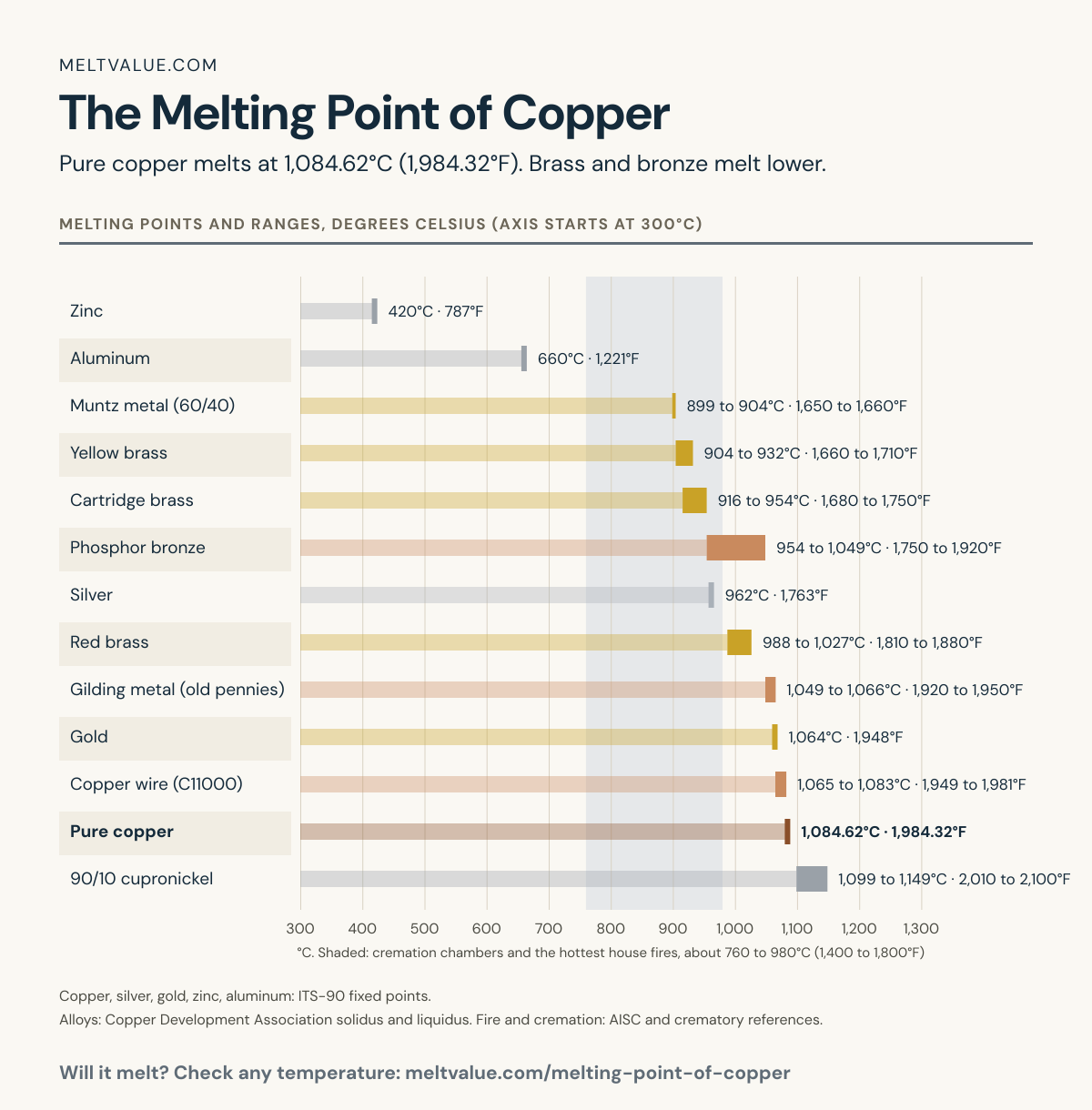
Pure copper melts at 1,084.62°C (1,984.32°F). That is 1,357.77 kelvins, one of the fixed points thermometers are calibrated to. Most copper you can hold is something else: wire starts melting at 1,065°C, brass at 888 to 1,027°C and bronze at 854 to 1,049°C, depending on the alloy.
Copper $5.64 per pound, updated November 27, 2026 at 2:44 AM EST.
Will It Melt? Check Any Temperature
Enter a temperature or tap a preset to see which coppers, brasses and bronzes would melt.
At 1,984.32°F (1,085°C)
- Zinc (modern penny core) (787.1°F)Melts
- Yellow brass (1,660 to 1,710°F)Melts
- Red brass (1,810 to 1,880°F)Melts
- Phosphor bronze (1,750 to 1,920°F)Melts
- Gilding metal (1962 to 1982 pennies) (1,920 to 1,950°F)Melts
- Copper wire (tough pitch) (1,949 to 1,981°F)Melts
- Pure copper (1,984.32°F)Melts
- 90/10 cupronickel (2,010 to 2,100°F)Stays solid
Alloy ranges are Copper Development Association values; each batch melts a little differently. "Starts to melt" means the alloy has passed its solidus, the point where the first liquid forms.
Melting Point of Brass, Bronze and Other Copper Alloys
Every copper alloy melts over a range: it starts to liquefy at the lower number (the solidus) and is fully liquid at the higher one (the liquidus). Zinc, tin and lead pull the range down, which is why brass melts well below copper. Nickel pushes it up, so cupronickel melts hotter than pure copper.
| Alloy | Melting range |
|---|---|
| Pure copperOne exact point, the ITS-90 copper point. | 1,084.62°C1,984.32°F |
| 70/30 cupronickel (C71500)70% copper, 30% nickel. Nickel raises the melting range above pure copper. | 1,171 to 1,238°C2,140 to 2,260°F |
| 90/10 cupronickel (C70600)90% copper, 10% nickel. | 1,099 to 1,149°C2,010 to 2,100°F |
| Electrolytic tough pitch copper (C11000)99.9% copper with a trace of oxygen. The standard grade for electrical wire. | 1,065 to 1,083°C1,949 to 1,981°F |
| Gilding metal (C21000)95% copper, 5% zinc. The same mix as 1962 to 1982 pennies. | 1,049 to 1,066°C1,920 to 1,950°F |
| Phosphor bronze (C51000)About 95% copper, 5% tin. | 954 to 1,049°C1,750 to 1,920°F |
| Commercial bronze (C22000)90% copper, 10% zinc. | 1,021 to 1,043°C1,870 to 1,910°F |
| Aluminum bronze (C95400)About 85% copper, 11% aluminum, 4% iron. | 1,027 to 1,038°C1,880 to 1,900°F |
| Red brass (C23000)85% copper, 15% zinc. | 988 to 1,027°C1,810 to 1,880°F |
| Silicon bronze (C65500)About 97% copper, 3% silicon. | 971 to 1,027°C1,780 to 1,880°F |
| Leaded red brass (85-5-5-5) (C83600)85% copper, 5% each tin, lead and zinc. | 854 to 1,010°C1,570 to 1,850°F |
| Beryllium copper (C17200)About 98% copper, 2% beryllium. | 866 to 982°C1,590 to 1,800°F |
| Bearing bronze (C93200)About 83% copper with tin, lead and zinc. | 854 to 977°C1,570 to 1,790°F |
| Cartridge brass (C26000)70% copper, 30% zinc. | 916 to 954°C1,680 to 1,750°F |
| Yellow brass (C27000)65% copper, 35% zinc. | 904 to 932°C1,660 to 1,710°F |
| Muntz metal (C28000)60% copper, 40% zinc. | 899 to 904°C1,650 to 1,660°F |
| Free-cutting brass (C36000)About 61.5% copper, 35.5% zinc, 3% lead. | 888 to 899°C1,630 to 1,650°F |
Solidus and liquidus from the Copper Development Association, published in °F; Celsius converted and rounded. Sorted from hottest to coolest by where melting finishes.
The brasses show the zinc effect clearly. Gilding metal, with 5% zinc, melts at 1,049 to 1,066°C. Red brass (15% zinc) melts at 988 to 1,027°C, cartridge brass (30%) at 916 to 954°C and Muntz metal (40%) at 899 to 904°C. For current scrap prices see brass price per pound.
Why Copper Wire Starts Melting at 1,065°C
The Copper Development Association lists electrolytic tough pitch copper (C11000), the standard grade for electrical wire, as starting to melt at 1,949°F (1,065°C), about 20°C below pure copper. The cause is oxygen. Tough pitch copper keeps a few hundredths of a percent of oxygen as copper oxide, and copper with copper oxide forms a mix that melts at 1,065°C, the copper-oxygen eutectic. When the wire heats past that point, that mix between the copper grains turns liquid first.
Deoxidized copper has no such shortcut. Phosphorus-deoxidized copper (C12200), the grade used for plumbing tube, is listed with a liquidus of 1,981°F (1,083°C). For scrap value by grade, see scrap copper prices.
What Happens When Pennies Melt
US cents made from 1962 to September 1982 are 95% copper and 5% zinc, the same mix as gilding metal, so they melt at about 1,049 to 1,066°C. Cents made since October 1982 are 97.5% zinc with a thin copper plating, and about 19% lighter (2.5 grams against 3.11). Heat one and the zinc core melts at about 420°C, far below copper, and by 907°C the zinc boils, all while the copper skin is still solid.
Melting either kind is against federal law: 31 CFR Part 82 bans melting or exporting pennies and nickels. See is it illegal to melt coins for the details, and the penny melt value page for what the metal in a penny is worth.
Why Copper Is Hard to Melt
The temperature is only part of it. Copper conducts heat extremely well: the Copper Development Association lists 226 Btu per foot-hour-°F for C11000, about 391 watts per meter-kelvin. A torch flame’s heat spreads through the whole piece instead of pooling where the flame hits, so thin wire may melt while a thick bar just glows. Melting more than a small piece takes a furnace and a crucible.
Molten copper also soaks up hydrogen and oxygen, which come back out as it freezes and leave porosity in castings. With brass there is a second problem: zinc boils at 907°C, below the full melting point of most brasses, so melting brass drives off zinc fumes. Work outdoors or with strong ventilation.
Melting is different from smelting. Melting turns scrap copper into liquid copper. Smelting pulls copper out of ore with chemistry and heat, which is a much bigger job.
Does Copper Wire Melt in a House Fire?
Usually not from the fire alone. The ATF’s Fire Research Laboratory notes that post-flashover room fires do not routinely reach temperatures that melt copper conductors. Even when a fire reaches 1,082°C, the conductor also needs enough time for the heat to soak in. Forensic research adds that copper’s conductivity makes small hot spots unlikely to melt wire, because the heat flows away along it.
Melted beads on wiring often point to electrical arcing, which is far hotter than a fire, and fire investigators study them closely. Research funded by the National Institute of Justice found that beads can form on wires that were not energized, too, so a bead alone does not prove an electrical cause.
Copper vs. Other Metals
Copper melts about 20°C above gold and 123°C above silver, and more than 370°C below nickel and iron. Aluminum, zinc, lead and tin all melt far lower.
| Metal | °C | °F |
|---|---|---|
| TinITS-90 fixed point | 231.93 | 449.5 |
| Lead | 327.46 | 621.4 |
| ZincITS-90 fixed point; boils at 907°C | 419.53 | 787.1 |
| AluminumITS-90 fixed point | 660.32 | 1,220.6 |
| SilverITS-90 fixed point | 961.78 | 1,763.2 |
| GoldITS-90 fixed point | 1,064.18 | 1,947.5 |
| CopperITS-90 fixed point | 1,084.62 | 1,984.3 |
| NickelRaises the melting range of cupronickel | 1,455 | 2,651 |
| IronSteel melts lower, depending on carbon | 1,538 | 2,800.4 |
| Palladium | 1,554.8 | 2,830.6 |
| Platinum | 1,768.3 | 3,214.9 |
Royal Society of Chemistry and ITS-90 values; platinum from Los Alamos National Laboratory. See the melting points of gold, silver, platinum and palladium.
Boiling Point of Copper
Copper boils at about 2,560°C (4,640°F) according to the Royal Society of Chemistry; Geoscience Australia gives 2,562°C. Liquid copper stays liquid across nearly 1,500°C before it boils.
What Copper Is Worth, Solid or Molten
At the copper spot price of $5.64 per pound, updated November 27, 2026 at 2:44 AM EST. Scrap yards pay less than spot. Use the copper calculator for your own weight, or see the copper price per pound chart.
Sources
- Royal Society of Chemistry: Copper: melting point 1,084.62°C (1,984.32°F, 1,357.77 K), boiling point 2,560°C (4,640°F) and density 8.96 g/cm³
- BIPM: Guide to the ITS-90, fixed points for radiation thermometry: copper (1,084.62°C) as a defining fixed point of the temperature scale
- Copper Development Association: Copper alloys advanced search: solidus and liquidus for C11000, C12200, C21000, C22000, C23000, C26000, C27000, C28000, C36000, C17200, C51000, C65500, C70600, C71500, C83600, C93200 and C95400, and C11000 thermal conductivity of 226 Btu/ft·h·°F
- Universidad Complutense de Madrid: Metallographic atlas, non-deoxidized copper: the copper and copper oxide eutectic forming at 0.39% oxygen in copper with 0.04% oxygen
- US Patent 5,108,026: Eutectic bonding of metal to ceramic: copper-oxygen eutectic liquid forming above 1,065°C
- Materials Transactions (2019): Oxygen and the solidification of pure copper castings: pure copper absorbing large amounts of hydrogen and oxygen during casting, and porosity from the copper oxide eutectic
- Royal Society of Chemistry: Periodic table: melting and boiling points of zinc (boils at 907°C), lead, tin, aluminum, nickel, iron and palladium
- Wikipedia: Penny (United States coin): cent compositions by year: 95% copper and 5% zinc from 1962 to September 1982, copper-plated zinc (97.5% zinc) since October 1982
- Federal Reserve Bank of Minneapolis: Small change: the copper-plated zinc cent being 19% lighter than the 95% copper cent
- Cornell Law School: 31 CFR Part 82: the federal ban on melting or exporting pennies and nickels
- ATF Fire Research Laboratory: Copper conductor melting technical bulletin: post-flashover compartment fires not routinely reaching copper’s melting point, and the time needed for a conductor to melt
- American Academy of Forensic Sciences (2007): Melting on copper wires in fires: copper’s high melting point and thermal conductivity requiring an extensive hot region for fire melting
- National Institute of Justice: Forensic investigation of electrical conductors: NFPA 921’s definition of an arc bead, and beads forming on non-energized as well as energized wires
- Geoscience Australia: Copper: melting point 1,084°C and boiling point 2,562°C