
Melting Point of Palladium
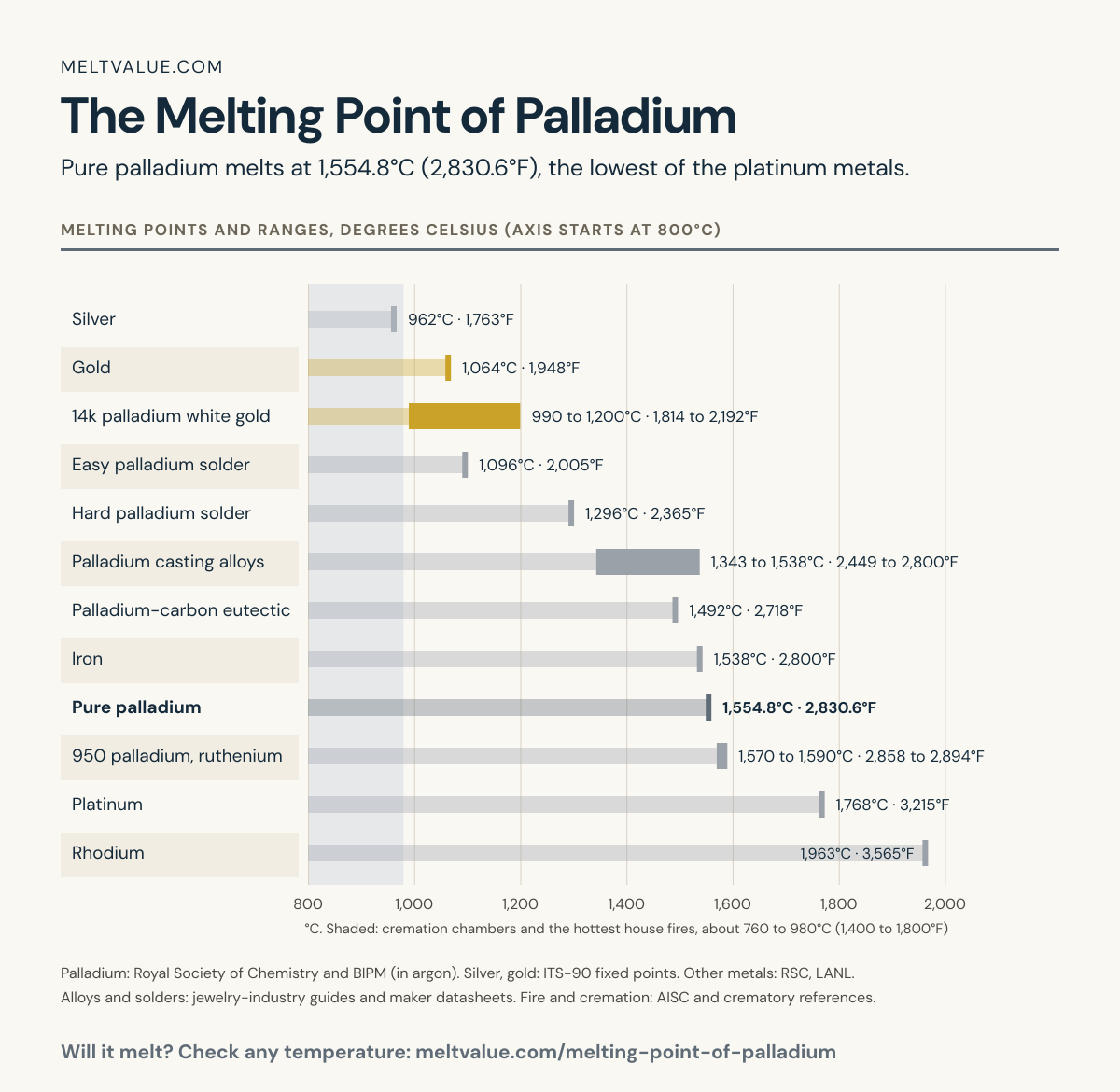
Pure palladium melts at 1,554.8°C (2,830.6°F). That is about 1,828 kelvins, the lowest melting point of the six platinum group metals and about 490°C above gold. Many references round the same value to 1,554.9°C, and measurements over the last century have ranged from 1,552 to 1,556.6°C.
Palladium $914.21 per troy ounce, updated November 27, 2026 at 2:44 AM EST.
Will It Melt? Check Any Temperature
Enter a temperature or tap a preset to see which palladium alloys and other metals would melt.
At 2,830.64°F (1,555°C)
- Pure gold (1,947.52°F)Melts
- 14k palladium white gold (1,814 to 2,192°F)Melts
- Hard palladium solder (flow) (2,365°F)Melts
- Palladium-carbon eutectic (2,718°F)Melts
- Pure palladium (2,830.6°F)Melts
- 950 palladium with ruthenium (2,858 to 2,894°F)Stays solid
- Pure platinum (3,214.9°F)Stays solid
Alloy ranges are typical; each maker’s recipe melts a little differently. Solders are shown at their flow points.
Why Sources Give Different Melting Points
Search for palladium’s melting point and you will see 1,554.8°C, 1,554.9°C, 1,555°C and sometimes 1,552°C. The small gaps come from rounding and from a century of better measurement. The earliest careful numbers were taken on older temperature scales: when the US Bureau of Standards measured 1,556.6°C in 1929, it calibrated against a gold point then put at 1,063°C, more than a degree below gold’s value today.
Air matters too. Molten palladium takes up oxygen, and a 1979 study in the journal Metrologia looked at how that oxygen changes its melting point. That is why the BIPM, the international body behind the world’s measurement standards, lists 1,554.8°C for palladium melted in argon.
| When | Source | Melting point |
|---|---|---|
| 1919 | Hoffmann and Meissner, GermanyEarlier results averaged below 1,553°C | 1,556°C |
| 1929 | US Bureau of StandardsOptical pyrometer against the gold point, then put at 1,063°C; uncertainty about 2° | 1,556.6°C |
| 1960s | Soviet thermocouple calibrationPalladium wire melted on the thermocouple tip | 1,552 ± 2°C |
| 2010 | BIPM (International Bureau of Weights and Measures)Accepted secondary reference point, measured in argon | 1,554.8°C |
| Today | Royal Society of Chemistry2,830.6°F, 1,828 K | 1,554.8°C |
| Today | Wikipedia, Los Alamos, WebElements2,830.82°F, 1,828.05 K | 1,554.9°C |
Japan’s national metrology institute, AIST, has also cited 1,553.5°C for pure palladium used as a fixed point.
Melting Point of 950 Palladium and Other Alloys
Palladium jewelry is usually stamped 950: 95% palladium and 5% other metals. In the US the 5% is mostly ruthenium, about 4.8 points of it, plus trace metals. Chinese manufacturers often use copper instead.
| Palladium | Melting range |
|---|---|
| 950 palladium with ruthenium95%. One US refiner’s casting grain with 3% ruthenium and 1.8% silver. Ruthenium lifts the range above pure palladium. | 1,570 to 1,590°C2,858 to 2,894°F |
| Pure palladium99.9%+. One exact point, measured in argon. | 1,554.8°C2,830.6°F |
| Palladium-carbon eutecticPalladium and carbon. Used in fixed-point cells to calibrate thermocouples. | 1,492°C2,718°F |
| Other palladium casting alloysMostly 95%. Gallium, silver, cobalt or copper pull the range below pure palladium. | 1,343 to 1,538°C2,449 to 2,800°F |
| Hard palladium solderPalladium, platinum, gold, silver. Flow point. | 1,296°C2,365°F |
| Medium palladium solderPalladium, platinum, gold, silver. Flow point. | 1,210°C2,210°F |
| 14k palladium white goldPalladium as the whitener. Gold alloy that uses palladium instead of nickel. | 990 to 1,200°C1,814 to 2,192°F |
| Easy palladium solderPalladium, platinum, gold, silver. Flow point. | 1,096°C2,005°F |
Sorted from hottest to coolest. Alloy and solder figures from jewelry-industry guides and maker datasheets; 14k palladium white gold from our melting point of gold page.
Palladium follows the same rule as platinum. Ruthenium melts at 2,333°C, so a few percent of it pushes 950 palladium slightly above the pure metal, and its melting range is only a few degrees wide. Gallium, silver, cobalt and copper melt lower and pull the alloy down, which is why casting alloys can melt as low as about 1,343°C. Casters often prefer a wider range, and alloy makers add cobalt or copper to get one.
Palladium and the Thermocouples in a Steel Mill
Palladium’s melting point does real work. Steel makers need to read molten steel near 1,500°C within a couple of degrees, using platinum-rhodium thermocouples dipped into the melt. To check those thermocouples above the copper and gold points, labs use the palladium wire method: a short piece of pure palladium wire is joined across or wrapped around the thermocouple tip and heated in a furnace. While the wire melts, the reading holds flat for a moment at palladium’s melting point, and that plateau gives a reference near 1,555°C.
Each check uses up the wire; Australia’s national measurement lab noted it loses about 20 mm of thermocouple wire per calibration. Labs are moving to small fixed-point cells instead, filled with pure palladium or with a palladium-carbon mix that melts at 1,492°C.
Palladium vs. Gold, Platinum and Other Metals
Palladium melts about 491°C above gold and 214°C below platinum, and it is the lowest-melting of the platinum group metals. It melts only about 17°C above iron.
| Metal | °C | °F |
|---|---|---|
| SilverITS-90 fixed point | 961.78 | 1,763.2 |
| GoldITS-90 fixed point | 1,064.18 | 1,947.5 |
| CopperITS-90 fixed point | 1,084.62 | 1,984.3 |
| Nickel | 1,455 | 2,651 |
| Cobalt | 1,495 | 2,723 |
| IronSteel melts lower, depending on carbon | 1,538 | 2,800.4 |
| PalladiumLowest-melting platinum group metal | 1,554.8 | 2,830.6 |
| Titanium | 1,670 | 3,038 |
| PlatinumPlatinum group metal | 1,768.3 | 3,214.9 |
| RhodiumPlatinum group metal | 1,963 | 3,565.4 |
| RutheniumPlatinum group metal; hardens 950 palladium | 2,333 | 4,231.4 |
| IridiumPlatinum group metal | 2,446 | 4,434.8 |
| OsmiumHighest-melting platinum group metal | 3,033 | 5,491.4 |
Silver, gold and copper are ITS-90 fixed points; platinum from Los Alamos National Laboratory; other metals from the Royal Society of Chemistry.
Does Palladium Melt in a Fire or During Cremation?
No. The American Institute of Steel Construction says a fully developed building fire rarely tops 1,800°F (982°C), and cremation chambers typically run at 760 to 980°C. Palladium needs 1,554.8°C, so 950 palladium rings come through intact. Gold parts, solder joints and palladium white gold, which starts melting near 990°C, are the pieces at risk. Palladium heated hard in air can also take on a blue-purple tint, which a jeweler can remove.
How Palladium Is Melted
- Induction under argon. Molten palladium soaks up gas from the air, so casters melt it by induction in a chamber pumped out and filled with argon. Suppliers advise against torch casting, and against hydrogen fuel if a torch is used.
- Extra sprues. Palladium gives off gas as it cools, so casters add two or three times the usual number of sprues to let it escape.
- Eye protection. At soldering and melting heat, palladium is bright enough that bench guides call for No. 5 or darker welding lenses.
- Solder. Palladium or platinum solders, in hard, medium and easy grades, join 950 palladium without melting it.
Melting does not change what palladium is worth. Buyers pay for the palladium content, which you can estimate with the palladium melt value calculator or the live palladium price per gram.
Palladium and Hydrogen
Palladium’s appetite for gas goes beyond the casting room. At room temperature it can absorb up to 900 times its own volume of hydrogen, a property Thomas Graham first noticed in 1866. The hydrogen comes back out when the metal is heated or the pressure drops, which is why palladium is used to purify hydrogen and studied for storing it.
Boiling Point of Palladium
Palladium boils at 2,963°C (5,365°F, 3,236 K), according to the Royal Society of Chemistry and WebElements. That leaves a liquid range of about 1,400°C, much narrower than platinum’s. William Hyde Wollaston discovered palladium in the early 1800s and named it after the newly found asteroid Pallas.
What Palladium Is Worth, Solid or Molten
Melt value at the palladium spot price of $914.21 per troy ounce, updated November 27, 2026 at 2:44 AM EST. Buyers pay less than full melt. See the palladium spot price chart.
Sources
- Royal Society of Chemistry: Palladium: melting point 1,554.8°C (2,830.6°F, 1,828 K), boiling point 2,963°C (5,365°F), density 12.0 g/cm³, Wollaston and the asteroid Pallas
- BIPM: CMC review protocol for high-temperature fixed points (2010): the melting point of palladium (1,554.8°C, in argon) as an accepted secondary reference point, realized by the wire method or miniature crucibles
- BIPM: Guide on Secondary Thermometry, specialized fixed points above 0°C: wire-bridge methods and palladium freezing points in alumina crucibles
- Wikipedia: Palladium: melting point 1,828.05 K (1,554.9°C, 2,830.82°F), and palladium as the lowest-melting and least dense platinum group metal
- Los Alamos National Laboratory: Palladium: melting point 1,554.9°C
- WebElements: Palladium: melting point 1,828.05 K and boiling point 3,236 K
- Bureau of Standards Journal of Research (1929): A new determination of the melting point of palladium: 1,556.6°C by optical pyrometer, the 1919 Hoffmann and Meissner value of 1,556°C, and the crucible method beating the wire method
- Journal of Chemical Education (1930): Melting point of palladium: palladium as a convenient high-temperature reference point, and gold then taken as 1,063°C
- OSTI: Calibration of noble metal thermocouples at the melting point of palladium (1961): 1,552 ± 2°C and wrapping palladium wire around the thermocouple junction
- AIST Synthesiology (2010): Thermocouple calibration standards: pure palladium at 1,553.5°C used as a high-temperature fixed point in several countries, and steel makers needing molten steel readings near 1,500°C
- IMEKO World Congress (2000): Improved uncertainty of palladium wire bridge method: the palladium wire-bridge method for Type R and S thermocouples and immersion thermocouples in the steel industry
- International Journal of Thermophysics (2017): Pd-C eutectic cells at NMIA: the melt-wire technique losing 20 mm of wire per calibration, and palladium-carbon eutectic cells at 1,492°C
- International Journal of Thermophysics (2016): Miniature palladium fixed-point cells: palladium in alumina and zirconia cells, and the 1979 Metrologia study of palladium’s melting point and its dependence on oxygen
- Ganoksin: 950 Palladium Bench Guide (Mark B. Mann): ruthenium as the usual US alloying metal, copper in China, solder flow points, No. 5 welding lenses and blue-purple discoloration
- JCK: 950 Palladium Bench Guide: ruthenium making up about 4.8% of the 5% alloy share
- Jewelry Technology Forum: Development of new 950Pd investment casting alloys: ruthenium, gallium and cobalt as the main alloying metals, ruthenium raising the melting range, and the very narrow range of 950PdRu
- Ganoksin: Tips for Casting Palladium: palladium alloys melting at 1,343 to 1,538°C, argon induction melting, and extra sprues because palladium gives off gas as it cools
- Ganoksin: Common FAQs for Metals Suppliers: machine casting over torch casting, and no hydrogen when torch casting palladium
- US Patent 7,749,433: High-hardness palladium alloy: induction melting in a chamber evacuated and then filled with argon
- Chemistry World: Focus on palladium’s hydrogen storage potential: palladium absorbing up to 900 times its own volume of hydrogen at room temperature
- Wikipedia: Palladium hydride: Thomas Graham first noting hydrogen absorption by palladium in 1866
- Royal Society of Chemistry: Periodic table: melting points of platinum group metals, nickel, cobalt, iron and titanium
- AISC: General fire science: fully developed building fires rarely above 1,800°F
- Wikipedia: Crematory: main cremation chambers at 760 to 980°C (1,400 to 1,800°F)