
Melting Point of Silver
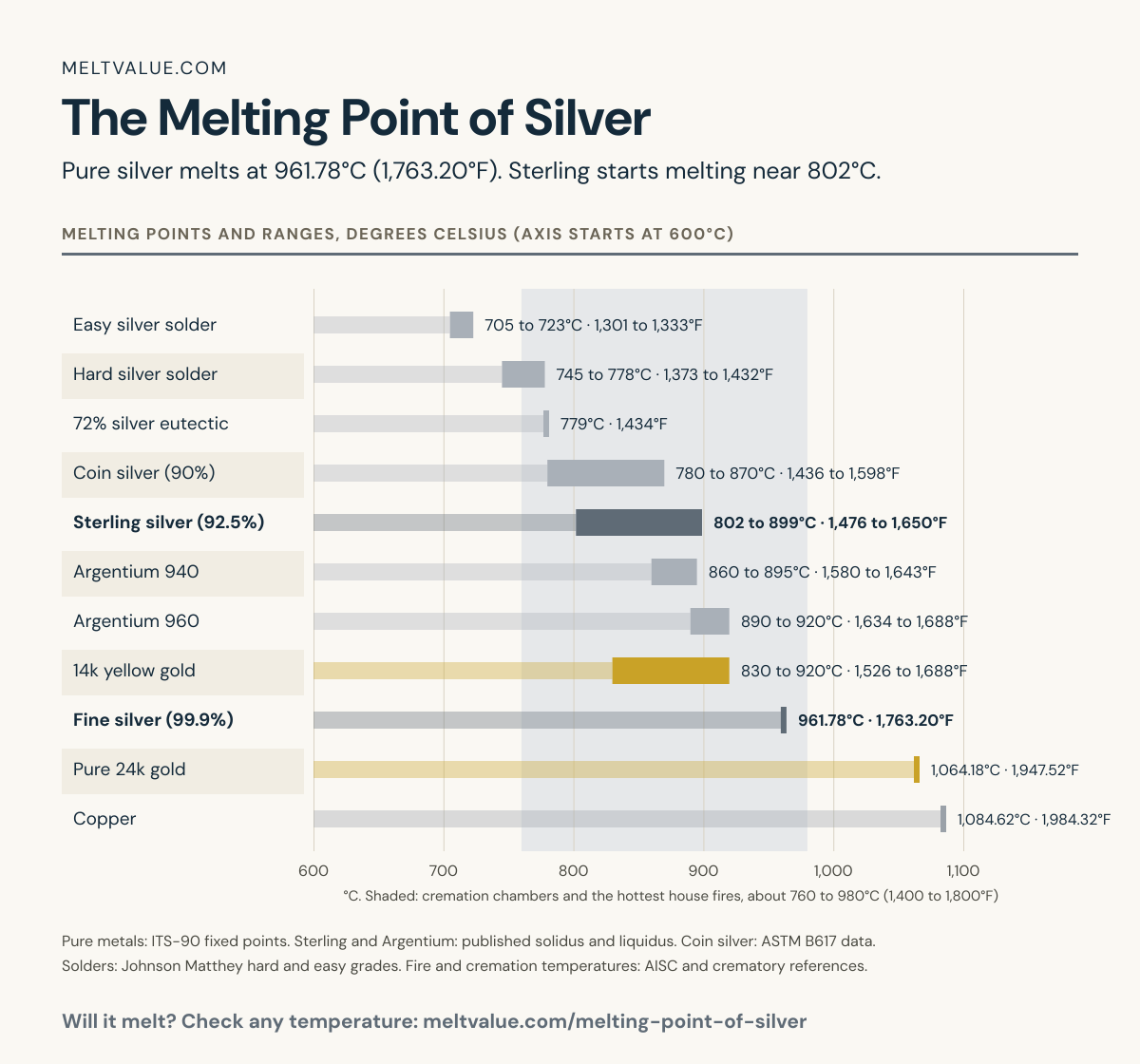
Pure silver melts at 961.78°C (1,763.20°F). That is 1,234.93 kelvins, one of the fixed points the world’s thermometers are calibrated to. Sterling silver melts over a range instead: it starts to soften and melt at about 802°C (1,476°F) and is fully liquid at about 893 to 899°C (1,640 to 1,650°F).
Will It Melt? Check Any Temperature
Enter a temperature or tap a preset to see which silvers, solders and other metals would melt.
At 1,500°F (816°C)
- Easy silver solder (1,301 to 1,333°F)Melts
- Hard silver solder (1,373 to 1,432°F)Melts
- Coin silver (90%) (1,436 to 1,598°F)Starts to melt
- Sterling silver (92.5%) (1,476 to 1,650°F)Starts to melt
- 14k yellow gold (1,526 to 1,688°F)Stays solid
- Fine silver (99.9%) (1,763.20°F)Stays solid
- Pure 24k gold (1,947.52°F)Stays solid
- Copper (1,984.32°F)Stays solid
Alloy ranges are typical; each recipe melts a little differently. "Starts to melt" means the alloy has passed its solidus, the point where the first liquid forms.
Melting Point of Silver by Type
Only pure silver melts at a single temperature. Every alloy melts across a range: the first liquid appears at the lower number (the solidus) and the last solid disappears at the higher one (the liquidus). Copper pulls both numbers down, which is why sterling and coin silver melt well below fine silver.
| Silver | Melting range |
|---|---|
| Fine silver (999)99.9%+ silver. One exact point, the ITS-90 silver point. | 961.78°C1,763.20°F |
| Argentium 96096% silver. Germanium alloy that meets the UK Britannia standard. | 890 to 920°C1,634 to 1,688°F |
| Argentium 94094% silver. Germanium sterling, tarnish resistant. | 860 to 895°C1,580 to 1,643°F |
| Sterling silver (925)92.5% silver. Silver and copper. Charts often list 893°C (1,640°F), the point where it is close to fully liquid. | 802 to 899°C1,476 to 1,650°F |
| Coin silver (900)90% silver. Old US coins and 1800s American silverware. Some tables list 879°C. | 780 to 870°C1,436 to 1,598°F |
| 72% silver, 28% copper72% silver. The eutectic: the lowest-melting silver and copper mix. | 779°C1,434°F |
| Hard silver solderSilver, copper, zinc silver. First joints on a piece. | 745 to 778°C1,373 to 1,432°F |
| Medium silver solderSilver, copper, zinc silver. Middle joints. | 720 to 765°C1,328 to 1,409°F |
| Easy silver solderSilver, copper, zinc silver. Last joints and repairs. | 705 to 723°C1,301 to 1,333°F |
Fine silver from the Royal Society of Chemistry and ITS-90. Sterling and Argentium from published solidus and liquidus values; coin silver from ASTM B617 data; solders from Johnson Matthey figures cited in a Canadian patent. Ranges vary by recipe.
Why Sterling Starts Melting Near 802°C
Most melting point charts give sterling one number, 893°C (1,640°F). That is close to where sterling turns fully liquid. Sterling actually starts to melt about 90°C earlier, at roughly 802°C (1,476°F), and between those two temperatures it is a slush of solid crystals and liquid metal. A jeweler who heats a sterling ring toward 893°C expecting it to hold its shape will watch it slump first.
The silver and copper phase diagram explains the gap. Silver and copper mixed at about 72% silver and 28% copper melt at one sharp temperature, 779.1°C, the lowest of any silver and copper mix (the eutectic). Solid silver can hold up to about 8.8% copper by weight in its crystals. Sterling has 7.5% copper, so all of it fits, and the alloy stays solid until about 802°C. Coin silver has 10% copper, a little more than fits, so a small amount of the 72/28 mix forms between the crystals and melts first, at about 780°C.
Heating sterling also oxidizes its copper. The dark copper oxide that forms on and under the surface is called firescale, and borax flux keeps it down. For what the 925 stamp means and how much silver a piece holds, see 925 silver meaning.
Silver vs. Gold and Other Metals
Pure silver melts 102.4°C (184.3°F) below pure gold and about 123°C below copper. Alloys can flip that order: 14k yellow gold starts melting near 830°C, below fine silver, and sterling starts below both. See the melting point of gold for every karat.
| Metal | °C | °F |
|---|---|---|
| TinITS-90 fixed point | 231.928 | 449.47 |
| ZincITS-90 fixed point | 419.527 | 787.15 |
| AluminumITS-90 fixed point | 660.323 | 1,220.58 |
| SilverITS-90 fixed point | 961.78 | 1,763.2 |
| GoldITS-90 fixed point | 1,064.18 | 1,947.52 |
| CopperITS-90 fixed point | 1,084.62 | 1,984.32 |
| IronSteel melts lower, depending on carbon | 1,538 | 2,800.4 |
| PalladiumPlatinum group metal | 1,554.8 | 2,830.64 |
| PlatinumAbout 800°C hotter than silver | 1,768.3 | 3,214.94 |
Does Silver Melt in a House Fire?
Sterling can. A room fire reaches flashover once its hot gases pass about 600°C (1,112°F). The American Institute of Steel Construction says a fully developed building fire rarely tops 1,800°F (982°C) and its average gas temperature rarely reaches 1,500°F (816°C). Sterling starts melting at about 1,476°F, so flatware and jewelry in the hottest part of a fire can sag or melt.
Teapots, candlesticks and other hollowware fail sooner, because their seams are held with silver solder that melts at 705 to 778°C. Fine silver bars and coins, at 1,763°F, survive all but the hottest spots. Melted or not, the silver is still there and still worth its silver content.
Does Silver Melt During Cremation?
Cremation chambers typically run at 760 to 980°C (1,400 to 1,800°F). Sterling silver, at 802 to 899°C, falls inside that range, so a sterling ring or pendant usually melts or deforms. Fine silver, at 961.78°C, melts only near the top of the range. Families who want jewelry back should ask for it to be removed before cremation.
Silver Solder Melting Points
Silver solders are silver, copper and zinc alloys built to melt below the sterling they join. Johnson Matthey lists hard solder at 745 to 778°C, medium at 720 to 765°C and easy at 705 to 723°C. Even hard solder is fully liquid below sterling’s 802°C starting point, so a joint can flow without melting the piece. Jewelers solder the first joints with hard and the last with easy, so earlier joints stay put.
Boiling Point of Silver
The Royal Society of Chemistry lists silver’s boiling point at 2,162°C (3,924°F, 2,435 K). Liquid silver stays liquid across about 1,200°C before it boils, so a torch or melting furnace never comes close to boiling it.
Why Molten Silver Spits
Molten silver soaks up oxygen from the air, about 22 times its own volume according to one silver alloy patent. Measured by weight, liquid silver in pure oxygen holds about 0.31% dissolved oxygen. The silver lets that gas go as it freezes, which can throw out droplets ("spitting") and leave bubbles and porosity in a casting. Carbon pulls the oxygen back out, which is why silver is often melted in a graphite crucible or under a layer of charcoal.
Why Scientists Use Silver’s Melting Point
The International Temperature Scale of 1990 rests on 17 reference points, and the freezing point of silver, 961.78°C (1,234.93 K), is one of them. Above it, the scale stops using platinum resistance thermometers and defines temperature by the light a hot body gives off, using Planck’s radiation law. Silver, gold and copper are the three metals allowed as the reference for that light. NIST realizes the silver and gold points in specially built furnaces to calibrate high-temperature thermometers.
How Silver Is Melted
- Heat source. A propane or butane torch with a large tip handles small amounts. Electric melting furnaces give steadier heat for bigger melts.
- Crucible. Graphite or ceramic. Graphite also helps soak up the oxygen molten silver absorbs. Keep separate crucibles for silver and gold.
- Flux. A sprinkle of borax limits oxidation and firescale on sterling.
- Safety. Work outdoors or under ventilation, wear eye protection and heat-resistant gloves, and pour only into dry, preheated molds, since moisture makes molten metal spit.
Melting does not purify silver. The copper in sterling stays in the melted button; separating it takes chemical or electrolytic refining. Melting does not raise the value either. Buyers pay for the silver content, which you can estimate with the silver melt value calculator or the live silver price per gram. For sets and serving pieces, see sterling silver flatware value.
In the United States, melting silver dimes, quarters, halves and dollars is legal; the federal ban covers pennies and nickels. See is it illegal to melt coins for the details, and check a coin’s collector value before melting it.
What Silver Is Worth, Solid or Molten
Melt value at the silver spot price of $44.09 per troy ounce, updated November 27, 2026 at 2:44 AM EST. Buyers pay less than full melt.
Sources
- Royal Society of Chemistry: Silver: melting point 961.78°C (1,763.2°F, 1,234.93 K), boiling point 2,162°C (3,924°F) and density 10.5 g/cm³
- BIPM: Guide to the ITS-90, fixed points for radiation thermometry: silver (961.78°C), gold (1,064.18°C) and copper (1,084.62°C) as defining fixed points
- NIST: Four-zone furnace for silver and gold freezing points: how NIST realizes the silver and gold points
- NIST: Kelvin and the ITS-90: the 17 reference points of the temperature scale
- Wikipedia: Argentium sterling silver: solidus and liquidus of traditional sterling (802 and 899°C), Argentium 940 (860 and 895°C) and Argentium 960 (890 and 920°C)
- Engineering ToolBox: Metals and alloys, melting temperatures: the commonly listed 893°C for sterling and 879°C for coin silver
- MakeItFrom: ASTM B617 coin silver: coin silver (90% silver, 9 to 10.4% copper) melting onset 780°C and completion 870°C
- Journal of Phase Equilibria and Diffusion (2020): the Ag-Cu-Si system: the silver-copper eutectic at 779.1°C and 39.9 atomic percent copper, and the 14.1 atomic percent limit of copper in solid silver
- MIT OpenCourseWare 3.091: Solid solutions self-assessment: the eutectic at about 28 wt% copper and 9 wt% copper in solid silver
- Ganoksin Orchid: Eutectic system: why sterling’s solidus sits above 779°C while higher-copper alloys melt at the eutectic
- Canadian Patent CA 2544861: silver solder alloys: solidus and liquidus of easy (705 to 723°C), medium (720 to 765°C) and hard (745 to 778°C) silver solders
- US Patent 6,841,012: Anti-tarnish silver alloy: molten silver absorbing about 22 times its volume of oxygen in air
- US Patent 4,397,686: Method for refining precious metals: about 0.31% dissolved oxygen by weight in liquid silver, and carbon as a deoxidizer
- Ganoksin: Precious metal alloys, part 1: torches, separate crucibles and borax flux
- AISC: General fire science: fully developed building fires rarely above 1,800°F, with average gas temperatures below 1,500°F
- NIST: Fire fighter temperature and heat flux facts: flashover once fire gases pass about 600°C
- Wikipedia: Crematory: main cremation chambers at 760 to 980°C (1,400 to 1,800°F)
- Omega Engineering: The International Temperature Scale of 1990: the tin, zinc and aluminum fixed points
- Royal Society of Chemistry: Palladium: melting point 1,554.8°C
- Wikipedia: Platinum: melting point 1,768.3°C
- Lenntech: Chemical elements listed by melting point: iron at 1,538°C
- Cornell Law School: 31 CFR Part 82: the federal ban on melting or exporting pennies and nickels