
Sterling Silver Flatware Value
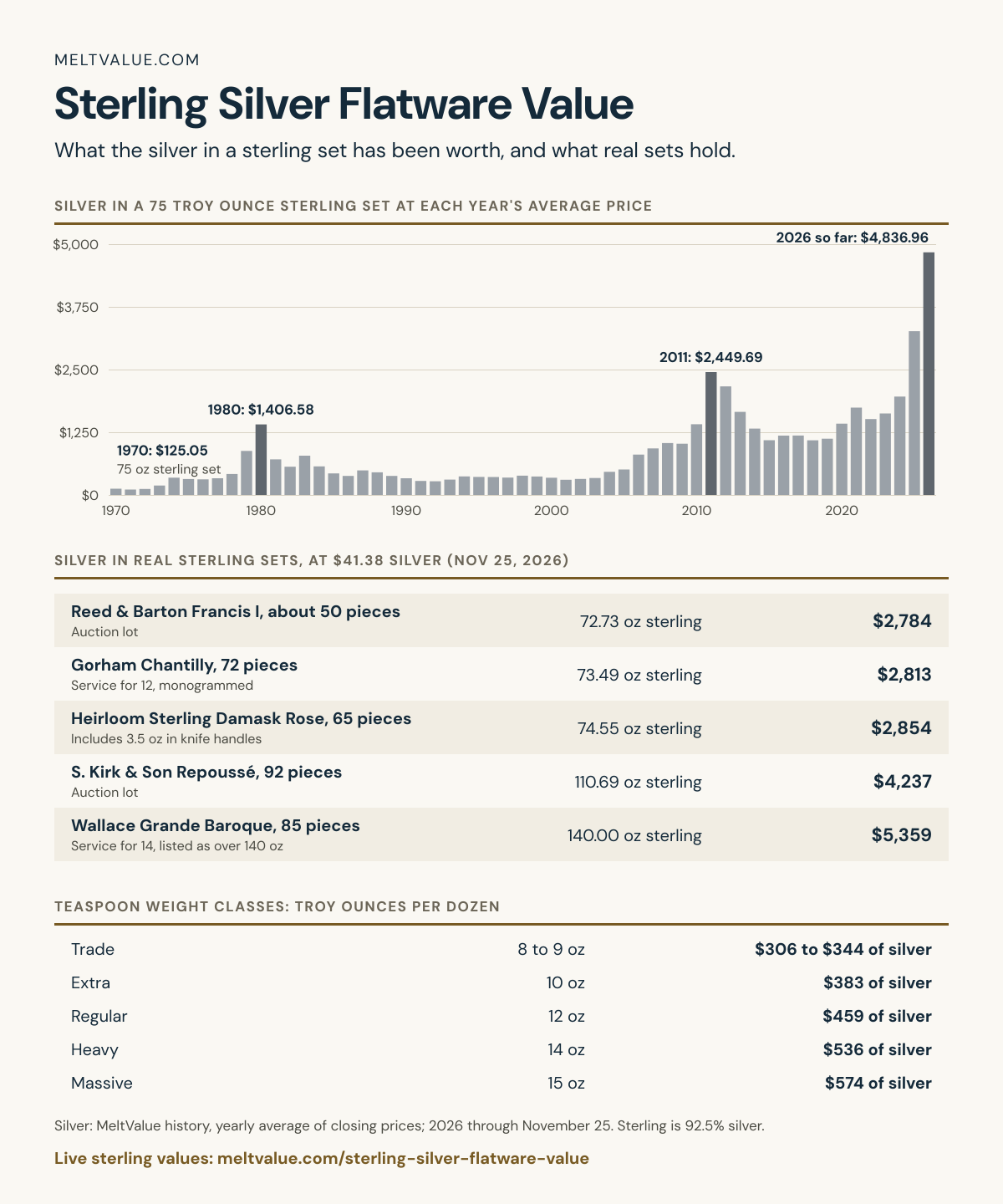
Sterling flatware is 92.5% silver, so each troy ounce of it holds $40.77 of silver at today’s price. A set weighing 75 troy ounces, close to the 72-piece Chantilly service below, holds $3,058. Knives are mostly steel and cement, and some patterns sell for more than their silver.
Silver $44.08 per troy ounce, updated November 27, 2026 at 2:42 AM EST.
Sterling Flatware Calculator
Weigh the solid pieces together on any kitchen scale, leaving out knives and anything else with a steel blade. Then count the hollow-handle pieces.
Silver value (melt)
$3,217.75
73 troy oz of pure silver in 72.92 troy oz of solid pieces plus about 6 troy oz of sterling in handles.
At 80% of melt, the going rate for sterling during the January 2026 refinery backlog, a buyer would offer $2,574.
About half a troy ounce per hollow handle is a rough figure; small butter spreaders hold less and carving sets more. If a buyer credits a different amount, change it above.
Sterling Silver Price per Ounce and Gram
Silver value of each standard at today’s price. Kitchen scales weigh in regular ounces and pounds, which are lighter than troy ounces and heavier than troy pounds.
| Standard | Per gram | Per troy oz | Per pound |
|---|---|---|---|
| Sterling (925)Marked Sterling or 925$37.16 per kitchen oz | $1.31 | $40.77 | $595 |
| Coin silver (900)Older American pieces marked Coin$36.16 per kitchen oz | $1.28 | $39.67 | $579 |
| Continental (800)Common on German and other European silver$32.14 per kitchen oz | $1.13 | $35.26 | $514 |
| Britannia (958)A higher British standard$38.49 per kitchen oz | $1.36 | $42.23 | $616 |
A common mistake is reading kitchen ounces as troy ounces, which overstates the silver by almost 10%. More on the stamp itself: 925 silver meaning. For bullion figures, see the silver price per gram.
How Much Does a Sterling Set Weigh?
Weights from real sets sold at auction and by dealers, with the silver they hold at today’s price:
| Set | Sterling | Silver value |
|---|---|---|
| Reed & Barton Francis I, about 50 piecesAuction lot, 2019 | 72.73 oz | $2,965 |
| Gorham Chantilly, 72 piecesSoup spoons, spreaders, knives, forks, salad forks and teaspoons; monogrammed | 73.49 oz | $2,996 |
| Heirloom Sterling Damask Rose, 65 pieces71.05 oz in solid pieces plus about 3.5 oz in knife handles | 74.55 oz | $3,040 |
| S. Kirk & Son Repoussé, 92 piecesAuction lot, 2023 | 110.69 oz | $4,513 |
| Wallace Grande Baroque, 85 piecesFive-piece settings for 14 with extra teaspoons, listed as over 140 oz | Over 140 oz | Over $5,708 |
Weight varies within a pattern, too. Starting in the mid-1890s, some large makers sold popular patterns in several weights, measured by what a dozen teaspoons weighed:
| Weight class | Dozen teaspoons | Silver value |
|---|---|---|
| Trade | 8 to 9 troy oz | $326 to $367 |
| Extra | 10 troy oz | $408 |
| Regular | 12 troy oz | $489 |
| Heavy | 14 troy oz | $571 |
| Massive | 15 troy oz | $612 |
Set weights are as listed by the seller or auction house. Your own set can be lighter or heavier, so weigh it.
Knives and Other Weighted Pieces
Sterling is too soft to hold an edge, so dinner knives in sterling sets have stainless steel blades. The blade’s tang sits inside a thin, hollow sterling handle, held by cement on older pieces and epoxy on newer ones. Pie servers, cake knives, cheese knives and carving sets are often built the same way.
Only the handle shell counts as silver, and it is much lighter than the piece feels. One 65-piece Damask Rose set held 71.05 troy ounces in its solid pieces and only about 3.5 troy ounces in all its weighted handles. Some butter spreaders and fish knives are solid sterling, so check for a seam where blade meets handle before you sort.
How to Tell Sterling From Silverplate
- Sterling, 925 or .925. US law requires anything marked sterling to be 925 parts per thousand silver, and the FTC applies the same floor to the words silver and solid silver.
- Coin, Pure Coin or 900. Older American silver made to the coin standard, 90% silver.
- 800, 830 or 835. European standards, common on German and Scandinavian pieces. The 800 setting gives a slightly low estimate for 830 and 835.
- A lion passant. The British sterling hallmark, usually beside a maker’s mark, a town mark and a date letter.
- EPNS, EP, Silverplate, Silver Plated, Quadruple Plate. Silverplate. The law bars plated items from carrying the sterling or coin marks.
- Nickel silver or German silver. No silver at all. It is the usual base metal under silverplate.
- Sterling Handle or Weighted. Only the handle is sterling.
A magnet helps too. Silver is not magnetic, so a piece that grabs a magnet has steel in it.
Melt It or Sell It as Flatware?
Melt value is a floor, not a ceiling. Replacement dealers sell popular patterns to people completing a set, and their retail prices run far above the silver. One dealer asked $5,725 for a Reed & Barton Francis I service for 10 with six serving pieces, listed at over 53 troy ounces counting each bladed piece as one ounce. That is roughly $2,161 of silver today. Single hollow-handle steak knives in older Wallace, Towle and International patterns retail around $90 each, against roughly $20 of silver at half an ounce per handle.
You will not get retail when you sell, but a pattern buyer can still beat a scrap offer. In a MarketWatch guide to selling silver, one expert named scrapping items that should have been sold intact as one of the biggest mistakes. These long-running patterns are among those replacement dealers stock:
| Pattern | Maker | Introduced |
|---|---|---|
| Chantilly | Gorham | 1895, designed by William Codman |
| Strasbourg | Gorham | 1897 |
| Buttercup | Gorham | 1899 |
| Francis I | Reed & Barton | 1907, designed by Ernest Meyers |
| Stradivari | Wallace | 1937 |
| Grande Baroque | Wallace | 1941 |
| French Provincial | Towle | 1948 |
Monograms, heavy wear and odd pieces narrow the market. Replacement dealers even list unmonogrammed pieces separately.
The 2025 to 2026 Sterling Rush
Silver rose more than 140% in 2025, then kept climbing. It closed at a record $117.39 on January 29, 2026, and briefly topped $120 before its biggest one-day drop on record. At that peak a 75-troy-ounce set held about $8,144 of silver.
Sellers lined up with flatware, and refiners fell behind. Several refiners stopped taking silver items below .999 fine for a time in late 2025. By January 2026 dealers were paying about 20% below melt for sterling, the slowest material to refine, and in early February at least one coin shop took sterling sellers by appointment only. Silver has since fallen to $44.08, 62% below that close. Chart the full run on silver price by year or see the highest silver price ever.
How to Sell Sterling Flatware
- Sort it. Separate sterling, silverplate and stainless by their marks. Put knives and bladed servers in their own pile.
- Weigh it. Weigh the solid sterling together and run the calculator. That melt figure is your floor.
- Look up the pattern. The maker and pattern name are often stamped on the back. Check what complete sets and single pieces sell for before you accept a scrap price.
- Get several offers. Compare each as a share of melt. Offers swing with how busy refiners are.
- Keep sets together for pattern buyers. Knives, serving pieces and full place settings are worth more to a set-completer than to a refiner.
Why Sterling Is 92.5% Silver
Pure silver is too soft for forks and spoons, so silversmiths add copper. Sterling has been the British standard for centuries, and the National Gold and Silver Stamping Act of 1906 made 925 the legal meaning of sterling in the United States. Before sterling took over, many American silversmiths worked to the 90% coin standard, which is why older pieces may be marked Coin.
Have other silver to price? Try the silver calculator, or for coins, the junk silver calculator.
Sources
- 15 U.S.C. § 296: Standard of fineness of silver articles: articles marked sterling must be 925 parts per thousand silver, and coin 900, with a small allowed divergence
- 15 U.S.C. § 297: Stamping plated articles: plated articles may not be marked sterling or coin
- FTC Jewelry Guides, 16 CFR 23.6: silver, solid silver and sterling claims require at least 925 parts per thousand silver
- Wikipedia: Fineness: silver standards from 800 through Britannia 958 and sterling 925
- Wikipedia: Coin silver: American silverware made to the 90% coin standard before sterling became common
- Wikipedia: Nickel silver: nickel silver, the usual base of silverplate (EPNS), contains no silver
- Wikipedia: Sterling silver: sterling as 92.5% silver and the British lion passant mark
- NGC: Jeff Garrett, Price points matter (January 2026): sterling, the slowest material for refiners to process, trading about 20% below melt
- Numismatic News: Price volatility and capacity problems: silver up more than 142% in 2025, refiner backlogs, and refiners that stopped taking silver below .999 for a time
- C-Ville Weekly: Locals are cashing in their candlesticks: silver’s 2026 record near $121 and record one-day drop, flatware sellers in line, appointments during refinery backups
- Yahoo Finance (MarketWatch): Five things to know before you sell silver: scrapping items that should have been sold intact named as a common mistake
- PCGS CU Forums: Sterling flatware knives: stainless blades and sterling handles of about half a troy ounce each