
Melting Point of Platinum
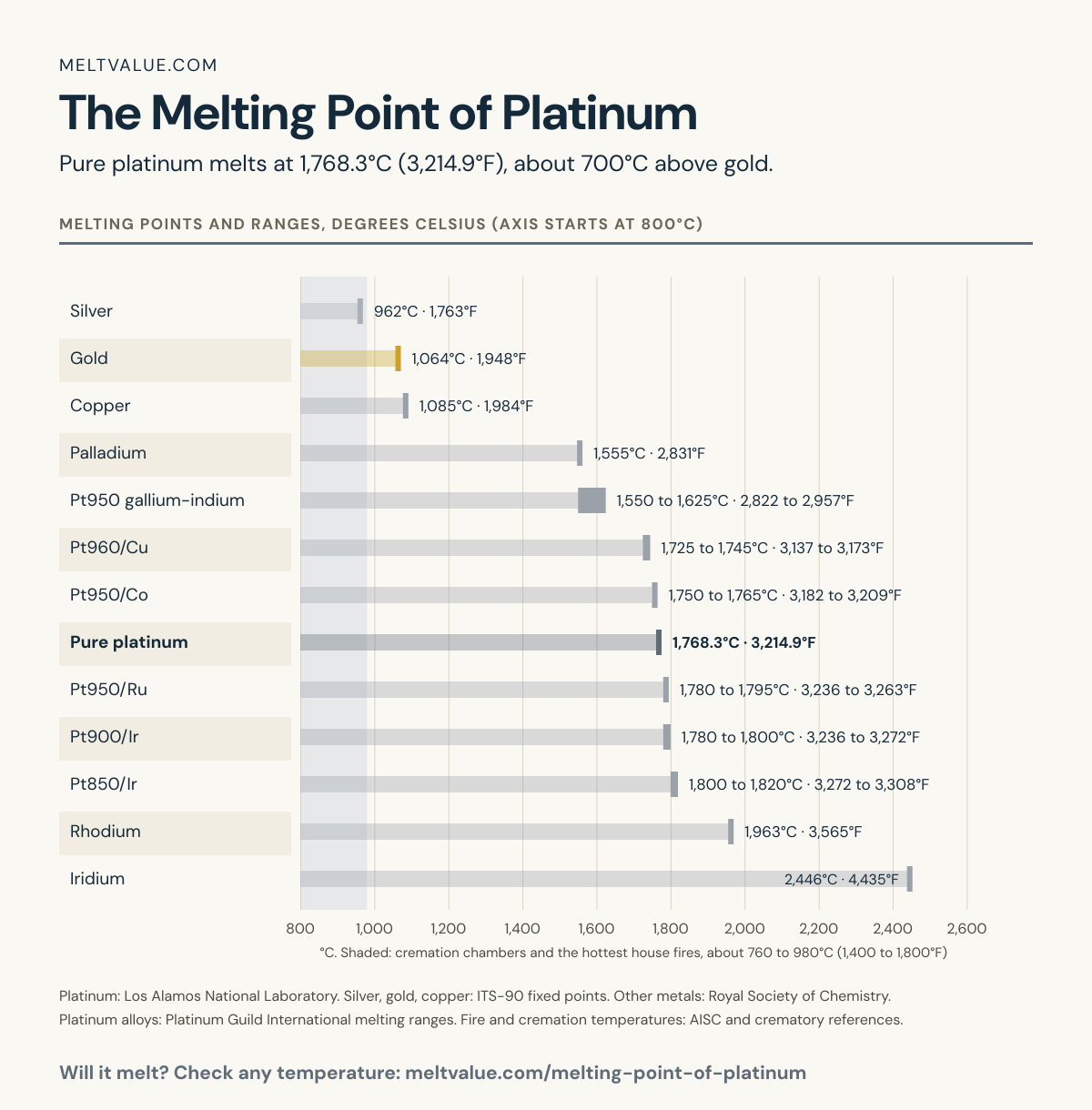
Pure platinum melts at 1,768.3°C (3,214.9°F). That is about 2,041 kelvins and roughly 700°C hotter than gold. Platinum jewelry alloys melt between about 1,550 and 1,820°C, and the ones hardened with iridium or ruthenium melt hotter than pure platinum.
Platinum $1,361.12 per troy ounce, updated November 27, 2026 at 2:44 AM EST.
Will It Melt? Check Any Temperature
Enter a temperature or tap a preset to see which platinum alloys and other metals would melt.
At 3,214.94°F (1,768°C)
- Pure gold (1,947.52°F)Melts
- Palladium (2,830.6°F)Melts
- Pt950 gallium-indium alloy (2,822 to 2,957°F)Melts
- Pt950/Co (cobalt) (3,182 to 3,209°F)Melts
- Pure platinum (3,214.9°F)Melts
- Pt950/Ru (ruthenium) (3,236 to 3,263°F)Stays solid
- Pt900/Ir (iridium) (3,236 to 3,272°F)Stays solid
- Rhodium (3,565°F)Stays solid
- Iridium (4,435°F)Stays solid
Alloy ranges are typical; each maker’s recipe melts a little differently. "Starts to melt" means the alloy has passed the point where the first liquid forms.
Melting Point of Platinum Alloys
Jewelry platinum is 85 to 96% platinum, hallmarked as Pt850, Pt900, Pt950 or Pt960. The rest is a hardening metal, and that metal decides whether the alloy melts above or below pure platinum.
| Platinum | Melting range |
|---|---|
| Pt850/Ir (iridium)85% platinum. Watch backs and springs, mostly in Japan. | 1,800 to 1,820°C3,272 to 3,308°F |
| Pt900/Ir (iridium)90% platinum. Long-time US all-purpose alloy, once stamped IRIDPLAT. | 1,780 to 1,800°C3,236 to 3,272°F |
| Pt950/Ru (ruthenium)95% platinum. Most common US alloy for machined wedding bands. | 1,780 to 1,795°C3,236 to 3,263°F |
| Pt950/Ir (iridium)95% platinum. Soft; favored for hand fabrication. | 1,780 to 1,790°C3,236 to 3,254°F |
| Pure platinum (999)99.9%+ platinum. One exact point. | 1,768.3°C3,214.9°F |
| Pt950/Co (cobalt)95% platinum. The standard casting alloy; slightly magnetic. | 1,750 to 1,765°C3,182 to 3,209°F |
| Pt950/Pd (palladium)95% platinum. Soft casting alloy used in Japan and Hong Kong. | 1,755 to 1,765°C3,191 to 3,209°F |
| Pt950/Co/Cu95% platinum. Fluid casting alloy, not magnetic. | 1,750 to 1,760°C3,182 to 3,200°F |
| Pt900/Pd (palladium)90% platinum. Japan’s general-purpose alloy. | 1,740 to 1,755°C3,164 to 3,191°F |
| Pt850/Pd (palladium)85% platinum. Chain making in Japan. | 1,730 to 1,750°C3,146 to 3,182°F |
| Pt960/Cu (copper)96% platinum. Germany’s general-purpose alloy. | 1,725 to 1,745°C3,137 to 3,173°F |
| Pt950 with gallium and indium95% platinum. Heat-treatable specialty alloy. | 1,550 to 1,625°C2,822 to 2,957°F |
Alloy ranges from Jurgen J. Maerz of Platinum Guild International (2004). Sorted from hottest to coolest.
Why Iridium and Ruthenium Raise the Melting Point
With gold and silver, alloying always lowers the melting point: copper and silver drag 14k gold more than 140°C below pure gold, and copper drags sterling below fine silver. Platinum is different because its favorite hardeners are its own relatives. Iridium melts at 2,446°C and ruthenium at 2,333°C, so a few percent of either lifts the alloy above pure platinum. Pt900/Ir melts at 1,780 to 1,800°C and Pt850/Ir at 1,800 to 1,820°C.
Cobalt, copper and palladium all melt below platinum, so they pull the range down. Pt950/Co, at 1,750 to 1,765°C, is the alloy most casters reach for because it flows well and fills fine detail. The heat-treatable gallium and indium alloys go lowest, to about 1,550°C. Cobalt platinum is also slightly magnetic, and it takes on a gray-blue oxide film when heated to about 1,000°C.
See how this compares with the melting point of gold by karat and the melting point of silver and sterling.
Platinum vs. Gold, Silver and Other Metals
Platinum melts about 704°C above gold, 807°C above silver and 214°C above palladium. It is still far from the top of the list: four of the other five platinum group metals melt hotter, and tungsten needs nearly twice the heat.
| Metal | °C | °F |
|---|---|---|
| SilverITS-90 fixed point | 961.78 | 1,763.2 |
| GoldITS-90 fixed point | 1,064.18 | 1,947.5 |
| CopperITS-90 fixed point | 1,084.62 | 1,984.3 |
| Nickel | 1,455 | 2,651 |
| CobaltUsed in Pt950/Co casting alloy | 1,495 | 2,723 |
| IronSteel melts lower, depending on carbon | 1,538 | 2,800.4 |
| PalladiumPlatinum group metal | 1,554.8 | 2,830.6 |
| Titanium | 1,670 | 3,038 |
| PlatinumPlatinum group metal | 1,768.3 | 3,214.9 |
| RhodiumPlatinum group metal; plates white gold | 1,963 | 3,565.4 |
| RutheniumPlatinum group metal; hardens Pt950/Ru | 2,333 | 4,231.4 |
| IridiumPlatinum group metal; hardens Pt900/Ir | 2,446 | 4,434.8 |
| OsmiumHighest-melting platinum group metal | 3,033 | 5,491.4 |
| TungstenHighest melting point of any metal | 3,414 | 6,177.2 |
Platinum from Los Alamos National Laboratory; silver, gold and copper are ITS-90 fixed points; other metals from the Royal Society of Chemistry. Other references put tungsten at 3,422°C.
Does Platinum Melt in a Fire or During Cremation?
No. The American Institute of Steel Construction says a fully developed building fire rarely tops 1,800°F (982°C), and cremation chambers typically run at 760 to 980°C. Platinum needs 1,768°C, almost 800°C more, so platinum rings and settings come through intact. The weak points are the other metals: gold or silver parts, and gold solder joints in mixed-metal pieces, can melt at those temperatures. Cobalt platinum may come out discolored by oxide, which a jeweler can polish off.
How Platinum Is Melted
- Fuel. An oxygen-fed torch is a must. Hydrogen and oxygen is the fastest: it melts platinum in seconds and burns without carbon. Propane and oxygen works but takes longer. Acetylene is out, because platinum soaks up its carbon and turns brittle.
- Torch tip. A multiport or rosebud tip that screws on. A soldered tip can melt in the heat reflected off the platinum and drop into the melt. The torch also needs a flashback arrestor.
- Crucible. Fused quartz or silica. Graphite, which works for gold and silver, can contaminate platinum with carbon.
- Eye protection. Molten platinum glows so brightly that melting it without dark welding-type glasses is like staring at the sun. Through them, the operator sees little but the glowing metal.
- Industrial melting. Refiners and alloy makers usually melt platinum by induction, in crucibles made for platinum alloys.
Melting does not change what platinum is worth. Buyers pay for the platinum content, which you can estimate with the platinum melt value calculator or the live platinum price per gram.
How People First Melted Platinum
Platinum’s melting point kept it out of reach for most of history. Native South Americans worked it without melting it at all: they mixed platinum and gold powders and heated them until the mix could be shaped with tools, a process called sintering. In 1752 the Swedish chemist Henrik Scheffer showed platinum would melt if arsenic was added, but the poisonous arsenic and impure metal made the method impractical.
The breakthrough came in Paris. By 1857 Henri Sainte-Claire Deville and his assistant Jules Henri Debray were melting platinum in a furnace of lime blocks heated by a gas and oxygen blowpipe. One of their first melted pieces was presented to Michael Faraday around 1859 and is now in the Science Museum Group collection. Their method stayed the standard until induction furnaces arrived decades later, and in 1862 they showed that alloying could harden platinum, which led to the jewelry alloys in the table above.
Platinum and the Kilogram
From 1889 until 20 May 2019 the kilogram was defined by a single object: a cylinder about 39 mm tall and wide, made of 90% platinum and 10% iridium and kept at the International Bureau of Weights and Measures near Paris. The international prototype meter bar of 1889 was platinum-iridium too. Platinum was picked for its resistance to corrosion and its density, and iridium for hardness. The kilogram’s alloy is the same 90/10 mix jewelers sell as Pt900/Ir, which melts at about 1,780 to 1,800°C.
Boiling Point of Platinum
Platinum boils at 3,825°C (6,917°F, 4,098 K), according to both the Royal Society of Chemistry and Los Alamos National Laboratory. It stays liquid across about 2,050°C before it boils.
What Platinum Is Worth, Solid or Molten
Melt value at the platinum spot price of $1,361.12 per troy ounce, updated November 27, 2026 at 2:44 AM EST. Buyers pay less than full melt. See the platinum spot price chart.
Sources
- Los Alamos National Laboratory: Platinum: melting point 1,768.3°C and boiling point 3,825°C
- Royal Society of Chemistry: Platinum: melting point 1,768.2°C (3,214.8°F, 2,041.4 K), boiling point 3,825°C (6,917°F) and density 21.5 g/cm³
- Wikipedia: Platinum: melting point 2,041.4 K (1,768.3°C, 3,214.9°F)
- Royal Society of Chemistry: Periodic table: melting points of palladium, rhodium, ruthenium, iridium, osmium, tungsten, iron, nickel, cobalt and titanium
- Ganoksin: Platinum Alloys, Features and Benefits (Jurgen J. Maerz, Platinum Guild International, 2004): melting ranges, hardness and uses of platinum jewelry alloys
- Ganoksin: Understanding the Process of Platinum Casting (Jurgen J. Maerz): hydrogen and oxygen as the fastest fuel, no acetylene, fused quartz or silica crucibles, screwed-on torch tips and eye protection
- Ganoksin: Jewelers’ torches explained: oxygen-fuel flame temperatures and hydrogen as the gas of choice for platinum
- JCK: Platinum safety: Platinum Guild International on eye protection when melting platinum
- US Patent 4,165,983: Jewelry alloys: pure platinum’s high melting point making it hard to cast, and melting test alloys with an oxy-hydrogen torch
- US Patent 7,410,546: Platinum alloy and method of production thereof: induction melting of platinum alloys
- Platinum Metals Review (1958): The History of the Melting of Platinum: Sainte-Claire Deville, Debray and the lime-block furnace by 1857, and their 1862 work on hardening platinum by alloying
- Science Museum Group: Platinum melted by Deville: one of the first pieces melted in the oxy-hydrogen flame, presented to Faraday about 1859
- Wikipedia: Jules Henri Debray: the Deville and Debray process lasting until induction furnaces
- Wikipedia: Metals of antiquity: Native South Americans sintering gold and platinum powders
- The Hexagon (2009): Rediscovery of the elements, platinum: Henrik Scheffer melting platinum with arsenic in 1752
- BIPM: The International Prototype of the Kilogram: a 39 mm cylinder of 90% platinum and 10% iridium that defined the kilogram until 20 May 2019
- Wikipedia: International Prototype of the Kilogram: iridium added for hardness while keeping platinum’s corrosion resistance and density
- NIST: Platinum-iridium kilograms and meter bars: the platinum-iridium prototype meter of 1889 and the kilogram copies
- AISC: General fire science: fully developed building fires rarely above 1,800°F
- Wikipedia: Crematory: main cremation chambers at 760 to 980°C (1,400 to 1,800°F)