
Washington Quarter Value
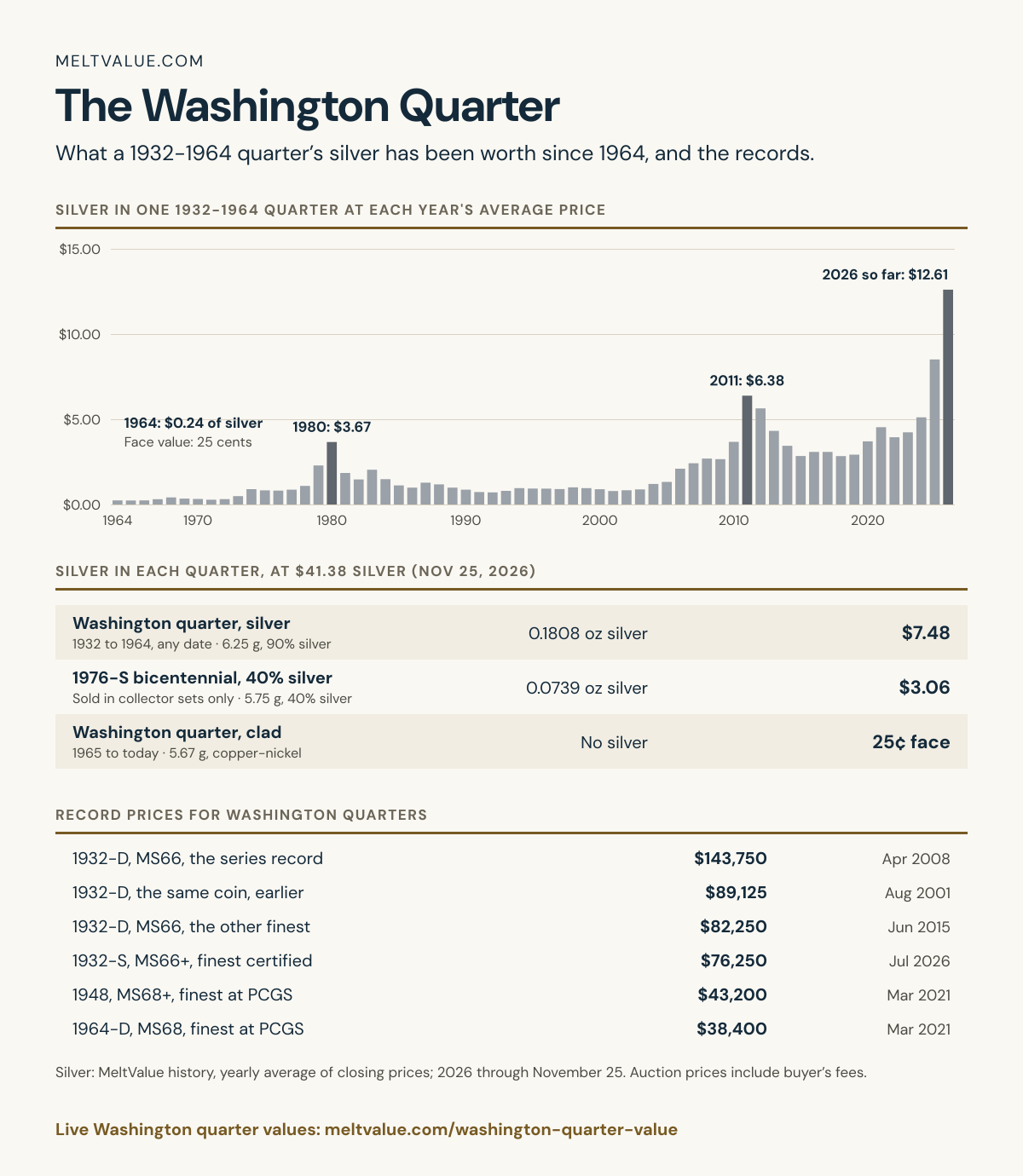
A Washington quarter dated 1932 to 1964 is 90% silver and worth $7.97 today. Later quarters are clad and worth 25 cents, apart from errors and a few scarce issues. The 1932-D and 1932-S bring around $100 in Fine condition, and the finest 1932-D sold for $143,750.
Silver $44.08 per troy ounce, updated November 27, 2026 at 2:42 AM EST.
Which Washington Quarters Are Silver
| Dates | Metal | Silver value |
|---|---|---|
| 1932 to 1964Every date and mint | 90% silver, 6.25 g | $7.97 |
| 1965 to todayCoins made for circulation | Copper-nickel clad, 5.67 g | None |
| 1976-S bicentennialCollector sets only | 40% silver, 5.75 g | $3.26 |
The Mint has also struck silver proof quarters for its silver proof sets since 1992. None of these circulated, so any quarter from change dated 1965 or later is clad. A clad quarter shows a copper stripe on its edge. More detail: silver quarter value and silver years.
What a Silver Washington Quarter Is Worth
Worn silver quarters from 1932 to 1964 sell for about their silver value, $7.97, or a little more. Most dates were struck in the tens of millions or more, so only condition, a rare mint mark or a variety lifts the price much above that. Uncirculated common dates bring a few dollars to tens of dollars more, and the single finest examples of some common dates have sold for tens of thousands.
The 1932-D and 1932-S
The Washington quarter debuted in 1932, in the depths of the Depression. Philadelphia struck 5,404,000, but Denver made only 436,800 and San Francisco 408,000, because banks needed few new coins. The Treasury was still selling uncirculated 1932-D and 1932-S quarters at face value plus postage in 1934. Today they are the two scarcest regular dates.
Worn, the two sell for similar prices, and the 1932-S may be the harder one to find. In Mint State the 1932-D is scarcer: it has the lowest MS65 population of any Washington quarter at PCGS. Here is what certified 1932-D quarters have sold for:
| 1932-D, grade | Price |
|---|---|
| Good to Fine 15PCGS Price Guide | Up to $140 |
| Very Fine 30Oct 2026 | $159 |
| About Uncirculated 53Aug 2026 | $342 |
| About Uncirculated 55Oct 2026 | $500 |
| MS64Jul 2026 | $2,806 |
| MS65May 2026 | $9,150 |
| MS66, one of the two finestOct 2025 | $78,000 |
Auction prices with buyer’s fees, except the first row. Fakes are common: an added D on a Philadelphia 1932 quarter is the usual trick, so buy only certified examples.
Other Rare Washington Quarters
| Coin | Value |
|---|---|
| 1932-DMintage 436,800. About 44,000 survive, 10,000 of them uncirculated. | About $100 in Fine; $9,150 in MS65 |
| 1932-SMintage 408,000, the lowest of the series. About 40,000 survive, 12,000 of them uncirculated. | Close to the 1932-D when worn; $76,250 for the finest |
| 1943 doubled die obverseThe scarcest major doubled die. PCGS has graded only about two dozen. Look at IN GOD WE TRUST and LIBERTY. | $144 in VG8; $22,250 in MS67 |
| 1937 doubled die obverseThe second scarcest of the five major doubled dies. | $21,150 for an MS66 |
| 1943-S doubled die obverseClear spread on IN GOD WE TRUST and LIBERTY. | $552 in MS64; $12,600 for an MS67 |
| 1934 doubled die obverseThe most dramatic and most common major doubled die. Strongest on IN GOD WE TRUST. | About $40 worn to $3,700 in top grades |
| 1965 on a silver planchetAn error. Weighs about 6.25 g instead of 5.67 g. | $7,050 to $16,800 at auction |
The five major doubled dies are the 1934, 1937, 1942-D, 1943 and 1943-S. Look for clearly doubled letters with notched serifs, not the flat, shelf-like smearing called machine doubling.
The 1965 Silver Quarter Error
When the Mint switched to clad quarters in 1965, a few leftover 90% silver planchets were struck with the new date. They weigh about 6.25 grams instead of 5.67, and the edge shows no copper. Examples have sold for $7,050 (AU53), $8,400 (AU55) and $16,800 (MS62). Weigh every 1965 quarter, and have a heavy one authenticated.
Scarce Clad Quarters
The Mint sold no uncirculated sets in 1982 and 1983, so few quarters from those years were saved new. Ordinary ones are worth face value, but gem uncirculated 1982 and 1983 quarters are scarce and carry a premium. Proof errors from the San Francisco Mint can bring thousands: a 1970-S proof quarter overstruck on a Canadian quarter sold for $7,800 in 2020, and one struck over a Philippine 25-centavo coin brought $4,600 in 2010.
The 1776-1976 dual-date quarters have their own guide: Bicentennial quarter value.
Silver Washington Quarter Calculator
Enter how many 1932 to 1964 quarters you have. Every date holds the same silver.
Silver value
$31.88
0.7232 troy oz of pure silver in $1.00 face value. A roll of 40 holds 7.23 oz.
Have a mix of silver coins? The junk silver calculator works from face value.
Record Prices
| Coin and grade | Sold for |
|---|---|
| 1932-D, MS66, the series recordApr 2008 | $143,750 |
| 1932-D, the same coin, earlierAug 2001 | $89,125 |
| 1932-D, MS66, the other finestJun 2015 | $82,250 |
| 1932-D, the other finest, againOct 2025 | $78,000 |
| 1932-S, MS66+, finest certifiedJul 2026 | $76,250 |
| 1932-D, the record coin, againJan 2018 | $74,400 |
| 1932-S, MS66Mar 2025 | $52,800 |
| 1948, MS68+, finest at PCGSMar 2021 | $43,200 |
| 1964-D, MS68, finest at PCGSMar 2021 | $38,400 |
| 1943 doubled die obverse, MS67Mar 2020 | $22,250 |
| 1937 doubled die obverse, MS66Jan 2013 | $21,150 |
| 1965 struck on a silver planchet, MS62Dec 2020 | $16,800 |
Auction prices include buyer’s fees. Only two 1932-D quarters are certified MS66, and their sales fill five of the six highest prices here. The list covers dates and varieties, not one-of-a-kind mint errors.
Where Is the Mint Mark?
| Dates | Mint mark |
|---|---|
| 1932 to 1964 | Back, below the wreath under the eagle. Philadelphia coins have none. |
| 1965 to 1967 | No mint marks on any quarter. |
| 1968 to 1979 | Front, right of the ribbon in Washington’s hair. Philadelphia coins have none. |
| 1980 to today | Front. Every coin carries one. |
D is Denver, S is San Francisco, P is Philadelphia and W is West Point.
Washington Quarter History
The Mint struck no quarters in 1931. For the 200th anniversary of George Washington’s birth in 1932, it replaced the Standing Liberty quarter with a portrait of Washington based on Jean-Antoine Houdon’s bust. The Commission of Fine Arts twice picked a design by Laura Gardin Fraser, but Treasury Secretary Andrew Mellon chose John Flanagan’s, and his successor kept it. Philadelphia began striking the new quarter in July 1932, and Denver and San Francisco followed in September. Quarter production stopped again in 1933.
The Coinage Act of 1965 took the silver out, and the quarter has been copper-nickel clad since. The eagle gave way to a colonial drummer for the 1976 bicentennial, then to state designs from 1999 and national park designs from 2010. In 2022, Fraser’s portrait finally replaced Flanagan’s on the front.
How to Sell Washington Quarters
- Sort silver from clad. Pull every quarter dated 1964 or earlier. Clad quarters from change are worth face value.
- Check the few that matter. Look for a D or S below the wreath on any 1932, weigh every 1965, and check the 1934, 1937 and 1943 for doubled lettering.
- Sell worn silver by face value or weight. Buyers pay close to melt for circulated 90% silver.
- Grade only the best. A plain uncirculated silver quarter is rarely worth the grading fee. The 1932-D, 1932-S, doubled dies and errors are.
More on quarters: the 1964 quarter value covers the last silver year, the Standing Liberty quarter came before it, and how much a quarter weighs covers every type.
Sources
- Wikipedia: Washington quarter: the Fraser and Flanagan design contest, the switch to clad in 1965 and the later redesigns
- U.S. Mint: The woman behind the long-awaited obverse quarter design: Laura Gardin Fraser’s 1932 design and its use on quarters from 2022
- PCGS CoinFacts: 1932-D 25C: the 436,800 mintage, about 44,000 survivors, the lowest MS65 population of the series, the sales of the two MS66 coins, and fakes made by adding a D
- PCGS CoinFacts: 1932-S 25C: the 408,000 mintage and about 40,000 survivors, 12,000 of them uncirculated
- PCGS Set Registry: 1932-D 25C expert comments: production starting in July 1932 at Philadelphia and September at Denver and San Francisco, and why so few D and S coins were struck
- PCGS: Tips for using PCGS auction prices data: PCGS Price Guide values for worn 1932-D quarters
- PCGS Auction Prices: Washington quarters: auction records by date, including $143,750 for the 1932-D and $38,400 for the 1964-D
- CoinWeek: 1932-S Washington quarter, the 25-cent coin that reached $76,250: the 1932-S record and the Treasury still selling uncirculated 1932-S quarters at face value in 1934
- CoinWeek: The only MS66+ 1932-S quarter: the $52,800 MS66 1932-S sold in March 2025
- Newman Numismatic Portal: 1948 25c: the 1948 MS68+ sale at $43,200
- PCGS CoinFacts: 1943 25C doubled die obverse: the scarcest major doubled die, with about two dozen graded
- CoinWeek: The wartime quarter that became a $22,250 rarity: the MS67 1943 doubled die at $22,250
- PCGS CoinFacts: 1937 25C doubled die obverse: its rank among the five major doubled dies and the MS66 sale at $21,150
- PCGS CoinFacts: 1934 25C doubled die obverse: the most dramatic and most common major doubled die, strongest on IN GOD WE TRUST
- Newman Numismatic Portal: 1943-S 25c doubled die obverse: recent sales from $552 in MS64 to $12,600 in MS67
- Coin World: Coveted 1965 Washington quarter error sells: a 1965 quarter on a 90% silver planchet selling for $7,050
- Newman Numismatic Portal: 1965 quarter errors: the 1965 silver planchet error at $16,800 in December 2020
- Newman Numismatic Portal: 1970-S proof quarter: a 1970-S proof overstruck on a Canadian quarter at $7,800
- Coin World: Market analysis of the 1932-D and 1932-S quarters: the two first-year rarities