
Barber Quarter Value
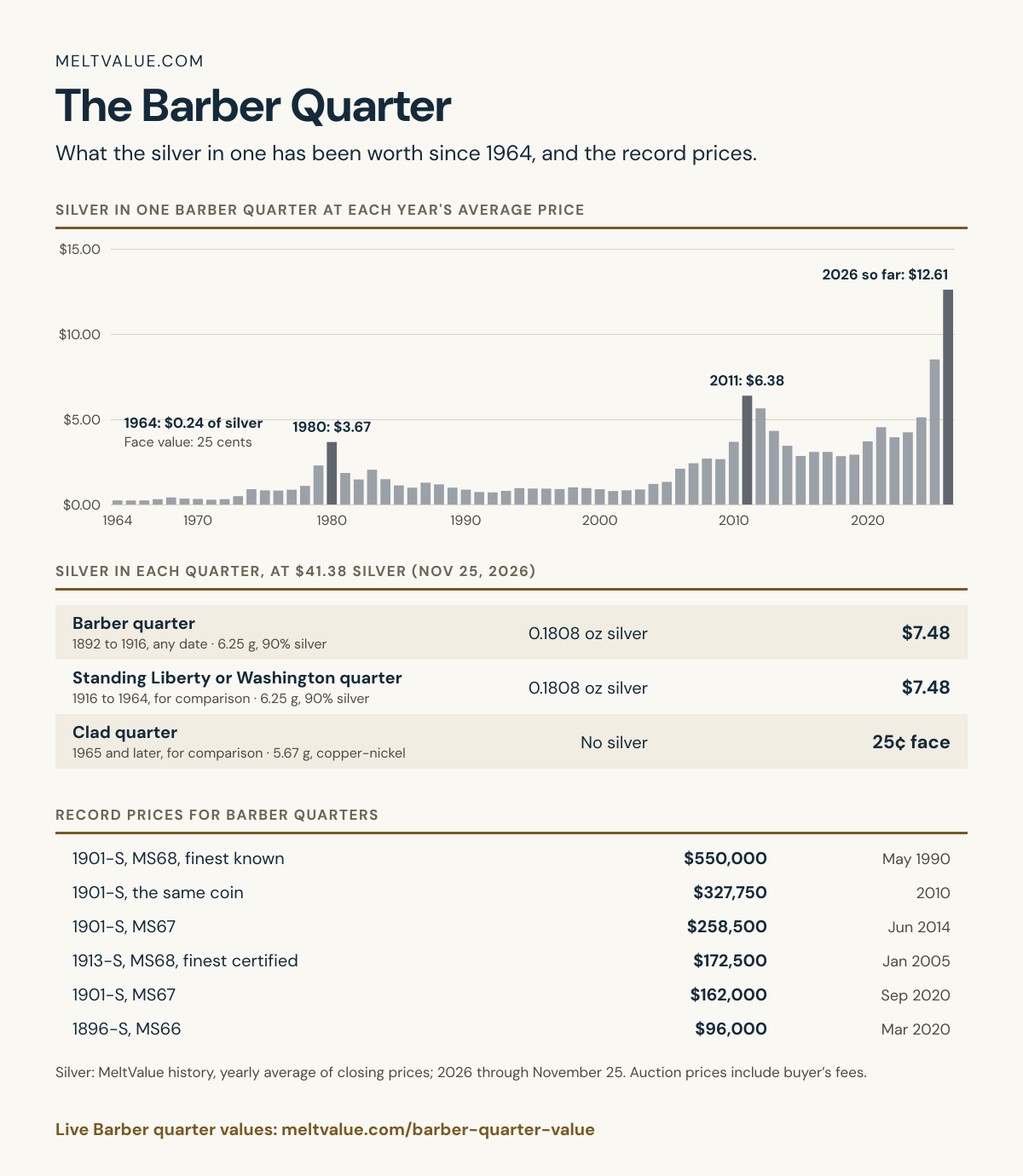
Most Barber quarters are worth their silver, $7.97 today, or a few dollars more. Common dates in Good condition sell for about $14 to $20. Three San Francisco dates, the 1896-S, 1901-S and 1913-S, bring $750 to $5,250 even in Good condition, and the finest 1901-S has sold for $550,000.
Silver $44.08 per troy ounce, updated November 27, 2026 at 2:42 AM EST.
Barber Quarter Value by Condition
Typical prices for common dates such as 1899, 1904 and 1914. Rare dates are in the next section.
| Condition | Typical value |
|---|---|
| Worn smoothDate barely readable | $7.97, silver value |
| Good to Very GoodUp to a few letters of LIBERTY show | About $14 to $20 |
| Fine to Very FineAll of LIBERTY readable | About $22 to $45 |
| Extremely Fine to About UncirculatedLight wear on the cheek, hair and eagle | About $75 to $210 |
| Uncirculated, MS63No wear, some marks | About $350 to $425 |
| Uncirculated, MS65Few marks, strong luster | About $700 to $1,300 |
Typical retail values for raw coins from Coin World’s guide. Cleaned or damaged coins sell for less, and dealers pay below retail.
The word LIBERTY on the headband is the quick grading clue. On a coin in Good condition few if any letters remain, and Very Good needs at least three. When every letter is readable, the coin grades Fine or better and sells for more.
Rare Barber Quarters
These dates sell well above silver in any condition. Values for coins graded by PCGS are from the PCGS Price Guide; survivor counts are PCGS estimates; records are the highest auction prices PCGS has logged for each date.
| Date | Good 4 |
|---|---|
| 1901-SMintage: 72,664. About 2,000 survive, most in About Good or Good. | $5,250Fine: $15,000Record: $550,000 |
| 1913-SMintage: 40,000. Lowest mintage of the series. About 2,500 survive. | $1,350Fine: $5,250Record: $172,500 |
| 1896-SMintage: 188,039. About 2,000 survive. | $750Fine: $2,750Record: $96,000 |
| 1897-SMintage: 542,229. Long overshadowed by the 1896-S. | $115Fine: $350Record: $47,000 |
| 1914-SMintage: 264,000. Same mintage as the 1916-D Mercury dime. | $120Fine: $375Record: $29,375 |
| 1909-OMintage: 712,000. The last quarter struck at New Orleans. | $125Fine: $575Record: $37,375 |
| 1913Mintage: 484,000. Lowest Philadelphia mintage of the series. | $50Fine: $150Record: $25,300 |
Collectors call the 1896-S, 1901-S and 1913-S the Big Three of the series.
Why the 1901-S Beats the 1913-S
The 1913-S has the lowest mintage, 40,000, fewer than any other regular-date U.S. silver coin of the 20th century. The 1901-S is still the rarer coin. In 1901 hardly anyone collected coins by mint mark, so almost none were saved, and the rest wore down in circulation for decades. PCGS estimates about 2,000 1901-S quarters survive, with about 80 in Mint State. More 1913-S quarters were set aside when new, and PCGS puts its figures at about 2,500 and 150.
A hoard pulled from New York City subway coins starting in the 1940s shows the same order. It held 8 examples of the 1901-S, 19 of the 1913-S, 29 of the 1896-S and 40 of the 1914-S. One surprise came in 1994, when a high-grade 1901-S turned up in a schoolhouse cornerstone in Reno, Nevada. PCGS later graded it MS65.
Fake 1901-S Quarters
Fakes of the 1901-S are common. NGC reports die-struck copies, altered dates and added mint marks, such as an S added to a Philadelphia 1901. Only two die pairs are known for the real coin, so specialists check the position of the date and mint mark against them. Buy one only in a PCGS or NGC holder, and have any raw coin authenticated before you sell it.
The same caution applies to the 1896-S and 1913-S. On every genuine 1896-S, the S sits above the space between the R of QUARTER and the D of DOLLAR.
Low-Mintage Barber Quarters
Fourteen Barber quarters were struck in quantities under one million. Check for these dates and mint marks before selling a group as silver.
| Date | Mintage |
|---|---|
| 1892-S | 964,079 |
| 1896-S | 188,039 |
| 1897-S | 542,229 |
| 1899-S | 708,000 |
| 1901-S | 72,664 |
| 1908-S | 784,000 |
| 1909-O | 712,000 |
| 1911-D | 933,600 |
| 1911-S | 988,000 |
| 1912-S | 708,000 |
| 1913 | 484,000 |
| 1913-S | 40,000 |
| 1914-S | 264,000 |
| 1915-S | 704,000 |
In all, the Mint struck more than 260 million Barber quarters for circulation, so most dates are common.
Barber Quarter Silver Calculator
Enter how many you have. Every date holds the same silver.
Silver value
$79.70
1.808 troy oz of pure silver in $2.50 face value. Rare dates are worth far more than their silver.
Mixing Barber quarters with other silver coins? The junk silver calculator works from face value.
Record Prices
| Coin and grade | Sold for |
|---|---|
| 1901-S, MS68, finest knownMay 1990 | $550,000 |
| 1901-S, the same coin2010 | $327,750 |
| 1901-S, MS67Jun 2014 | $258,500 |
| 1913-S, MS68, finest certifiedJan 2005 | $172,500 |
| 1901-S, MS67Sep 2020 | $162,000 |
| 1896-S, MS66Mar 2020 | $96,000 |
| 1892 Proof, finest known Deep CameoJul 2008 | $46,000 |
Auction prices include buyer’s fees. No Barber quarter has brought more at auction than the 1990 record; the same 1901-S sold for $327,750 in 2010. The 1913-S that set its record in 2005 resold for $86,250 in 2009.
How to Identify a Barber Quarter
- Front: Liberty faces right, wearing a cap, a laurel wreath and a headband marked LIBERTY. IN GOD WE TRUST runs above her, 13 stars circle the edge, and the date sits below.
- Back: a heraldic eagle based on the Great Seal, with a shield on its breast, arrows and an olive branch in its talons, and an E PLURIBUS UNUM ribbon in its beak. UNITED STATES OF AMERICA and QUARTER DOLLAR run around the edge.
- Mint mark: just below the eagle’s tail. O for New Orleans, S for San Francisco, D for Denver from 1906, none for Philadelphia.
- Specs: 6.25 grams, 24.3 mm, reeded edge, 90% silver and 10% copper.
A full standing figure of Liberty means a Standing Liberty quarter from 1916 to 1930. A Barber dime has the same portrait but a wreath on the back; see the Barber dime value. The Barber half dollar uses the same portrait and eagle on a larger coin.
1892 Type I and Type II
The first 1892 quarters had a reverse in relief too high for the coins to stack well, so Barber lowered the relief during the year. To tell them apart, look at the E in UNITED. On Type I the eagle’s wing barely touches the E, and its middle crossbar shows. On Type II the larger wing covers that crossbar. Collectors remember it as “now you see it, now you don’t.” Both types exist for Philadelphia, New Orleans and San Francisco, and Type I is the harder one to find.
Proof Barber Quarters
The Philadelphia Mint struck proofs for collectors every year from 1892 to 1915, from 1,245 in 1892 down to 380 in 1914. They have mirror fields and sharp detail. Proof 67 coins have sold for about $2,000 to $8,400 at auction in recent years, and the finest known 1892 Deep Cameo brought $46,000.
Barber Quarter History
An 1890 law let the Mint replace coin designs that had been in use for 25 years, and the Seated Liberty quarter had run since 1838. In 1891 Mint Director Edward Leech held an open contest for new silver designs. A jury that included Augustus Saint-Gaudens rejected every entry, and Leech gave the job to Chief Engraver Charles Barber.
Barber’s quarter entered production on January 2, 1892, alongside his dime and half dollar. Leech asked for an eagle adapted from the Great Seal on the quarter and half. The design ran through 1916, when the Standing Liberty quarter replaced it.
How to Sell Barber Quarters
- Sort by date and mint mark. Pull out every S-mint coin and the low-mintage dates above, above all any 1896-S, 1901-S or 1913-S.
- Sell worn common dates as silver. Buyers price them by face value or by count, a little over melt.
- Leave them dirty. Cleaning leaves fine scratches and lowers the value of any collectible coin.
- Grade the best. Uncirculated coins and rare dates are worth sending to PCGS or NGC before selling.
More on silver quarters: the silver quarter value covers every silver year, and the 1964 quarter value covers the last one.
Sources
- Wikipedia: Barber coinage: the 1890 law, the failed 1891 design contest, the January 2, 1892 start, the heraldic eagle reverse, the mint mark below the eagle and the 1916 replacement
- Wikipedia: United States quarter mintage figures: every Barber quarter mintage, including proofs
- PCGS CoinFacts: 1901-S 25C: about 2,000 survivors, 80 in Mint State, the Reno cornerstone coin, and the $550,000, $327,750 and $258,500 sales
- PCGS CoinFacts: 1913-S 25C: about 2,500 survivors, 150 in Mint State, and the MS68 sales at $172,500 in 2005 and $86,250 in 2009
- PCGS CoinFacts: 1896-S 25C: about 2,000 survivors and the mint mark position above the space between R and D
- PCGS CoinFacts: 1892 25C: the Type I and Type II reverses of 1892
- PCGS CoinFacts: 1892 25C Deep Cameo Proof: the finest known Deep Cameo proof at $46,000 in July 2008
- PCGS Price Guide: Barber quarters: Good and Fine values for the rare dates
- PCGS Auction Prices: Barber quarters: the auction record for each date, including the $96,000 1896-S
- NGC Auction Central: Barber quarters: the top prices realized, including the 1901-S MS67 at $162,000 in September 2020
- NGC: Counterfeit detection, deception includes condition: die-struck copies, altered dates and added mint marks on the 1901-S
- CoinWeek: An “authenticated” counterfeit 1901-S Barber quarter: the two known die pairs for the 1901-S
- CoinWeek: 1892 Barber quarter, a collector’s guide: why the reverse relief was lowered in 1892
- Numismatic News: ‘S’ Barber quarters toughest of 20th century?: the New York subway hoard counts
- Numismatic News: 1897-S quarter hidden behind giants: the 1914-S sharing the 264,000 mintage of the 1916-D Mercury dime
- Numismatic News: Barber quarter easier in Mint State: the 1897-S in the shadow of the 1896-S
- Numismatic News: 1913-S Barber has no place to go but up: the 1913-S as the lowest-mintage regular-date silver coin of the 20th century
- Coin World: 1899 Barber quarter dollar values: values by grade for common dates
- Newman Numismatic Portal: Barber quarter proofs: recent Proof 67 sale prices