
Barber Half Dollar Value
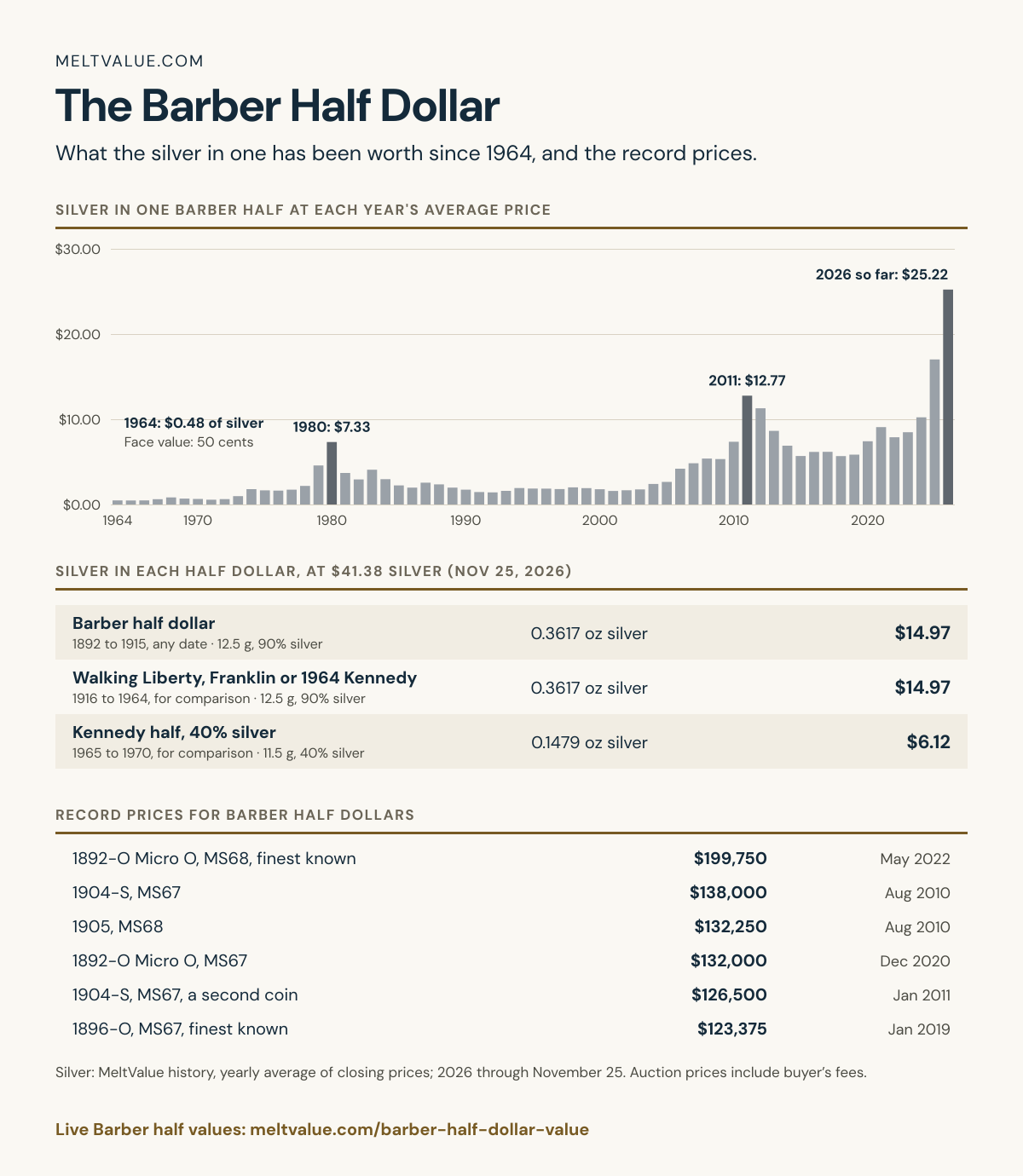
A worn Barber half dollar is worth about its silver, $15.94 today. Better-preserved coins sell for more, and the rare dates below bring $95 to $375 even in Good condition. The rarest, the 1892-O Micro O, sells for thousands worn and has topped $199,000.
Silver $44.08 per troy ounce, updated November 27, 2026 at 2:42 AM EST.
Barber Half Dollar Value by Condition
PCGS Price Guide values for common dates, such as the 1915-D, in PCGS holders. Rare dates are in the next section.
| Condition | Value |
|---|---|
| Worn below GoodRims worn into the letters | About $15.94, the silver value |
| Good 4Little or none of LIBERTY shows | $55 |
| Fine 12All of LIBERTY readable | $120 |
| Very Fine 30LIBERTY sharp, wear on the high points | $235 |
| Extremely Fine 40Light wear on the cheek, hair and eagle | $275 |
| Uncirculated, MS63No wear, some marks | $1,075 |
| Uncirculated, MS65Few marks, strong luster | $2,250 |
Raw coins sell for less than graded ones, and well-worn common dates trade close to their silver value. Cleaned or damaged coins bring less, and dealers pay below retail.
The word LIBERTY on Liberty’s headband is the quick grading clue. In Good it is gone or nearly gone. When every letter is readable, the coin grades Fine or better and the price roughly doubles.
Rare Barber Half Dollars
These dates sell well above silver in any condition. Values for coins graded by PCGS are from the PCGS Price Guide; survivor counts are PCGS estimates; records are the highest auction prices PCGS has logged for each date.
| Date | Good 4 |
|---|---|
| 1892-O Micro OMintage: part of 390,000. About 85 survive. | About $5,800Record: $199,750 |
| 1892-OMintage: 390,000. About 1,500 survive. | $375Fine: $725Record: $108,688 |
| 1892-SMintage: 1,029,028. About 2,500 survive. | $300Fine: $600Record: $32,200 |
| 1893-SMintage: 740,000. Among the scarcest dates. | $185Fine: $625Record: $29,900 |
| 1896-SMintage: 1,140,948. Scarce despite a mintage over one million. | $135Fine: $475Record: $54,625 |
| 1897-OMintage: 632,000. About 1,000 survive. | $175Fine: $475Record: $43,125 |
| 1897-SMintage: 933,900. About 2,000 survive. | $200Fine: $400Record: $43,125 |
| 1901-SMintage: 847,044. Jumps to $1,500 in Extremely Fine 40. | $110Fine: $375Record: $86,250 |
| 1904-SMintage: 553,038. About 1,750 survive, only 120 in Mint State. | $95Fine: $500Record: $138,000 |
| 1913Mintage: 188,000. Third lowest mintage of the series. | $125Fine: $350Record: $19,388 |
| 1914Mintage: 124,230. Lowest mintage of the series. | $135Fine: $400Record: $37,375 |
| 1915Mintage: 138,000. The last Barber half from Philadelphia. | $100Fine: $325Record: $42,300 |
The Micro O value in Good is from 2025 auction sales. In the mid-1970s, collector James Bennett Pryor found an original roll of 1892-S halves; he kept the best one and offered the other 19, all frosty gems, to dealer Jim Halperin.
The 1892-O Micro O
In 1892 the New Orleans Mint struck its first half dollars since 1861, 390,000 of them. On one die, a Mint worker punched the O with a tool meant for a smaller coin, most likely the quarter. The result is a tiny O under the eagle’s tail. On a regular 1892-O, the mint mark has even walls and an oval opening, shaped like the O in DOLLAR just below it.
PCGS estimates about 85 survive in all grades and only about 20 in Mint State. Worn examples sold for $5,760 to $8,550 in 2025. The finest known, an MS68 once in the Eliasberg collection, sold for $199,750 in May 2022. Check any 1892-O against a magnifier before you sell it, and send a possible Micro O to PCGS or NGC.
High-Grade Rarities: 1904-S and 1896-O
Some Barber halves are cheap worn and very expensive new. The 1904-S lists at $95 in Good but $3,500 in Extremely Fine and $12,750 in MS60. PCGS estimates about 1,750 survive, only about 120 of them in Mint State. Two MS67 coins have sold for $138,000 (2010) and $126,500 (2011).
The 1896-O is another. Collector J. M. Clapp bought the finest known straight from the New Orleans Mint in August 1896, and that coin, now graded MS67, sold for $123,375 in January 2019.
The 1913, 1914 and 1915 Halves
Philadelphia struck only 188,000 halves in 1913, 124,230 in 1914 and 138,000 in 1915. They are the only three U.S. half dollars of the 20th century with mintages under 200,000. Collectors prize even worn examples, so many have been graded, and they sell for $100 to $135 in Good. Gems are scarce.
Low-Mintage Barber Half Dollars
Twenty-one Barber halves were struck for circulation in quantities under one million. Check for these dates and mint marks before selling a group as silver.
| Date | Mintage |
|---|---|
| 1892 | 934,000 |
| 1892-O | 390,000 |
| 1893-S | 740,000 |
| 1896 | 950,000 |
| 1896-O | 924,000 |
| 1897-O | 632,000 |
| 1897-S | 933,900 |
| 1898-O | 874,000 |
| 1901-S | 847,044 |
| 1904-S | 553,038 |
| 1905 | 662,000 |
| 1905-O | 505,000 |
| 1909-O | 925,400 |
| 1910 | 418,000 |
| 1911-D | 695,080 |
| 1913 | 188,000 |
| 1913-D | 534,000 |
| 1913-S | 604,000 |
| 1914 | 124,230 |
| 1914-S | 992,000 |
| 1915 | 138,000 |
A low mintage does not always mean a high price. The 1892, with 934,000 struck, is the most common date of the series because the new design was an instant hit with collectors.
Barber Half Dollar Silver Calculator
Enter how many you have. Every date holds the same silver.
Silver value
$159.44
3.617 troy oz of pure silver in $5.00 face value. Rare dates are worth far more than their silver.
Mixing Barber halves with other silver coins? The junk silver calculator works from face value.
Record Prices
| Coin and grade | Sold for |
|---|---|
| 1892-O Micro O, MS68, finest knownMay 2022 | $199,750 |
| 1904-S, MS67Aug 2010 | $138,000 |
| 1905, MS68Aug 2010 | $132,250 |
| 1892-O Micro O, MS67Dec 2020 | $132,000 |
| 1904-S, MS67, a second coinJan 2011 | $126,500 |
| 1896-O, MS67, finest knownJan 2019 | $123,375 |
| 1892-O, Specimen 66Apr 2013 | $108,688 |
Auction prices include buyer’s fees. The 1904-S that brought $138,000 in 2010 resold for $91,063 in 2015.
How to Identify a Barber Half Dollar
- Front: Liberty faces right, wearing a cap, a laurel wreath and a headband marked LIBERTY. IN GOD WE TRUST runs above her, 13 stars circle the edge, and the date sits below.
- Back: a heraldic eagle based on the Great Seal, holding arrows and an olive branch, with an E PLURIBUS UNUM ribbon in its beak and 13 stars above. UNITED STATES OF AMERICA and HALF DOLLAR run around the edge.
- Mint mark: below the eagle’s tail, above the D in DOLLAR. O for New Orleans, S for San Francisco, D for Denver from 1906, none for Philadelphia.
- Specs: 12.5 grams, 30.6 mm, reeded edge, 90% silver and 10% copper.
A walking figure of Liberty means a Walking Liberty half dollar from 1916 to 1947. The Barber quarter uses the same portrait and eagle on a smaller coin.
Proof Barber Half Dollars
The Philadelphia Mint struck proofs for collectors every year from 1892 to 1915: 1,245 in the first year and fewer than 1,000 in most later years. They have mirror fields and sharp detail. The top auction prices PCGS has logged for proofs run from $10,350 for the 1908 to $80,500 for the 1897.
Barber Half Dollar History
An 1890 law let the Mint replace coin designs that had been in use for 25 years. In 1891 Mint Director Edward Leech held an open contest for new silver designs. A jury that included Augustus Saint-Gaudens rejected every entry, and Leech gave the job to Chief Engraver Charles Barber.
The first Barber halves were struck at Philadelphia on January 2, 1892, alongside the new dime and quarter. Halves came from Philadelphia, New Orleans, San Francisco and, from 1906, Denver. None were struck in 1916, when Adolph Weinman’s Walking Liberty design took over.
How to Sell Barber Half Dollars
- Sort by date and mint mark. Pull out the rare dates above, every 1892-O for a Micro O check, and the 1913, 1914 and 1915.
- Sell worn common dates as silver. Buyers price them by face value or by count, close to melt.
- Leave them dirty. Cleaning leaves fine scratches and lowers the value of any collectible coin.
- Grade the best. Uncirculated coins and rare dates are worth sending to PCGS or NGC before selling.
More on silver halves: the silver half dollar melt value covers every silver year, and the 1964 Kennedy half dollar value covers the last 90% silver one.
Sources
- Wikipedia: Barber coinage: the 1890 law, the failed 1891 design contest, the heraldic eagle reverse and the half dollar’s specifications
- Wikipedia: United States half dollar mintage figures: Barber half mintages, with the Micro O counted in the 1892-O total
- PCGS: 21 Barber half dollars with mintages under 1 million: the 21 business-strike issues under one million
- PCGS CoinFacts: 1892-O 50C Micro O: about 85 survivors, 20 in Mint State, and the quarter-size mint mark punch
- PCGS CoinFacts: 1892-O 50C: about 1,500 survivors and the regular mint mark shape
- PCGS CoinFacts: 1892-S 50C: about 2,500 survivors and the roll James Bennett Pryor found in the 1970s
- PCGS CoinFacts: 1897-O 50C: about 1,000 survivors
- PCGS CoinFacts: 1897-S 50C: about 2,000 survivors
- PCGS CoinFacts: 1904-S 50C: about 1,750 survivors, 120 in Mint State, and the MS67 sales at $138,000 and $126,500
- PCGS CoinFacts: 1896-O 50C: the finest known, bought from the New Orleans Mint in August 1896
- PCGS CoinFacts: 1914 50C: the lowest mintage of the series and demand for circulated examples
- PCGS Price Guide: Barber half dollars: values by grade for common and rare dates
- PCGS Auction Prices: Barber half dollars: the auction record for each date, including proofs
- NGC Auction Central: Barber half dollars: the top prices realized, including the 1905 MS68 and the Micro O MS67
- PCGS: Important collections draw record bidding: the 1896-O MS67 at $123,375
- CoinWeek: Coin profile, 1892-O Barber half dollar, Micro O: the finest known Micro O selling for $199,750 in May 2022
- Numismatic News: 1913 overshadowed by other good Barbers: the only three half dollars of the 20th century with mintages under 200,000
- Newman Numismatic Portal: Barber halves: worn common dates trading close to melt and the scarcest dates
- Coin World: 1897 Barber half dollar: the first strikes on January 2, 1892, no halves in 1916, and the Walking Liberty replacement