
Standing Liberty Quarter Value
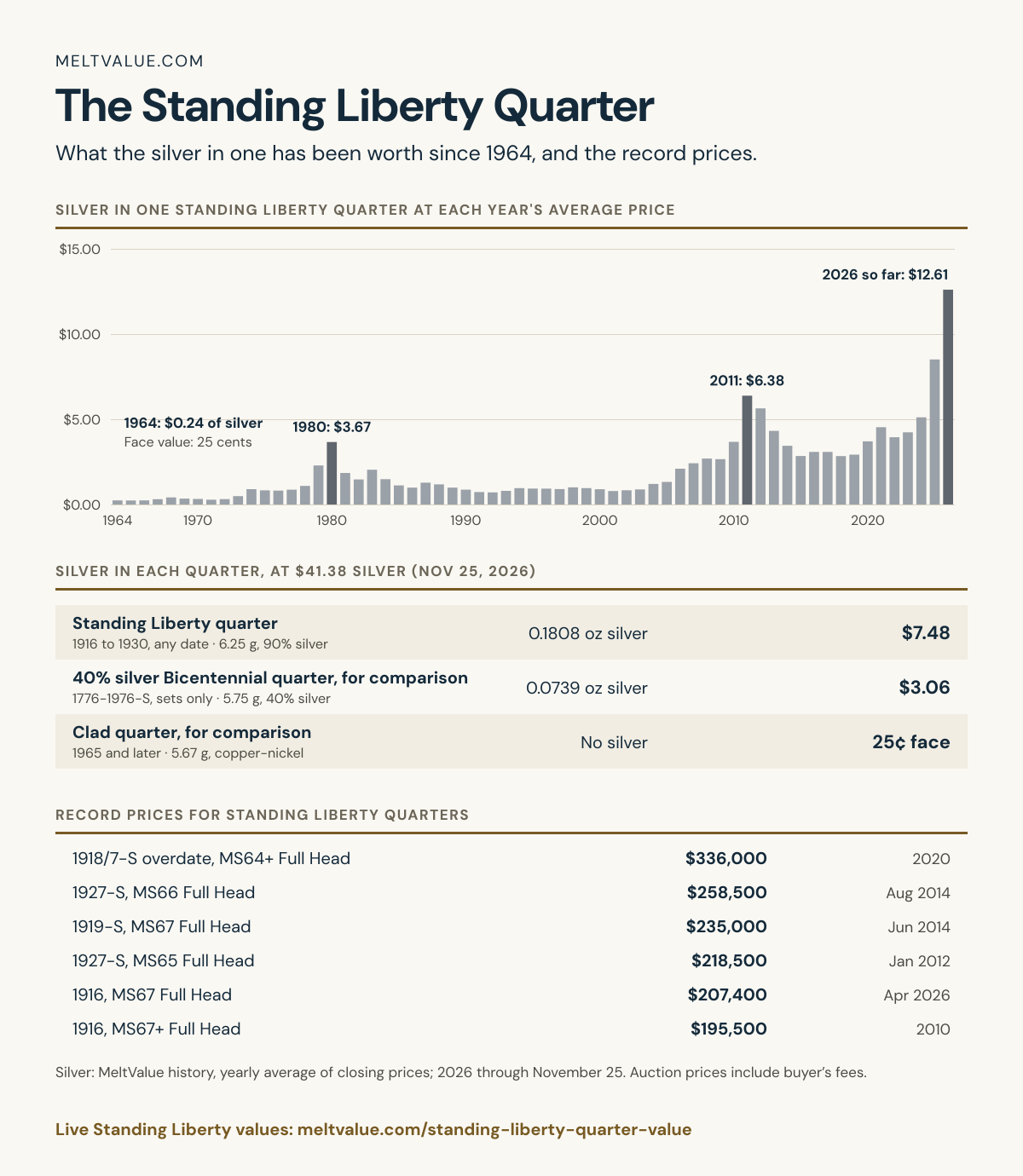
Every Standing Liberty quarter is worth at least its silver: $7.98 today. Worn common dates sell for a little more, about $10 to $20 when the date still shows. Five rare dates, the 1916, 1918/7-S, 1921, 1923-S and 1927-S, sell well above silver, and fully struck “Full Head” coins have sold for more than $300,000.
Silver $44.13 per troy ounce, updated November 27, 2026 at 2:38 AM EST.
Three Types of Standing Liberty Quarter
Hermon MacNeil’s quarter was struck from 1916 to 1930 in three versions. Check the eagle side first: stars below the eagle mean Type 2 or 3.
| Type | How to spot it |
|---|---|
| Type 1, 1916 to 19171916, 1917, 1917-D, 1917-S | Liberty’s right breast is bare. No stars below the eagle. Date raised on the step under her feet. |
| Type 2, 1917 to 19241917 to 1924, all mints | Liberty wears a coat of chain mail. Three stars sit below a higher eagle. Date still raised, so it wore off fast. |
| Type 3, 1925 to 19301925 to 1930, all mints | Same as Type 2, but the date is recessed into the step, so it survives wear far better. |
Standing Liberty Quarter Value by Condition
Typical prices for common dates such as 1926, 1929 and 1930. Rare dates are listed in the next section.
| Condition | Typical value |
|---|---|
| No date visibleWorn smooth where the date was | $7.98, silver value |
| Good to Very GoodDate readable, little detail left | About $10 to $20 |
| Fine to Very FineShield and gown folds show | About $25 to $40 |
| Extremely Fine to About UncirculatedLight wear on the high points | About $60 to $120 |
| Uncirculated, MS63No wear, some marks | About $220 to $320 |
| MS63 Full HeadSame, with every hair line struck up | About $500 to $600 |
| MS66 Full HeadNear perfect and fully struck | About $4,000 to $5,000 |
Typical retail values and recent public sale prices. Cleaned or damaged coins sell for less, and dealers pay below retail.
Rare Standing Liberty Quarters
Most of these dates sell well above silver even when worn. Values are PCGS estimates. The 1927-D shows that a low mintage does not always mean a high price.
| Date | Worn |
|---|---|
| 1916Mintage: 52,000. About 10,750 survive. Type 1 with no stars below the eagle. | About $3,000 in Good 4Uncirculated: Nearly $20,000 in MS63 Full Head |
| 1918/7-S overdateMintage: Unknown, part of the 1918-S. A 7 shows under the last 8. About 3,000 survive; the rarest coin in the series. | About $1,700 in Good 4Uncirculated: $50,000 and up in Mint State Full Head |
| 1927-SMintage: 396,000. Lowest mintage after 1916. Cheap when worn, very rare in top grades. | About $50 to $75 in Good to Very GoodUncirculated: About $47,500 in MS63 Full Head |
| 1923-SMintage: 1,360,000. Scarce in every grade. | About $400 in Good 4Uncirculated: Nearly $4,000 in MS63 Full Head |
| 1921Mintage: 1,916,000. Lowest Philadelphia mintage after 1916. | About $150 in Good 4Uncirculated: About $3,000 in MS63 Full Head |
| 1927-DMintage: 976,000. Low mintage, but priced only a little above other Type 3 coins. | Near common-date pricesUncirculated: A modest premium over common dates |
The 1916 is rare because the Mint struck all 52,000 in the last two weeks of December 1916, and they did not reach the public until January 17, 1917. The 1918/7-S overdate came from a 1917 working die that was struck again with a 1918 hub, so a 7 shows inside the final 8. No one knows how many were made.
What Full Head Means
The presses often failed to bring up the fine detail of Liberty’s head. Graders add “Full Head” (FH) to coins that show it complete. For Type 2 and Type 3 coins, PCGS requires a complete hairline, three distinct leaves in Liberty’s hair and a visible ear hole.
The label changes prices more than almost anything else in the series. A 1926 in MS63 sold for $216 to $276 in 2024, while the same grade with Full Head brings about twice that. Some Denver and San Francisco dates from the 1920s are almost never fully struck: a 1926-D, a common coin without the label, sold for $19,520 to $23,400 in MS65 Full Head in 2026.
Dateless Standing Liberty Quarters
Until 1925 the date sat on a raised step, and it was among the first parts to wear away. Mint officials noticed worn dates coming back in late 1924 and recessed the step, so coins dated 1925 to 1930 usually keep their dates.
- Stars below the eagle: a dateless Type 2 from 1917 to 1924. It is worth its silver value, $7.98 today.
- No stars below the eagle: a Type 1 from 1916 or 1917. Specialists can tell the two years apart, so have it checked. A dateless 1916 is still worth far more than its silver.
- Skip the acid. Date-restoring chemicals etch the metal. Collectors treat the result as damage, so a restored coin is worth less than an untouched one.
Standing Liberty Quarter Silver Calculator
Enter how many you have. Any date, worn or dateless, holds the same silver.
Silver value
$7.98
0.1808 troy oz of pure silver in $0.25 face value. Check dates and mint marks first: rare dates are worth far more than silver.
Selling a mix of old silver coins? The junk silver calculator works from face value.
Record Prices
| Coin and grade | Sold for |
|---|---|
| 1918/7-S overdate, MS64+ Full Head2020 | $336,000 |
| 1927-S, MS66 Full HeadAug 2014 | $258,500 |
| 1919-S, MS67 Full HeadJun 2014 | $235,000 |
| 1927-S, MS65 Full HeadJan 2012 | $218,500 |
| 1916, MS67 Full HeadApr 2026 | $207,400 |
| 1916, MS67+ Full Head2010 | $195,500 |
Public auction results, including buyer’s fees.
Standing Liberty Quarter Mintages
The three mints struck 226,770,400 Standing Liberty quarters. None were made in 1922.
| Year | Phila. | Denver | S.F. |
|---|---|---|---|
| 1916 | 52,000 | None | None |
| 1917 Type 1 | 8,740,000 | 1,509,200 | 1,952,000 |
| 1917 Type 2 | 13,880,000 | 6,224,400 | 5,552,000 |
| 1918 | 14,240,000 | 7,380,800 | 11,072,000 |
| 1919 | 11,324,000 | 1,944,000 | 1,836,000 |
| 1920 | 27,860,000 | 3,586,400 | 6,380,000 |
| 1921 | 1,916,000 | None | None |
| 1923 | 9,716,000 | None | 1,360,000 |
| 1924 | 10,920,000 | 3,112,000 | 2,860,000 |
| 1925 | 12,280,000 | None | None |
| 1926 | 11,316,000 | 1,716,000 | 2,700,000 |
| 1927 | 11,912,000 | 976,000 | 396,000 |
| 1928 | 6,336,000 | 1,627,600 | 2,644,000 |
| 1929 | 11,140,000 | 1,358,000 | 1,764,000 |
| 1930 | 5,632,000 | None | 1,556,000 |
The 1918/7-S overdate is part of the 1918-S total.
Specifications
- Weight: 6.25 grams
- Metal: 90% silver, 10% copper
- Pure silver: 0.1808 troy ounces
- Diameter: 24.3 mm, reeded edge
- Mint mark: at the base of the wall, just left of Liberty’s foot
Standing Liberty Quarter History
In 1916 the Mint replaced the Barber designs on the dime, quarter and half dollar (see the Barber quarter value). Chief Engraver Charles Barber’s own sketches were rejected in March 1916, and the quarter went to sculptor Hermon MacNeil. Barber’s lack of cooperation delayed the work, and only 52,000 quarters dated 1916 were struck, at the end of December.
The Mint changed MacNeil’s design without asking him, and he objected in January 1917. His revised version, finished that February, covered Liberty in chain mail, raised the eagle and moved three stars beneath it. Congress approved the change, and it became law on July 9, 1917. The popular story that public outrage over Liberty’s bare breast forced the change is a myth: coin historian David Lange found no evidence of an outcry, and objections inside the Treasury are the likelier cause.
Worn dates led to the recessed date of 1925. No quarters were struck in 1922, and none in 1931, when the Depression cut demand. Congress then chose the quarter to honor George Washington’s 200th birthday, and the Washington quarter replaced MacNeil’s design in 1932.
How to Sell Standing Liberty Quarters
- Sort first. Pull out the 1916, 1921, 1923-S and 1927-S, any 1918-S (check for a 7 under the 8), and any Type 1 coin without stars under the eagle.
- Sell worn common dates as silver. Dateless and well-worn coins trade on silver content, often a little above it.
- Do not clean them. Cleaning cuts the price of any coin worth more than silver.
- Grade the best. Uncirculated coins, possible Full Heads and rare dates are worth sending to PCGS or NGC before selling.
Older and newer quarters: see the silver quarter melt value for every silver year, the 1964 quarter value, and the Bicentennial quarter value.
Sources
- Wikipedia: Standing Liberty quarter: the design history, Barber’s rejected sketches, the January 17, 1917 release, the 1917 redesign, the 1925 recessed date, the mint mark position, specifications and the end of the series
- Wikipedia: United States quarter mintage figures: every Standing Liberty mintage by year and mint, and no quarters in 1922
- PCGS: The rare dates of the Standing Liberty series: survivor estimates and values for the 1916, 1918/7-S, 1921, 1923-S and 1927-S, the $336,000 and $195,500 records, and the Full Head standard
- PCGS: 1925 Standing Liberty quarters: the recessed date used from 1925 through 1930
- NGC Auction Central: Standing Liberty quarters: the top prices realized, led by a 1927-S MS66 Full Head at $258,500
- Newman Numismatic Portal: Standing Liberty quarters: the 1921, 1923-S, 1927-D and 1927-S as scarce issues and the 1918-S 8 over 7 as the most popular variety
- Newman Numismatic Portal: 1916 25c Full Head sales: MS63 Full Head sales of $19,200 to $21,000 in 2022 and 2023
- Newman Numismatic Portal: 1926 25c sales: MS63 sales of $216 to $276 in 2024
- Newman Numismatic Portal: 1927-S 25c: the 396,000 mintage and true scarcity starting in About Uncirculated
- Newman Numismatic Portal: 1927-S 25c Full Head: the 1927-S Full Head as the rarest in the series
- CoinWeek: Standing Liberty quarter, Type 2 (1917-1930): MacNeil receiving 20 of the new quarters on January 10, 1917 and finishing his revised design in mid-February
- Coin World: Why this 1916 Standing Liberty quarter is a classic: a 1916 in MS65 Full Head at $28,750 and the premium for Full Head coins