
Bicentennial Quarter Value
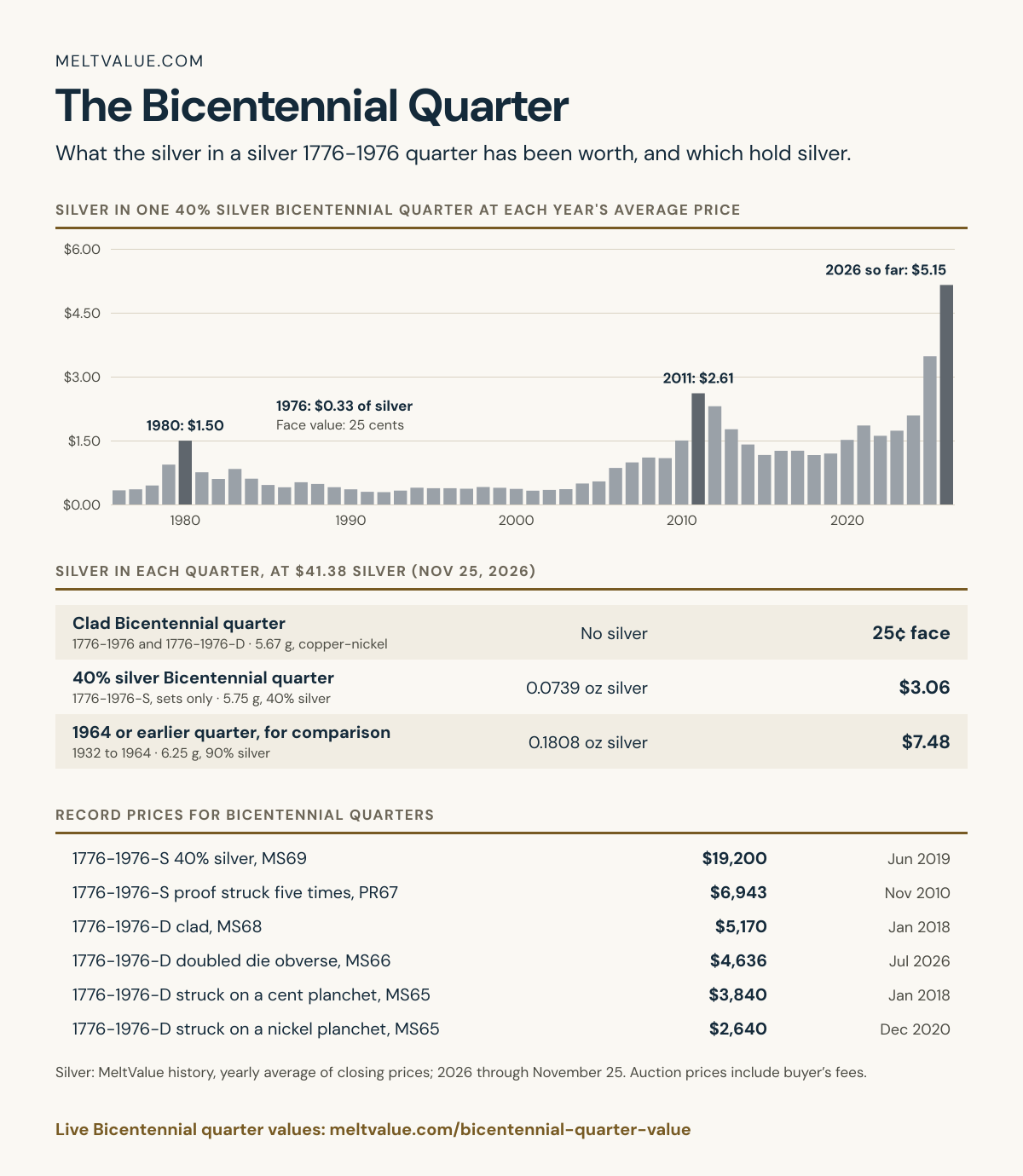
Most Bicentennial quarters are worth 25 cents. The Mint made more than 1.6 billion of the drummer boy quarters for circulation, and they hold no silver. The 40% silver versions, sold to collectors with an S mint mark, hold $3.06 worth of silver today. Top grades and certain errors bring hundreds to thousands.
Silver $41.47 per troy ounce, updated November 26, 2026 at 8:47 AM EST.
The Five Kinds of Bicentennial Quarter
Every Bicentennial quarter is dated 1776-1976. The mint mark and finish tell you which one you have.
| Coin | Typical value |
|---|---|
| 1776-1976, no mint markPhiladelphia, clad, for circulationMintage: 809,784,016 | 25¢ worn; about 50¢ to $1 uncirculated |
| 1776-1976-DDenver, clad, for circulationMintage: 860,118,839 | 25¢ worn; about 50¢ to $1 uncirculated |
| 1776-1976-S proofSan Francisco, clad, in Proof SetsMintage: 7,059,099 | About $3 to $6 |
| 1776-1976-S silverSan Francisco, 40% silver, in three-coin uncirculated setsMintage: 11,000,000 struck | About $3 to $10 |
| 1776-1976-S silver proofSan Francisco, 40% silver, in three-coin proof setsMintage: 4,000,000 struck | About $5 to $12 |
Raw coins. Graded top-condition coins sell for more; see below.
Is Your Bicentennial Quarter Silver?
- Look for an S. The mint mark sits to the right of Washington’s hair ribbon. No mint mark or a D means clad. An S can still be clad, because San Francisco made 7 million clad proofs too.
- Check the edge. A bright copper stripe means clad. On a silver quarter the edge looks gray, with at most a faint line.
- Weigh it, carefully. A silver quarter weighs 5.75 grams and a clad one 5.67 grams. The gap is small, so you need a scale that reads hundredths of a gram.
- Think about where it came from. Silver quarters were sold only in three-coin sets with a half dollar and dollar. One found in change is almost always clad.
What Top-Grade Bicentennial Quarters Sell For
Because so many were saved, ordinary uncirculated Bicentennial quarters are cheap: a roll of 40 clad coins sells for about $20. The money is in near-perfect coins. PCGS calls the 1776-1976-D scarce in MS66, and fewer than a dozen are known in MS68. The Philadelphia coin is scarcer than Denver in high grades. Public auction results:
| Coin and grade | Sold for |
|---|---|
| 1776-1976-D clad, MS67May 2026 | $59 to $64 |
| 1776-1976-D clad, MS67Apr 2025 | $139 |
| 1776-1976-D clad, MS68May 2022 | $1,740 |
| 1776-1976-D clad, MS68Jan 2018 | $5,170 |
| 1776-1976-S silver, MS682019 | $84 to $111 |
| 1776-1976-S silver, MS69Jun 2019 | $19,200 |
| 1776-1976-S silver proof, PR70 Deep Cameo2024 to 2025 | $119 to $125 |
| 1776-1976-S clad proof, PR70 Deep CameoFeb 2022 | $89 |
Auction prices include buyer’s fees. Dealers pay less.
Silver Bicentennial Quarter Value
Each 40% silver Bicentennial quarter holds 0.0739 troy ounces of silver, worth $3.06 today. Uncirculated silver quarters sell for about $3 to $10 each, and a roll of 40 lists at about $176, or $4.40 a coin. Proofs straight from the sets usually sell for $5 to $12, and a perfect PR70 Deep Cameo brings over $100.
Only the very top grades are worth much more. An uncirculated silver quarter in MS68 brought $84 to $111 in 2019. One of the few graded MS69 sold for $19,200 that June.
Bicentennial Quarter Silver Calculator
Enter how many of each you have. Silver values update live.
Silver value
$3.06
0.0739 troy oz of pure silver.
Bicentennial Quarter Errors Worth Money
With more than 1.6 billion struck, errors turn up. These are the kinds that have sold for real money, with auction prices:
| Error | Price |
|---|---|
| 1776-1976-D doubled die obverseBold doubling on LIBERTY and IN GOD WE TRUST. Listed as FS-101; a weaker FS-102 brings about $100 to $260. | $228 (AU53) to $4,636 (MS66, Jul 2026) |
| Struck more than onceA coin that stayed in the press and took extra blows. | $6,943 for a 1776-1976-S proof struck five times (Nov 2010) |
| Struck on a cent planchetA small copper blank fed into the quarter press. | $1,320 (MS63, 2024) to $3,840 (MS65, 2018) |
| Die capA stuck coin pressed into the die, leaving a cap-shaped piece. | $2,880 for a 1776-1976-D |
| Struck on a nickel planchetA 5-cent blank struck with quarter dies. | $2,640 (MS65, Dec 2020) |
| Struck through clothA cloth pattern pressed into the surface. | $1,159 (MS63, Jun 2026) |
| Die breakA raised line or blob of metal from a cracked die. | $336 (MS65, Oct 2021) |
| Clipped or broadstruckMissing a curved bite, or spread wide without the collar. | $84 to $222 (MS63 to MS66) |
A worn quarter with minor scratches or a small spot is not an error. Damage after striking adds no value.
Bicentennial Quarter Specifications
| Clad | 40% silver | |
|---|---|---|
| Mints | Philadelphia, Denver, San Francisco (proofs) | San Francisco only |
| Weight | 5.67 g | 5.75 g |
| Metal | 75% copper, 25% nickel over pure copper | 80% silver outer layers over a 21% silver center |
| Pure silver | None | 0.0739 troy oz |
| Diameter | 24.3 mm | 24.3 mm |
| Edge | Reeded, bright copper stripe | Reeded, gray with a faint line |
Bicentennial Quarter History
Congress approved new reverse designs for the quarter, half dollar and dollar under Public Law 93-127. The Treasury opened a design contest, and 884 entries came in by the January 1974 deadline. Jack L. Ahr of Arlington Heights, Illinois, won the quarter with a colonial drummer, a victory torch and 13 stars for the original colonies. Each winner received $5,000. Mint Director Mary Brooks announced the winners on NBC’s Today show in March 1974, and the first trial strikes took place at the Philadelphia Mint on August 12, 1974.
The Mint struck Bicentennial quarters through 1975 and 1976, all with the 1776-1976 double date, so there are no 1975 quarters. The Mint released the new quarter on August 18, 1975. The silver coins went into three-coin sets with the Bicentennial half dollar and dollar, and the uncirculated set first sold for $9. The eagle reverse returned in 1977.
How to Sell Bicentennial Quarters
- Spend the worn ones. A circulated clad Bicentennial quarter is worth 25 cents.
- Keep the sets together. Silver three-coin sets in their original packaging sell more easily than loose coins.
- Look closely at D-mint coins. Doubled letters on LIBERTY and IN GOD WE TRUST could mean the doubled die obverse.
- Grade only the best. Grading costs more than most of these coins are worth. Only flawless coins with a shot at MS67 or better, and true errors, justify it.
For older quarters, see the silver quarter melt value and 1964 quarter value. The Bicentennial dollar is covered on our Eisenhower dollar value page.
Sources
- US Mint: Bicentennial coins and medals: Public Law 93-127, the copper-nickel and 40% silver versions, and Jack Ahr of Arlington Heights, Illinois
- US Mint: Judging begins to select Bicentennial coin designs: the 884 design entries
- US Mint: Bicentennial coin design winners visit Washington: the $5,000 paid for each winning design
- US Mint press release, August 6, 1974: the first Bicentennial strikes at the Philadelphia Mint on August 12, 1974
- US Mint press release on Bicentennial set prices: the three-piece 40% silver uncirculated set at $9
- US Mint: Mint announces release of Bicentennial dollar: the quarter released on August 18, 1975, and silver sets at $7 each in lots of 50
- Wikipedia: Washington quarter mintage figures: the 809,784,016 and 860,118,839 struck for circulation and the S-mint totals
- PCGS CoinFacts: 1976 25C clad: the Philadelphia coin as the scarcer of the two in high grades
- PCGS CoinFacts: 1976-D 25C clad: 5.67 grams and 24.3 mm
- PCGS: 1976-D 25C expert comments: MS66 scarce and fewer than a dozen known in MS68
- PCGS CoinFacts: 1976-S 25C clad proof: 7,059,099 struck, copper-nickel over a pure copper center
- PCGS CoinFacts: 1976-S 25C silver: 5.75 grams, 40% silver, 11,000,000 struck
- PCGS: 1976-S 25C silver expert comments: MS69 as really scarce, with none graded finer
- NGC Auction Central: 1776-1976-S silver 25C: the MS69 at $19,200 in June 2019 and MS68 sales at $84 and $111
- Newman Numismatic Portal: 1976-D 25c sales: the MS68 at $5,170, doubled die, cent planchet, die break and clip sales
- Newman Numismatic Portal: 1976-S 25c clad proof sales: the proof struck five times at $6,943
- Coin World: Bicentennial quarters continue to circulate: the FS-101 doubled die and its bold doubling on the obverse legends
- CoinWeek: 1976-D Bicentennial quarter, a collector’s guide: the 1976-D die cap sold for $2,880
- CoinWeek: 1976-S Bicentennial quarter clad proof: the 2,845,450 and 4,149,730 Proof Sets sold in 1975 and 1976
- CoinWeek: 40 years since US Bicentennial coins hit pocket change: the January 1974 contest deadline and the winners announced on the Today Show