
Bicentennial Half Dollar Value
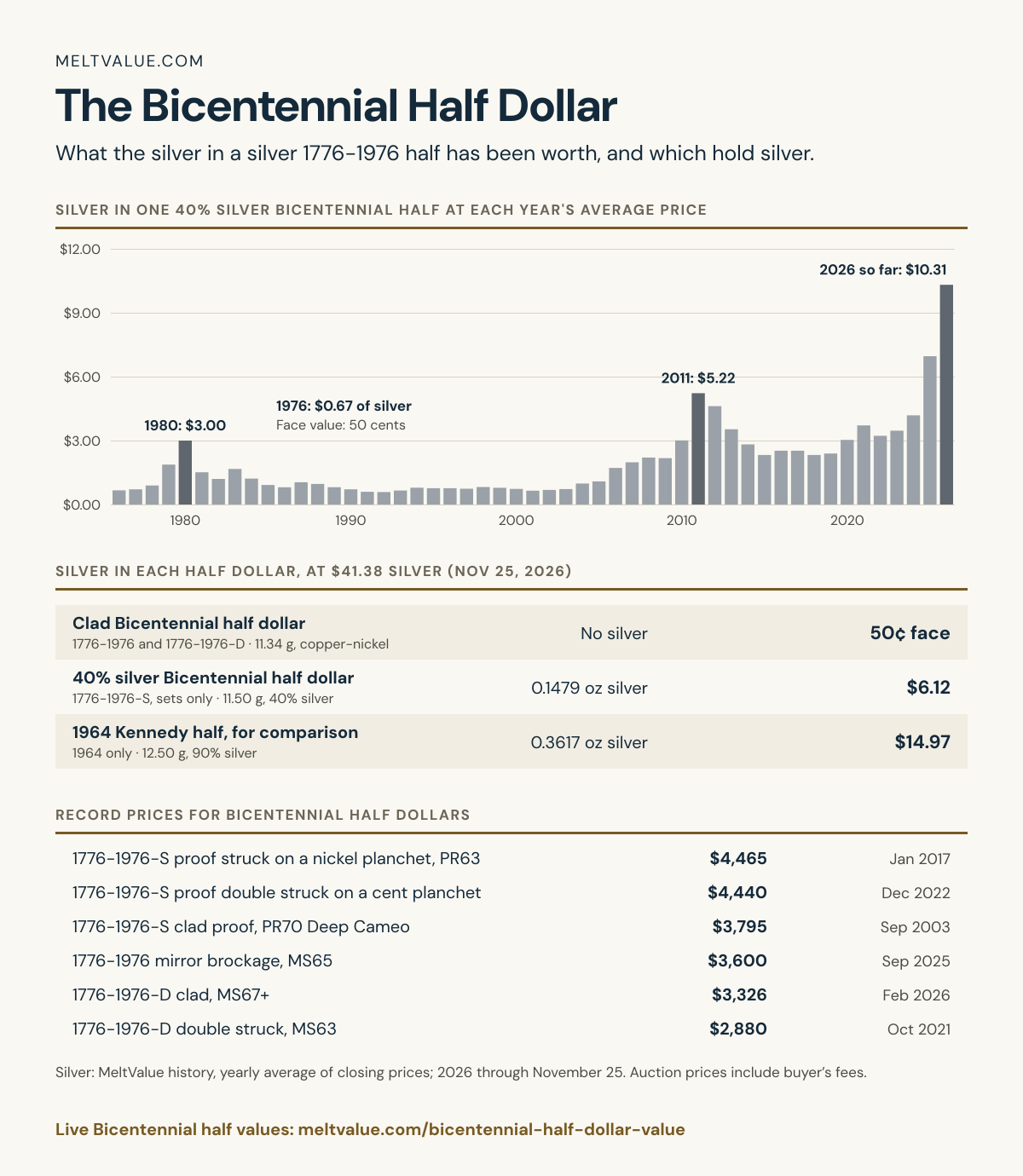
Most 1776-1976 half dollars are worth 50 cents. The Mint made more than 520 million of the Independence Hall halves for circulation, and they hold no silver. The 40% silver versions, sold to collectors with an S mint mark, hold $6.13 worth of silver today. Top grades and dramatic errors bring hundreds to thousands.
Silver $41.47 per troy ounce, updated November 26, 2026 at 8:47 AM EST.
The Five Kinds of Bicentennial Half Dollar
Every Bicentennial half is dated 1776-1976 and shows Independence Hall on the back. The mint mark and finish tell you which one you have.
| Coin | Typical value |
|---|---|
| 1776-1976, no mint markPhiladelphia, clad, for circulationMintage: 234,308,000 | 50¢ worn; about $1 to $3 uncirculated |
| 1776-1976-DDenver, clad, for circulationMintage: 287,565,248 | 50¢ worn; about $1 to $3 uncirculated |
| 1776-1976-S proofSan Francisco, clad, in Proof SetsMintage: 7,059,099 | About $3 to $7 |
| 1776-1976-S silverSan Francisco, 40% silver, in three-coin uncirculated setsMintage: 11,000,000 struck | About $6 to $12 |
| 1776-1976-S silver proofSan Francisco, 40% silver, in three-coin proof setsMintage: 4,000,000 struck | About $9 to $15 |
Raw coins. Graded top-condition coins sell for more; see below.
Is Your Bicentennial Half Dollar Silver?
- Look for an S. The mint mark sits below Kennedy’s neck, above the date. No mint mark or a D means clad. An S can still be clad, because San Francisco made 7 million clad proofs too.
- Check the edge. A bright copper stripe means clad. On a silver half the edge looks gray, with at most a faint line.
- Weigh it. A silver half weighs 11.50 grams and a clad one 11.34 grams. Use a scale that reads hundredths of a gram, since worn coins lose a little weight.
- Think about where it came from. Silver halves were sold only in three-coin sets with a quarter and dollar. One found in a bank roll is almost always clad.
What Top-Grade Bicentennial Halves Sell For
Millions of these halves were saved, so ordinary uncirculated coins are cheap. The most common grade for a graded 1776-1976-D is MS65. The money is at the very top: PCGS has graded no 1776-1976-D finer than MS67+, and those coins sell for thousands. Public auction results:
| Coin and grade | Sold for |
|---|---|
| 1776-1976-D clad, MS67+2026 | $1,631 to $3,326 |
| 1776-1976-D clad, MS67+Jun 2025 | $2,244 |
| 1776-1976 clad, MS67Nov 2017 | $468 |
| 1776-1976-S silver, MS66 to MS672022 | $32 to $43 |
| 1776-1976-S silver, MS68Nov 2023 | $111 |
| 1776-1976-S silver proof, PR70 Deep CameoDec 2020 | $528 |
| 1776-1976-S clad proof, PR70 Deep Cameo2026 | $214 to $343 |
Auction prices include buyer’s fees. Dealers pay less.
The Clad Proof That Lost Over 90% of Its Value
The clad proof half from the regular Proof Sets shows how fast a condition rarity can fade. In 2003 one graded PCGS PR70 Deep Cameo sold for $3,795. The first coin PCGS ever certified in that grade sold for $3,737.50 in 2011, then resold for $2,232.50 in 2015. As collectors sent in more coins and more came back perfect, the price fell. In 2026 PR70 Deep Cameo examples sold for $214 to $343.
The lesson for anyone holding these Proof Sets, which cost $7 new and trade for about $25 to $30 today: a PR70 grade can still be worth a few hundred dollars, but grading only pays when the coin looks flawless under magnification.
Silver Bicentennial Half Dollar Value
Each 40% silver Bicentennial half holds 0.1479 troy ounces of silver, worth $6.13 today. Uncirculated silver halves usually sell for about $6 to $12, close to their silver value. Silver proofs straight from the sets bring about $9 to $15, and a perfect PR70 Deep Cameo sold for $528 in 2020.
Graded uncirculated silver halves stay modest until the top grades: MS66 and MS67 coins sold for $32 to $43 in 2022, and an MS68 brought $111 in 2023.
Bicentennial Half Dollar Silver Calculator
Enter how many of each you have. Silver values update live.
Silver value
$6.13
0.1479 troy oz of pure silver.
Bicentennial Half Dollar Errors Worth Money
Wrong-planchet strikes and other major errors bring the biggest prices. These are the kinds that have sold for real money, with auction prices:
| Error | Price |
|---|---|
| Struck on a nickel planchetA small 5-cent blank struck with half dollar proof dies. | $4,465 for a 1776-1976-S proof (PR63, Jan 2017) |
| Double struck on a cent planchetA copper cent blank struck twice by half dollar dies. | $4,440 for a 1776-1976-S proof (PR65, Dec 2022) |
| Mirror brockageA full backward, sunken image of Independence Hall on the Kennedy side. | $3,600 (MS65, Sep 2025) |
| Double struckA coin that failed to leave the press and took a second blow off center. | $2,350 to $2,880 for 1776-1976-D coins (MS63 to MS67) |
| Struck on a foreign planchetA blank meant for another country’s coin. | $1,260 for a 1776-1976-S proof (PR67, Jul 2021) |
| Struck on a quarter planchetA smaller, lighter coin, about 5.5 grams. | $780 (MS62, Aug 2022) |
| Struck off centerPart of the design missing, with a blank crescent. | $149 to $528 (MS62 to MS66) |
| 1776-1976-S silver doubled die obverseListed as FS-101. Look for doubling on the front lettering. | $72 (MS66) to $210 (MS67) |
| Clipped planchetOne or more curved bites missing from the edge. | $156 to $159 (MS64) |
Scratches, dents and worn spots are damage, not errors, and add no value.
Bicentennial Half Dollar Specifications
| Clad | 40% silver | |
|---|---|---|
| Mints | Philadelphia, Denver, San Francisco (proofs) | San Francisco only |
| Weight | 11.34 g | 11.50 g |
| Metal | 75% copper, 25% nickel over pure copper | 80% silver outer layers over a 21% silver center |
| Pure silver | None | 0.1479 troy oz |
| Diameter | 30.6 mm | 30.6 mm |
| Edge | Reeded, bright copper stripe | Reeded, gray with a faint line |
Bicentennial Half Dollar History
Congress approved new reverse designs for the quarter, half dollar and dollar to mark 200 years of independence, and the Treasury opened a design contest. Of the 884 entries, the half dollar went to Seth G. Huntington of Minneapolis, who ran the art department at the Brown & Bigelow marketing firm. His Independence Hall carries 200 YEARS OF FREEDOM on the left and E PLURIBUS UNUM on the right. Each winner received $5,000. Mint Director Mary Brooks announced the winners on NBC’s Today show in March 1974, and the first trial strikes took place at the Philadelphia Mint on August 12, 1974.
The half dollar was the first Bicentennial coin released, on July 7, 1975, at a ceremony at the Federal Reserve Bank of Minneapolis, Huntington’s hometown. The Mint struck Bicentennial halves through 1975 and 1976, all dated 1776-1976. The silver versions went into three-coin sets with the quarter and dollar, and the uncirculated set first sold for $9. On September 9, 1976, Brooks announced that Treasury Secretary William E. Simon had ordered the Bicentennial designs retired, and the eagle reverse returned in 1977. Huntington died in 2021 at age 101.
How to Sell Bicentennial Half Dollars
- Spend or keep the worn ones. A circulated clad Bicentennial half is worth 50 cents.
- Keep the sets together. Silver three-coin sets in their original packaging sell more easily than loose coins.
- Look for anything odd. A coin that is too small, off center, double struck or shows a backward design could be a major error.
- Grade only the best. Grading costs more than most of these coins are worth. Only flawless coins with a shot at MS67 or PR70, and true errors, justify it.
For older halves, see the Kennedy half dollar melt value and 1964 Kennedy half dollar value. The other Bicentennial coins have their own pages: the Bicentennial quarter value and the Eisenhower dollar value.
Sources
- US Mint: Bicentennial coins and medals: Seth Huntington of Minneapolis, the half dollar released July 7, 1975, and 521.9 million struck for circulation
- US Mint: Remarks of Mint Director Mary Brooks, July 7, 1975: the release ceremony at the Federal Reserve Bank of Minneapolis
- US Mint: Judging begins to select Bicentennial coin designs: the 884 design entries
- US Mint: Bicentennial coin design winners visit Washington: the $5,000 paid for each winning design
- US Mint press release, August 6, 1974: the first Bicentennial strikes at the Philadelphia Mint on August 12, 1974
- US Mint press release on Bicentennial set prices: the three-piece 40% silver uncirculated set at $9
- US Mint: Half dollar specifications: 11.340 grams, 30.61 mm and 150 reeds for the clad half
- Wikipedia: Kennedy half dollar mintage figures: the 234,308,000 and 287,565,248 struck for circulation and the S-mint totals
- Wikipedia: Seth G. Huntington: his death in 2021 at age 101
- PCGS CoinFacts: 1976 50C clad: the Philadelphia mintage and condition census
- PCGS CoinFacts: 1976-D 50C clad: MS67+ as the finest grade, sales from $1,631.25 to $3,325.50, and the September 9, 1976 order to retire the designs
- PCGS CoinFacts: 1976-S 50C silver: 11.50 grams, 11,000,000 struck, 80% silver outer layers over a 21% silver center
- PCGS: 1976-S 50C silver expert comments: silver halves sold only in three-piece sets
- PCGS CoinFacts: 1976-S 50C clad proof: 7,059,099 struck
- PCGS: 1976-S 50C clad proof expert comments: Proof Sets issued at $7.00 and trading for $25 to $30 today
- PCGS CoinFacts: 1976-S 50C clad proof, Deep Cameo: PR70 Deep Cameo sales of $3,795 in 2003, the first certified coin at $3,737.50 in 2011 and $2,232.50 in 2015, and $324 to $343.13 in 2026
- PCGS: Bicentennial half dollars common in circulation: more than 520 million struck and still found in bank rolls
- Newman Numismatic Portal: 1976 50c clad sales: the mirror brockage, quarter planchet, off-center and clip sales
- Newman Numismatic Portal: 1976-S 50c silver proof sales: the nickel planchet and cent planchet errors and proof values
- Newman Numismatic Portal: 1976-S 50c silver sales: silver MS66 to MS68 sales and the FS-101 doubled die
- CoinWeek: 1976 Bicentennial Kennedy half dollar: Huntington at Brown & Bigelow and the Minneapolis release
- CoinWeek: 1976 Bicentennial Kennedy half dollar, a collector’s guide: the reverse lettering, 200 YEARS OF FREEDOM and E PLURIBUS UNUM
- CoinWeek: 1976-D Bicentennial Kennedy half dollar: MS65 as the most common grade for the 1776-1976-D
- CoinWeek: 40 years since US Bicentennial coins hit pocket change: the January 1974 contest deadline and the winners announced on the Today Show