
Eisenhower Dollar Value
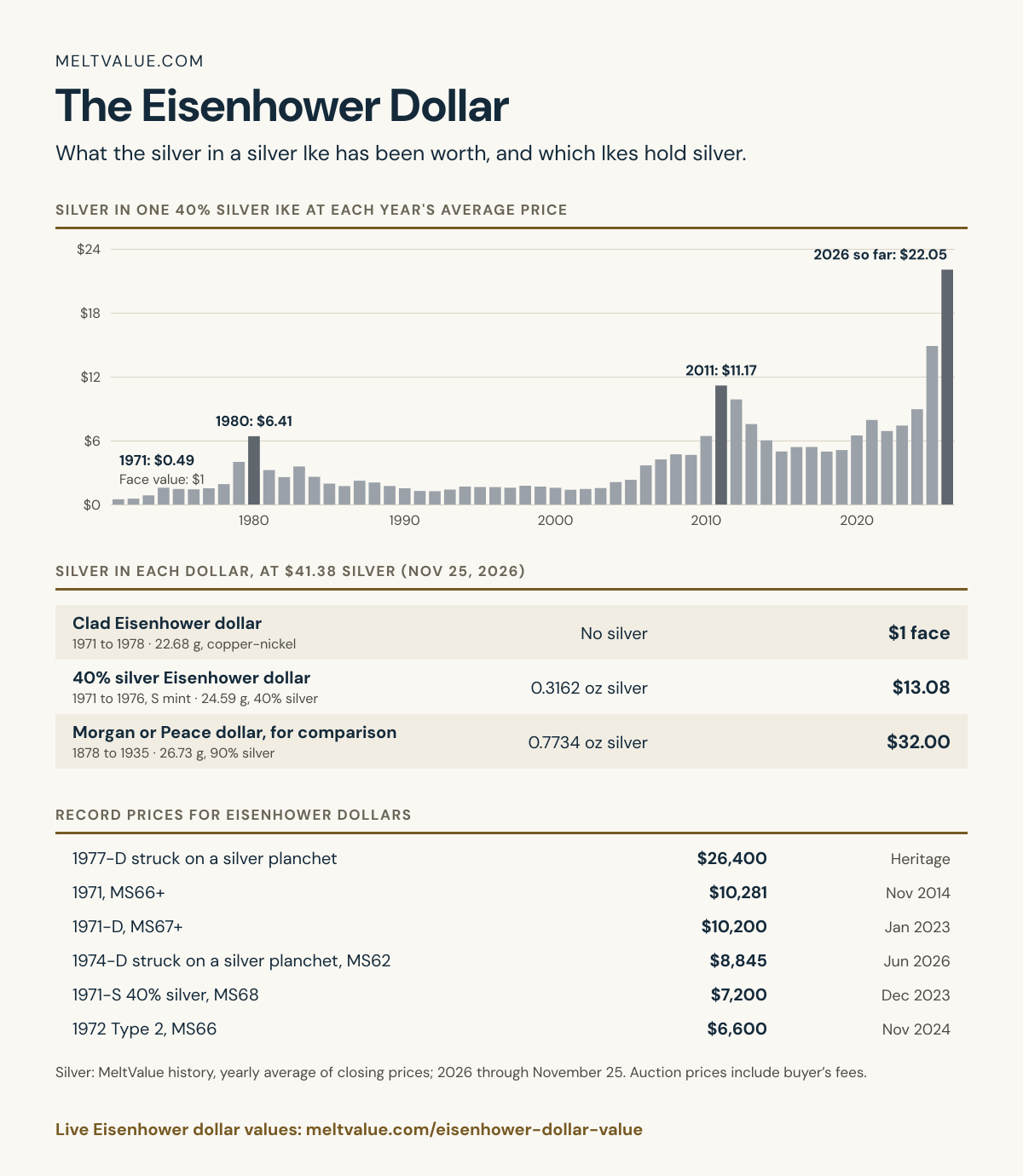
Most Eisenhower dollars are worth $1. The big Ikes from 1971 to 1978 that turned up in change are copper and nickel, with no silver. The 40% silver versions, sold to collectors with an S mint mark, hold $13.11 worth of silver today. A few varieties and errors bring hundreds to thousands.
Silver $41.47 per troy ounce, updated November 26, 2026 at 8:47 AM EST.
Is Your Eisenhower Dollar Silver?
- Look for an S. Only San Francisco struck silver Ikes. No mint mark (Philadelphia) or a D (Denver) means clad. But S proofs from 1973 to 1978 were also made in clad, so an S alone is not proof.
- Check the edge. A copper stripe on the edge means clad. A silver Ike has a solid gray edge.
- Weigh it. A silver Ike weighs about 24.59 grams; a clad one weighs 22.68 grams. A kitchen scale that reads tenths of a gram will tell them apart.
- Check the packaging. Silver Ikes from 1971 to 1974 came in a blue envelope (uncirculated) or a brown box (proof). The 1776-1976 silver coins came in three-coin sets with a quarter and half dollar.
What Clad Eisenhower Dollars Are Worth
Grade decides everything for a common clad Ike. Most were handled roughly, so top grades are scarce, and the price jumps at MS66.
| Condition | Typical value |
|---|---|
| CirculatedSpent and worn. Most Ikes found in drawers and tills. | $1 |
| Uncirculated, rawNever spent, not graded. Common from Mint Sets and rolls. | $3 to $10 |
| MS65, gradedA 1972 Type 3 MS65+ sold for $145 in October 2025. | $65 to $145 |
| MS66, gradedA 1974-D brought $169 in November 2025; a 1972 Type 3 brought $1,952 in March 2026. | $170 to $1,950 |
| MS67, gradedA 1972-D MS67 sold for $610 to $702 in August 2026. | $600 and up |
Common dates. Auction prices include buyer’s fees; dealers pay less.
What Silver Eisenhower Dollars Are Worth
Every 40% silver Ike holds 0.3162 troy ounces of silver, worth $13.11 today. In their original blue packs or brown boxes, they usually retail for about $20 to $35, a modest premium over the silver. Dealers buying them often pay close to silver value.
Because they were made for collectors and never spent, silver Ikes survive in high grades, and only the very top grades bring real money. A 1971-S graded MS68 sold for $7,200 in December 2023, and a 1972-S in MS69 brought $3,120 in December 2024.
Eisenhower Dollar Silver Calculator
Enter how many of each you have. Silver values update live.
Silver value
$13.11
0.3162 troy oz of pure silver.
The 1972 Type 2: The Rare Ike
Philadelphia used three reverse designs in 1972. The Type 2 was struck with a reverse die meant for proof coins, and it is the only scarce one. To check, look at the Earth on the back, just below Florida. The Type 2 has no islands there. Types 1 and 3 show islands, and Type 3 shows the Earth in higher relief. Only Philadelphia clad coins count: the 1972-S silver coins use a similar proof-style reverse but are not the variety.
Recent auction results for the 1972 Type 2:
| Grade | Sold for | Date |
|---|---|---|
| MS62 | $59 | Jul 2026 |
| MS63 | $90 | May 2026 |
| MS64 | $154 to $268 | May to Jun 2026 |
| MS65 | $1,220 | Jun 2026 |
| MS66 | $6,600 | Nov 2024 |
Raw Type 1 and Type 3 coins trade for about $5 to $10 uncirculated.
1776-1976 Bicentennial Eisenhower Dollars
Dollars struck in 1975 and 1976 carry the double date 1776-1976 and a reverse by Dennis R. Williams showing the Liberty Bell over the Moon. No dollars are dated 1975. Circulated Bicentennial Ikes are worth $1, and the silver 1776-1976-S coins from the three-coin sets are worth about their silver value.
There are two reverse types. Type 1 has bold, thick lettering; Type 2 has thinner lettering, clearest in UNITED STATES OF AMERICA and ONE DOLLAR. The Philadelphia Type 1, with 4,019,000 struck, is hard to find in MS65 and up, and the Denver Type 1 is much scarcer than the Type 2 in MS66 and up.
Rare Eisenhower Dollar Errors
The rarest Ikes are wrong-planchet errors: clad coins struck by mistake on 40% silver blanks. They look normal but weigh about 24.6 grams and lack the copper stripe on the edge.
| Error | Price |
|---|---|
| 1977-D on a 40% silver planchetSilver blanks meant for San Francisco were struck at Denver. About 10 to 15 are known. | $26,400 for one at Heritage; $7,475 for an MS62 (2011) |
| 1974-D on a 40% silver planchetSame mix-up, a few years earlier. About 30 are known. | $8,845 (Jun 2026, MS62); $6,600 (Aug 2024, MS61) |
| 1776-1976-D on a 40% silver planchetOnly two have been reported. | Rarely offered |
| 1776-1976 silver proof, no mint markOnly one has been reported, said to have come from a department store cash register in 1977. | Unique |
Auction prices include buyer’s fees.
Eisenhower Dollar Mintages by Year
| Date | Mintage |
|---|---|
| 1971Hard to find above MS65 | 47,799,000 |
| 1971-DFirst Ikes struck; the most common in top grades | 68,587,424 |
| 1971-S silverBlue pack and brown box | 6,868,530 unc; 4,265,234 proof |
| 1972Three reverse types; the Type 2 is the rare one | 75,890,000 |
| 1972-DLargest Ike mintage before 1976 | 92,548,511 |
| 1972-S silver | 2,193,056 unc; 1,811,631 proof |
| 1973Mint Sets only | 1,769,258 |
| 1973-DMint Sets only | 1,769,258 |
| 1973-SProof Sets | 2,760,339 clad proof |
| 1973-S silver | 1,883,140 unc; 1,013,646 proof |
| 1974 | 27,366,000 |
| 1974-DAbout 30 struck on silver planchets | 45,517,000 |
| 1974-SProof Sets | 2,612,568 clad proof |
| 1974-S silver | 1,900,156 unc; 1,306,579 proof |
| 1776-1976 Type 1Bold letters; scarce in MS65 | 4,019,000 |
| 1776-1976 Type 2Thin letters; the most common Ike | 113,318,000 |
| 1776-1976-D Type 1 | 21,048,710 |
| 1776-1976-D Type 2 | 82,179,564 |
| 1776-1976-SBoth types, in Proof Sets | 6,995,180 clad proof |
| 1776-1976-S silverThree-coin silver sets | About 4.9 million unc; about 4 million proof |
| 1977 | 12,596,000 |
| 1977-DAbout 10 to 15 struck on silver planchets | 32,983,006 |
| 1977-SProof Sets | 3,251,152 clad proof |
| 1978 | 25,702,000 |
| 1978-DThe scarcest Denver Ike in top grades | 33,012,890 |
| 1978-SProof Sets | 3,127,781 clad proof |
The Mint struck about 2 million each of the 1973 and 1973-D dollars; 1,769,258 of each went out in Mint Sets.
Eisenhower Dollar Specifications
| Clad | 40% silver | |
|---|---|---|
| Years | 1971 to 1978 | 1971 to 1974, 1776-1976 |
| Mints | Philadelphia, Denver, San Francisco (proofs) | San Francisco only |
| Weight | 22.68 g | 24.59 g |
| Metal | 75% copper, 25% nickel over pure copper | 80% silver outer layers over a 21% silver center |
| Pure silver | None | 0.3162 troy oz |
| Diameter | 38.1 mm | 38.1 mm |
| Edge | Reeded, copper stripe | Reeded, solid gray |
Eisenhower Dollar History
President Dwight D. Eisenhower died in 1969, and Congress chose a new dollar coin to honor him. The Coinage Act of 1965 had barred silver dollars for five years, and after a fight over the metal, Congress settled on copper-nickel clad coins for circulation and 40% silver coins for collectors. Chief Engraver Frank Gasparro designed the coin, with a reverse based on the Apollo 11 mission insignia: an eagle landing on the Moon. Denver struck the first ones in 1971.
The big dollar never caught on in daily use outside casinos and parts of the West. The Bicentennial design ran in 1975 and 1976, the original reverse returned for 1977 and 1978, and the much smaller Susan B. Anthony dollar replaced the Ike in 1979.
How to Sell Eisenhower Dollars
- Sort silver from clad. Weigh any S-mint coins. Clad Ikes in circulated condition are worth face value at any bank.
- Keep silver Ikes in their packaging. Original blue packs and brown boxes sell more easily than loose coins.
- Check every 1972 Philadelphia coin. A Type 2 is worth $50 or more even in low Mint State grades.
- Weigh 1974-D and 1977-D coins. One at about 24.6 grams with no copper stripe could be a silver-planchet error worth thousands.
- Grade only the best. Grading costs more than most Ikes are worth. Only coins that might reach MS66 or better justify the fee.
For older silver dollars, see the silver dollar melt value, Morgan dollar melt value and Peace dollar melt value, or check the live silver spot price.
Sources
- Wikipedia: Eisenhower dollar: weights, 38.1 mm, the 1776-1976 double date on coins struck in 1975 and 1976, and 0.3162 troy oz of silver in silver-clad pieces
- PCGS CoinFacts: 1971-D $1: 68,587,424 struck, Denver as the first mint to strike Ikes, and copper-nickel over a pure copper core
- PCGS CoinFacts: 1971 $1: an MS66+ sold for $10,281.25 in November 2014
- PCGS CoinFacts: 1971-S $1 silver: 6,868,530 struck, the blue pack, and an MS68 sold for $7,200 in December 2023
- PCGS CoinFacts: 1974-D $1: only the 1971-D is more common in high grades
- PCGS CoinFacts: 1976 $1 Type 1: 4,019,000 struck, the scarcer 1976 variety, hard to find even in MS65
- PCGS CoinFacts: 1978-D $1: the scarcest Denver Ike in high grades
- PCGS CoinFacts: 1972 $1 Type 3: how the islands near Florida tell the 1972 types apart
- PCGS: 1977-D $1 expert comments: about 10 to 15 known on 40% silver planchets, and Mint Sets that sell for $15 to $20
- PCGS: Silver Dollars and Trade Dollars encyclopedia, 1974-D: about 30 known struck on silver planchets
- PCGS: Silver Dollars and Trade Dollars encyclopedia, 1776-1976-D: two silver-planchet errors reported
- PCGS: Silver Dollars and Trade Dollars encyclopedia, 1776-1976: one silver proof without a mint mark reported
- CoinWeek: Mike Byers on the 1976-D Ike on a silver planchet: a 1977-D on a silver planchet sold by Heritage for $26,400
- CoinWeek: 1972 Eisenhower dollar, a collector’s guide: only the Type 2 is scarce, struck with a reverse die meant for proofs; raw Type 1 and 3 coins trade for $5 to $10
- NGC: The 1972 Eisenhower dollar: the three 1972 types, with the Type 2 the rarest
- Coin World: 1973-S Eisenhower dollar one of two in its grade: silver Ikes have a solid edge; clad Ikes show a copper stripe