
Roosevelt Dime Value
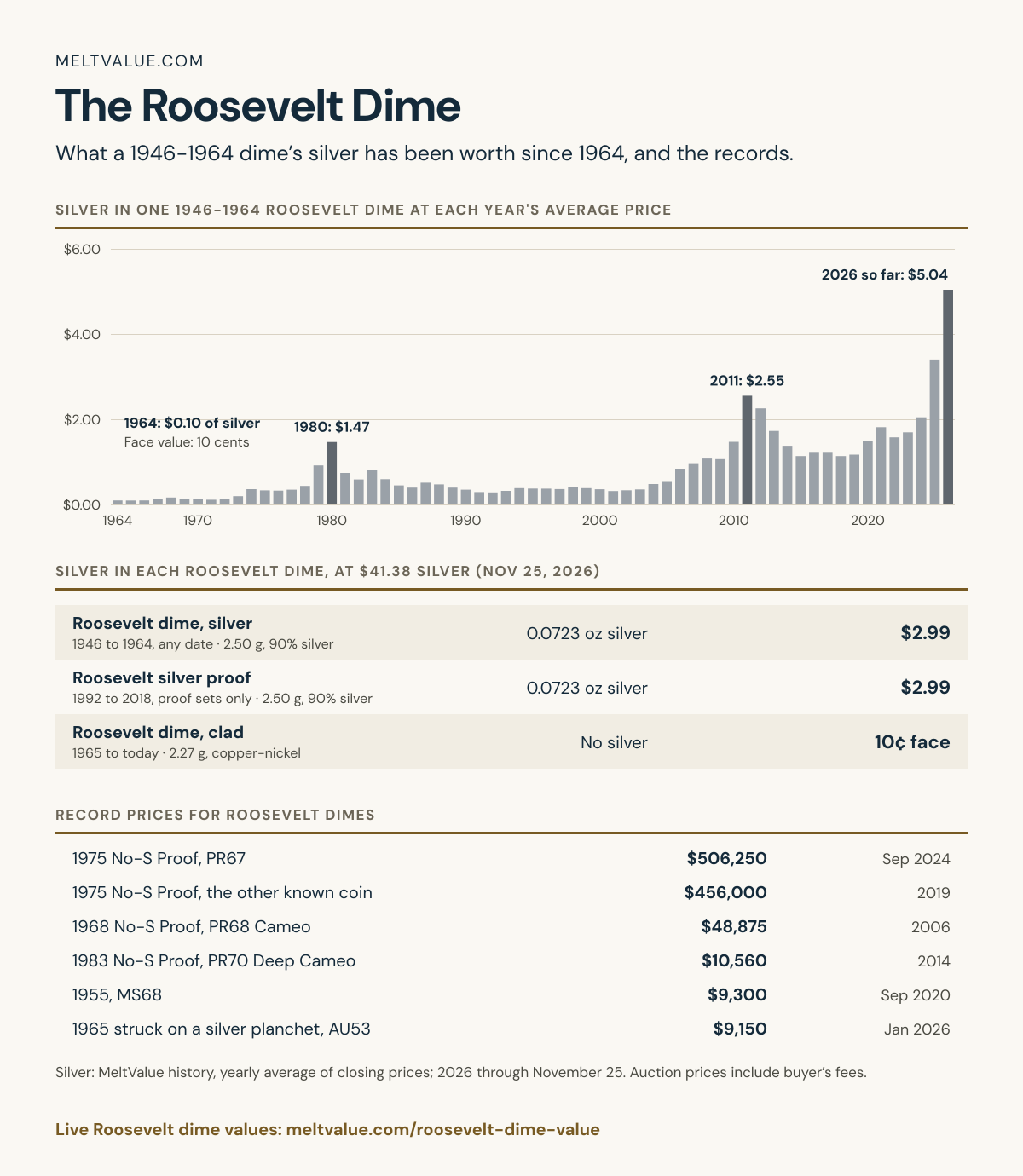
A Roosevelt dime dated 1946 to 1964 is 90% silver and worth $3.19 today. Dimes dated 1965 and later are clad and worth 10 cents, apart from a few errors and varieties. The rarest, the 1975 No-S proof, sold for $506,250.
Silver $44.08 per troy ounce, updated November 27, 2026 at 2:42 AM EST.
Which Roosevelt Dimes Are Silver
| Dates | Metal | Silver value |
|---|---|---|
| 1946 to 1964Every date and mint | 90% silver, 2.50 g | $3.19 |
| 1965 to todayCoins made for circulation | Copper-nickel clad, 2.27 g | None |
| 1992 to 2018Silver proofs, S mint mark | 90% silver, 2.50 g | $3.19 |
Since 2019 the Mint has struck its silver proof dimes in 99.9% silver. Silver proofs came only in the Mint’s silver proof sets, so any Roosevelt dime from pocket change dated 1965 or later is clad. Look at the edge: a clad dime shows a copper stripe.
What a Silver Roosevelt Dime Is Worth
Roosevelt dimes from 1946 to 1964 were made by the billions, so no silver date is rare in worn condition. Worn coins sell for about their silver value. Condition and strike change everything above that. Here is what one date, the 1955, has brought in public sales:
| 1955 dime, grade | Sold for |
|---|---|
| Worn, any date | About $3.19 |
| MS64Jun 2009 | $15 |
| MS66Mar 2020 | $17 |
| MS66 Full BandsJan 2026 | $114 |
| MS67+Jul 2025 | $720 |
| MS68, tied for finest gradedSep 2020 | $9,300 |
Public sale prices for graded coins, with buyer’s fees. The 1955 has one of the lowest silver mintages, about 12.4 million, yet ordinary uncirculated examples still sell for little.
The lowest silver mintages are the 1955 and the 1949-S (13,510,000). The 1949-S trades for a slight premium over melt when worn, and it is among the hardest silver dimes to find with Full Bands.
Rare Roosevelt Dimes
Values from PCGS, recent auctions and PCGS auction records. Most of these are proofs from Mint sets, not coins from change. The 1982 No-P and the 1965 silver error are the exceptions. For the 1965 error and clad 1965 coins, see 1965 dime value.
| Coin | Typical value |
|---|---|
| 1975 No-S ProofTwo known | Hundreds of thousandsRecord: $506,250 |
| 1968 No-S ProofVery few known | $12,500 in PR65Record: $48,875 |
| 1983 No-S ProofSeveral hundred | $750 in PR69 Deep CameoRecord: $10,560 |
| 1965 on a silver planchetRare error, weighs 2.50 g | About $9,000 |
| 1970 No-S ProofSeveral hundred | $750 in PR67Record: $6,038 |
| 1982 No-PNo more than about 150,000 | $300 in MS65Record: $2,185 |
| 1996-W1,457,000, mint sets only | $74 to $84 in MS68 Full Bands |
Records are the auction records PCGS cites. The 1965 silver dime value is from sales at $9,000 (2024) and $9,150 (2026). The 1996-W prices are 2026 sales; an MS69 brought $356.63 in July 2022.
The No-S Proof Dimes
From 1968 the San Francisco Mint made the proof coins sold in Mint sets. Their dies were made at Philadelphia, where an S was punched into each one. A few dies slipped through without it. That gave collectors No-S proof dimes dated 1968, 1970, 1975 and 1983.
The 1975 is the great rarity. The first was found in a proof set in 1977 and the second seven years later. An Ohio collector and his mother bought one in 1978 for $18,200 and kept it for nearly 50 years; it sold for $506,250 in September 2024. Check old proof sets from these years before you sell them.
The 1982 No-P Dime
Philadelphia began putting a P on its dimes in 1980. In 1982, dimes from two obverse dies left the Mint without it, the first circulating coins to leave Philadelphia that way. Thousands turned up in change, mostly in northwest Ohio, including change handed out at the Cedar Point amusement park, and in Pittsburgh and the Northeast. PCGS puts the total at no more than about 150,000. They sell for about $300 in MS65, and worn ones still bring a premium.
The 1965 Silver Dime Error
When the Mint switched to clad dimes in 1965, a few leftover 90% silver planchets got struck with the new date. These errors weigh 2.50 grams instead of 2.27, and the edge shows no copper. Two sold for $9,000 and $9,150 in 2024 and 2026. Weigh any 1965 dime on a scale that reads to a hundredth of a gram, and have a heavy one authenticated.
Full Bands
The torch on the back has two sets of horizontal bands. PCGS adds Full Bands (FB) to uncirculated dimes graded MS60 or better that show full separation in both the upper and lower bands. Strong strikes are uncommon for many dates, so FB coins sell for several times as much as plain ones. A 1955 in MS66 sold for $17; an MS66 with Full Bands brought $114.
Silver Roosevelt Dime Calculator
Enter how many 1946 to 1964 dimes you have. Every date holds the same silver.
Silver value
$31.87
0.723 troy oz of pure silver in $1.00 face value. A roll of 50 holds 3.62 oz.
Have a mix of silver coins? The junk silver calculator works from face value.
Record Prices
| Coin and grade | Sold for |
|---|---|
| 1975 No-S Proof, PR67Sep 2024 | $506,250 |
| 1975 No-S Proof, the other known coin2019 | $456,000 |
| 1975 No-S Proof, the same coinAug 2011 | $349,600 |
| 1968 No-S Proof, PR68 Cameo2006 | $48,875 |
| 1983 No-S Proof, PR70 Deep Cameo2014 | $10,560 |
| 1955, MS68Sep 2020 | $9,300 |
| 1965 struck on a silver planchet, AU53Jan 2026 | $9,150 |
Auction prices include buyer’s fees.
Where Is the Mint Mark?
| Dates | Mint mark |
|---|---|
| 1946 to 1964 | Back, left of the torch’s base. P coins have none. |
| 1965 to 1967 | No mint marks on any dime. |
| 1968 to 1979 | Front, above the date. Philadelphia dimes have none. |
| 1980 to today | Front, above the date. P, D, S or W on every coin. |
D is Denver, S is San Francisco, P is Philadelphia and W is West Point.
Roosevelt Dime History
Franklin Roosevelt had polio and helped found the March of Dimes. After he died on April 12, 1945, the Treasury chose the dime to honor him. Chief Engraver John R. Sinnock designed it, with Roosevelt on the front and a torch between olive and oak branches on the back. The Mint first struck it on January 19, 1946, and released it on January 30, which would have been Roosevelt’s 64th birthday, in time for that year’s March of Dimes campaign.
Sinnock’s initials, JS, sit below the neck. A Cold War rumor said they stood for Joseph Stalin; they did not. Some say Sinnock drew on bas-relief portraits of Roosevelt by sculptor Selma Burke; that has never been confirmed. The Coinage Act of 1965 took silver out of the dime, and the design has run ever since. For the 50th anniversary, the Mint added a 1996-W dime to its uncirculated sets.
How to Sell Roosevelt Dimes
- Sort silver from clad. Pull every dime dated 1964 or earlier. Clad dimes from change are worth face value.
- Check the few that matter. Look for 1982 dimes with no mint mark, weigh every 1965, and go through proof sets from 1968, 1970, 1975 and 1983.
- Sell worn silver by face value or weight. Buyers pay close to melt for circulated 90% silver.
- Grade only the best. A plain uncirculated silver dime is not worth the grading fee. Full Bands coins in MS66 or better, errors and No-S proofs are.
More on dimes: the silver dime melt value covers rolls and bags, the 1964 dime value covers the last silver year, and the Mercury dime came before the Roosevelt.
Sources
- Wikipedia: Roosevelt dime: Roosevelt and the March of Dimes, Sinnock’s design, the first strikes on January 19, 1946 and the January 30 release
- Wikipedia: John R. Sinnock: the JS initials and the Stalin rumor
- PCGS: No-mintmark Roosevelt dimes shine: the 1968, 1970, 1975 and 1983 No-S proofs and the 1982 No-P, with values and records, including the $506,250 sale
- PCGS: Top 100 modern coins, the 1975 No-S dime: the discovery of both 1975 No-S dimes and how S mint marks were punched into proof dies
- PCGS CoinFacts: 1975 10C No S Proof: why only the proof, not the circulating 1975 dime, is rare
- PCGS: The scarce 1996-W Roosevelt dime: the 1,457,000 mintage and its release in 1996 mint sets
- PCGS CoinFacts: 1996-W 10C: the 50th anniversary issue and MS69 sales
- PCGS: What are Full Bands on Roosevelt dimes?: the Full Bands definition
- PCGS Set Registry: 1949-S 10C Full Bands: the 1949-S as the second lowest silver mintage and its rarity with Full Bands
- PCGS Auction Prices: Roosevelt dimes: auction records by date
- Coin World: 1946 Roosevelt dime: the March of Dimes timing, the Selma Burke claim and the mint mark changes of 1965, 1968 and 1980
- Newman Numismatic Portal: Roosevelt dimes: Full Bands premiums