
UK Silver Hallmarks: How to Read and Date Them
A British silver hallmark tells you how pure the silver is, which assay office tested it and, on most pieces made before 1999, the year. 925 or a walking lion means sterling, 92.5% silver. A gram of sterling is worth £0.99 as scrap today.
01
Read your hallmark in five steps
Pick what you can see on the piece. The marks are often under 2 mm tall, so a loupe or your phone camera on zoom helps.
1Which metal?
2What does the purity mark show?
3Which town mark is beside it?
Optional since 1999, so a modern piece may have none. Leave it blank if you can’t see one.
Your hallmark
925: silver that is at least 92.5% pure.
£49.66
Melt value of the silver in 50 g at today’s price.
- Online refiners and bullion dealers
- £44.69 to £48.17
- High street jewellers and pawnbrokers
- £29.79 to £42.21
Buyer ranges are typical shares of melt, not quotes. Antique and signed pieces can sell above melt to a dealer or at auction. For any weight, use the UK scrap silver calculator.
02
The marks in a UK silver hallmark
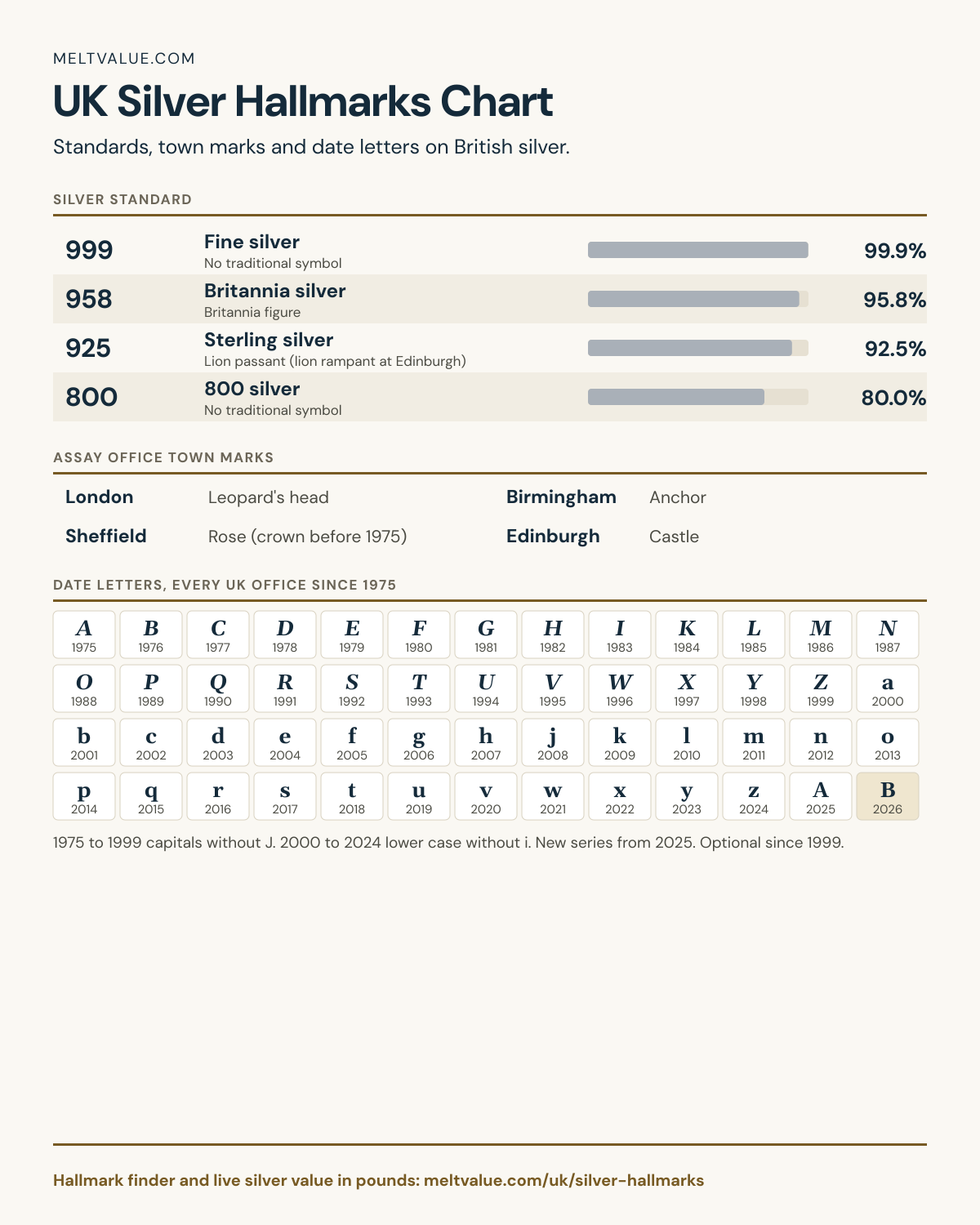
The law requires three marks: the sponsor’s mark, the fineness number and the town mark. The date letter and the traditional symbol have been optional since 1999, though most older silver carries both.
Sponsor’s mark
Compulsory
Initials of the maker, retailer or importer who sent the piece in, inside a shield of their own design. It used to be called the maker’s mark, and reference books list the initials by office, so it can name the silversmith.
Fineness mark
Compulsory
A number in an oval: 999, 958, 925 or 800, the least silver the piece holds in parts per 1,000. Before 1999 British silver showed a symbol instead, such as the walking lion for sterling.
Town mark
Compulsory
The symbol of the assay office that tested the piece: a leopard’s head for London, an anchor for Birmingham, a rose for Sheffield (a crown before 1975) and a castle for Edinburgh.
Date letter
Optional since 1999
One letter for the year. All four offices have shared the same letter since 1975, changing on 1 January. Before that each office ran its own alphabets, fonts and shield shapes.
You may also see a pair of scales beside a number. That is the Common Control Mark of the International Convention on Hallmarks, which the UK signed in 1972. Member countries accept each other’s convention marks, so a piece tested abroad can carry one instead of a British hallmark.
03
UK silver standards and what they are worth
The UK allows four silver standards. The value per gram is the melt value at today’s silver price.
| Mark | Name | Silver | Traditional symbol | Per gram |
|---|---|---|---|---|
| 999 | Fine silver | 99.9% | None | £1.07 |
| 958 | Britannia silver | 95.8% | Britannia figure | £1.03 |
| 925 | Sterling silver | 92.5% | Lion passant (lion rampant at Edinburgh) | £0.99 |
| 800 | 800 silver | 80.0% | None | £0.86 |
800 is the lowest UK standard. You see it mostly on continental European silver.
04
Assay office town marks
Four UK offices test silver today. Five more have closed, and their marks still turn up on antique silver.
| Town mark | Office | Status | Notes |
|---|---|---|---|
| Leopard's head | London | Open | The oldest office, at Goldsmiths’ Hall. The leopard’s head lost its crown in 1821. |
| Anchor | Birmingham | Open | Opened in 1773, the same year as Sheffield. |
| Rose | Sheffield | Open | Opened in 1773. Used a crown on silver until 1975, then the York rose. |
| Castle | Edinburgh | Open | A three-towered castle. Scotland’s only office since Glasgow closed. |
| Three wheatsheaves and a sword | Chester | Closed | Closed in 1962. Common on Victorian and Edwardian jewellery. |
| Tree, bird, bell and fish | Glasgow | Closed | Closed in 1964. |
| Three castles | Newcastle | Closed | Closed in 1884. |
| Castle with three towers | Exeter | Closed | Closed in 1883. Easy to confuse with Edinburgh. |
| Cross with five lions | York | Closed | Closed in the 1850s. Its marks are rare. |
| Hibernia | Dublin (Ireland) | Open | The Irish office. Its marks are not UK hallmarks. |
05
Hallmark date letters since 1975
Every UK office has used the same date letter since 1975, and it changes on 1 January. The 1975 series ran from A to Z in capitals and skipped J. The 2000 series ran from a to z in lower case and skipped i, so 2008 is j. A new series of serif capitals began with A in 2025, and 2026 is B.
1975 to 1999, capitals
2000 to 2024, lower case
2025 onward, serif capitals
For silver marked before 1975, read the letter against the chart for the office whose town mark sits beside it. The font, the case and the shape of the shield tell one cycle from the next. London changed its letter each May and Birmingham each July, so one letter can span two calendar years. Birmingham Assay Office keeps an archive of every date letter it has struck since 1773.
06
Older and extra marks
Duty mark
1784 to 1890
A monarch’s head in profile, struck to show the silver duty had been paid. A duty mark on its own dates the piece to those years.
Thistle and crown
Before 1975
Edinburgh marked sterling with a thistle until 1975, then switched to the standing lion. Sheffield used a crown as its town mark on silver until it changed to the rose.
Import marks
Since 1904
The offices strike different town marks on silver imported from abroad, so an unfamiliar town mark next to a British-looking hallmark usually means a foreign-made piece.
| Year | Commemorative mark |
|---|---|
| 1935 | Heads of George V and Queen Mary (Silver Jubilee) |
| 1953 | Head of Elizabeth II (Coronation) |
| 1977 | Head of Elizabeth II (Silver Jubilee) |
| 1999 to 2000 | Millennium mark |
| 2002 | Elizabeth II (Golden Jubilee) |
| 2012 | Elizabeth II (Diamond Jubilee) |
| 2022 | Elizabeth II (Platinum Jubilee) |
Commemorative marks were optional and struck beside the hallmark for royal and national occasions.
07
Marks that look like hallmarks but are not
EPNS, EP and EPBM
Electroplated nickel silver, electroplated, and electroplated Britannia metal. A thin coat of silver over base metal. Scrap buyers pay little or nothing for plate. See what silver stamps mean for the full list.
A1, Sheffield plate and pseudo marks
Victorian and later silver plate often carries small marks in shields that copy the look of a hallmark. With no fineness number or lion and no town mark, it is plate.
925 or Sterling on its own
A maker’s claim, common on imported jewellery. It is often accurate, but no assay office has tested it.
Pieces under 7.78 g
Silver lighter than 7.78 grams can be sold as silver without a hallmark, so small earrings and thin chains often have none.
08
What hallmarked silver is worth
Weigh it in grams
A kitchen scale that reads to 1 g is fine for cutlery and trays. Use a jeweller’s scale for rings and chains. Take off any wooden handles or filled bases if you can.
Read the standard
925 or a lion is 92.5% silver, 958 or Britannia is 95.8%.
Multiply by today’s price
Weight times purity times the silver price per gram gives the melt value. At today’s price, 100 g of sterling holds £99.31 of silver.
| Buyer | Share of melt | 100 g of sterling |
|---|---|---|
| Online refiners and bullion dealers | 90 to 97% | £89.38 to £96.33 |
| High street jewellers and pawnbrokers | 60 to 85% | £59.59 to £84.41 |
Typical ranges, not quotes. Antique silver by a known maker can sell for more than melt to a dealer or at auction.
Work out any weight in the UK scrap silver calculator, price cutlery sets with the sterling flatware value guide, or check today’s silver price per gram in pounds. For gold pieces, see UK gold hallmarks.
Frequently Asked Questions
Sources: UK Government hallmarking guidance notes (standards, exemption weights, compulsory marks); Birmingham Assay Office (silver standards and symbols, date letters); Sheffield Assay Office (the shared date letter and the 2025 series).
UK sterling silver (925) was worth £0.99 per gram on 28 November 2026 at 21:45 GMT. Source: MeltValue.