
The short version
- 1717Britain drifts onto gold after Isaac Newton, Master of the Mint, overvalues the gold guinea.
- 1834Congress revalues gold and the US goes onto gold in all but name. From 1837 an ounce costs $20.67, a price that holds for nearly a century.
- 1870sGermany adopts gold, France stops coining silver freely, and the US returns to gold in 1879. The classical gold standard runs from about 1880 to 1914.
- 1933Roosevelt orders Americans to turn in their gold and ends the right to swap dollars for it.
- 1944At Bretton Woods, the dollar is tied to gold at $35 and the world's currencies are tied to the dollar.
- 1971Nixon "closes the gold window." Foreign governments can no longer trade dollars for gold. By 1973 the system is gone.
The idea
What the gold standard was
Under a gold standard, a country’s unit of money is a set weight of gold. From 1837 to 1933 an American dollar meant 23.22 grains of pure gold, about 1.5 grams. Anyone could take gold to the Mint and have it struck into coins, and anyone holding paper money could trade it for gold coin. Since a dollar and that sliver of gold were the same thing, an ounce of gold always cost $20.67.
Most of the money people used was never gold. They paid with bank notes, checks and Treasury paper, each of them a promise to pay gold on demand. The system held as long as people believed the promise, and it cracked whenever too many tried to collect at once.
It came in three forms. In a gold coin standard, like the United States before 1933, gold coins circulated beside paper. In a gold bullion standard, like Britain after 1925, the central bank exchanged notes only for large bars. In a gold exchange standard, countries held their reserves in a currency that was itself convertible into gold: the setup behind both the 1920s system and Bretton Woods.
How it balanced trade on its own
- Gold flows out. A country buys more abroad than it sells, and pays the difference in gold.
- Money shrinks. With less gold, it has less money, so its prices and wages fall.
- Exports recover. Its goods get cheaper abroad, so it sells more and buys less.
- Gold flows back. The surplus brings gold home and the money supply recovers.
Economists call this the price-specie-flow mechanism. Central banks were expected to help it along by raising interest rates when gold left and lowering them when it arrived, the so-called rules of the game. The Bank of England mostly followed them between 1870 and 1914. France and Belgium often did not.
Because every gold country fixed a price for gold, exchange rates were fixed too. The United States set gold at $20.67 an ounce and Britain at £3 17s 10½d, so a pound was always worth $4.867.
1717to 1821
Britain stumbles onto gold
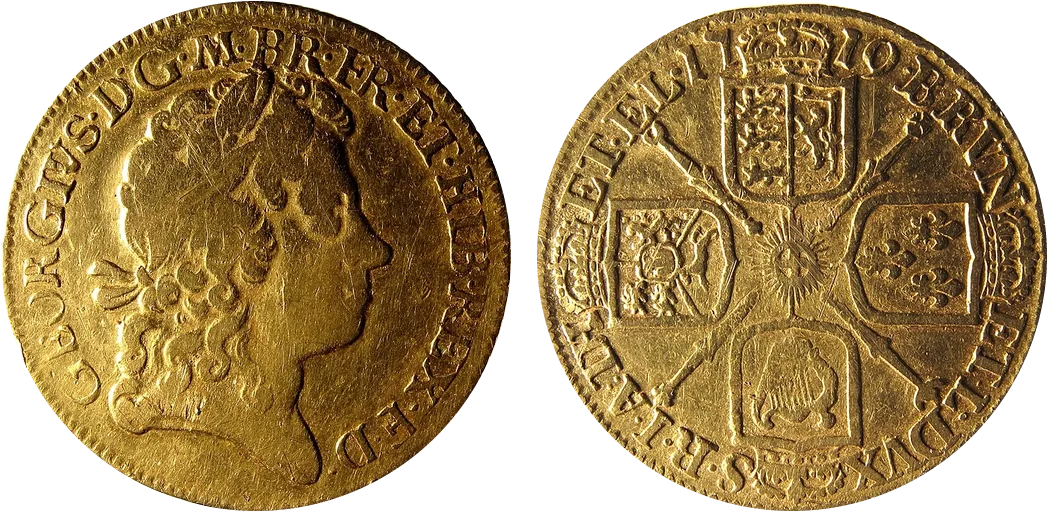
Britain ended up on gold by accident. In 1717 Isaac Newton, then Master of the Royal Mint, fixed the gold guinea at 21 shillings. That valued gold slightly higher against silver than prices on the Continent did, so full-weight silver coins were melted or shipped abroad, and gold became the money people actually used.
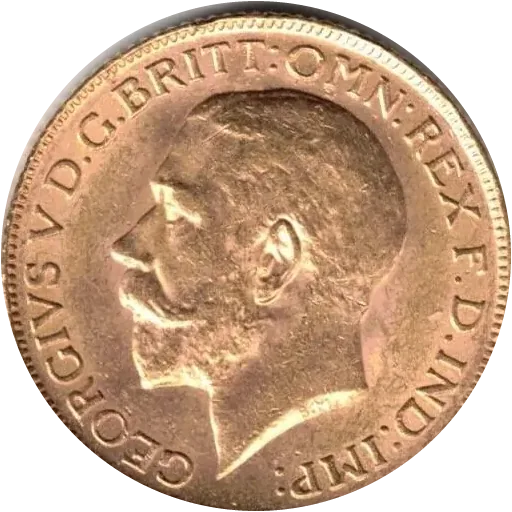
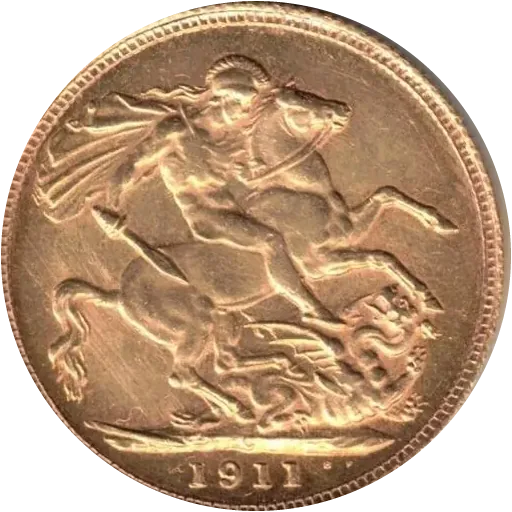
War with revolutionary France forced the Bank of England to stop paying out gold in 1797. Parliament voted in 1819 to restore it, and by 1821 notes were convertible again at the old price. For the next century London sat at the center of world finance, and the pound was as good as gold.
1792to 1900
America’s long fight over gold
The young United States tried to use both metals. The Coinage Act of 1792 defined a dollar in silver or in gold, at a ratio of 15 to 1. Europe valued gold a little higher, so gold coins left the country and Americans paid in silver. When Congress lightened the gold dollar in 1834, the problem flipped: silver was now the undervalued metal, it disappeared, and the country ran on gold.
The Civil War broke the link. In 1862 Congress authorized greenbacks, paper dollars that could not be exchanged for gold, and for 17 years gold had a floating price in paper money. It took until 1879 to make greenbacks convertible again at the old $20.67.
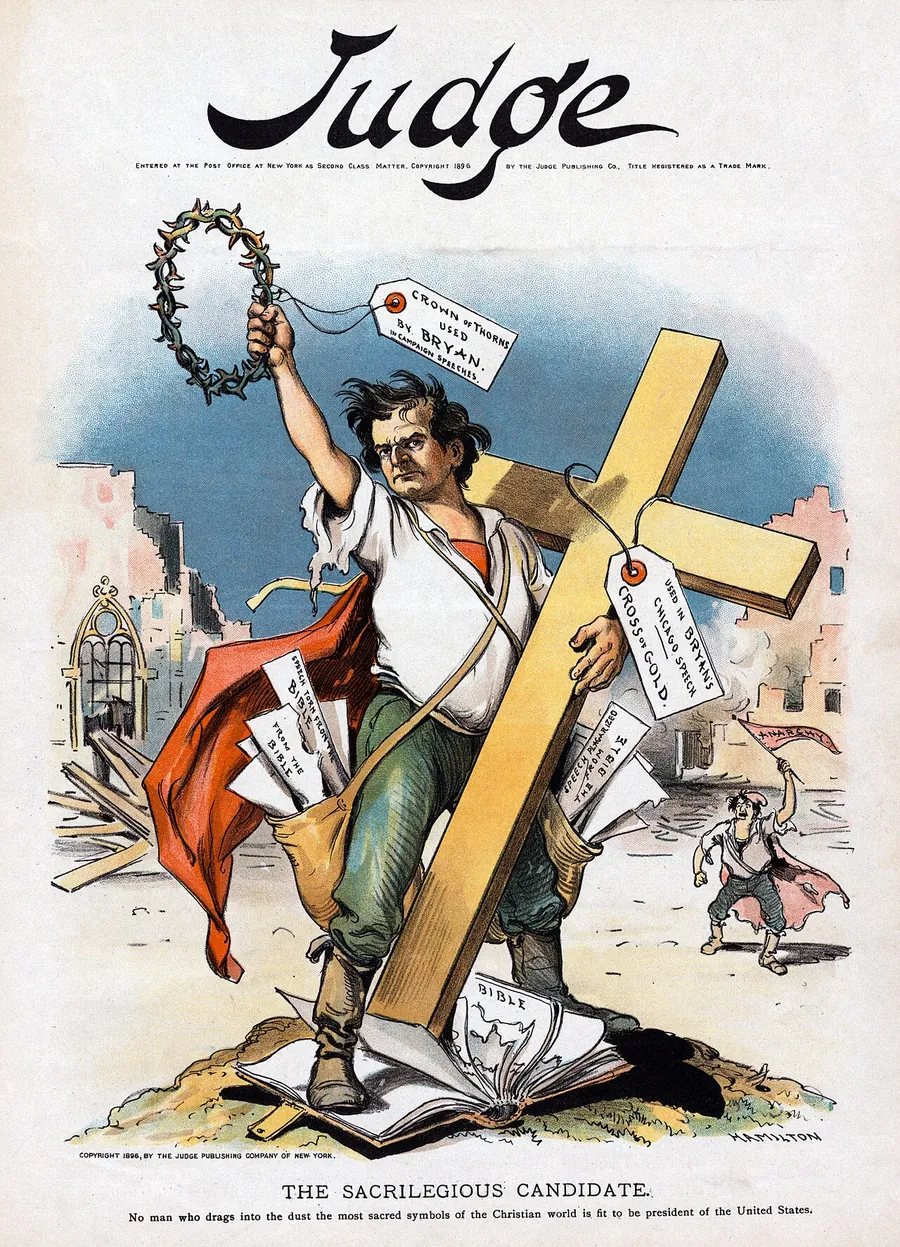
Then came the fight over silver. Prices in gold countries fell for nearly two decades after 1873, which made debts harder to repay, and farmers and silver miners wanted silver coined freely again to loosen the money supply. The fight peaked in 1896, when William Jennings Bryan won the Democratic nomination with a speech against gold. He lost to William McKinley, and in 1900 the Gold Standard Act put the dollar on gold alone.
- The Coinage Act defines the dollar as 371.25 grains of pure silver or 24.75 grains of pure gold, a ratio of 15 to 1. Europe valued gold at about 15½ to 1, so American gold coins went abroad and silver did the work.
- Congress cuts the gold in the dollar to set a ratio of about 16 to 1. Now silver is the undervalued metal, and the country is on gold in all but name.
- A small adjustment leaves the dollar at 23.22 grains of gold: $20.67 an ounce.
- To pay for the Civil War, the Legal Tender Acts create greenbacks, paper money that cannot be swapped for gold. Gold trades at a premium for 17 years.
- A rewrite of the coinage laws drops the standard silver dollar. Silver interests later call it "the Crime of '73."
- Greenbacks become convertible into gold again at the old price of $20.67.
- The Bland-Allison Act and then the Sherman Silver Purchase Act order the Treasury to buy silver. The Sherman Act is repealed in 1893.
- William Jennings Bryan tells the Democratic convention in Chicago, "You shall not crucify mankind upon a cross of gold." He loses the election to William McKinley.
- The Gold Standard Act makes gold the only standard: a dollar is 25.8 grains of gold nine-tenths fine, which is 23.22 grains of pure gold.
The gold coin of this era was the $20 double eagle, which held just under an ounce of gold. See what one is worth today.
1871to 1914
The world on gold
Until the 1870s most countries used silver or both metals, and France kept gold and silver together at a fixed ratio. Germany broke that system. After winning the Franco-Prussian War in 1871, the new German Empire stopped coining silver and moved to a gold mark, completed in July 1873. In September 1873 the Paris mint limited silver coinage, and other countries followed. Over the rest of the decade, silver lost about a fifth of its value against gold.
The period from about 1880 to 1914 is known as the classical gold standard. Most major economies kept their currencies convertible into gold, exchange rates between them stayed fixed, and money moved between countries with few barriers.
The rules bent in emergencies. Britain suspended payment from 1797 to 1821 and the United States from 1862 to 1879, but both came back at the original price, and that record made the promise believable.
1914to 1934
War, depression and the end of gold coins
World War I ended the classical system. The warring governments printed money to pay for the fighting and stopped paying out gold. In the 1920s they rebuilt a weaker version, the gold exchange standard, in which many central banks held dollars and pounds instead of gold. Britain returned in 1925 at its prewar price, which overvalued the pound and kept the country in deflation until a run on its gold forced it off on September 21, 1931.
In the United States the crisis came in early 1933. Americans pulled gold out of banks and foreign investors, fearing a devaluation, pulled it out of the country. By March the Federal Reserve Bank of New York could no longer honor its promise to convert currency into gold, and Roosevelt closed the banks. Within a year Roosevelt and Congress had called in the public’s gold, ended convertibility, canceled gold clauses in contracts, and raised the price of gold to $35, which cut the dollar’s gold value to 59% of what the 1900 act had promised.
Critics at the time called the program immoral. Economic historians have mostly reached a different verdict: the recovery in the US and in most leading economies began when each one left gold and let prices rise.
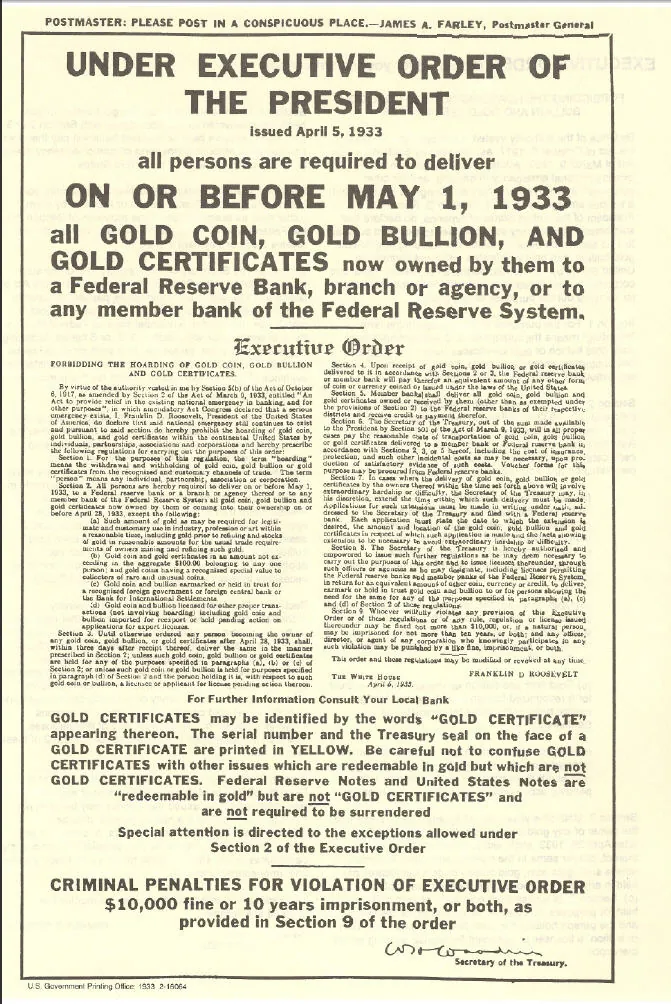
- The Federal Reserve Act requires the new central bank to hold gold worth 40% of the notes it issues and to redeem them at $20.67 an ounce.
- World War I. The warring countries print money to fight and stop paying out gold.
- Britain returns to gold at its prewar price, which leaves the pound overvalued. Deflation follows.
- Britain leaves the gold standard after a run on its gold.
- With gold draining from the Federal Reserve, Roosevelt declares a national bank holiday.
- Executive Order 6102 orders Americans to turn in gold coin, bullion and gold certificates at $20.67 an ounce.
- A proclamation suspends the gold standard: no gold exports, and no swapping currency for gold.
- Congress cancels "gold clauses" in all contracts, public and private. The Supreme Court upholds this in 1935.
- The Gold Reserve Act hands all monetary gold to the Treasury. The next day Roosevelt sets the price at $35 an ounce.
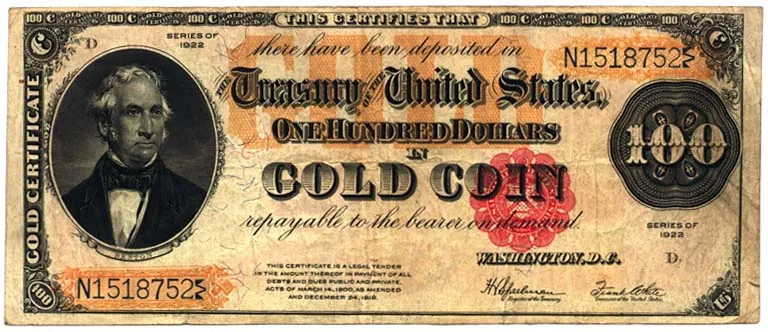
Read the full order, section by section, on our Executive Order 6102 page.
1944to 1971
Bretton Woods
In July 1944, with the war still on, delegates from 44 nations met at the Mount Washington Hotel in Bretton Woods, New Hampshire, to design the postwar money system. Other currencies would be pegged to the dollar, and the dollar would be pegged to gold at $35 an ounce. Only foreign governments and central banks could exchange dollars for gold; Americans still could not. The United States held about three-quarters of the world’s official gold, so the promise looked safe.
The design carried its own weakness. The world needed dollars to trade, and it got them through US deficits, but every dollar sent abroad was a claim on US gold. By 1961 those claims were larger than the gold. Economists call this the Triffin dilemma: without more dollars the system could not work, and with more dollars it could not hold. Rising US inflation after 1965 made it worse.
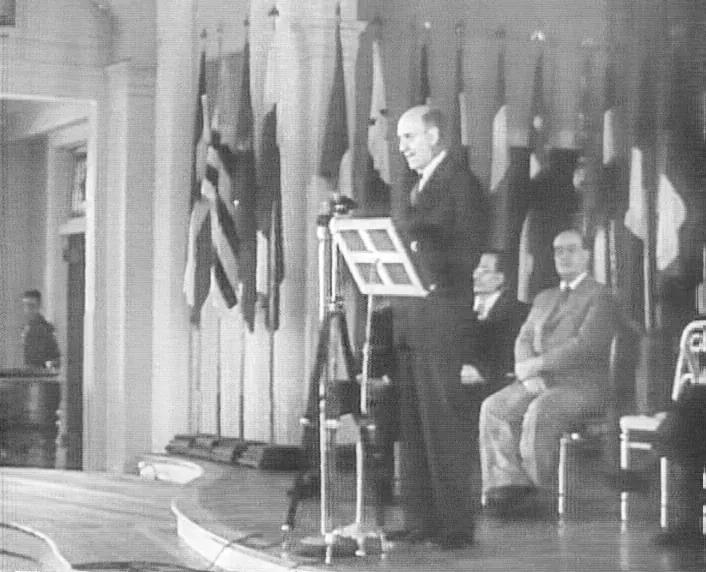
- Delegates from 44 nations meet at Bretton Woods, New Hampshire, and create the International Monetary Fund and the World Bank.
- The system becomes fully operational as European currencies become convertible for trade.
- A run in the London market pushes gold to $40 an ounce, above the official $35.
- Eight central banks form the London Gold Pool to hold the price at $35.
- Congress ends the gold reserve requirement for Federal Reserve deposits.
- The Gold Pool collapses. A two-tier market follows: $35 between central banks, a free price for everyone else. Gold backing for Federal Reserve notes ends the same month.
1971to 1976
The gold window closes
By the summer of 1971, money was pouring out of the dollar and foreign governments were asking to swap their dollars for US gold. On Sunday evening, August 15, after a weekend at Camp David, Richard Nixon went on television.
“I have directed Secretary Connally to suspend temporarily the convertibility of the dollar into gold or other reserve assets, except in amounts and conditions determined to be in the interest of monetary stability and in the best interests of the United States.”
Richard Nixon, address to the nation, August 15, 1971
“Temporarily” turned out to be permanent. A December 1971 deal at the Smithsonian Institution set a new price of $38, and in February 1973 the dollar was cut again, to $42.22. Within weeks the major currencies were floating, and the Bretton Woods system was over. In 1974 Americans were allowed to own gold again, and in 1976 Congress took the gold definition out of the law.
The Treasury still carries its gold at the last official price, $42.2222 an ounce. Its 261.5 million ounces are on the books at $11.04 billion. At today's price they are worth about $956 billion. See how much gold the US has and what is in Fort Knox.
- Nixon and his advisers, including Fed chairman Arthur Burns, Treasury Secretary John Connally and Paul Volcker, plan a new policy at Camp David.
- Nixon closes the gold window, freezes wages and prices for 90 days, and puts a 10% surcharge on imports.
- The Smithsonian Agreement devalues the dollar about 8.5%, to $38 an ounce.
- The dollar is devalued again, to $42.22. Within a month nearly every major currency floats.
- Americans can legally buy, hold and sell gold again for the first time since 1933.
- Congress removes the gold definition of the dollar from the law.
- Switzerland, the last country with a gold link, drops the 40% gold backing of the franc in a new constitution.
Which standard was the US on?
The United States was legally on a gold standard only from 1900 to 1933, and on one in all but name from 1834 to 1933, apart from a 17-year break for greenbacks. This table shows what a dollar meant in each period.
| Years | Standard | What a dollar meant | Gold, per ounce |
|---|---|---|---|
| 1792 to 1834 | Two metals, mostly silver | 371.25 grains of silver or 24.75 grains of gold | $19.39 |
| 1834 to 1861 | Two metals, mostly gold | About 23.2 grains of gold | $20.69, then $20.67 from 1837 |
| 1862 to 1878 | Greenbacks | Government paper that could not be swapped for gold | Floated, as high as about $57 in 1864 |
| 1879 to 1933 | Gold standard (in law from 1900) | 23.22 grains of gold | $20.67 |
| 1934 to 1971 | Gold for foreign governments only | 13.71 grains of gold, but Americans could not redeem | $35 |
| 1971 to 1973 | Official price, no convertibility | Nothing you could collect | $38, then $42.22 |
| 1973 to today | Fiat money | Backed by law and trust, not metal | $3,654 now |
What a gold dollar is worth today
Each definition of the dollar was a weight of gold. Pick one to see how much gold a dollar held and what that gold sells for at today’s price, updated November 28, 2026 at 9:46 PM EST.
Did the gold standard work?
Over the long run the gold standard kept prices very steady: from 1880 to 1914, US inflation averaged 0.1% a year. Over months and years it was far bumpier than the money system that followed, because the money supply moved with gold flows and gold discoveries, and policymakers had little room to respond to a slump.
| Measure, United States | Gold standard era | After World War II | Periods compared |
|---|---|---|---|
| Average inflation | 0.1% a year | 4.1% a year | 1880 to 1914 vs 1946 to 2003 |
| Short-run price instability (coefficient of variation) | 17.0 | 0.88 | 1879 to 1913 vs 1946 to 1990 |
| Swings in real output (coefficient of variation) | 3.5 | 0.4 | 1879 to 1913 vs 1946 to 2003 |
| Average unemployment | 6.8% | 5.9% | 1879 to 1913 vs 1946 to 2003 |
Figures from Michael D. Bordo. A higher coefficient of variation means more year-to-year instability. Milton Friedman estimated that running a full gold coin standard would have cost the US more than 2.5% of national output in 1960, the cost of producing the gold.
Could the US go back?
Calls to return to gold come up from time to time. Supporters like the simplicity of the rule: a fixed gold price would limit how much money the government and the Federal Reserve could create. Critics answer that it would tie the economy to the supply of one metal, bring back larger swings in prices and jobs, and leave the Fed unable to respond to a crisis.
Any return would also have to fix a price. Here is what an ounce would need to cost for the Treasury’s gold to cover the money in circulation today.
- $9,467an ounce to back all paper currency and coin ($2.48 trillion), about 2.6 times today's price
- $89,265an ounce to back M2, which adds bank deposits ($23.3 trillion), about 24 times today's price
Uses the Treasury’s 261.5 million troy ounces and Federal Reserve figures for August 2026. A gold standard does not have to cover 100%: from 1913 the Federal Reserve had to hold gold worth 40% of the notes it issued.
Common questions
Frequently Asked Questions
For the coins themselves, from the 1792 Coinage Act to the end of the penny, see the history of US coinage. For prices, see gold price by year.
Sources
- Federal Reserve History: Roosevelt's Gold Program: the 40% gold cover, the 1933 drains and bank holiday, the April 20 proclamation, the gold clause resolution and the research on recovery
- Federal Reserve History: Gold Reserve Act of 1934: the act's provisions, the $35 price and 59% figure, and the 1974 return of private ownership
- Federal Reserve History: Launch of the Bretton Woods System: 1958, the 1968 change to a dollar standard and the end in 1973
- Federal Reserve History: Nixon Ends Convertibility of U.S. Dollars to Gold: the London Gold Pool, the Triffin dilemma, Camp David and August 15, 1971
- Federal Reserve History: The Smithsonian Agreement: the $38 and $42 devaluations and the floating of currencies in 1973
- Congressional Research Service: Brief History of the Gold Standard in the United States (2011): US statutes and gold weights from 1792 to 1976
- Michael D. Bordo, "Gold Standard," Concise Encyclopedia of Economics: how the system worked, the par rate, the rules of the game and the performance figures
- Gold Standard Act of 1900, 31 Stat. 45: the definition of the dollar
- The American Presidency Project: Nixon's address of August 15, 1971: the quoted passage
- Teaching American History (Ashland University): The Cross of Gold Speech: the speech and its date
- IMF Finance & Development: Gold, Silver, and Monetary Stability: Germany's switch to gold in 1871 to 1873, France in 1873 and the deflation that followed
- Hansard: Gold Standard (Amendment) Bill, House of Commons, September 21, 1931: Britain's departure from gold
- World Bank Group Archives: Bretton Woods Monetary Conference: the conference dates and the 44 nations
- Office of the Historian, U.S. Department of State: Nixon and the End of the Bretton Woods System: the New Economic Policy
- National Archives: Executive Order 11825: the December 31, 1974 end of gold restrictions
- Federal Reserve: Does the Federal Reserve own or hold gold?: the $42.2222 statutory price
- Bureau of the Fiscal Service: Status Report of U.S. Government Gold Reserve: the Treasury's gold holdings
- Federal Reserve H.6 release, September 22, 2026: currency in circulation and M2 for August 2026
- swissinfo.ch: Swiss franc to leave gold standard: the end of the franc's gold link
Images: gold guinea, Portable Antiquities Scheme (CC BY 2.0); Judge magazine cartoon by Grant Hamilton, 1896; Executive Order 6102 notice, U.S. Government Printing Office; Bretton Woods photograph, U.S. Office of War Information, National Archives; gold certificate, Bureau of Engraving and Printing. Gold prices: MeasuringWorth (Lawrence H. Officer and Samuel H. Williamson) before 1968, daily closes after.
The US price of gold was fixed at $20.67 an ounce from 1837 to 1933. Franklin Roosevelt ended gold convertibility for Americans in 1933, and Richard Nixon ended it for foreign governments on August 15, 1971. Source: MeltValue.