
$2.50 Gold Coin Value
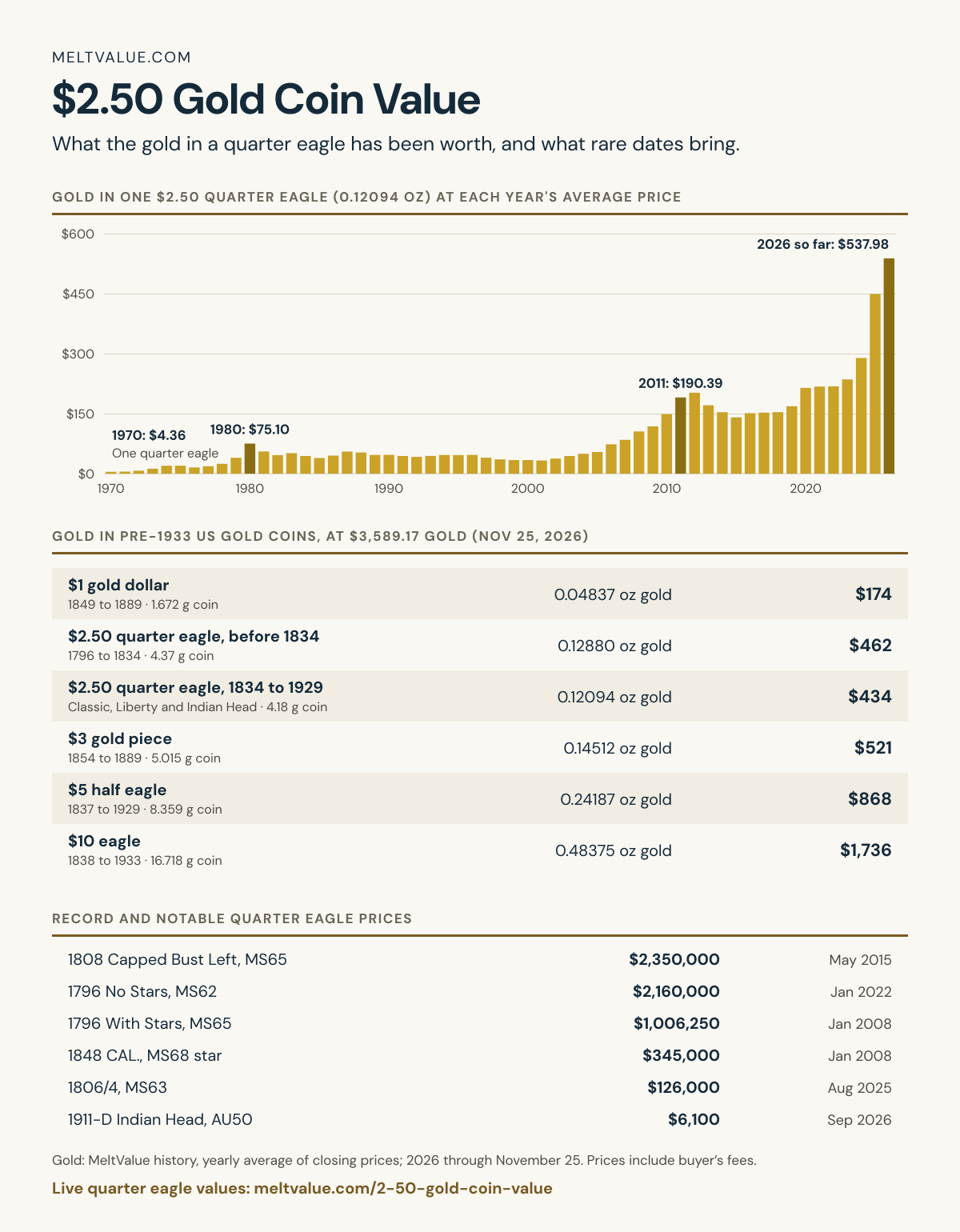
A $2.50 gold coin, or quarter eagle, holds $442 worth of gold today. Every quarter eagle from 1834 to 1929 contains 0.12094 troy ounces of pure gold. Common dates sell well above that, because collectors pay up for the smallest regular US gold coin, and rare dates bring thousands to millions.
Gold $3,656.36 per troy ounce, updated November 27, 2026 at 2:43 AM EST.
Which $2.50 Gold Coin Do You Have?
The United States struck quarter eagles from 1796 to 1929 in six main designs. Check yours against this list.
| Type | How to tell |
|---|---|
| Draped Bust1796 to 1807 | Liberty in a soft cap facing right. The first 1796 coins have no stars on the front. |
| Capped Bust Left1808 only | Liberty in a large cap facing left. A one-year design with 2,710 struck. |
| Capped Head Left1821 to 1834 | Liberty’s head in a cap, ringed by stars. Every date is scarce. |
| Classic Head1834 to 1839 | Liberty with curly hair and a headband, no motto over the eagle. The first coins on the lighter 1834 standard. |
| Liberty Head1840 to 1907 | Liberty in a coronet marked LIBERTY. The back reads 2 1/2 D. The longest-running design. |
| Indian Head1908 to 1929 | A Native American in a headdress, cut into the coin instead of raised. The back reads 2 1/2 DOLLARS. |
The Mint also struck two commemorative quarter eagles, the 1915-S Panama-Pacific and the 1926 Sesquicentennial, with the same gold content. Collectors price them separately.
$2.50 Gold Coin Value Calculator
Enter how many quarter eagles you have. Prices update live.
Gold value
$442
0.1209 troy oz of pure gold. At 2026 premiums from AU to MS63, common-date Indian Heads would sell for about $575 to $774 at today’s gold price.
What Common Quarter Eagles Sell For
Quarter eagles carry bigger premiums over melt than larger gold coins. Take the 1926 Indian Head, one of the most common dates. In public auctions in 2026 it sold for:
- AU58: $793 in February, about 34% over its gold value that day.
- MS62: $763 in July, about 55% over.
- MS63: $854 in July, about 73% over.
- MS64+ with a CAC sticker: $1,159 in August, about 117% over.
- MS66: $12,810 in June. Gem Indian Heads are scarce, because the cheek, the highest point of the design, almost always shows friction.
Applied to today’s gold price, a common-date Indian Head in AU to MS63 works out to roughly $575 to $774. Late Liberty Heads are the other affordable choice: the 1907, the last year of the design, is the most common quarter eagle of all and the easiest to find uncirculated.
Selling is a different number. Dealers often pay close to gold value for raw, worn or cleaned common dates, and more for certified Mint State coins. Get two or three offers, and check the date against the lists below first.
Indian Head Quarter Eagle Dates and Mintages
The full set has 15 coins. None were struck from 1916 to 1924, and Denver made them in only three years. Mintages for 1908 to 1915 include the small number of proofs.
| Date | Mintage | Notes |
|---|---|---|
| 1908 | 565,057 | Common |
| 1909 | 441,899 | Common |
| 1910 | 492,682 | Common |
| 1911 | 704,191 | Common; used to fake the 1911-D |
| 1911-D | 55,680 | The scarcest date |
| 1912 | 616,197 | Common |
| 1913 | 722,165 | Common |
| 1914 | 240,117 | Second-lowest mintage, scarce in high grades |
| 1914-D | 448,000 | Scarce in high grades |
| 1915 | 606,100 | Common |
| 1925-D | 578,000 | Among the most common |
| 1926 | 446,000 | Among the most common |
| 1927 | 388,000 | Common |
| 1928 | 416,000 | Common |
| 1929 | 532,000 | Common; the last US quarter eagle |
Rare $2.50 Gold Coins Worth Far More Than Gold
Every quarter eagle made before 1834 is scarce, as are Liberty Heads from the Charlotte (C) and Dahlonega (D) mints. These are the best known rarities.
| Coin | Record or typical price |
|---|---|
| 1808 Capped Bust LeftOne-year design; about 125 to 150 survive.Mintage: 2,710 | $2,350,000 (May 2015, MS65), the quarter eagle record |
| 1796 No StarsThe first quarter eagle, the only one without stars on the front.Mintage: 963 | $2,160,000 (Jan 2022, MS62); $1,725,000 (Jan 2008, MS65) |
| 1796 With StarsStars added later in the first year.Mintage: A few hundred | $1,006,250 (Jan 2008, MS65) |
| 1806/4Struck from an 1804 die recut for 1806.Mintage: 1,136 | $126,000 (Aug 2025, MS63) |
| 1848 CAL.Struck from the first California gold sent to the Mint, stamped CAL. above the eagle.Mintage: 1,389 | $345,000 (Jan 2008, MS68★) |
| 1841 Little PrincessStruck only as proofs; no business strikes.Mintage: Not recorded | Price guides list it at about $60,000 to $700,000 by grade |
| 1864One of the rarest Liberty Head business strikes.Mintage: 2,772 | Many survivors are damaged, which makes nice ones scarcer still |
| 1911-D Indian HeadLess than a quarter of the next-lowest mintage.Mintage: 55,680 | $6,100 (Sep 2026, AU50) |
Auction prices include buyer’s fees.
The 1911-D is the coin most people hope they have. Look for a clear D on the back, left of the arrows. Coins with a weak, barely visible D resell for less, and many fakes are genuine 1911 coins with a D added, so buy one only in a PCGS or NGC holder.
$2.50 Gold Coin Specifications
| 1834 to 1929 | Before 1834 | |
|---|---|---|
| Covers | Classic Head, Liberty Head, Indian Head | Draped Bust, Capped Bust, Capped Head |
| Weight | 4.18 g | 4.37 g |
| Purity | 90% gold (89.92% in 1834 to 1836) | 91.67% gold |
| Pure gold | 0.12094 troy oz | About 0.1288 troy oz |
| Diameter | 18 mm | 20 mm on the earliest coins |
| Edge | Reeded | Reeded |
The Liberty Head was designed by Christian Gobrecht and the Indian Head by Bela Lyon Pratt. Today a quarter eagle holds about 177 times its face value in gold.
$2.50 Gold Coin History
The Coinage Act of 1792 created the quarter eagle, a quarter of the $10 eagle, and the first ones came out in 1796. For decades the Mint struck it only now and then: none from 1809 to 1820, and only small batches until 1834, when Congress cut the gold in US coins and most older gold was melted. From 1837 the coin settled at 4.18 grams of 90% gold.
Gobrecht’s Liberty Head ran from 1840 to 1907, longer than any other quarter eagle design. In 1848 the Mint stamped CAL. on 1,389 coins made from the first California gold it received, a souvenir of the Gold Rush. In 1908 Pratt’s Indian Head replaced the Liberty, with its design sunk into the coin, a first for US circulating coinage along with the matching half eagle.
Demand faded. In 1911 the Mint Director even recommended that Congress abolish the coin. No quarter eagles were struck from 1916 to 1924, and the last came in 1929. After the 1933 gold recall, many were turned in and melted. For the larger coins of the same era, see the $5 gold coin value and $10 gold coin value.
How to Sell a $2.50 Gold Coin
- Know the gold value. Use the calculator above so you can judge any offer.
- Check the date and mint mark. Compare them with the rare list. Anything before 1834, any C or D Liberty Head, and the 1911-D deserve a closer look.
- Consider grading for Mint State coins. Certified Indian Heads in MS63 and up sell for well over melt; raw coins usually do not.
- Get several quotes. Coin shops, bullion dealers and auction houses post different prices.
- Don’t clean it. Cleaning can cut a collector coin to melt value.
For every pre-1933 coin at once, see US gold coin melt values, or check the live gold spot price. The $1 gold coin value covers the only smaller US gold coin.
Sources
- Wikipedia: Quarter eagle: the $2.50 gold coin authorized by the Coinage Act of 1792, struck from 1796 to 1929, its types and weights
- Wikipedia: Indian Head gold pieces: Bela Lyon Pratt’s recessed design for the 1908 quarter eagle and half eagle
- PCGS CoinFacts: 1808 $2.50: 2,710 struck, 4.37 grams, and the finest known coin, the Pogue MS65, at $2,350,000 in 2015
- PCGS CoinFacts: 1796 $2.50 No Stars: 963 struck, 20 mm and 4.37 grams, and the MS65 at $1,725,000 in January 2008
- NGC Auction Central: Early $2.50: top early quarter eagle prices, including the 1796 No Stars MS62 at $2,160,000 in 2022 and the 1796 With Stars MS65 at $1,006,250
- CNN: This $2.50 coin just sold for $2.4 million: the May 2015 sale of the 1808 quarter eagle
- PCGS CoinFacts: 1848 $2.50 CAL.: 1,389 struck from California gold that reached the Mint in December 1848
- NGC: Legendary coins, 1848 CAL. quarter eagle: the counterstamp CAL. above the eagle, and its standing as perhaps the first US commemorative
- PCGS CoinFacts: 1911-D $2.50: 55,680 struck, less than a quarter of the 1914, and fakes made by adding a D to a real 1911
- NGC: Collecting Indian Head quarter eagles: Jeff Garrett’s date-by-date mintages, the 1911-D as the series’ top date, weak D coins as weaker resale, and the 1914 in high grades
- CoinWeek: 1911-D Indian Head quarter eagle: the series-low mintage and the counterfeit risk
- CoinWeek: 1926 Indian Head quarter eagle: a common date collected mostly in Mint State, and the 1926 Sesquicentennial $2.50 commemorative