
$5 Gold Coin Value
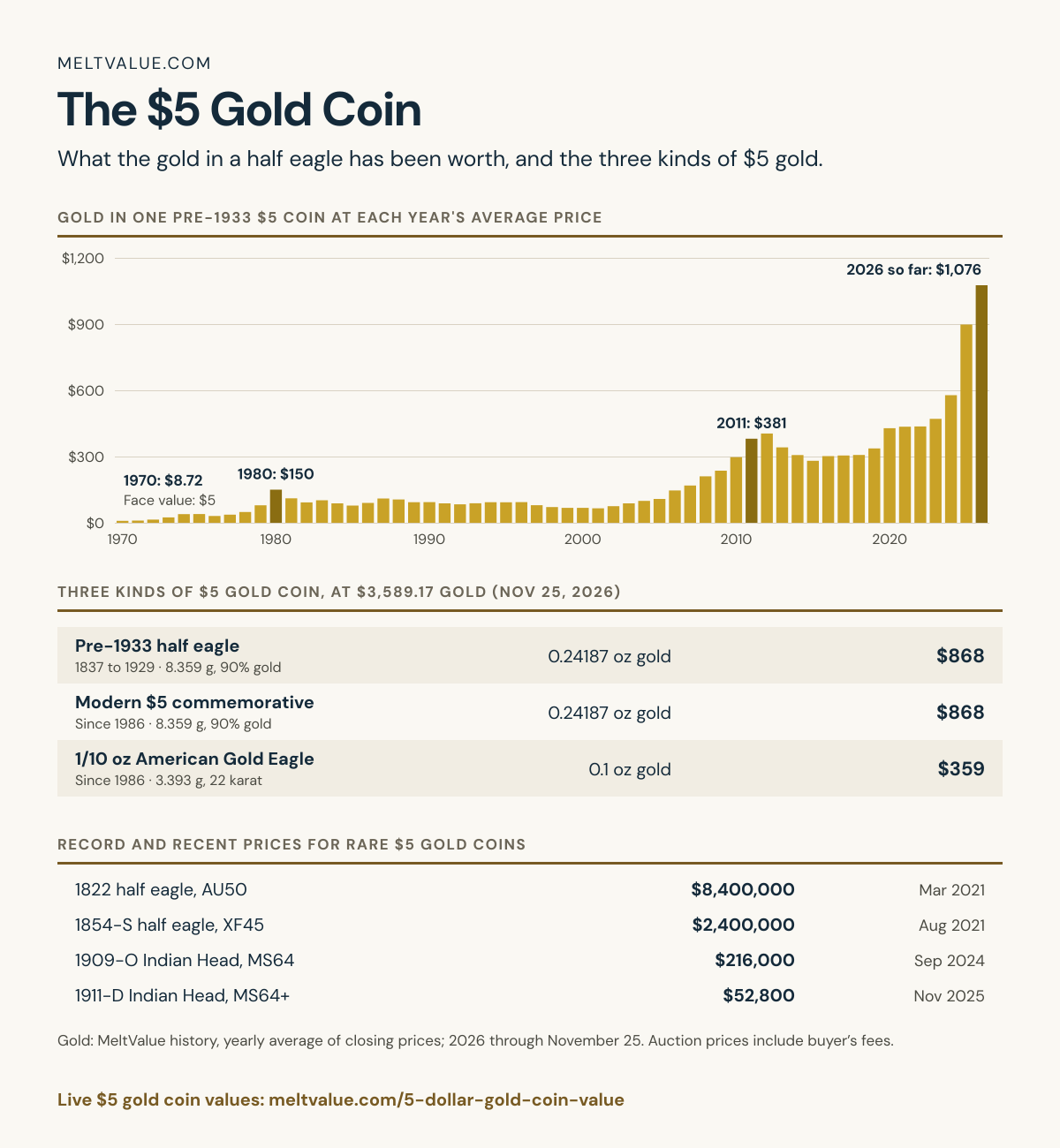
A pre-1933 $5 gold coin holds $864 worth of gold today. Every half eagle from the late 1830s to 1929 contains 0.24187 troy ounces of pure gold, and so does every modern $5 commemorative. The modern 1/10 oz Gold Eagle, also marked $5, holds less. Common dates sell for a little more than their gold; a few rare dates sell for thousands to millions.
Gold $3,570.25 per troy ounce, updated November 26, 2026 at 8:47 AM EST.
Which $5 Gold Coin Do You Have?
The United States has made $5 gold coins since 1795. Check the design and date against this list.
| Type | How to tell |
|---|---|
| Early half eagles1795 to 1834 | Capped or draped bust of Liberty. Heavier than later coins, and every date is scarce. |
| Classic Head1834 to 1838 | Liberty with curly hair and a headband. The back reads 5 D. |
| Liberty Head, no motto1839 to 1866 | Liberty in a coronet marked LIBERTY. The back reads FIVE D., with no motto. |
| Liberty Head, with motto1866 to 1908 | IN GOD WE TRUST above the eagle. The most common type. |
| Indian Head1908 to 1916, 1929 | A sunken design: a Native American in a headdress and a standing eagle, cut into the coin. |
| Modern commemorative1986 to today | Dated 1986 or later, marked FIVE DOLLARS, with a different design for each event. |
| 1/10 oz American Gold Eagle1986 to today | Small, 16.5 mm across, marked 1/10 OZ. FINE GOLD and 5 DOLLARS. |
Liberty and Indian Head $5 Value by Condition
Most half eagles are common dates, and their price is the gold value plus a premium. Indian Heads carry a bigger premium than Liberty Heads, because fewer survive in nice condition. These are typical dealer selling ranges for common dates in November 2026.
| Condition | Liberty Head | Indian Head |
|---|---|---|
| Gold valueThe floor for any date | $864 | $864 |
| Cleaned or ex-jewelry0% to 5% / 5% to 10% over | $864 to $907 | $907 to $950 |
| Circulated, XF to AU3% to 12% / 8% to 20% over | $889 to $967 | $933 to $1,036 |
Common dates only. Scarce dates and mint marks are priced coin by coin.
Uncirculated coins cost more, and the gap grows fast for Indian Heads. On one large dealer’s price list in late 2026, compared with an XF coin of the same type:
- MS62 cost about 10% more for either type.
- MS63 cost about 17% more for a Liberty Head and 22% more for an Indian Head.
- MS64 cost about 25% more for a Liberty Head and 60% more for an Indian Head.
- MS65 cost about 70% more for a Liberty Head and about seven times as much for an Indian Head.
Selling is a different number. Dealers often pay close to the gold value for raw common dates, and more for certified Mint State coins. Get two or three offers, and check the date against the rare list below first.
Modern $5 Gold Coins
Modern $5 commemoratives have the same size and gold as the old half eagle: 8.359 grams, 90% gold, 0.24187 ounces of pure gold. The Mint has issued them for events and anniversaries since 1986. Most trade a little over their gold value, which is $864 today. Coins in their original box, graded 70 or with low mintages can bring more.
The 1/10 oz American Gold Eagle carries a $5 face value but holds exactly 0.1 troy ounce of gold, worth $357 today. It is a 22-karat bullion coin, made since 1986. In 2026 the cheapest dealers sold new ones for about 12% over spot. Small coins cost more per ounce to make and sell, so expect to buy above melt and sell near it. See US gold coin melt values for every Gold Eagle size.
$5 Gold Coin Value Calculator
Enter how many of each kind you have. Prices update live.
Gold value
$864
0.2419 troy oz of pure gold. Worn common-date half eagles typically sell for $889 to $967 (Liberty Head) or $933 to $1,036 (Indian Head).
Common Dates That Trade Near Gold Value
- Liberty Head: most Philadelphia and San Francisco dates from the 1880s through 1908. Worn examples are common, especially from the West, where the coins circulated.
- Indian Head: the 1908, 1909, 1910, 1911, 1912 and 1914-D. The 1909-D, with 3,423,560 struck, is the most common of all, and the 1911-S, with 1,416,000, is next.
Rare $5 Gold Coins Worth Far More Than Gold
Early half eagles from before 1834 are all scarce, as are coins from the Charlotte (C), Dahlonega (D, 1838 to 1861) and Carson City (CC) mints. These are the best known rarities.
| Coin | Record or typical price |
|---|---|
| 1822 half eagleThree known; two are in the Smithsonian.Mintage: 17,796 reported | $8,400,000 (Mar 2021, AU50) |
| 1798 Small EagleOne of the earliest US gold coins; few survive.Mintage: Not recorded by variety | $2,820,000 (Feb 2026) |
| 1854-S Liberty HeadFirst San Francisco half eagles; three known.Mintage: 268 | $2,400,000 (Aug 2021, XF45) |
| 1875 Liberty HeadFewer than 10 business strikes known.Mintage: 200 | Only the 1854-S Liberty is rarer |
| 1909-O Indian HeadThe only Indian Head $5 from New Orleans.Mintage: 34,200 | $216,000 (Sep 2024, MS64); about $9,000 to $17,000 in AU |
| 1929 Indian HeadMost were melted after 1933; only a few hundred survive.Mintage: 662,000 | $34,800 (June 2025, MS63); $45,600 (Apr 2025, MS64) |
| 1911-D Indian HeadLow mintage; very rare in Mint State.Mintage: 72,500 | $52,800 (Nov 2025, MS64+) |
| 1908-S Indian HeadScarce San Francisco date.Mintage: 82,000 | Fakes are common; buy only certified coins |
Auction prices include buyer’s fees.
$5 Gold Coin Specifications
| Half eagle | 1/10 oz Gold Eagle | |
|---|---|---|
| Covers | Liberty Head, Indian Head, modern commemoratives | Bullion coin since 1986 |
| Weight | 8.359 g | 3.393 g |
| Purity | 90% gold, 10% copper | 22 karat (91.67%) |
| Pure gold | 0.24187 troy oz | 0.1000 troy oz |
| Diameter | 21.6 mm (22.5 mm in 1839 to 1840) | 16.5 mm |
| Edge | Reeded | Reeded |
The Liberty Head was designed by Christian Gobrecht and the Indian Head by Bela Lyon Pratt. The mint mark is on the back of both: below the eagle on a Liberty Head from 1840 on, and left of the arrowheads on an Indian Head. Today a pre-1933 $5 coin holds about 173 times its face value in gold.
$5 Gold Coin History
The half eagle was the first gold coin the United States made. Congress authorized it in 1792, and the first ones came out in 1795. Early half eagles were heavier than later ones, and few survive. In 1834 Congress cut the gold in each coin, and from 1837 a half eagle held exactly 0.24187 ounces of gold.
Christian Gobrecht’s Liberty Head arrived in 1839 and lasted 70 years. IN GOD WE TRUST was added above the eagle in 1866. The Liberty Head half eagle is the only US gold coin struck at all seven mints: Philadelphia, Charlotte, Dahlonega, New Orleans, San Francisco, Carson City and Denver.
In 1908 sculptor Bela Lyon Pratt replaced it with the Indian Head, with its design sunk into the coin. Half eagles were struck every year through 1916 and once more in 1929. After the 1933 gold recall, the Treasury melted most of the 1929 coins, which is why so few exist. Since 1986 the $5 face value has lived on in commemoratives and the 1/10 oz American Gold Eagle.
How to Sell a $5 Gold Coin
- Know the gold value. Use the calculator above so you can judge any offer.
- Check the date and mint mark. Compare them with the rare list. C, D, CC and O coins deserve a closer look.
- Get several quotes. Coin shops, bullion dealers and auction houses post different prices.
- Keep modern coins in their boxes. Commemoratives sell best with the original box and certificate.
- Don’t clean them. Cleaning can cut a collector coin to melt value.
For other sizes, see the $20 gold coin value and US gold coin melt values, or check the live gold spot price.
Sources
- Wikipedia: Half eagle: the first US gold coin, authorized in 1792, its types and dates, and the 1839 change from 5 D. to FIVE D.
- US Mint: Gold eagles: the half eagle and eagle first released in 1795
- CoinWeek: Liberty Head half eagles, a guide for collectors: Christian Gobrecht’s 1839 design, the motto added in 1866, and the only US gold type struck at seven mints
- Wikipedia: Indian Head gold pieces: Bela Lyon Pratt’s design, 8.359 g and 0.24187 oz of gold, the mint mark left of the arrowhead, and the only US circulating coins with recessed designs
- PCGS CoinFacts: Indian Head $5: Bela Lyon Pratt’s design, 662,000 struck in 1929 with only a small number surviving, and the 1909-D as the most available Mint State date
- CoinWeek: Indian Head half eagle, 1908 to 1929: yearly production through 1916, one more year in 1929, and the melting of most 1929 coins after the 1933 gold recall
- PCGS: The allure of the 1822 Capped Bust half eagle: 17,796 struck, three known, and the $8.4 million sale in March 2021
- Coin World: 1822 gold half eagle sells for $8.4 million: the March 25, 2021 sale of the only privately held 1822
- PCGS: Stack’s Bowers bidders crush records at James A. Stack, Sr. Part II: the 1798 Small Eagle half eagle at $2.82 million on February 3, 2026
- Numismatic News: Just three 1854-S gold half eagles known: San Francisco’s 268 half eagles in its first year
- Artdaily: World’s Fair of Money soars to more than $68 million at Heritage: the 1854-S half eagle in XF45 at $2.4 million in August 2021
- PCGS CoinFacts: 1875 $5: 200 business strikes; among Liberty Head half eagles only the 1854-S is rarer
- PCGS CoinFacts: 1909-O $5: 34,200 struck, the only New Orleans Indian Head half eagle, and a $216,000 MS64 sale in September 2024
- Numismatic News: Most 1929 half eagles melted down: why a 662,000 mintage produced a rarity
- US Mint: Bald Eagle commemorative gold five dollar coin: modern $5 gold specs: 8.359 grams, 0.850 inch, 90% gold
- US Mint: American Eagle gold proof coin: American Gold Eagle sizes and face values