
$10 Gold Coin Value
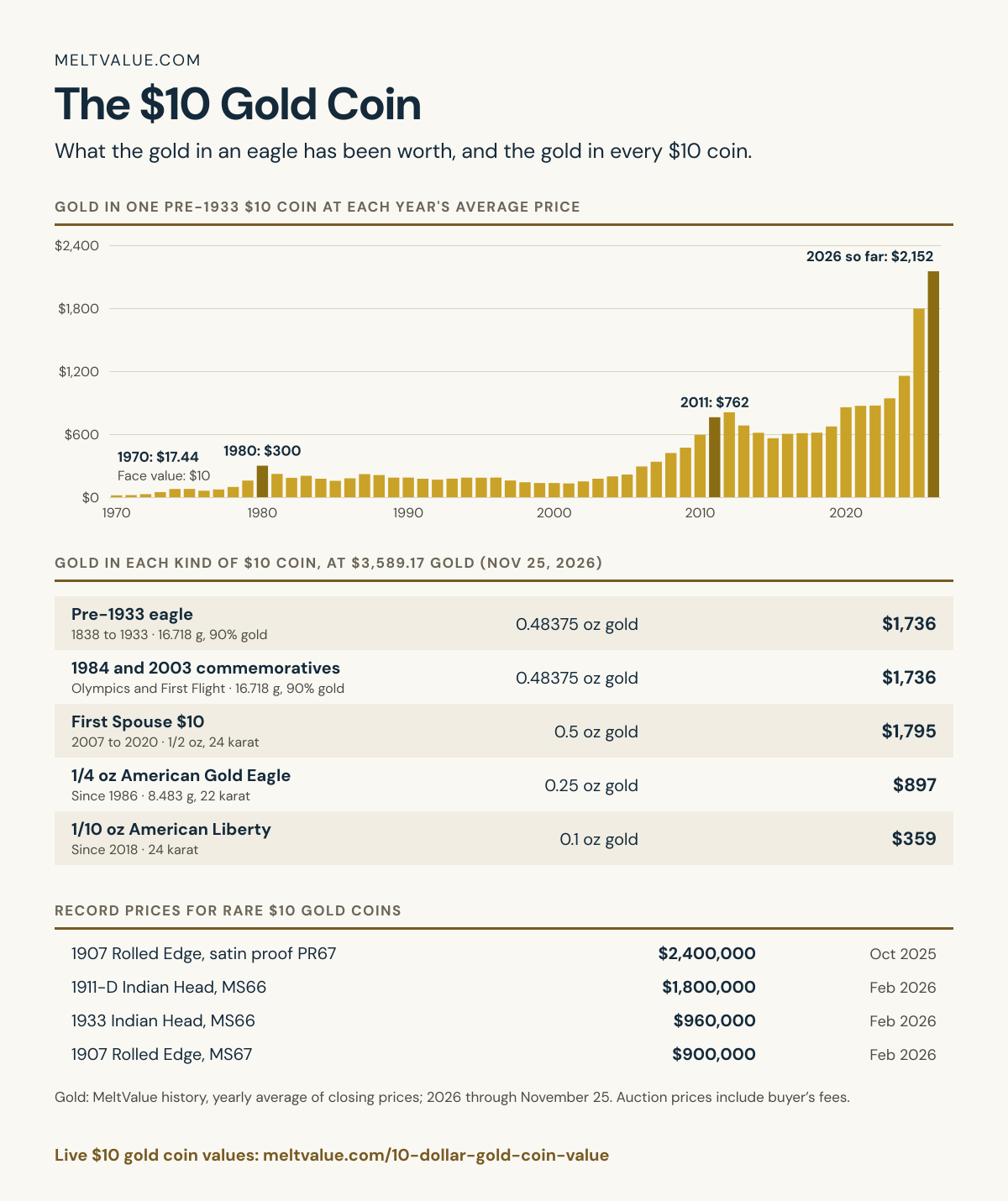
A pre-1933 $10 gold coin holds $1,727 worth of gold today. Every eagle from 1838 to 1933 contains 0.48375 troy ounces of pure gold, and common dates trade close to that. Modern coins marked $10 hold from 0.1 to 0.5 ounce, so check which one you have. A handful of rare dates sell for thousands to millions.
Gold $3,570.25 per troy ounce, updated November 26, 2026 at 8:47 AM EST.
How Much Gold Is in a $10 Gold Coin?
| Coin | Pure gold | Gold value |
|---|---|---|
| Early eagle1795 to 1804 · 17.50 g, 91.67% gold | 0.5158 oz | $1,842 |
| Liberty or Indian Head eagle1838 to 1933 · 16.718 g, 90% gold | 0.48375 oz | $1,727 |
| 1984 Olympic or 2003 First FlightCommemoratives · 16.718 g, 90% gold | 0.48375 oz | $1,727 |
| First Spouse2007 to 2020 · 24 karat | 0.5000 oz | $1,785 |
| 1/4 oz American Gold EagleSince 1986 · 8.483 g, 22 karat | 0.2500 oz | $893 |
| 1/10 oz American LibertySince 2018 · 24 karat | 0.1000 oz | $357 |
Every early eagle is a rarity worth far more than its gold. The 2000 Library of Congress $10 sets a quarter-ounce platinum center inside a 90% gold ring.
Which $10 Gold Coin Do You Have?
The United States has made $10 gold coins, called eagles, since 1795. Check the design and date against this list.
| Type | How to tell |
|---|---|
| Early eagles1795 to 1804 | Capped bust of Liberty, 33 mm across, larger than later eagles. Every date is scarce. No eagles were struck from 1805 to 1837. |
| Liberty Head, no motto1838 to 1866 | Liberty in a coronet marked LIBERTY. The back reads TEN D., with no motto above the eagle. |
| Liberty Head, with motto1866 to 1907 | IN GOD WE TRUST above the eagle. The most common Liberty type. |
| Indian Head, no motto1907 to 1908 | Liberty in a feathered headdress; a standing eagle on the back; no motto. |
| Indian Head, with motto1908 to 1933 | IN GOD WE TRUST to the left of the eagle. Stars on the edge instead of reeding. |
| Modern commemoratives1984, 2000 and 2003 | Marked TEN DOLLARS: the 1984 Olympics, 2000 Library of Congress (gold ring, platinum center) and 2003 First Flight coins. |
| First Spouse2007 to 2020 | A First Lady, or Liberty, on the front; $10, 1/2 OZ. and .9999 FINE GOLD on the back. |
| 1/4 oz American Gold EagleSince 1986 | 22 mm across, marked 1/4 OZ. FINE GOLD and 10 DOLLARS. |
| 1/10 oz American LibertySince 2018 | A modern Liberty design; marked 1/10 OZ. .9999 FINE GOLD and 10 DOLLARS. |
Liberty and Indian Head $10 Value by Condition
Common-date eagles trade almost like bullion. In 2026, dealers sold worn Liberty Heads for only a percent or two over melt, and Indian Heads for a little more. These are typical selling ranges for common dates.
| Condition | Liberty Head | Indian Head |
|---|---|---|
| Gold valueThe floor for any date | $1,727 | $1,727 |
| Cleaned or ex-jewelry0% to 2% / 1% to 4% over | $1,727 to $1,762 | $1,744 to $1,796 |
| Circulated, XF to AU1% to 4% / 2% to 5% over | $1,744 to $1,796 | $1,762 to $1,813 |
| Uncirculated, MS60 to MS623% to 6% / 6% to 10% over | $1,779 to $1,831 | $1,831 to $1,900 |
Common dates only. Scarce dates and mint marks are priced coin by coin.
Higher grades pull away from melt, faster for Indian Heads. Recent auction results for the two most common dates show the pattern:
- 1901-S Liberty Head: an MS63+ brought $2,196 in September 2026, about 3% over its gold value that day. An MS65 brought $2,928 in June 2026, about 47% over, and an MS66 brought $5,124.
- 1926 Indian Head: an MS64+ brought $2,806 in July 2026, about 44% over the $1,943 its gold was worth.
Selling is a different number. One large dealer’s buyback price for a certified MS63 Liberty eagle was about 7% below its selling price. For raw common dates, expect offers close to melt. Get two or three quotes, and check the date against the rare list first.
Modern $10 Gold Coins
Commemoratives. The 1984 Los Angeles Olympics $10 was the first gold coin the US Mint had struck since 1933, and the first US coin with a W mint mark. It and the 2003 First Flight $10 match the old eagle: 16.718 grams, 90% gold, 0.48375 ounces of pure gold, worth $1,727 today. Common examples trade near that, and top grades bring more. The 2000 Library of Congress $10, with a platinum center inside a gold ring, had one of the smallest mintages of any modern coin and often sells above its metal value.
First Spouse coins. From 2007 to 2020 the Mint struck a $10 coin for each First Lady, with a Liberty design for presidents who served without one. Each holds half an ounce of 24-karat gold, worth $1,785 today. Most trade close to that, though many later issues had uncirculated mintages under 2,000.
The 1/4 oz American Gold Eagle carries a $10 face value but holds exactly 0.25 troy ounce of gold, worth $893 today. It is a 22-karat bullion coin made since 1986. Expect to buy it above melt and sell it near melt. The 1/10 oz American Liberty proof, made since 2018, is also a $10 coin and holds 0.1 ounce of 24-karat gold. See US gold coin melt values for every Gold Eagle size.
$10 Gold Coin Value Calculator
Enter how many of each kind you have. Prices update live.
Gold value
$1,727
0.4838 troy oz of pure gold. Worn common-date eagles typically sell for $1,744 to $1,796 (Liberty Head) or $1,762 to $1,813 (Indian Head).
Common Dates That Trade Near Gold Value
- 1901-S Liberty Head: 2,812,750 struck, the most common Liberty eagle. PCGS estimates as many as 200,000 survive.
- 1932 Indian Head: 4,463,000 struck, the most common Indian eagle by far.
- 1926 Indian Head: 1,014,000 struck, the second most common.
- 1910-D Indian Head: 2,356,640 struck, the most plentiful branch-mint Indian eagle in Mint State.
- Other late Liberty dates from Philadelphia and San Francisco are usually available near melt in circulated grades.
Rare $10 Gold Coins Worth Far More Than Gold
Early eagles from 1795 to 1804 are all scarce, as are most Carson City (CC) coins. These are the best known rarities.
| Coin | Recent or record price |
|---|---|
| 1907 Rolled EdgeAlso called Rounded Rim. Nearly all were melted; about 40 survive.Mintage: 31,500 struck | $900,000 (Feb 2026, MS67); $2,400,000 for a satin proof (Oct 2025) |
| 1933 Indian HeadSome were paid out before the recall, so it is legal to own, unlike the 1933 $20. About 30 to 40 survive.Mintage: 312,500 | $960,000 (Feb 2026, MS66) |
| 1920-S Indian HeadMost melted; perhaps 80 to 120 survive.Mintage: 126,500 | $312,000 (Aug 2024, MS64+); $146,400 (Mar 2026, MS63) |
| 1930-S Indian HeadMost never left the Mint; 150 to 200 survive.Mintage: 96,000 | $112,850 (Jul 2026, MS64+); $87,000 (Jan 2025, MS65) |
| 1907 Wire RimTechnically a pattern; about 400 survive.Mintage: About 500 | $97,600 (Jun 2026, MS65) |
| 1911-D Indian HeadLowest regular Indian mintage.Mintage: 30,100 | $1,800,000 (Feb 2026, MS66), a record for a regular Indian eagle; $13,420 (Jan 2026, MS63); about $5,000 in AU58 |
| 1911-S Indian HeadLow mintage; hard in high grades.Mintage: 51,000 | $31,720 (Jun 2026, MS64) |
| 1875 Liberty HeadLowest mintage of any regular US gold coin; 5 or 6 known.Mintage: 100 | Rarely offered |
Auction prices include buyer’s fees.
$10 Gold Coin Specifications
| Eagle | 1/4 oz Gold Eagle | |
|---|---|---|
| Covers | Liberty Head, Indian Head, 1984 and 2003 commemoratives | Bullion coin since 1986 |
| Weight | 16.718 g | 8.483 g |
| Purity | 90% gold, 10% copper | 22 karat (91.67%) |
| Pure gold | 0.48375 troy oz | 0.2500 troy oz |
| Diameter | About 27 mm | 22 mm |
| Edge | Reeded (Liberty, commemoratives); raised stars (Indian) | Reeded |
The Indian Head edge has 46 raised stars through 1911 and 48 from 1912, after Arizona and New Mexico became states. Today a pre-1933 eagle holds about 173 times its face value in gold.
$10 Gold Coin History
The eagle was the largest US denomination when the Mint began striking gold in 1795, alongside the half eagle. Production stopped after 1804 and did not resume until 1838, when Christian Gobrecht’s Liberty Head arrived at the new 0.48375 ounce standard. IN GOD WE TRUST was added above the eagle in 1866.
In 1907, at President Theodore Roosevelt’s urging, Augustus Saint-Gaudens gave the eagle a new design: Liberty in a feathered headdress, and a standing eagle on the back. The first versions, the Wire Rim and Rolled Edge, were struck in higher relief than the final design, and most Rolled Edge coins were melted before release once the design changed. Roosevelt also left off the motto, and Congress put it back in 1908.
Indian Head eagles were struck every year through 1916, then only in 1920, 1926, 1930, 1932 and 1933. After the 1933 gold recall, most of the later coins still held by the Treasury were melted. The $10 face value returned in 1984 on an Olympic commemorative, in 1986 on the 1/4 oz American Gold Eagle and in 2007 on the First Spouse series.
How to Sell a $10 Gold Coin
- Know the gold value. Use the calculator above so you can judge any offer.
- Check the date and mint mark. Compare them with the rare list. CC, O and early S coins deserve a closer look.
- Get several quotes. Coin shops, bullion dealers and auction houses post different prices.
- Consider grading only for high-end coins. An MS64 or MS65 can bring far more than melt; a worn common date will not cover the fee.
- Don’t clean it. Cleaning can cut a collector coin to melt value.
For other sizes, see the $20 gold coin value, the $5 gold coin value and US gold coin melt values, or check the live gold spot price.
Sources
- US Mint: Gold eagles: the eagle and half eagle first released in 1795
- Wikipedia: Indian Head eagle: 16.718 g, 0.48375 oz of gold, 26.92 mm, a starred edge, Saint-Gaudens’s design, and production through 1933
- Wikipedia: Turban Head eagle: early eagles of 1795 to 1804: 17.50 g of 91.67% gold, 33 mm
- Coin World: Know your US coins, Capped Bust $10 eagle: production halted in 1804 and no eagles for decades after
- Coin World: Know your US coins, Indian Head $10 eagle: the missing motto that led Congress to restore it
- PCGS CoinFacts: 1932 $10: 4,463,000 struck, the most common Indian Head eagle
- PCGS CoinFacts: 1926 $10: the second most common issue after the 1932
- PCGS CoinFacts: 1901-S $10: 2,812,750 struck, the most common Liberty Head eagle
- PCGS CoinFacts: 1933 $10: 312,500 struck, and legal ownership never in question
- PCGS CoinFacts: 1907 $10 Rolled Edge: struck in quantity for circulation but melted before release
- PCGS CoinFacts: 1907 $10 Wire Rim: technically a pattern; all 500 made the same way
- PCGS CoinFacts: 1875 $10: 100 business strikes, the lowest mintage of any regular-issue US gold coin, with 5 or 6 known
- Coin World: Auction record realized for Indian Head eagle: the satin finish proof 1907 Rolled Edge at $2.4 million in October 2025
- Coin World: Heritage presents top Indian Head gold $10 eagles: the 1920-S MS64+ at $312,000 in August 2024
- NGC: Collecting Saint-Gaudens, 1907 to 1911-S $10s: a Wire Rim mintage of 500, and all but 42 Rolled Edge coins melted
- PCGS: Stack’s Bowers bidders crush records at James A. Stack, Sr. Part II: the February 3, 2026 sale: 1911-D MS66 at $1.8 million, 1933 MS66 at $960,000 and 1907 Rounded Rim MS67 at $900,000
- NGC: Collecting Saint-Gaudens, 1912 to 1933 $10s: mintages by date and the two extra edge stars added in 1912 for Arizona and New Mexico
- ANA: The rare 1933 ten-dollar Indian Head gold piece: the only 1933 US gold coin anyone can own, apart from one double eagle
- PCGS: 1984 $10 Olympic gold coins: the first US gold coin struck since 1933 and the first with a W mint mark
- US Mint: First in Flight Centennial $10 gold coin: the 2003 $10 commemorative, 90% gold
- PCGS CoinFacts: 2003-W $10 First Flight: 16.72 g and 26.92 mm, the same size as the old eagle
- US Mint: Library of Congress bimetallic $10: a gold ring around a platinum center, about half an ounce of precious metal
- PCGS CoinFacts: 2000-W $10 Library of Congress: a quarter-ounce platinum center and one of the lowest mintages of any modern coin
- US Mint: First Spouse gold coins: one-half ounce $10 gold coins honoring first spouses, with Liberty designs for presidents who served without one
- Newman Numismatic Portal: $10 First Spouse: half an ounce of .9999 gold each; many later uncirculated issues under 2,000 struck
- US Mint: 2018 American Liberty gold coin: a $10 denomination and 1/10 oz of 99.99% gold
- US Mint: American Eagle gold proof coin: the 1/4 oz coin: $10 face value, 22 mm, 0.25 oz of gold, 8.483 g