
Wheat Penny Value
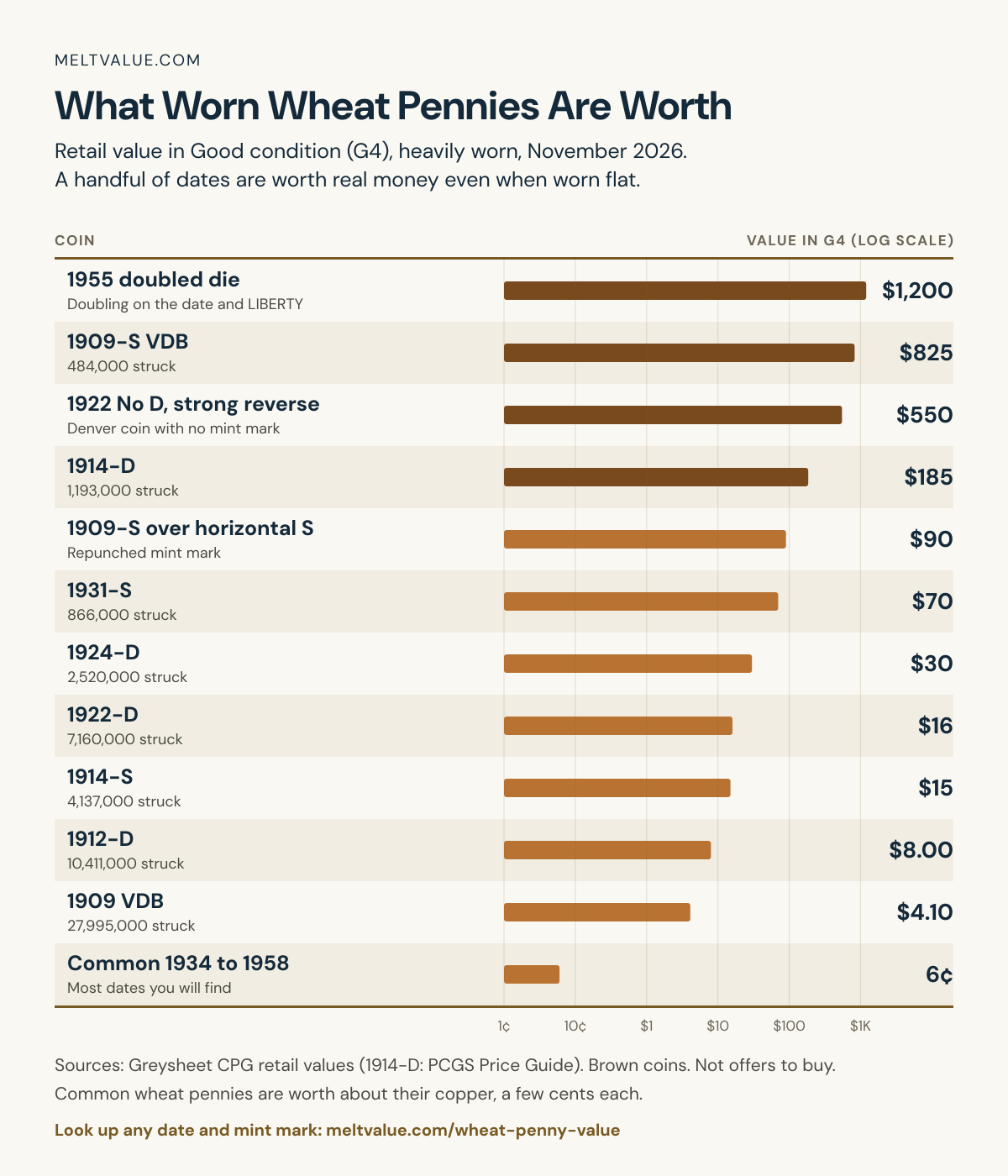
Most wheat pennies are worth a few cents: about 3.5¢ in copper and about 6¢ to collectors in worn condition. The ones worth real money are a short list. A worn 1931-S brings about $70, a 1914-D $185, a 1909-S VDB $825 and a 1955 doubled die $1,200. Look up your date and mint mark below.
Copper $5.39 a pound, updated November 26, 2026 at 8:47 AM EST. Coin values: Greysheet CPG retail, November 2026.
Look Up Your Wheat Penny
1944
A common date
Worn coins are worth about their copper, 3.5¢, to about 6¢. Bright red uncirculated coins sell for more. Test it with a magnet: a 1944 cent that sticks may be a rare steel error.
Retail guide values for brown coins, not offers. Grade decides most of the value.
Wheat Pennies Worth Money
| Coin | Good | XF | MS63 |
|---|---|---|---|
| 1955 doubled dieAbout 20,000 to 24,000 struck | $1,200 | $1,950 | $4,500 |
| 1909-S VDB484,000 struck | $825 | $1,500 | $2,550 |
| 1922 No D, strong reversePart of 7,160,000 struck | $550 | $2,050 | $21,500 |
| 1914-D*1,193,000 struck | $185 | $850 | $4,500 |
| 1922 No D, weak reversePart of 7,160,000 struck | $100 | $575 | $3,750 |
| 1931-S866,000 struck | $70 | $100 | $175 |
| 1924-D2,520,000 struck | $30 | $115 | $725 |
| 1922-D7,160,000 struck | $16 | $45 | $235 |
| 1914-S4,137,000 struck | $15 | $90 | $575 |
| 1912-D10,411,000 struck | $8.00 | $80 | $290 |
| 1909 VDB27,995,000 struck | $4.10 | $12 | $32 |
| 1924-S11,696,000 struck | $1.50 | $35 | $340 |
| 1926-D28,020,000 struck | $1.50 | $16 | $170 |
| 1927-S14,276,000 struck | 80¢ | $16 | $215 |
| 191475,238,432 struck | 80¢ | $20 | $75 |
| 1936-S29,130,000 struck | 25¢ | 55¢ | n/a |
| 1926157,088,000 struck | 20¢ | $1.50 | $14 |
Greysheet CPG retail values for brown coins, November 2026. *1914-D: PCGS Price Guide. Good (G4) is worn nearly flat with the rims intact; Fine (F12) shows some wheat lines; XF (XF40) has light wear; MS63 is uncirculated.
The Big Five Rare Dates
- 1909-S VDB. The first Lincoln cents carried designer Victor David Brenner’s initials at the bottom of the reverse. The Mint removed them shortly after release, so San Francisco struck only 484,000 with VDB. It is the most famous coin in the series.
- 1914-D. Denver struck 1,193,000, and most went straight into circulation. PCGS treats it as the true rarity of the series, since it is far scarcer than the 1909-S VDB in top condition. Fakes and altered dates are common, so buy a certified one.
- 1922 No D. Only Denver made cents in 1922. Some were struck from a die so worn or clogged that the D disappeared. The version with a strong reverse is the one worth big money; weak reverse coins sell for a fraction.
- 1931-S. Just 866,000 were struck, the second-lowest mintage of the series. Collectors saved many at the time, which keeps worn ones near $70 to $100.
- 1955 doubled die. A die struck twice by the hub put doubled letters on the front, plain to the naked eye. Estimates run from 20,000 to 24,000 coins. Many reached the public as change tucked into 23¢ cigarette packs around Boston and upstate New York.
What Common Wheat Pennies Are Worth
Almost every wheat penny from the 1930s to 1958 is common. Retail guides list a worn common date at about 6¢. A worn 1936-S lists at 25¢ and a 1926 at 20¢, and their uncirculated values only climb into dollars at the top grades. PCGS notes that a 50-coin roll of circulated 1944 cents retails for under $10, under 20¢ a coin.
Condition and color are what lift a common wheat cent. Coins are graded brown (BN), red-brown (RB) or red (RD), with full red worth the most. A 1955 red-brown cent lists at 55¢ in MS63, $4.05 in MS65 and $61 in MS67, so a common coin only pays for grading when it is close to flawless.
The copper sets the floor. Each wheat cent weighs 3.11 grams and is 95% copper, about 3.5¢ worth at today’s price.
Copper Value by the Roll, Pound and Bag
| Amount | Coins | Copper value |
|---|---|---|
| One wheat penny | 1 | 3.5¢ |
| Roll of 50 ($0.50 face) | 50 | $1.76 |
| One pound | 146 | $5.12 |
| $5 face (500 coins) | 500 | $17.55 |
| $50 bag (5,000 coins, about 34 lb) | 5,000 | $176 |
50 wheat pennies hold about $1.76 of copper.
Copper only, at 95% of 3.11 grams. The tin and zinc in the other 5% add little. Federal rules ban melting pennies, so this is a floor for value, not scrap cash.
Other Varieties Worth Checking
- 1909-S over horizontal S: an S punched over a sideways S, about $90 even in Good.
- 1958 doubled die: only three known. The finest sold for $1,136,250 on January 22, 2023.
- Repunched and over mint marks: the 1944-D/S, 1946-S/D, 1951-D/S and 1956-D/D show a second mint mark under or beside the first.
- Smaller doubled dies: the 1917, 1936 and 1941 cents have doubled-die varieties that need a magnifier to see.
- Wrong-metal errors: a copper 1943 or a steel 1944 is worth tens of thousands of dollars or more. The 1943 steel penny guide shows how to test both.
Varieties are worth the money only once a grading service or variety specialist confirms them. Many coins that look doubled show machine doubling from a loose die, which adds nothing.
How to Read a Wheat Penny
- Date and mint mark. The mint mark sits under the date: none for Philadelphia, D for Denver, S for San Francisco.
- Wear. Look at the wheat stalks on the back. Clear lines across the stalks mean Fine or better; smooth stalks mean Good.
- Color. Original red or red-brown color adds value. A coin cleaned to a bright pink is worth less to collectors, never more.
- Rare dates. A 1909-S VDB, 1914-D, 1922 No D, 1931-S or 1955 doubled die should be checked by a coin dealer or graded before you sell it. These dates are often faked.
A Short History of the Wheat Cent
The Lincoln cent arrived in 1909 for the 100th anniversary of Abraham Lincoln’s birth. Victor David Brenner designed both sides, with two wheat ears on the reverse. His VDB initials were removed from the reverse in 1909 after complaints, and they returned in 1918 on Lincoln’s shoulder, where they have stayed.
The wheat reverse ran for 50 years, through 1958, before the Lincoln Memorial replaced it in 1959. Cents were 95% copper the whole time except 1943, when they were made of steel, and from 1944 to 1946 the copper came partly from spent shell casings. The Mint struck its last circulating penny on November 12, 2025. Pennies remain legal tender, and wheat cents still turn up in rolls, jars and old collections.
How to Sell Wheat Pennies
- Common dates: sell them by the roll or the pound. Bulk common dates trade for not much more than their copper.
- Better dates and nice coins: pull them out before you sell the rest, using the table above. A coin dealer will offer less than retail values.
- Rare dates and varieties: get them graded or checked first. A certified 1909-S VDB or 1914-D sells faster and for more.
The guide to selling rare coins covers dealers, auctions and grading, and penny melt value has copper values for every penny type.
Sources
- Newman Numismatic Portal: Lincoln cents, wheat reverse: the 1909 to 1958 run, Brenner’s design and VDB initials, and the scarce dates and varieties
- Numista: 1909-S VDB cent: Greysheet CPG retail values and the 484,000 mintage
- Numista: 1922 No D cent: CPG values for the strong and weak reverse, mintage included with the 1922-D
- Numista: 1931-S cent: CPG values by grade
- Numista: 1955 doubled die cent: CPG values by grade
- Numista: 1924-D cent: CPG values and the 2,520,000 mintage
- Numista: 1914-S cent: CPG values and the 4,137,000 mintage
- Numista: 1922-D cent: CPG values and the 7,160,000 mintage
- Numista: 1912-D cent: CPG values and the 10,411,000 mintage
- Numista: 1909 VDB cent: CPG values and the 27,995,000 mintage
- Numista: 1924-S, 1926, 1926-D, 1927-S and 1914 cents: CPG values for these better and common dates (entries 5737, 5741, 5742, 5746 and 5712)
- Numista: 1909-S over horizontal S: a $90 CPG value in Good
- Numista: 1909 cent: a $1.90 CPG value in Good for the 1909 without VDB
- Numista: 1910-S cent: a $14 CPG value in Good
- Wikipedia: Lincoln cent mintage figures: mintages by year and mint, including which mints struck cents each year
- Newman Numismatic Portal: 1936-S cent: CPG values for a common 1930s date
- Newman Numismatic Portal: 1955 red-brown cent: CPG values of 55¢ in MS63, $4.05 in MS65 and $61 in MS67
- PCGS Price Guide: Lincoln cents, wheat reverse: 1914-D values in Good, Fine, Extremely Fine and MS63
- PCGS CoinFacts: 1914-D cent: the case for the 1914-D as the rarest regular date, and its scarcity in top grades
- PCGS CoinFacts: 1955 doubled die: cigarette pack distribution around Boston and upstate New York
- PCGS: Smoking pays off for collectors: two cents tucked into 23¢ cigarette packs as change
- PCGS CoinFacts: 1955 doubled die expert comments: an original estimate of 20,000 to 24,000 coins
- PCGS CoinFacts: 1958 doubled die: three known and the $1,136,250 sale on January 22, 2023
- PCGS CoinFacts: 1944 cent: circulated 1944 rolls retailing under $10 and singles near $1
- NGC: Face Value, 1909 Lincoln cents: 50 years of wheat reverse followed by the Lincoln Memorial
- Federal Register: 31 CFR Part 82: the rule against melting or exporting one-cent coins
- US Mint: final circulating penny: the last circulating cent struck November 12, 2025, and pennies remaining legal tender