
1943 Steel Penny Value
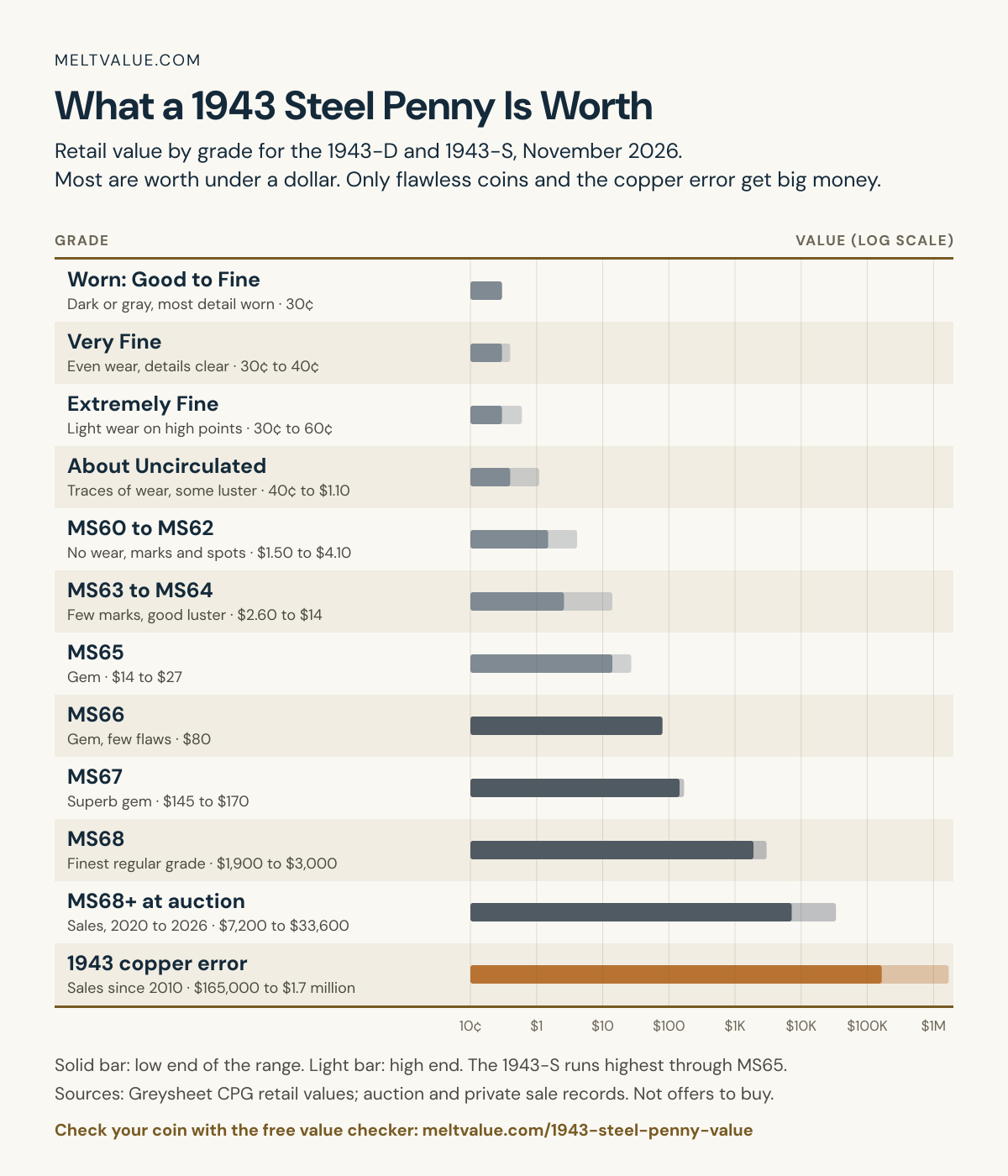
A worn 1943 steel penny is worth about 30¢ to 60¢, and an uncirculated one $1.50 to $27. Over a billion were made, so only flawless coins in MS67 and MS68 bring real money, from $145 into the thousands. The 1943 penny that sells for six figures is the copper one, struck by mistake. It doesn’t stick to a magnet. Odds are yours does.
Retail values from Greysheet CPG for the 1943-D and 1943-S, November 2026. Copper figure: the lowest auction result we found since 2010, an XF45 in 2017.
What Is My 1943 Penny Worth?
Answer five questions. A fridge magnet and a kitchen scale that reads to 0.01 gram settle most coins.
Circulated steel cent
30¢
- No mint mark means Philadelphia. It is the most common of the three and sells for about what a 1943-D does, shown here.
- Spots and rust put a coin at the low end. Dealers usually buy worn steel cents in bulk, for well under these retail figures.
Retail guide values, not offers. Grades are estimates until a grading service sees the coin.
1943 Steel Penny Value by Grade
| Grade | 1943-D | 1943-S |
|---|---|---|
| Good to FineG4 to F15: heavy wear, dark or gray | 30¢ | 30¢ |
| Very FineVF20 to VF35: even wear, details clear | 30¢ | 40¢ |
| Extremely FineXF40 to XF45: light wear on high points | 30¢ | 60¢ |
| AU50 to AU53Traces of wear, some luster | 40¢ | 80¢ |
| AU55Wear only on the cheek and wheat tips | 40¢ | $1.10 |
| AU58A hint of rub | 80¢ | $1.10 |
| MS60No wear, many marks or spots | $1.50 | $2.60 |
| MS61 | $1.60 | $3.40 |
| MS62 | $1.90 | $4.10 |
| MS63A few marks, good luster | $2.60 | $5.50 |
| MS64 | $5.50 | $14 |
| MS65Gem | $14 | $27 |
| MS66 | $80 | $80 |
| MS67Superb gem | $145 | $170 |
| MS68Finest regular grade | $1,900 | $3,000 |
| MS68+ at auctionPhiladelphia: $33,600 in 2020 | $19,520 | $7,200 |
Greysheet CPG retail values, November 2026; MS68+ rows are auction results for 2020 to 2026. Philadelphia coins (no mint mark) sell for about what a 1943-D does below MS68.
No mint mark? That is a Philadelphia coin, and it is the most common steel cent by far. Philadelphia struck about three times as many as either branch mint. PCGS calls it the scarcest of the three only in MS68 and higher, where one sold for $33,600 in 2020. The 1943-S, the smallest mintage, runs a little higher than the 1943-D through MS65.
Retail values are what a collector pays a dealer. A dealer buying from you pays less. Recent dealer-network bids for graded coins ran about $4 for MS64, $60 to $90 for MS66, $110 to $130 for MS67 and $1,500 to $2,400 for MS68. For worn coins, most dealers buy in bulk or not at all.
Recent Sales of Uncirculated Steel Cents
| Coin | Sold |
|---|---|
| Ten 1943 cents, NGC MS65March 2026 | $240 lot, $24 each |
| Three-coin 1943 P-D-S set, NGC MS66August 2026 | $207 |
| 1943, NGC MS67July 2026 | $114 |
| 1943-S, NGC MS67July 2026 | $130 |
| 1943-D, PCGS MS67August 2026 | $149 |
| 1943, NGC MS68September 2026 | $1,586 |
| 1943, PCGS MS68September 2026 | $2,200 |
| 1943-D, PCGS MS68June 2026 | $2,440 |
| 1943-S, PCGS MS68July 2026 | $2,440 |
Public auction results at Heritage and Stack’s Bowers, prices with buyer’s fees.
The jump from MS67 to MS68 is where steel cents get expensive. A single grade point turns a $130 coin into a $2,400 one. CoinWeek notes that gem steel cents sell for about $30, roughly what grading costs, so sending in an ordinary uncirculated coin rarely pays.
The Copper 1943 Penny
A handful of 1943 cents were struck on bronze blanks left over from 1942. Coin World counts 15 or more from Philadelphia and one from Denver, and counts for San Francisco run from five to seven. Auctioneers put the total at around two dozen; the Mint’s own 1999 estimate was about 40. Today every genuine one is a six-figure coin.
| Copper 1943 | Known | Top sale |
|---|---|---|
| 1943 (Philadelphia)AU55 sold for $264,000 in January 2025 | 15+ | Over $1 millionMS63 red, private, 2018 |
| 1943-D (Denver)Same coin brought $840,000 at auction in 2021 | 1 | $1.7 millionMS64 brown, private, 2010 |
| 1943-S (San Francisco)MS63 brown $504,000 (2020); AU55 $456,000 (2026) | 5 to 7 | $1 millionMS62 brown, private, 2012 |
The first one turned up in 1947, when 16-year-old Don Lutes found it in change from his high school cafeteria in Pittsfield, Massachusetts. A rumor at the time said Henry Ford would trade a new car for one; Ford’s company told Lutes it wasn’t true, and the Treasury told him no copper cents were struck in 1943. His coin, graded AU53, sold for $204,000 in January 2019.
Most copper 1943s that people find are fakes. One auction house president told Coin World that none of the countless discoveries people brought him over a decade were genuine. Here is how to sort yours:
- Magnet. A steel cent coated in copper sticks. A genuine copper 1943 does not.
- Weight. Copper weighs 3.11 grams. Steel weighs 2.70 grams.
- The 3. The 3 in a real 1943 has a long tail that dips below the other digits. The Mint warns that fakes are often 1945, 1948 and 1949 cents with the last digit altered, and those 3s look wrong next to a genuine one.
- Authentication. A coin that passes all three goes to PCGS or NGC before you call a buyer. Fakes struck on real copper blanks pass the first two tests.
Even a real one isn’t worth much as metal. Its 2.95 grams of copper come to 3.5¢ at today’s copper price of $5.39 a pound.
Copper price updated November 26, 2026 at 8:47 AM EST.
1944 Steel Pennies
The mirror-image error happened the next year. When the Mint went back to copper in 1944, a few cents were struck on leftover steel blanks, or possibly on blanks for Belgian 2 franc coins the Philadelphia Mint struck in 1944. A 1944 cent that sticks to a magnet is worth checking.
| Steel 1944 | Known | Sale |
|---|---|---|
| 1944 (Philadelphia) | 25 to 30 | $168,000MS64, January 2025 |
| 1944-D (Denver) | About 10 | $122,000MS62, January 2026 |
| 1944-S (San Francisco) | 2 | $408,000MS66, August 2021 |
Steel Cent Varieties and Errors Worth Money
| Variety or error | Sold for |
|---|---|
| 1943-D/D repunched mint mark (FS-501)A second D shows southwest of the main D | $342 MS63 (2026), $552 MS64 (2025), $8,400 MS67 (2025) |
| 1943 doubled die obverse (FS-101)Doubling on the front, seen under magnification | $690 MS65 (2023), $2,280 MS67 (2024) |
| Struck on a silver dime blankSilver color, not magnetic, about 2.5 grams, design off the edge | $1,440 to $4,636 (2019 to 2026) |
| Off-center or clippedPart of the design missing, or a curved bite from the edge | $104 to $444 in mint state |
Graded coins at public auction. Raw coins sell for less until a grading service confirms the variety.
Reprocessed and Plated Steel Pennies
Steel cents rust once the thin zinc coat wears through, so many survivors look dark and spotted. To make them sell, dealers stripped thousands and replated them with zinc or chrome. These reprocessed coins are everywhere, sometimes sold as “brilliant uncirculated,” and they are worth little or nothing to collectors. NGC will not grade one.
Spot them by the shine. A reprocessed cent looks mirror bright, bluish, dipped or painted. An original uncirculated steel cent has a satin luster, with a cartwheel of light that rolls around the coin as you tilt it. Copper-plated steel cents are a different novelty: a New York coin company plated 5,000 in the early 1960s and released them, and coin dealers fielded calls for months from people who thought they had struck it rich.
Why the Mint Made Steel Pennies
The war needed copper for ammunition. Congress authorized a new cent metal on December 18, 1942, and after trying everything from plastic to glass, the Mint settled on low-carbon steel with a thin zinc coat. Production started February 27, 1943, and the switch saved enough copper for 1.25 million artillery shells.
People hated them. New steel cents looked like dimes. Vending machines used magnets to catch steel slugs, so they caught steel cents too. The coins rusted and darkened. In 1944 the Mint went back to 95% copper, using metal partly from spent shell casings, and made those shell-case cents through 1946.
The Mint began pulling steel cents in 1945 and recovered 163 million over 20 years, about 15% of the total. In 1959 the Philadelphia Mint handed 1,250,000 of them to a steel company to melt for their metal. The rest kept circulating into the early 1960s, and people saved huge numbers of them as curiosities, which is why so many turn up today.
Mintage and Specifications
| Coin | Struck |
|---|---|
| 1943 (no mint mark)Philadelphia | 684,628,670 |
| 1943-DDenver | 217,660,000 |
| 1943-SSan Francisco | 191,550,000 |
| Total | 1,093,838,670 |
- Metal: low-carbon steel coated with zinc. It is the only regular-issue US coin a magnet picks up.
- Weight: 2.70 grams, against 3.11 grams for a copper cent. See how much a penny weighs for every year.
- Diameter: 19 millimeters, the same as every Lincoln cent.
- Design: Victor David Brenner’s Lincoln portrait and wheat ears reverse, unchanged from 1909.
- Proofs: none. The Mint struck no proof cents in 1943.
What the Metal Is Worth
Almost nothing. At the November 2026 US scrap steel price of about $347 a metric ton, the steel in a 1943 cent is worth 0.09¢, under a tenth of a cent. In 1943 steel cost $34 a gross ton, so the steel in each cent cost the Mint about a hundredth of a cent, and the government made a large profit on them. Copper cents are a different story: see penny melt value for the copper in older pennies, and wheat penny value for the 1909 to 1958 dates worth money.
How to Sell a 1943 Steel Penny
- Worn coins: sell them in bulk or keep them. A single worn steel cent isn’t worth a trip to a coin shop.
- Nice uncirculated coins: a coin shop will make an offer below the retail values above. Three-coin P-D-S sets are popular with buyers.
- Possible MS67 or MS68: grade it first. The grade decides whether it is a $150 coin or a $2,500 one, and graded top coins sell at auction.
- Copper 1943 or steel 1944: get it authenticated by PCGS or NGC before you sell, and sell through a major auction.
The guide to selling rare coins covers auctions, dealers and grading in more depth.
Sources
- PCGS CoinFacts: 1943 1C: weight of 2.70 grams, 19 mm diameter, zinc-coated steel, 684,628,670 struck, no proofs in 1943, and the Philadelphia coin scarcest of the three in MS68 and up
- PCGS CoinFacts: 1943-D 1C: abundant in circulated and low Mint State grades
- Numista: 1943-D steel cent: Greysheet CPG retail values by grade and the 217,660,000 mintage
- Numista: 1943-S steel cent: Greysheet CPG retail values by grade and the 191,550,000 mintage
- CoinWeek: 1943 Lincoln Steel Cent, a collector’s guide: the December 18, 1942 law, production from February 27, 1943, gems selling near the cost of grading, MS68+ sales of $33,600 and $32,374, and 5,000 steel cents copper-plated in the early 1960s
- NGC: Counterfeit Detection, reprocessed steel cents: what reprocessing is and that NGC will not certify reprocessed 1943 cents (September 11, 2018)
- US Mint: Special 1943 copper penny: about 40 copper 1943 cents believed to exist, and fakes made by plating steel cents or altering 1945, 1948 and 1949 dates (1999)
- The National WWII Museum: US money in World War II: copper saved for 1.25 million artillery shells, vending machine and dime confusion, and the 1944 return to 95% copper from shell casings
- Numismatic News: Majority of steel cents eluded Mint: withdrawals from 1945 that recovered 163 million steel cents in 20 years
- Wikipedia: 1943 steel cent: the long-tailed 3, magnets in vending machines, reprocessing, the only regular-issue US coin a magnet picks up, the 1943 steel price of $34 a gross ton and the large profit on steel cents
- PCGS CoinFacts: 1943-D bronze cent: the unique 1943-D bronze cent and its $1.7 million sale in 2010, and the $373,750 1944-S steel cent of 2008
- Coin World: 1943-D bronze cent at $840,000: the January 2021 auction result
- Coin World: 1943 bronze cent sells for over $1 million: the only red MS63, sold privately, and counts of 15 or more Philadelphia, one Denver and seven San Francisco coins (2018)
- PCGS: Simpson buys the finest 1943-S bronze cent: the MS62 brown 1943-S sold for $1 million in 2012
- PCGS CoinFacts: 1943-S bronze cent: five known
- Newman Numismatic Portal: 1943-S bronze cent records: the MS63 brown at $504,000 on November 19, 2020
- Coin World: Off-metal 1943 and 1944 Lincoln cents at FUN sale: all authentic 1943 bronze cents are six-figure rarities (2016)
- Coin World: WWII Mint mistake brings $298,125: an AU50 copper 1943 sold November 13, 2022, and an auctioneer saying none of the claimed finds sent to him were real
- PCGS ValueView: 1943-S bronze AU55: the $456,000 sale in spring 2026
- Newman Numismatic Portal: 1943 bronze cent records: an AU55 at $264,000 on January 16, 2025 and an XF45 at $165,000 in February 2017
- Artdaily: 1943 cent found in a school cafeteria sells for $204,000: the Don Lutes coin, the false Ford car rumor and the January 10, 2019 sale
- PCGS CoinFacts: 1944 steel cent: 25 to 30 survivors and the Belgian 2 franc blank theory
- Newman Numismatic Portal: 1944 steel cent records: an MS64 at $168,000 on January 16, 2025
- Newman Numismatic Portal: 1944-S steel cent records: the MS66 at $408,000 on August 18, 2021
- CoinWeek: 1944-D Lincoln steel cent: about 10 known
- GMK Center: US scrap prices, November 2026: US HMS 1&2 steel scrap at $347 a metric ton (November 11, 2026)
