
Trade Dollar Value
A trade dollar holds 0.7874 troy ounces of silver, worth $34.71 today, but a genuine one sells for far more. The PCGS Price Guide lists a worn common date at $245, and Mint State coins start around $1,375. The rarest, the 1885 proof, sold for $3.96 million.
Silver $44.08 per troy ounce, updated November 27, 2026 at 2:42 AM EST.
What a Trade Dollar Is Worth by Grade
These prices are for the common San Francisco dates, 1875-S to 1878-S, the easiest trade dollars to find. Even a heavily worn one brings several times its $34.71 in silver.
| Grade | Price |
|---|---|
| Good 4PCGS Price Guide | $245 |
| Fine 12PCGS Price Guide | $325 |
| Extremely Fine 40PCGS Price Guide | $475 |
| MS60PCGS Price Guide | $1,375 |
| MS63, 1876-SSold Dec 2025 | $2,280 |
| MS65+, 1877-SSold May 2026 | $9,150 |
| MS66, 1878-SSold May 2024 | $14,400 |
PCGS Price Guide values are average dealer asking prices for PCGS-graded coins. Sales are auction prices with buyer’s fees. Chopmarked, cleaned or damaged coins sell for less.
Trade Dollar Mintages and Notes by Date
| Date | Struck |
|---|---|
| 1873Rarer than any Philadelphia date but the 1875. | 396,635 |
| 1873-CCNearly all went to China. Prices climb fast above AU. | 124,500 |
| 1873-SThe first San Francisco issue. | 703,000 |
| 1874 | 987,100 |
| 1874-CCMost went to Asia, so it is seldom seen in Mint State. | 1,373,200 |
| 1874-S | 2,549,000 |
| 1875Lowest Philadelphia mintage. Worn, unchopped coins are scarcer than any other Philadelphia date. | 218,200 |
| 1875-CC | 1,573,700 |
| 1875-SThe easiest date to find in Mint State. | 4,487,000 |
| 1875-S/CCAn S punched over a CC. Rare in Mint State. | Part of 1875-S |
| 1876Most are Type I/I. The Type II/II pairing is very rare. | 455,000 |
| 1876-CCThe rarest trade dollar in Mint State. One die variety has a strongly doubled reverse. | 509,000 |
| 1876-SCommon worn, and often chopmarked. | 5,227,000 |
| 1877Plentiful worn, but a major rarity in MS65. | 3,039,200 |
| 1877-CCVery rare in Mint State. | 534,000 |
| 1877-SThe highest mintage and the most common trade dollar, chopmarked or not. | 9,519,000 |
| 1878-CCLowest mintage. Thousands were melted, and perhaps 400 to 500 survive. | 97,000 |
| 1878-SVery common in all grades. | 4,162,000 |
Business strikes only. Philadelphia struck no business strikes in 1878, and all trade dollars dated 1879 to 1885 are proofs. The mint mark sits on the back, below the eagle and above the ED of TRADE DOLLAR. Coins without one are from Philadelphia.
The Rare Trade Dollars
| Coin | Value |
|---|---|
| 1885 proofFive known, struck in secret and unknown until 1908. | $3.96 million for the finest |
| 1884 proofTen known, also struck off the books. | $1.14 million in 2019, matched in 2025 |
| 1878-CCThe rarest business strike in VF to AU grades. | $3,420 in XF40 and $6,600 in AU55 (2018); $143,750 in MS65 (2007) |
| 1874-CCHard to find above MS64. | $52,800 (2018) and $43,200 (2020) in MS65 |
| 1875-S/CCVery rare in Mint State. | $18,213 to $24,675 in MS64 since 2015 |
| 1875Lowest Philadelphia mintage. | $13,800 in MS65+ (2025) |
| 1873-CCSecond-lowest business-strike mintage. | $1,980 in VF30 (2025); $6,600 in MS60 (2024) |
| 1876-CCAny Mint State coin is a prize. | $4,080 in MS61 (2021) |
Auction prices with buyer’s fees. Carson City dates are favorite targets for counterfeiters, so buy them only certified.
Chopmarks
Chinese merchants stamped small characters and symbols into silver coins after testing them, a practice called chopmarking. Many trade dollars carry one or more chops, and most chopped coins were eventually melted in China.
A chopmarked trade dollar usually sells for less than an unmarked coin in the same grade. A chopmarked 1878-S in XF40 sold for $336 in September 2025, below the $475 PCGS Price Guide value for an unmarked coin in that grade. Some collectors seek out bold or unusual chops, and those can add value. PCGS and NGC grade chopmarked coins and note the chops on the label.
How to Spot a Fake Trade Dollar
Trade dollars are among the most counterfeited US coins. Most fakes are made in China and sold online, and fakes with the CC mint mark are the most common.
- Weigh it. A genuine trade dollar weighs about 27.2 grams and measures 38.1 mm. Cast fakes often weigh noticeably more or less.
- Check the design types. Counterfeiters sometimes pair an obverse and reverse type that never appeared together on a genuine coin.
- Be wary of a bargain. A trade dollar priced near melt is almost always fake.
- Buy certified. Stick to PCGS or NGC holders, and type the certification number into the grader’s own website.
Type I and Type II Designs
The Mint changed both sides of the coin in 1875 and 1876. On the front, the Type I design (1873 to 1876) has the ribbon ends beside Liberty pointing left, and Type II (1876 to 1885) has them pointing down. On the back, Type I (1873 to 1876) has a berry below the eagle’s claw, and Type II (1875 to 1885) does not. Collectors call each pairing by both types, such as Type I/II, and a few pairings for certain dates are rare.
Trade Dollar Melt Value Calculator
Every trade dollar holds the same silver. Enter how many you have.
Melt value
$34.71
0.7874 troy oz of pure silver. Genuine coins sell well above this.
Compare the Morgan dollar, which replaced it in 1878, or every silver dollar on the silver dollar melt value page.
Proof Trade Dollars
The Philadelphia Mint struck proofs for collectors every year from 1873 to 1883, and after 1878 proofs were the only trade dollars made. Proofs dated 1884 and 1885 were struck in secret and stayed unknown until 1908. Recent sales include $6,100 for an 1883 in PR63 and $20,740 for an 1877 in PR65 Ultra Cameo, both in January 2026.
| Year | Proofs struck |
|---|---|
| 1873 | 865 |
| 1874 | 700 |
| 1875 | 700 |
| 1876 | 1,150 |
| 1877 | 510 |
| 1878 | 900 |
| 1879 | 1,541 |
| 1880 | 1,987 |
| 1881 | 960 |
| 1882 | 1,097 |
| 1883 | 979 |
| 1884 | 10 known |
| 1885 | 5 known |
Record Prices
| Coin and grade | Sold for |
|---|---|
| 1885 proof, PR66, finest of five knownJan 2019 | $3,960,000 |
| 1885 proof, the same coin, private saleJan 2006 | $3,300,000 |
| 1884 proof, PR66, one of ten knownJan 2019 | $1,140,000 |
| 1885 proof, the Farouk coin2004 | $1,006,250 |
| 1878-CC, MS65Jan 2007 | $143,750 |
| 1878-CC, MS64Mar 2010 | $80,500 |
| 1873, MS66, the 1873 recordApr 2022 | $60,000 |
| 1874-CC, MS65Mar 2018 | $52,800 |
| 1877 proof, PR67 Deep Cameo2025 | $40,800 |
| 1878-S, MS66Jan 2017 | $22,325 |
Auction prices include buyer’s fees. The finest 1885 went to collector Dell Loy Hansen. None of the five belongs to the Smithsonian, the American Numismatic Society or the ANA.
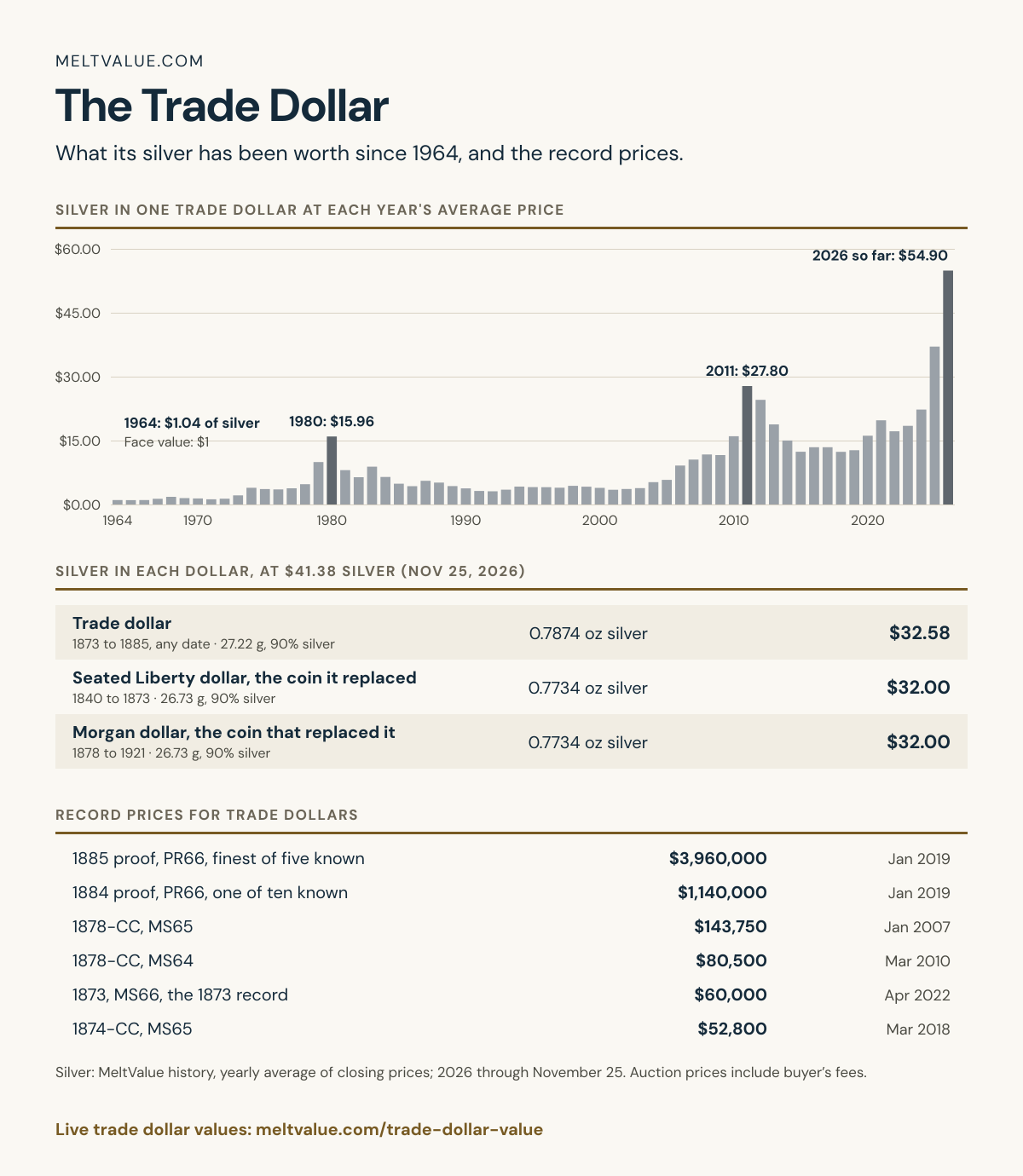
Trade Dollar History
In the 1870s, merchants in China wanted large silver coins, and the Mexican peso ruled that trade. The Coinage Act of 1873 answered with the trade dollar, holding 378 grains of pure silver against 371.25 in the Seated Liberty dollar it replaced. William Barber designed it, with Liberty seated facing left and holding an olive branch out over the sea, and the weight and fineness spelled out on the back: 420 GRAINS, 900 FINE.
The act also made trade dollars legal tender at home for debts up to $5. When silver fell, the coin’s 378 grains dropped from $1.05 in gold in 1873 to 83 cents by 1876, and trade dollars flooded into US commerce at face value. Congress revoked their legal tender status on July 22, 1876. Treasury Secretary John Sherman halted production on February 22, 1878, the year the Morgan dollar arrived, and Carson City melted 44,148 trade dollars it still held.
Nearly 36 million were struck in all. In 1887, Congress opened a six-month window to redeem trade dollars at face value, and 7,689,036 came back, about 20% of the mintage. The Coinage Act of 1965 restored their legal tender status, apparently by accident.
How to Sell a Trade Dollar
- Confirm it is genuine. Weigh it and compare the details. A raw trade dollar of uncertain origin should go to PCGS or NGC before you sell.
- Find the date and mint mark. A CC coin or a Philadelphia 1875 is worth far more than a common S-mint date.
- Never clean it. Cleaning cuts the value of any trade dollar, and graders give cleaned coins a details grade instead of a number.
- Get more than one offer. Genuine trade dollars are always collector coins, so do not accept a melt-value offer.
More on old silver: the Peace dollar, the Barber half dollar and US silver coin melt values.
Sources
- Wikipedia: Trade dollar (United States coin): the 27.2 g, 38.1 mm specs, William Barber’s design, legal tender up to $5, demonetization in 1876 and remonetization in 1965
- American Numismatic Society: A trade dollar song and chorus, 1883: the 378 grains of pure silver, worth $1.05 in gold in 1873 and 83 cents by 1876
- PCGS: The History of United States Coinage (Garrett Collection), chapter 8: the July 22, 1876 act that revoked legal tender status
- PCGS: Silver Dollars & Trade Dollars of the United States, 1887 redemption: the six-month redemption of 7,689,036 trade dollars, about 20% of the mintage
- PCGS: Silver Dollars & Trade Dollars of the United States, 1877-S: the record 9,519,000 mintage and its rank as the most common trade dollar
- PCGS: Silver Dollars & Trade Dollars of the United States, proof mintages: proof mintages from 1873 to 1883
- PCGS Price Guide: Trade dollars: type values from Good 4 to MS60
- PCGS CoinFacts: 1878-CC T$1: the 97,000 mintage, the 44,148 trade dollars melted at Carson City, and the MS65 sale at $143,750
- PCGS CoinFacts: 1878-S T$1: Secretary Sherman halting trade dollar coinage on February 22, 1878, and the $36 million total struck
- PCGS CoinFacts: 1876 T$1: the Type I and Type II obverses and the 1965 restoration of legal tender status
- PCGS CoinFacts: 1876-CC T$1: the rarest trade dollar in Mint State and its doubled reverse die
- PCGS CoinFacts: 1873-CC T$1: nearly the whole mintage sent to China
- PCGS CoinFacts: 1885 T$1 proof: the five known and the earlier sales of $1 million and a reported $3.3 million
- CoinNews: 1885 trade dollar realizes $3.96 million: the January 10, 2019 sale of the finest 1885
- PCGS CoinFacts: 1884 T$1 proof, Cameo: the $1,140,000 sale of January 10, 2019
- Coin World: Market analysis, proof 1884 trade dollar: the ten known and the matching $1.14 million sale in January 2025
- CoinWeek: 1884 trade dollar proof, a collector’s guide: the 1884 and 1885 proofs staying unknown until 1908
- PCGS: Buying trade dollars without fear: trade dollars ranking among the most counterfeited US coins, mostly made in China
- Coin World: Trade dollars high on the list of most counterfeited coins: Carson City fakes being the most common, and fakes that pair the wrong design types
- Coin World: The market for once-shunned chop-marked trade dollars: interesting chopmarks sometimes adding value