
Sacagawea Dollar Value
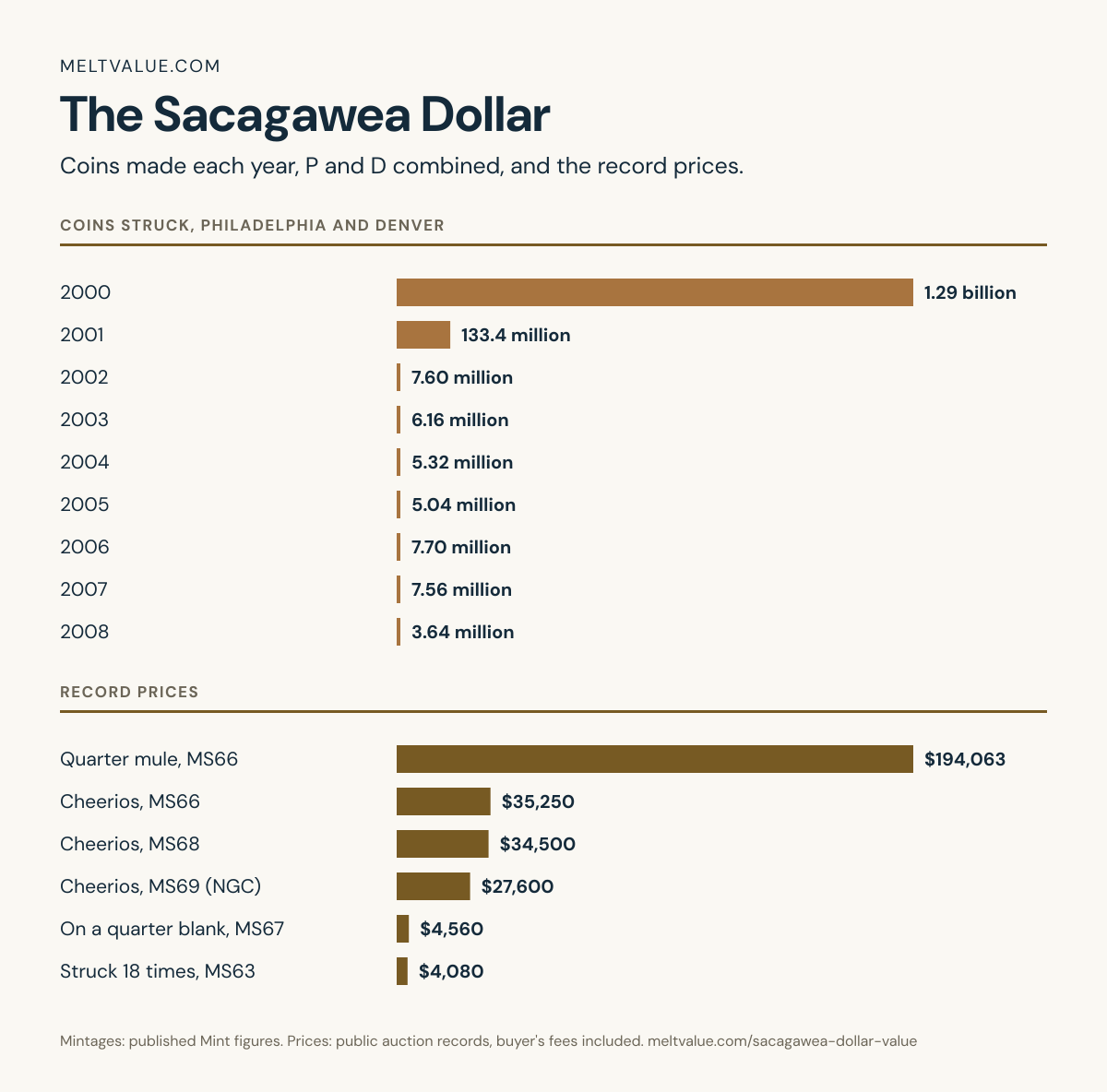
Most Sacagawea dollars are worth $1. Over 1.2 billion were struck in 2000, and the golden color comes from manganese brass, not gold. The metal in one coin is worth 9.3¢ today. A few 2000-P coins are worth far more: the Cheerios dollar has sold for $35,250, and the Washington quarter mule for $194,062.
Metal prices: copper $5.64/lb, nickel $7.14/lb, zinc $1.63/lb. Updated November 27, 2026 at 2:43 AM EST.
Sacagawea Dollar Values by Date
These values cover the original Sacagawea dollar with the soaring eagle reverse, dated 2000 to 2008. The date and mint mark are on the front, below Sacagawea’s chin.
| Coin | Typical value |
|---|---|
| 2000-PPhiladelphiaMintage: 767,140,000 | $1 worn; $2 to $5 uncirculated |
| 2000-DDenverMintage: 518,916,000 | $1 worn; $2 to $5 uncirculated |
| 2000-P CheeriosDetailed tail feathers, packed in Cheerios boxesMintage: 5,500 | About $500 worn; $1,250 and up uncirculated |
| 2000-P GoodacreSatin presentation coins paid to the designerMintage: 5,000 | About $100 to $450; graded coins more |
| 2000-P Wounded EagleRaised die line across the eagle’s belly | $60 worn; $200 to $415 in MS64 to MS66 |
| 2001-P and 2001-DLast big circulation year until 2009Mintage: 62,468,000 / 70,939,500 | $1 worn; $2 to $5 uncirculated |
| 2002 to 2006, P and DSold only to collectors, in rolls, bags and Mint SetsMintage: 2.5 to 4.9 million each | $2 to $5 uncirculated |
| 2007 and 2008, P and DCollector issues; 2008 is the lowest mintageMintage: 3.64 to 3.92 million (2007); 1,820,000 each (2008) | $2 to $6 uncirculated |
| 2000-S to 2008-S proofsMirror finish, from Proof SetsMintage: 2.1 to 4.0 million a year | $3 to $10 |
Raw, ungraded coins. Graded coins in MS67 and finer sell for more.
How to Spot a Sacagawea Dollar Worth Money
- Check the tail feathers on a 2000-P. The Cheerios dollar was struck from an early reverse with strong, detailed lines in the eagle’s tail feathers. On a regular coin the tail is smooth with faint lines. Collectors only noticed the difference in June 2005, so some are still out there.
- Look for a line on the eagle. The Wounded Eagle has a raised die line running across the eagle’s belly, as if it were cut. PCGS has certified fewer than 300.
- Look at both sides of a golden coin. If one side shows George Washington and QUARTER DOLLAR while the other shows the eagle and ONE DOLLAR, you have the mule. Only about 20 are known.
- Ignore the tarnish. Most Sacagawea dollars have turned brown or spotty. That is normal for manganese brass and does not make a coin special.
What Rare Sacagawea Dollars Sell For
Public auction results for the Cheerios dollar, the mule, the Wounded Eagle and the Goodacre coins:
| Coin and grade | Sold for |
|---|---|
| (2000)-P quarter mule, MS66Jan 2024 | $194,063 |
| (2000)-P quarter mule, MS67 (NGC)Mar 2018 | $192,000 |
| 2000-P Cheerios, MS66Jul 2015 | $35,250 |
| 2000-P Cheerios, MS68Jul 2008 | $34,500 |
| 2000-P Cheerios, MS69 (NGC), finest knownNov 2024 | $27,600 |
| 2000-P Cheerios, MS67, autographed labelSep 2022 | $6,250 |
| 2000-P Wounded Eagle, MS67Aug 2014 | $1,645 |
| 2000-P Wounded Eagle, MS66Feb 2026 | $415 |
| 2000-P Goodacre presentation, SP67Mar 2019 | $312 |
Auction prices include buyer’s fees. Dealers pay less.
Sacagawea Dollar Melt Value Calculator
A Sacagawea dollar is a pure copper center clad in manganese brass. Overall it is 88.5% copper, 6% zinc, 3.5% manganese and 2% nickel, which comes to about 7.2 grams of copper per coin. At today’s prices the metal is worth 9.3¢. The calculator leaves out the manganese, which adds well under a tenth of a cent.
Enter how many you have to compare the metal with the face value.
Metal value
9.3¢
Face value $1.00. Copper 8.9¢. Nickel 0.3¢. Zinc 0.2¢. There is no gold in a Sacagawea dollar.
Sacagawea Dollar Varieties and Errors
The first year produced the famous varieties. Errors from every year sell too:
| Variety or error | Price |
|---|---|
| (2000)-P Washington quarter muleA state quarter front paired with the dollar back, on a dollar blank. No date. Two Mint employees were charged with taking five of them. | $192,000 to $194,063 |
| 2000-P CheeriosBoldly detailed tail feathers; 5,500 went into cereal boxes in 1999. | $6,250 (MS67) to $35,250 (MS66) |
| Struck on a quarter planchetA silver-colored clad quarter blank struck with dollar dies. | $2,880 (MS65) to $4,560 (MS67), Aug 2024 |
| Struck many timesA coin that stayed in the press and took repeated blows. | $4,080 (struck 18 times, MS63, Dec 2024) |
| 2000-P Wounded EagleRaised die gouge across the eagle’s belly. | $201 (MS64) to $1,645 (MS67) |
Wear, scratches and damage after the coin left the Mint add no value.
Sacagawea Dollar Specifications
| Years | 2000 to 2008 (eagle reverse); Native American dollars since 2009 |
|---|---|
| Mints | Philadelphia (P), Denver (D), San Francisco (S proofs) |
| Weight | 8.1 grams |
| Diameter | 26.5 mm |
| Metal | Pure copper center clad in manganese brass (77% copper, 12% zinc, 7% manganese, 4% nickel) |
| Overall | 88.5% copper, 6% zinc, 3.5% manganese, 2% nickel |
| Edge | Plain |
| Designers | Glenna Goodacre (front), Thomas D. Rogers Sr. (eagle) |
| Law | Public Law 105-124 (1997) |
Sacagawea Dollar History
The 50 States Commemorative Coin Program Act of December 1, 1997, Public Law 105-124, called for a new dollar coin, golden in color, to replace the Susan B. Anthony dollar. Glenna Goodacre won the design contest with Sacagawea, the Shoshone guide of the Lewis and Clark Expedition, carrying her infant son Jean Baptiste. Her model was Randy’L He-dow Teton, a Shoshone college student. Thomas D. Rogers Sr. designed the soaring eagle.
To get the coin noticed, the Mint gave General Mills 5,500 dollars for Cheerios boxes in 1999. Those early coins came from a prototype reverse, and nobody noticed until 2005. In May 2000 Frank Wallis of Arkansas found the first quarter mule in a bank roll, and the Mint confirmed the error on June 19, 2000.
Like the Anthony dollar, the coin did not catch on. Mintage dropped from about 1.29 billion in 2000 to 133 million in 2001, and from 2002 the Mint made them only for collectors. In 2009 the reverse began changing every year under the Native American dollar program.
How to Sell Sacagawea Dollars
- Spend the ordinary ones. A circulated Sacagawea dollar is worth $1, and the brown tarnish does not change that.
- Check every 2000-P. Look at the tail feathers and the eagle’s belly before you spend it.
- Get expert help for big finds. A Cheerios dollar or a mule should be certified by PCGS or NGC before you sell. Certification adds buyer trust worth thousands.
- Keep sets and holders intact. Goodacre coins and Cheerios coins in original packaging sell for more.
See the Susan B. Anthony dollar value for the coin it replaced, or the gold dollar coin value for the 1800s gold dollars that really are gold.
Sources
- US Mint: Sacagawea Golden Dollar Coin: years of issue, Public Law 105-124, the alloy and Randy’L He-dow Teton as Goodacre’s model
- Wikipedia: Sacagawea dollar: cladding and overall composition, designers and circulation years
- Coin Mintages: Sacagawea Dollar Mintages: mintages for every date, including 5,500 Cheerios and 5,000 Goodacre coins
- PCGS: Looking back on the Sacagawea dollar: the Wounded Eagle die flaw and fewer than 300 certified
- CoinWeek: Looking back on the Sacagawea dollar 20 years later: the 5,500 coins given to General Mills
- CoinWeek: The Mint’s impossible $1.25 coin sets a $194,000 record: the $194,062.50 mule sale, 20 known, the two employees charged and Frank Wallis’s discovery
- NGC: Sacagawea dollar mule sets a record: the NGC MS67 mule at $192,000 in March 2018
- NGC Auction Central: Sacagawea dollars: Cheerios dollars at $35,250 (MS66) and $34,500 (MS68)
- Newman Numismatic Portal: 2000-P Sacagawea MS67 sales: the quarter planchet error at $4,560, Cheerios MS67 at $6,250 and Wounded Eagle sales
- CoinWeek: 2000-D Sacagawea dollar: the drop from 519 million Denver coins in 2000 to 3.73 million in 2002