
Gold Nugget Value
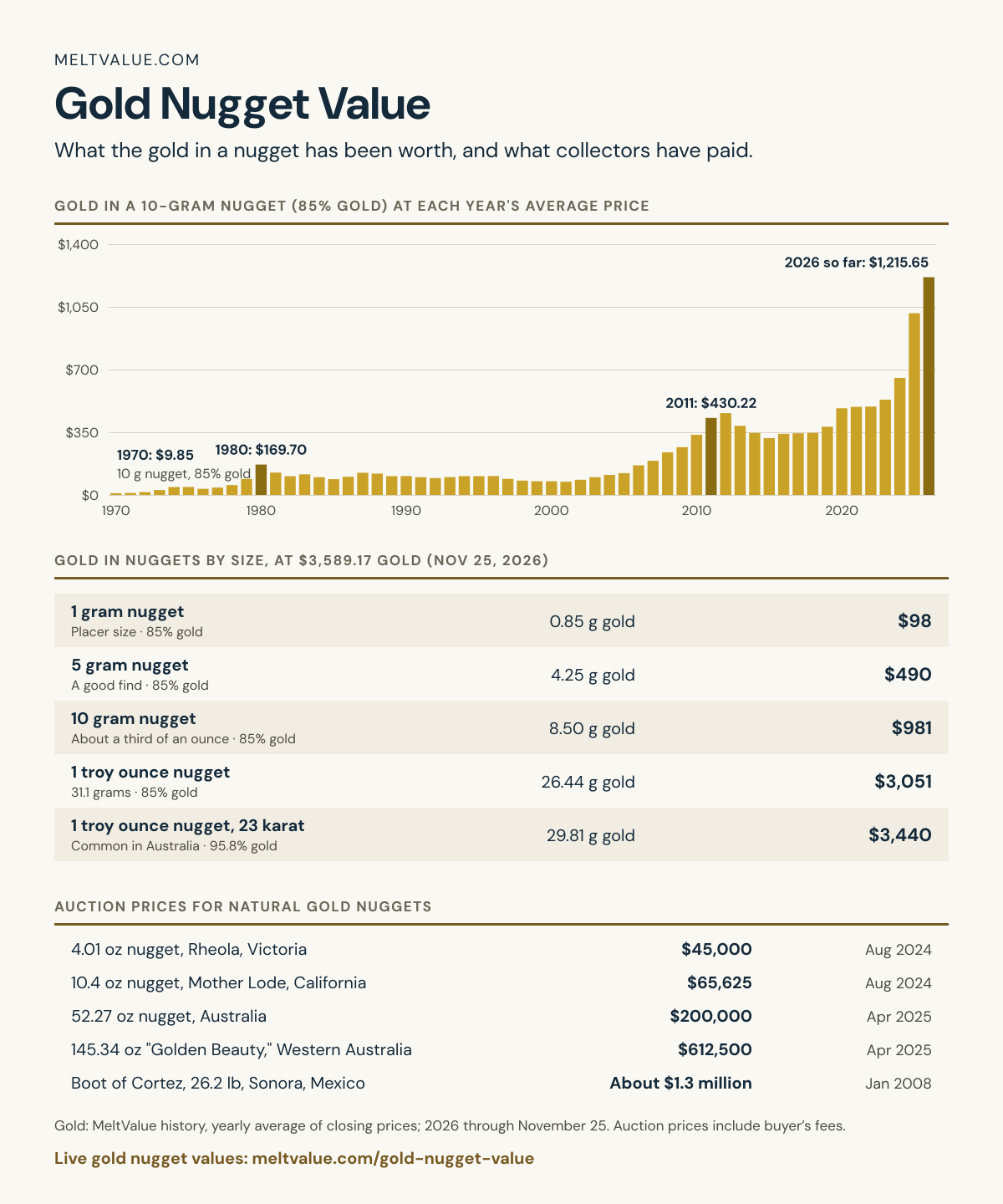
A gold nugget is worth at least the gold in it, and most natural nuggets are 83% to 92% gold. At today’s price of $114.66 per gram for pure gold, a 10-gram nugget at 85% holds $975 of gold. Collectors pay more for large or striking nuggets, sometimes several times their gold value.
Gold $3,566.46 per troy ounce, updated November 26, 2026 at 2:54 PM EST.
Gold Nugget Value Calculator
Weigh the nugget, pick a purity and see the value of its gold. If you have no assay, start at 85%, the average for North American gold, and try the other settings to see the range.
Gold value (melt)
$487.32
4.25 g of pure gold in a 5 g nugget.
A refiner paying 95% of melt would offer $463 before fees. A collector may pay more for a large or attractive nugget.
Gold Nugget Price per Gram
The gold value of natural nuggets at today’s price, by purity:
| Purity | Per gram | Per pennyweight | 1 troy oz nugget |
|---|---|---|---|
| 95.8% (23 karat)Australian nuggets often test this high | $109.89 | $170.89 | $3,418 |
| 91.7% (22 karat)Top of the usual range | $105.11 | $163.46 | $3,269 |
| 85%Average for North American gold | $97.46 | $151.57 | $3,031 |
| 83.3% (20 karat)Bottom of the usual range, common in Alaska | $95.55 | $148.60 | $2,972 |
| 65%High-silver gold, as in parts of Nevada | $74.53 | $115.91 | $2,318 |
Melt values for the gold alone; any silver in the nugget adds a little. Need karat prices for jewelry? See the gold price per gram by karat.
How Pure Is a Gold Nugget?
No natural nugget is pure gold. Most run 20 to 22 karat, or about 83% to 92% gold, and the rest is mostly silver with some copper. Purity is often written as fineness, in parts per thousand: an 865 fine nugget is 86.5% gold.
Where a nugget comes from matters. Australian nuggets often test at 23 karat or higher, and some have assayed near 99%. North American gold averages about 85%. Alaskan nuggets tend toward the low end of the usual range, and some Nevada gold is as low as 65% because it carries so much silver. Gold with that much silver is called electrum.
Color hints at purity. A deep orange-yellow nugget usually holds more gold, and a pale, greenish or whitish one usually holds more silver. Only an assay gives a number. Refiners melt and fire assay; many buyers scan the surface with an XRF gun, which reads fast but only sees the outside.
What Collectors Pay for Gold Nuggets
Recent auction results show how far above, or close to, the gold price a nugget can sell. Sale prices include buyer’s fees.
| Nugget | Price | Times gold price |
|---|---|---|
| 209 g nugget with rock, presumed AlaskaApr 2024. Gold about $2,320. Sold for about the value of its estimated 5.5 oz of gold.$1,936 per oz of weight | $13,011 | 0.8x |
| 4.01 oz nugget, Rheola, Victoria, AustraliaAug 2024. Gold about $2,500. Sculptural shape.$11,222 per oz of weight | $45,000 | 4.5x |
| 10.4 oz nugget, Mother Lode, CaliforniaAug 2024. Gold about $2,500. Top nugget of the sale.$6,310 per oz of weight | $65,625 | 2.5x |
| 52.27 oz nugget, AustraliaApr 2025. Gold about $3,300. Sold the same day as the Golden Beauty.$3,826 per oz of weight | $200,000 | 1.2x |
| “Golden Beauty,” 145.34 oz, Western AustraliaApr 2025. Gold about $3,300. Found in 1979 with a metal detector.$4,214 per oz of weight | $612,500 | 1.3x |
| Boot of Cortez, 26.2 lb, Sonora, MexicoJan 2008. Gold about $880. About 4 times its melt value then.$3,402 per oz of weight | About $1.3 million | 3.9x |
| Boot of Cortez, offered againJun 2026. Gold $4,216. Reserve not met; the bid was below its roughly $1.6 million melt value.$3,926 per oz of weight | Top bid $1.5 million | 0.9x |
“Times gold price” divides the price per ounce of total nugget weight by the gold price that day. It does not deduct silver or attached rock, so the premium over the nugget’s actual gold is higher than shown. Gold prices are approximate except June 12, 2026, from MeltValue’s price history.
The pattern is not simple. The two big nuggets sold in April 2025 brought only about 1.2 to 1.3 times the price of their weight in gold, while a 4-ounce Australian piece with an unusual shape brought about 4.5 times. The Boot of Cortez sold for about four times its melt value in 2008. When it came back in June 2026, appraised at $3 million to $7 million, the top bid of $1.5 million fell short of its gold value and the reserve.
The records sit on their own page: see the largest gold nugget ever found, from the Welcome Stranger to the Hand of Faith, found in 1980 and sold to the Golden Nugget casino in Las Vegas for roughly $1 million.
What Makes a Nugget Worth More Than Its Gold
- Size. Big nuggets are scarce, and the scarcity climbs with weight. The auction house that sold the Golden Beauty compares a 1 ounce nugget’s rarity to a 5-carat diamond.
- Shape and character. Sculptural forms, crystalline gold and bright, clean surfaces draw collectors. A dull lump of the same weight often sells closer to melt.
- Gold in quartz. Gold set in white quartz can sell as a mineral specimen, priced on looks more than gold content.
- Origin and story. A named nugget with a known finder and find site, like the Golden Beauty or the Boot of Cortez, adds provenance buyers pay for.
- Rock and dirt. These cut the gold content per gram. The 209-gram Alaska nugget above sold for about its estimated gold, not more.
Gold in Quartz: Estimate the Gold Inside
A nugget with quartz attached weighs more than its gold. Specific gravity can estimate the split without breaking the specimen, because for the same volume gold weighs about 19.3 times as much as water and quartz about 2.65 times. A US patent on grading nuggets describes the method.
To measure it, set a cup of water on a digital scale and press tare. Hang the specimen from a thread so it sits fully underwater without touching the cup. The reading in grams equals the specimen’s volume in cubic centimeters. Enter that with the dry weight:
Estimated gold
67.36 g, worth $7,723.24
Specific gravity 6.00. About 79.2 g of gold alloy and 40.8 g of quartz.
Assumes the rock is quartz and the rest of the alloy is silver, which makes 85% gold about 17.2 times as heavy as water. Iron oxide, pyrite or trapped air will throw the estimate off, so treat it as a guide, not an assay.
Is It Real Gold?
The most common false alarm is pyrite, called fool’s gold. Pyrite is brassy and brittle and crumbles under a knife point, while gold is soft enough to dent with a pin. Weight gives it away too: pyrite’s specific gravity is near 5, about a quarter of gold’s.
The water test above works here. Divide the dry weight by the water reading. A solid natural nugget with no rock should come out around 15 to 19, depending on its silver. A result near 5 points to pyrite, and one near 8.5 points to brass.
How to Sell a Gold Nugget
- Weigh it. A scale that reads to 0.01 gram is best for small nuggets. Some placer buyers quote in pennyweights; one is 1.555 grams.
- Work out melt. Use the calculator with 85% if you have no assay. That number is your floor.
- Pick the right buyer. Flakes, small pickers and rough nuggets usually sell for their gold. Refiners pay on the assay, sometimes up to 95% of melt less a fee. Placer buyers often quote a percentage of spot on the raw weight instead, so ask what the percentage applies to. Larger, cleaner or unusual pieces belong with mineral collectors, specimen dealers or auctions.
- Do not melt a good nugget. Melting erases any collector premium. Get a specimen quote first.
- Get more than one offer. Prices for the same nugget can differ widely, so compare every offer against melt.
Where Gold Nuggets Come From
A nugget is a natural lump of native gold. Many are found in placers, where streams wash gold out of eroding rock and drop the heavy pieces in gravel. Prospectors find them by panning, sluicing and metal detecting; the Golden Beauty, the Hand of Faith and the Boot of Cortez were all detector finds.
Nuggets found in the Victorian gold rush, which began in the 1850s, were far larger than the Hand of Faith. For the scale of an American rush, see how much gold the California Gold Rush found, and for any other gold item, try the gold calculator.
Sources
- Wikipedia: Gold nugget: nuggets usually 20 to 22 karat (83% to 92% gold), Australian nuggets often 23 karat or higher, Alaskan nuggets at the low end, silver and copper as the common impurities
- USGS: Gold (general interest publication): fineness as parts per thousand of gold, and how silver, copper and other metals change gold’s color
- Gold Prospectors Association of America: Selling your gold: North American gold averaging about 85% pure, Nevada gold as low as 65%, Australian nuggets assayed as high as 99%, and refiners paying up to 95% of assay less a fee
- Coin World: Mining discoveries in August sale: the 10.4 oz Mother Lode nugget at $65,625 and the 4.01 oz Rheola nugget at $45,000
- Cllct: Huge gold nugget sells for $612,500: the Golden Beauty sale with buyer’s premium, and the auctioneer’s comparison of a 1 oz nugget to a 5-carat diamond
- Popular Science: Huge gold nugget set for auction: the Golden Beauty found in 1979 by John and Frances Aggiss near Kalgoorlie, about 7.5 inches across
- KTAR: Glendale auction house to sell 26-pound gold nugget: the Boot of Cortez: found in 1989 in Mexico, bought in 2008 for $1.3 million, appraised at $3 million to $7 million
- Wikipedia: Hand of Faith: the 875 troy ounce nugget found in 1980, sold to the Golden Nugget casino chain for about a million dollars, and the far larger nuggets of the Victorian gold rush
- US Patent 4,210,027: Method for determination and grading of precious minerals: estimating the gold in a nugget with quartz from its specific gravity, and gold alloys weighing less than pure gold
- University of Notre Dame: Specific gravity: specific gravity of quartz (2.65) and gold (19.3)
- Wikipedia: Silver: density of silver, 10.49 g/cm³
- Wikipedia: Brass: density of brass, about 8.4 to 8.7 g/cm³
- Wikipedia: Pyrite: pyrite, or fool’s gold: brass-yellow, brittle, with a specific gravity near 5