
Dental Gold Value
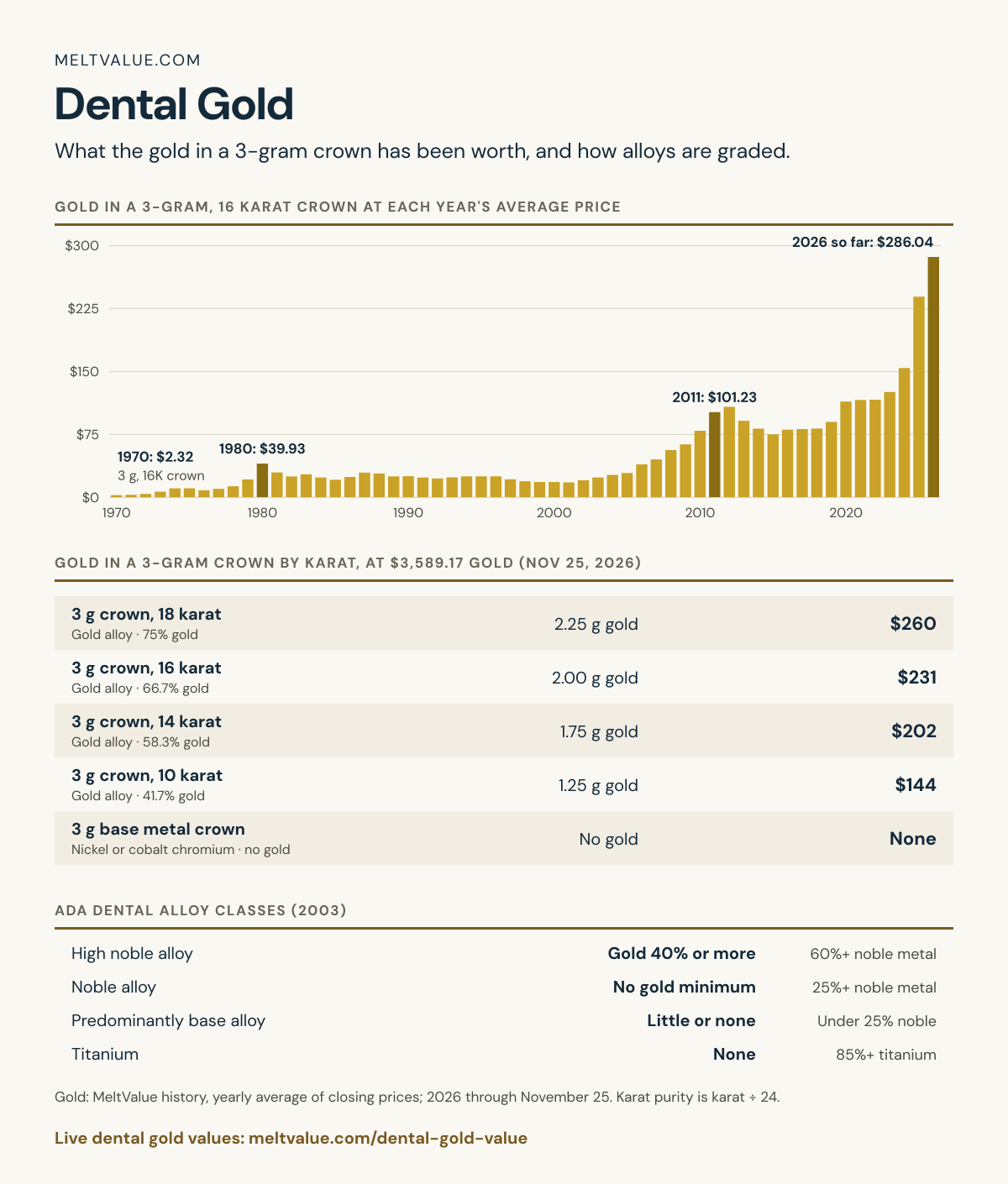
A gold crown usually weighs about 2 to 4 grams, and its value depends on how much of that weight is gold. At today’s gold price of $114.66 per gram, a 3-gram crown at 16 karat holds $229 of gold. Crowns made from palladium, platinum or base metal alloys hold less gold or none.
Gold $3,566.46 per troy ounce, updated November 26, 2026 at 2:54 PM EST.
Dental Gold Calculator
Enter the weight and karat. If you do not know the karat, start with 16 karat, a common figure for yellow all-metal crowns, then compare 10 and 18 karat to see the range.
Gold value
$229.33
2 g of pure gold in 3 g of alloy. Any palladium or platinum in the alloy adds value on top.
What a Gold Crown Is Worth
Gold value of a single crown at today’s price, by weight and karat:
| Karat | 2 g crown | 3 g crown | 4 g crown |
|---|---|---|---|
| 10 karat41.7% gold | $96 | $143 | $191 |
| 14 karat58.3% gold | $134 | $201 | $268 |
| 16 karat66.7% gold | $153 | $229 | $306 |
| 18 karat75.0% gold | $172 | $258 | $344 |
| 20 karat83.3% gold | $191 | $287 | $382 |
| 22 karat91.7% gold | $210 | $315 | $420 |
These are melt values for the gold alone. A buyer pays less after testing and refining costs, and the share varies from buyer to buyer. More on karats: the gold karat chart.
How Much Gold Is in a Dental Crown
Dental crowns are made from alloys, never pure gold. The American Dental Association sorts dental casting alloys by how much noble metal they contain, meaning gold and the platinum group metals:
| ADA class | What it means for gold |
|---|---|
| High nobleAt least 60% noble metal, and at least 40% gold | All-metal crowns and high-gold metal-ceramic alloys. Holds the most gold. |
| NobleAt least 25% noble metal, no gold minimum | Often palladium-silver or low-gold alloys. May hold some gold. |
| Predominantly baseUnder 25% noble metal | Nickel-chromium and cobalt-chromium alloys. Little or no gold. |
| TitaniumAt least 85% titanium | No gold. |
Traditional yellow casting gold sits near the top of that range. ISO 1562, the standard for gold dental casting alloys, covers alloys with at least 75% gold and platinum group metals, and yellow high-gold alloys described in dental patents run from about 60% to 90% gold. High-gold alloys made to bond with porcelain hold upwards of about 70% gold.
Color is a poor guide. Adding more than about 5% palladium or 10% platinum turns a gold alloy pale yellow or white, so a silver-colored crown can still hold real precious metal. Others are nickel-chromium or cobalt-chromium with none. A refiner’s test is the only sure answer.
Which Dental Work Holds Gold
- Full gold crowns. All metal, often a high noble alloy. These hold the most gold per piece.
- Inlays and onlays. Smaller cast pieces that fill part of a tooth, often in soft, high-gold alloys.
- Bridges. Several joined units, so they weigh much more than a single crown.
- Porcelain-fused-to-metal crowns. A thin metal shell under porcelain. The metal may be high noble, noble or base, and the porcelain counts for nothing.
- All-porcelain, zirconia and resin crowns. No metal at all.
Palladium alloys are common in dental work too. If yours tests as palladium, see the palladium price per gram.
Can You Keep Your Gold Crown?
Usually, yes. The CDC says dentists may return extracted teeth to patients on request, and once returned they no longer fall under the OSHA bloodborne pathogens rules. OSHA itself wrote in 1993 that nothing in its standard stops a dentist from giving patients their own teeth. Some offices still decline, so ask before the crown comes out.
How to Sell Dental Gold
- Ask for it back. Tell your dentist before any crown or bridge is removed that you want to keep it.
- Weigh it. A small digital scale that reads to 0.1 gram is enough for a rough figure. Dental labs often quote pennyweights; one pennyweight is 1.555 grams.
- Get it tested. Dental alloys vary too much to guess. Choose a buyer who tests the metal and pays on the result, not a flat price per tooth.
- Compare offers with melt. Use the calculator above, and expect offers below full melt. Several pieces sold together usually earn a better rate than one.
Gold in Dentistry
Gold has repaired teeth for thousands of years. The first known gold shell crown is thought to be Roman, and gold stayed the standard for crowns and inlays because it resists corrosion and can be cast and shaped precisely. As gold prices rose, labs turned to alloys with less gold, then to palladium-based alloys and base metals, and today to porcelain, zirconia and resin. Dentists and dental labs still weigh precious metal in pennyweights.
That history is why old dental work is worth checking. A crown placed decades ago is more likely to be a rich yellow gold alloy than one placed today. For other gold items, try the gold calculator or the 14k gold price.
Sources
- American Dental Association: Materials for indirect restorations: the 2003 ADA classes: high noble, noble, predominantly base and titanium
- ISO 1562: Dental casting gold alloys: gold-based dental casting alloys with at least 75% gold and platinum group metals
- US Patent 5,695,714: Gold-palladium alloys for dental materials: high-gold metal-ceramic alloys with gold content upwards of about 70%
- European Patent EP0904765A2: Gold colored dental alloy: yellow high-gold dental alloys of 60% to 90% gold, and palladium or platinum turning alloys pale or white
- CDC: Extracted teeth: dentists may return extracted teeth to patients on request
- OSHA: Standard interpretation on returning extracted teeth (1993): nothing in the bloodborne pathogens standard stops a dentist from returning a patient’s own teeth
- CDC Stacks: Gold shell crowns history: the first known gold shell crown, of Roman origin
- Wikipedia: Pennyweight: dentists and dental labs still weighing precious metal in pennyweights