
Buffalo Nickel Value
A common worn Buffalo nickel sells for about $4 to $8. Dateless ones bring less, and the metal in any Buffalo nickel is worth 6.6¢ today. Scarce dates and varieties are a different story: a 1937-D 3-Legged sells for hundreds even when worn, and the record for a single Buffalo nickel is $350,750.
Metal prices: copper $5.65/lb, nickel $7.14/lb. Updated November 27, 2026 at 2:42 AM EST.
Buffalo Nickel Values by Date
The date is on the shoulder on the front. The mint mark, D or S, is on the back below FIVE CENTS. Philadelphia coins have no mint mark. The dates that matter most:
| Coin | Typical value |
|---|---|
| DatelessDate worn away, the most common find | 10¢ to 50¢ |
| Common datesMost Philadelphia coins and many later D and S coins | $4 to $8 worn; about $40 to $240 in MS60 to MS65 |
| 1913 Type 1Bison standing on a raised moundMintage: 30,992,000 (Philadelphia) | $12 to $25 worn; $45 and up uncirculated |
| 1913-D Type 2Denver, flat groundMintage: 4,156,000 | About $160 in VG; more in better grades |
| 1913-S Type 2San Francisco, flat groundMintage: 1,209,000 | About $270 in VG; more in better grades |
| 1921-SScarce San Francisco date | $40 and up worn; about $350 in VF |
| 1926-SLowest mintage of the seriesMintage: 970,000 | About $55 in VG; $5,000 and up uncirculated |
| 1918/7-D overdateA 7 showing under the 8Mintage: Part of 8,362,000 | About $1,100 in VG; $350,750 record |
| 1937-D 3-LeggedBison’s front right leg missingMintage: Part of 17,826,000 | About $500 worn; $3,660 in MS62 |
Raw coins in typical condition. Scarce dates swing widely with grade; check a current price guide before selling.
How to Tell What Your Buffalo Nickel Is Worth
- Find the date. The date sits high on the Indian’s shoulder and wore off fast. If you can read all four digits, the coin is worth more than a dateless one. Avoid acid date-restoring liquids, which leave a scar that buyers discount.
- Check the mint mark. Turn it over. A D or S under FIVE CENTS on a 1913 to 1928 coin can mean a scarce date. Look up the date and mint together.
- Count the bison’s legs on a 1937-D. On the 3-Legged variety the front leg facing you is gone and the rest of the coin looks normal. Fakes are made by scraping the leg off an ordinary 1937-D, so look for tool marks.
- Look for the mound on a 1913. On a Type 1 the bison stands on a raised mound with FIVE CENTS on it. On a Type 2 it stands on a flat line with FIVE CENTS in a recess below.
- Check for doubling. Doubled letters on the 1916 date or LIBERTY, or on E PLURIBUS UNUM on a 1935, can mean a doubled die worth thousands.
Buffalo Nickel Auction Records
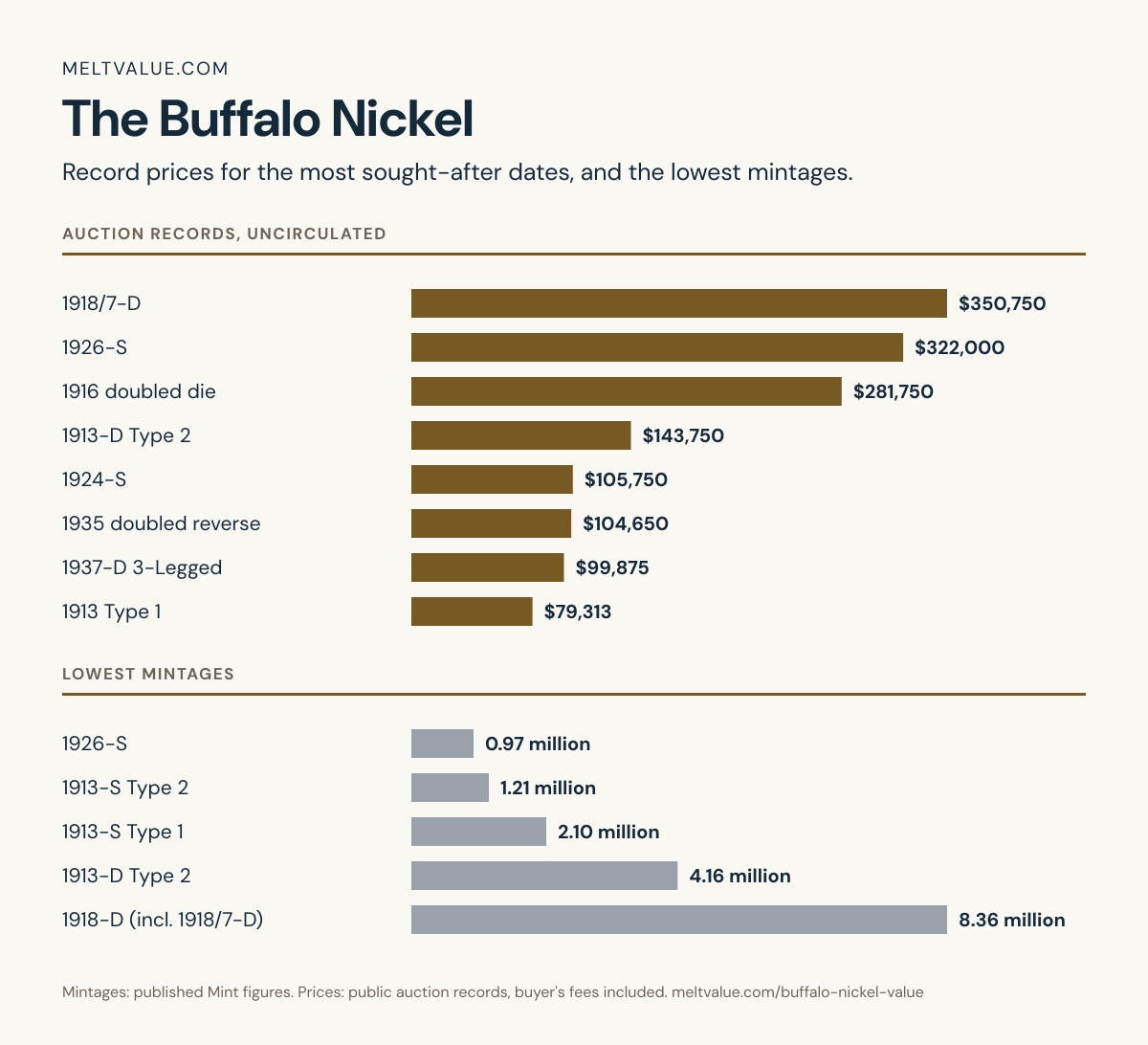
The highest public prices for the most sought-after Buffalo nickels, all in uncirculated grades, from PCGS auction records:
| Coin | Sold for |
|---|---|
| 1918/7-D overdateMS65 | $350,750 |
| 1926-SMS66 | $322,000 |
| 1916 Doubled Die ObverseMS64 | $281,750 |
| 1913-D Type 2MS | $143,750 |
| 1924-SMS66+ | $105,750 |
| 1935 Doubled Die ReverseMS | $104,650 |
| 1937-D 3-LeggedMS66 | $99,875 |
| 1913 Type 1MS | $79,312 |
| 1937-D 3-Legged, sold January 2020Tied finest | $72,000 |
Auction prices include buyer’s fees. These are condition records for coins with almost no wear. Worn examples sell for a small fraction.
Buffalo Nickel Melt Value Calculator
Every Buffalo nickel weighs 5 grams and is 75% copper and 25% nickel, the same as a nickel today. There is no silver in it. That is 3.75 grams of copper and 1.25 grams of nickel, worth 6.6¢ at today’s prices.
Melting is not an option anyway: federal rules have banned melting nickels since 2006. Use the calculator to see what the metal in a roll or a jar adds up to.
Metal value
6.6¢
Face value $0.05. Copper 4.7¢. Nickel 2.0¢. A roll of 40 holds 200 grams of metal.
Buffalo Nickel Varieties Worth Money
These die varieties sell for far more than regular dates. Prices are the PCGS auction records:
| Variety | Price |
|---|---|
| 1918/7-D overdateDenver used a die hubbed with both 1917 and 1918. The 7 shows under the 8. About two dozen survive in Mint State. | $350,750 |
| 1916 Doubled Die ObverseStrong doubling on the date and LIBERTY. | $281,750 |
| 1935 Doubled Die ReverseDoubling on E PLURIBUS UNUM and FIVE CENTS. | $104,650 |
| 1937-D 3-LeggedA worn, over-polished reverse die lost the front leg. Many went out in Montana. | $99,875 |
| 1914/3 overdateA 3 under the 4 in the date. | $63,250 |
| 1936-D 3½ LegsPart of the front leg missing; scarcer than the 1937-D. | $20,700 |
| 1938-D/SAn S mint mark under the D. | $25,300 |
A bison with a leg scraped away, or a date restored with acid, is damage and lowers the value.
Buffalo Nickel Specifications
| Years | 1913 to 1938 |
|---|---|
| Mints | Philadelphia (none), Denver (D), San Francisco (S) |
| Weight | 5.0 grams |
| Diameter | 21.2 mm |
| Metal | 75% copper, 25% nickel; no silver |
| Edge | Plain |
| Designer | James Earle Fraser; the F below the date is his initial |
| Official name | Indian Head nickel |
Buffalo Nickel History
Sculptor James Earle Fraser designed the coin to replace the Liberty Head nickel, and it reached the public in early 1913. The Indian on the front is a composite of three Native American chiefs, and Fraser said the bison was modeled on Black Diamond, which lived in New York’s Central Park menagerie.
The original design put the bison on a raised mound with FIVE CENTS on top, where it wore off quickly. Within months Chief Engraver Charles Barber flattened the ground and recessed the denomination, creating the Type 2. The date stayed raised, so by the 1950s millions of Buffalo nickels in change had no readable date.
The design was hard to strike well and broke many dies. After 25 years the Mint replaced it with the Jefferson nickel in 1938.
How to Sell Buffalo Nickels
- Sort by date first. Separate dateless coins, common dates and anything from 1913 to 1928 with a D or S. The last group is where the money is.
- Do not clean them. Cleaning or polishing cuts the value of a collectible nickel by half or more.
- Sell common dates in bulk. Dealers buy dateless and common Buffalo nickels by the roll or the pound.
- Certify the big ones. A 1937-D 3-Legged, a 1918/7-D or a 1916 doubled die should be graded by PCGS or NGC, because fakes of all three are common.
For metal values of every US nickel, use the nickel melt value calculator. The silver nickels of 1942 to 1945 are covered on the war nickel melt value page.
Sources
- PCGS: Buffalo nickel auction prices: the auction record for every date and variety
- PCGS: Buffalo nickel collector guide: specifications, the Type 1 mound and the raised date that wore off
- PCGS: Nickel type coin prices: common Type 1 and Type 2 values by grade
- CoinWeek: 1913 Buffalo Nickel Type 1: the 30,992,000 and 2,105,000 Type 1 mintages and the plain edge
- CoinWeek: Buffalo nickel: Charles Barber’s Type 2 change
- CoinWeek: 1937-D 3-Legged Buffalo nickel: the worn Denver die, the 17,826,000 mintage and the $72,000 sale in January 2020
- Stack’s Bowers Coin Resource Center: Buffalo nickel Type 2: the 1926-S mintage of 970,000, the 1918/7-D survivors and dateless coins after the 1950s
- Newman Numismatic Portal: Buffalo nickels: the 1937-D and 1936-D leg varieties