
77 New Zealand Gold Statistics (November 2026)
New Zealand mined 6,639 kilograms of gold in 2024, worth NZ$840 million, and its central bank holds none. The Macraes mine in East Otago produced 59% of it, and Waihi most of the rest.
New Zealand digs up about six and a half tonnes of gold a year, most of it from two mines run by one company. Its central bank owns none of it. Two new mines are on the way, and gold in New Zealand dollars set its highest close on record in March 2026.
Each of the 77 figures below links to the government body, company filing or newspaper that published it and carries a date.
We track gold in New Zealand dollars every day at MeltValue.com, so the price figures in the last section come from our own record back to 1971. Those are labeled as ours.
01
Top New Zealand gold statistics
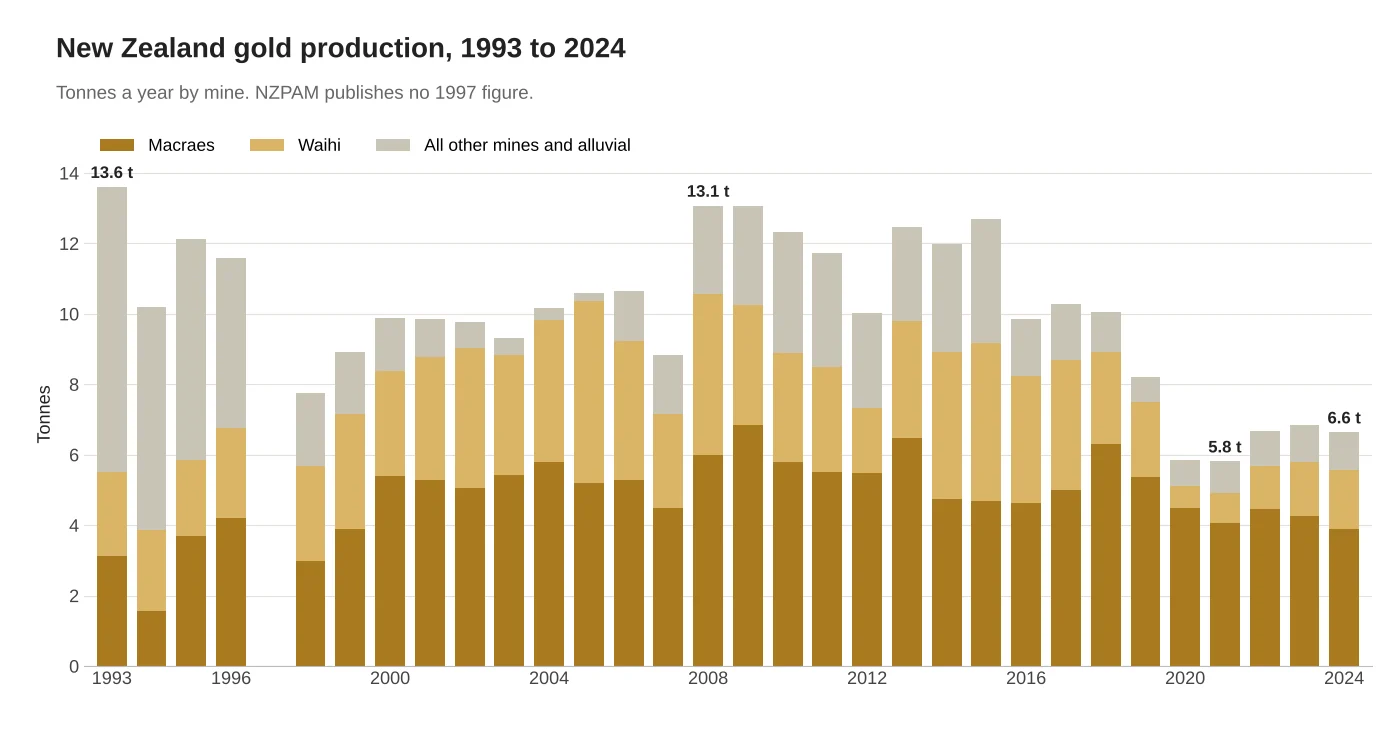
- National output in 2024 was less than half the 13,607 kilograms mined in 1993 (NZPAM, Nov 2025)
- OceanaGold's two New Zealand mines produced 222,100 ounces in 2025: 147,000 from Macraes and 75,100 from Waihi (OceanaGold, Feb 2026)
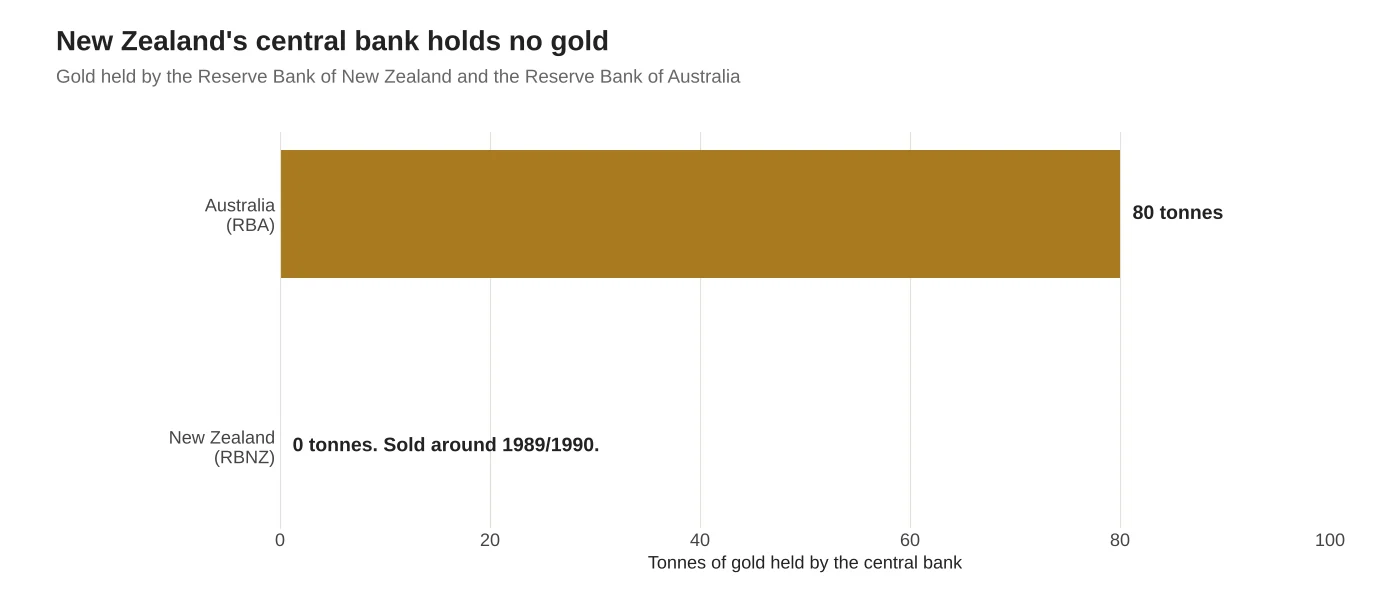
- The Reserve Bank sold its remaining gold, about $14 million worth, around 1989 and 1990 (Reserve Bank of New Zealand, Aug 2023)
- Australia's central bank holds 80 tonnes of gold, unchanged since 1997 (Reserve Bank of Australia, Jun 2026)
- Waihi North became the first major mining project approved under the Fast-track Approvals Act, on December 18, 2025, after 112 working days (RNZ, Dec 2025)
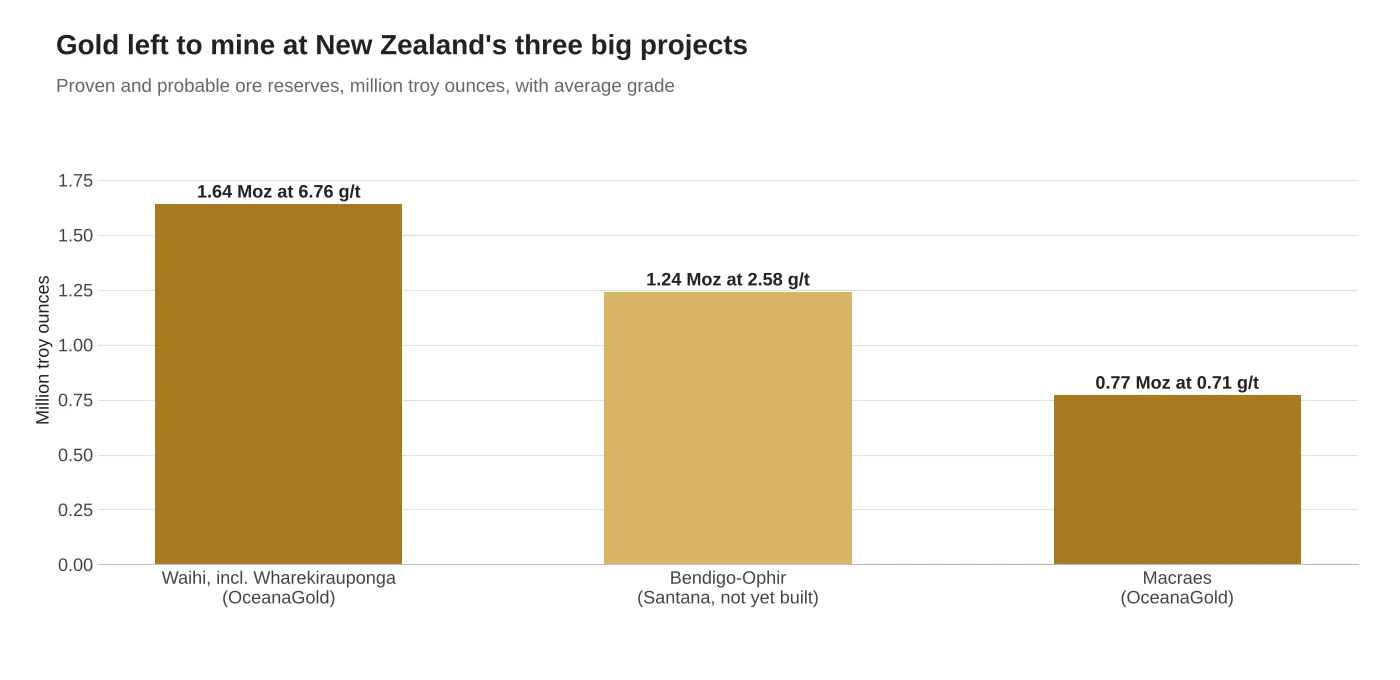
- The Wharekirauponga deposit at Waihi North holds 1.21 million ounces of reserves at 9.20 grams of gold per tonne (OceanaGold, Feb 2026)
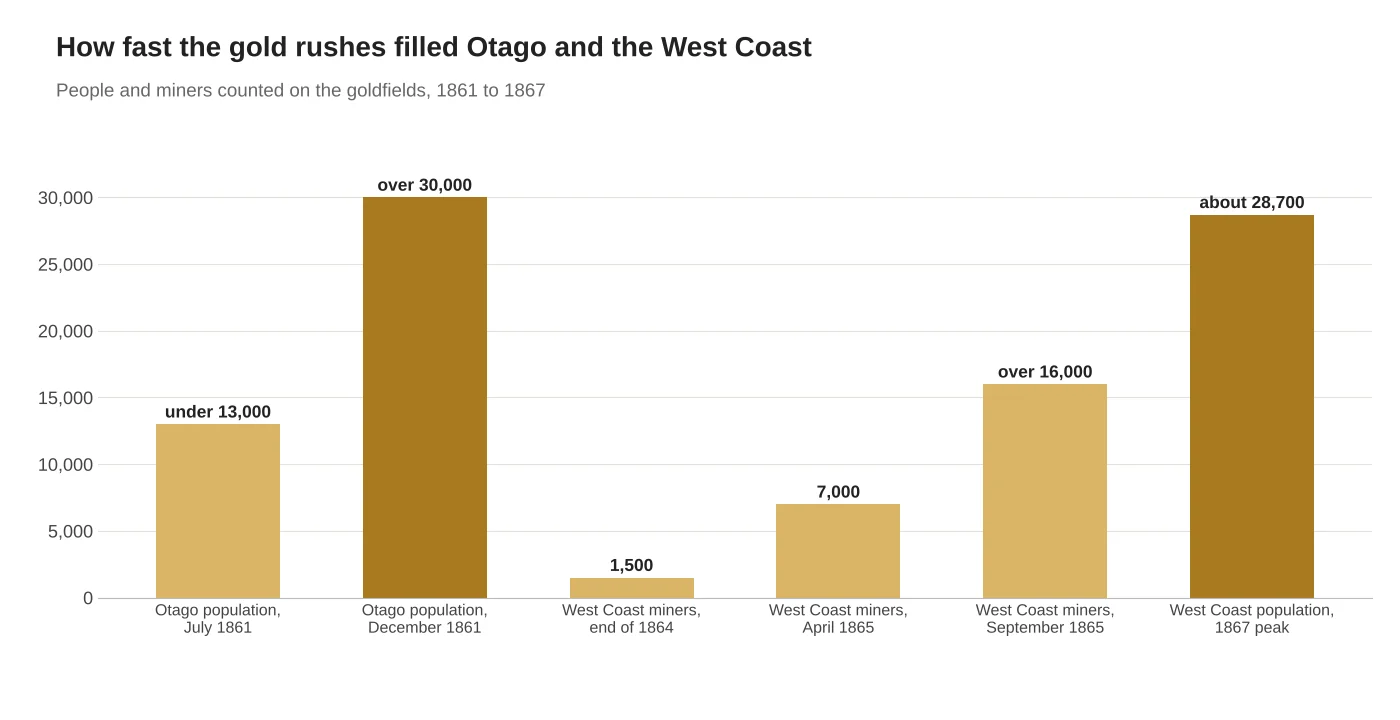
- Between July and December 1861, the Otago gold rush lifted the province's population from under 13,000 to over 30,000 (Te Ara, Apr 2009)
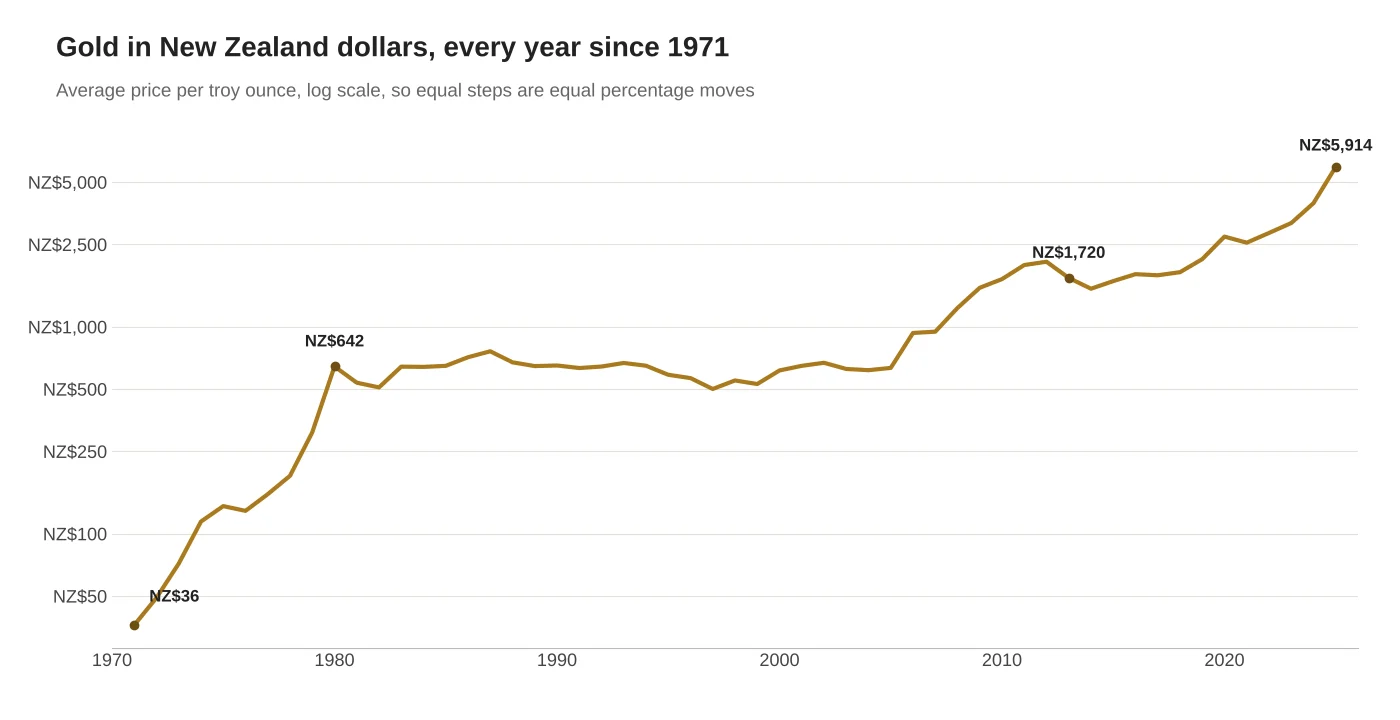
- Gold rose 62.5% in New Zealand dollars in 2025, its best year since a 154.0% jump in 1979 (MeltValue.com, Nov 2026)
02
How much gold does New Zealand mine?
Less every few years. Output has run at roughly half its 1990s level since 2020, and the money has gone the other way because the price has more than doubled.
How much gold did New Zealand produce in recent years?
About 6.6 to 6.8 tonnes a year since 2022, on figures permit holders report to the government.
- Gold production totalled 220,000 ounces in 2023, a 2.5% increase on 2022 (NZPAM, Nov 2024)
- Gold made up 98.9% of the value of all metals New Zealand produced in 2024, with silver most of the rest (NZPAM, Nov 2025)
- Mines produced 6,208 kilograms of silver in 2024, and 97% of it came from Waihi (NZPAM, Nov 2025)
Has New Zealand gold production gone up or down?
Down. The 2008 total was almost double the 2024 total.
- Output reached 13,075 kilograms in 2008, the highest since 1993 (NZPAM, Nov 2025)
- Production fell 28.7% to 5,860 kilograms in 2020, when Waihi produced only 615 kilograms (NZPAM, Nov 2025)
- The 2021 total of 5,815 kilograms is the lowest in the series, which starts in 1993 (NZPAM, Nov 2025)
How does New Zealand compare with the rest of the world?
It is a small producer. World mines produced about 3,300 tonnes in 2025, so New Zealand's 6.6 tonnes is around 0.2% of world output on our arithmetic.
- World gold mine production was an estimated 3,300 tonnes in 2025 (USGS, Feb 2026)
- The U.S. Geological Survey does not count New Zealand among the world's major producers of mineral commodities, and puts metals and industrial minerals at 2.1% of its GDP (USGS, Nov 2026)
- New Zealand's mineral exports totalled $1.46 billion in the year to June 2023 (NZPAM, Feb 2025)
- Exports of precious metals, jewellery and coins rose $166 million, or 166%, to $266 million in March 2026 (Stats NZ, Apr 2026)
- Gold exports alone rose $84 million, or 74%, to $198 million in February 2026 (Stats NZ, Mar 2026)
03
Where is gold mined in New Zealand?
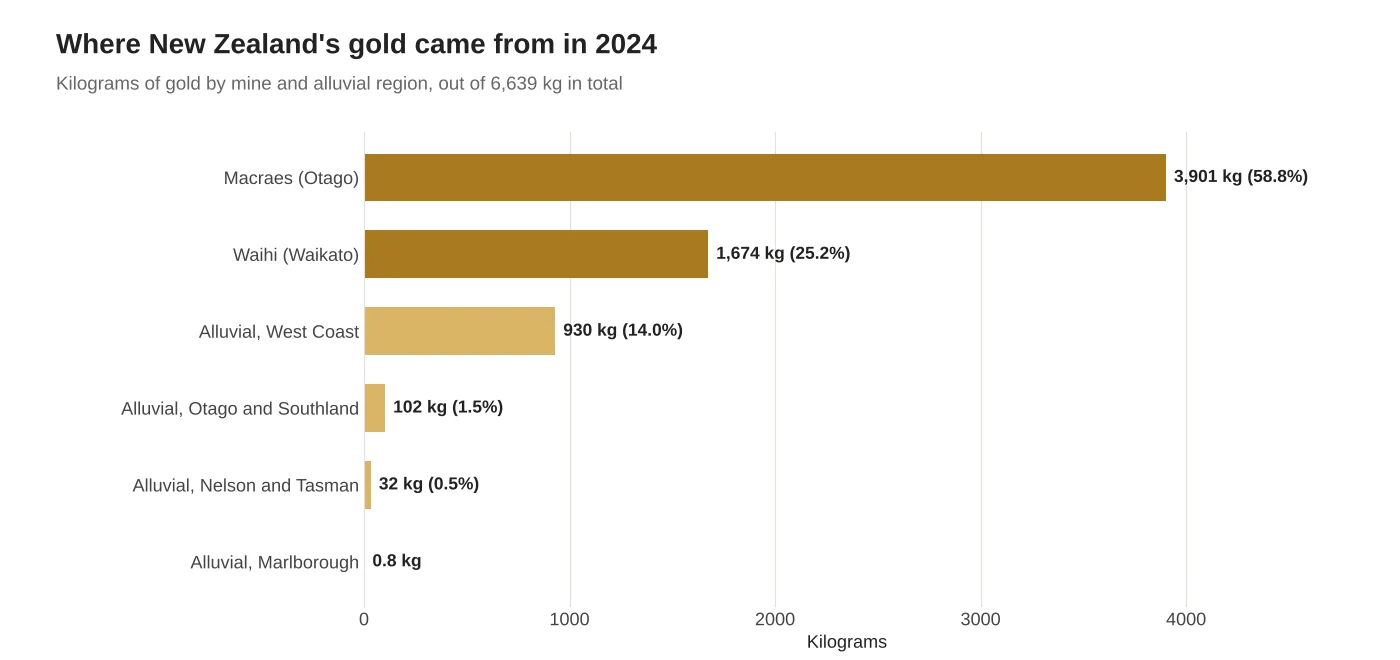
Two hard rock mines and a scatter of alluvial claims. Macraes and Waihi produce about 84% of the gold, and most of the rest comes out of West Coast gravels.
Which is New Zealand's biggest gold mine?
Macraes, an open pit and underground operation in East Otago owned by OceanaGold.
- Macraes produced 125,400 ounces in 2024 before rising 17% in 2025 (OceanaGold, Feb 2026)
- Its all-in sustaining cost was US$1,861 an ounce in 2025 (OceanaGold, Feb 2026)
- Macraes has 0.77 million ounces of proven and probable reserves at 0.71 grams per tonne (OceanaGold, Feb 2026)
- A new underground mine and open pit cutbacks extend the mine life at Macraes to 2032, five years longer than before (OceanaGold, Feb 2026)
How much gold comes from Waihi?
Waihi, in the Coromandel, produced a quarter of New Zealand's gold in 2024 and has been mined on and off since 1878.
- Waihi produced 1,674 kilograms of gold in 2024 (NZPAM, Nov 2025)
- Its output rose 40% in 2025 from 53,800 ounces the year before (OceanaGold, Feb 2026)
- Waihi's all-in sustaining cost was US$2,077 an ounce in 2025 (OceanaGold, Feb 2026)
- The modern Martha mine has averaged around 100,000 ounces of gold a year since 1987 (OceanaGold Waihi, Nov 2026)
How much gold do alluvial miners find?
About a tonne a year, mostly from river gravels on the West Coast.
- Alluvial mining on the West Coast produced 930 kilograms in 2024, 14.0% of the national total (NZPAM, Nov 2025)
- Alluvial miners in Otago and Southland produced 102 kilograms, those in Nelson and Tasman 32 kilograms, and Marlborough less than one kilogram (NZPAM, Nov 2025)
Where can you pan for gold in New Zealand?
Only in set areas, all in the South Island, unless you hold a permit.
- New Zealand has 19 public gold fossicking sites, and nine of them are on the West Coast (DOC, Jul 2025)
- All public gold fossicking areas are in the South Island, and looking for gold anywhere else needs a permit, even on your own land, because the Crown owns the gold (NZPAM, Nov 2026)
- A small-scale Tier 3 gold mining permit covers one unbroken area of less than 50 hectares (NZPAM, Nov 2026)
04
What new gold mines are planned in New Zealand?
Two big ones, and they point to New Zealand's gold output climbing again. Waihi North has its consent. Bendigo-Ophir is waiting on a decision due in January 2027.
What is the Waihi North Project?
A new underground mine at Wharekirauponga, about 10 kilometres north of the current Waihi operation, reached by a tunnel.
- OceanaGold says the project will extend mining at Waihi to around 2040 and earn over NZ$8 billion in export revenue at current gold prices (OceanaGold, Dec 2025)
- It is budgeted at about NZ$1 billion, the largest investment project in OceanaGold's portfolio (OceanaGold, Dec 2025)
- The Expert Panel assessed it against 26 Acts and regulatory instruments, and 263 parties were invited to comment (OceanaGold, Dec 2025)
- Ministers said the consent lets the operation run until 2043 (New Zealand Government, Dec 2025)
What is the Bendigo-Ophir gold project?
A proposed mine near Bendigo in Central Otago, built around the Rise and Shine deposit.
- Rise and Shine holds a mineral resource of 2.08 million ounces at 2.4 grams per tonne (Santana Minerals, Sep 2026)
- The updated pre-feasibility study plans peak output of 120,000 ounces a year over an initial mine life of 13.8 years (Santana Minerals, Sep 2026)
- Building it would cost an estimated A$277 million, including a 10% contingency (Santana Minerals, Sep 2026)
- The mine would employ an average of 351 people directly and support up to 814 jobs counting indirect work (Santana Minerals, Sep 2026)
- Santana lodged its Fast-track application on October 31, 2025, and the final decision is scheduled for January 20, 2027 (Santana Minerals, Sep 2026)
How much does the government want mining to grow?
It wants mineral exports doubled within a decade, and it names gold as one of the first places that growth comes from.
- The Minerals Strategy aims to double the value of mineral exports to $3 billion by 2035, with 7,000 or more regional jobs (MBIE, Jan 2025)
- The strategy lists gold and silver, metallurgical coal and iron sands as exports that can be scaled up immediately (MBIE, Jan 2025)
- Large mines pay a royalty of 2% of revenue or 10% of accounting profits on the mineral mined, whichever is higher (NZ Herald, Apr 2025)
05
Does New Zealand have gold reserves?
No. The Reserve Bank of New Zealand owns no gold at all, and it has been that way for more than 35 years.
When did New Zealand own gold?
The Reserve Bank took over the country's bank gold when it opened in 1934 and held small amounts for decades after.
- In 1934 the trading banks transferred all their gold to the new Reserve Bank, a holding valued at £4,351,727 (Grey River Argus via Papers Past, Oct 1934)
- The Reserve Bank had already sold £500,000 of that gold by October 1, 1934 (Grey River Argus via Papers Past, Oct 1934)
- New Zealanders have not had to offer their gold to the Reserve Bank since the Gold Acquisition Notice of 1948 was revoked in 1954 (The Press via Papers Past, Sep 1964)
- In 1964 the Reserve Bank's gold reserve was valued at £243,625 (The Press via Papers Past, Sep 1964)
Who buys New Zealand's mined gold?
Not the Reserve Bank. It stopped buying newly mined gold decades ago, and in the 1960s most of the country's output went to Australia.
- The Reserve Bank does not buy newly won gold, a minister told Parliament in 1964 (The Press via Papers Past, Sep 1964)
- Of the 36,000 ounces mined in New Zealand in 1962 and 1963, 21,000 ounces were exported to Australia (The Press via Papers Past, Sep 1964)
How does New Zealand compare with Australia?
Australia's central bank has held the same 80 tonnes since 1997. New Zealand's holds none.
- Australia's 80 tonnes would be worth about NZ$17.2 billion at the November 27, 2026 gold price, on our arithmetic (Reserve Bank of Australia, Jun 2026)
06
How big was the New Zealand gold rush?
The rushes of the 1860s brought tens of thousands of people to parts of the South Island that had few European settlers, and they did it in a matter of months.
When did the Otago gold rush start?
In May 1861, when Gabriel Read found gold at Tuapeka, near Lawrence.
- Gabriel Read found gold in the gully that now bears his name on May 25, 1861 (DOC, Nov 2026)
- Gold returns from the Lawrence district were 171,038 ounces in 1861 and 199,547 ounces in 1862 (DOC, Nov 2026)
- Mining was so heavy that the original floor of Gabriels Gully lay 50 metres below today's level (DOC, Nov 2026)
- More than £6,000,000 of gold came from Otago's four major fields in the early 1860s (Heritage New Zealand, Nov 2026)
How big was the West Coast gold rush?
Almost as big as Otago's. Payable gold turned up at Greenstone Creek in 1864, and the rush ran from 1865 to 1867.
- West Coast miners numbered 1,500 at the end of 1864, 7,000 by April 1865 and over 16,000 by September 1865 (Te Ara, Apr 2009)
- At the 1867 peak there were probably about 29,000 people on the West Coast, around 12% of New Zealand's European population (Te Ara, Mar 2009)
- Hokitika had 72 hotels at Christmas 1865, all of them packed with miners (Te Ara, Mar 2009)
- With 4,866 people in 1867, Hokitika was the largest town on the West Coast (Te Ara, Sep 2016)
How much gold has New Zealand produced in total?
Tens of millions of ounces since the 1850s, and one Waihi mine accounts for a large share.
- Over 27 million ounces of gold, worth nearly £125 million, had been exported from New Zealand by 1966 (Te Ara, Apr 2009)
- New Zealand's first gold discovery was by Charles Ring at Kapanga Creek, Coromandel, in 1852 (OceanaGold Waihi, Nov 2026)
- The Martha mine produced about 5.6 million ounces of gold and 38.4 million ounces of silver before it closed in 1952 (OceanaGold Waihi, Nov 2026)
- Martha produced more than twice the gold and silver of all other New Zealand goldfields put together, and around 60% of all the gold from the Coromandel (Te Ara, Apr 2016)
- Between 1930 and 1934, national output peaked at 166,354 ounces in 1932 (King Country Chronicle via Papers Past, Sep 1935)
07
What is the highest gold price ever in New Zealand?
NZ$9,109.52 an ounce, set on March 3, 2026. Gold in New Zealand dollars has gained in 39 of the 55 years from 1971 to 2025.
How much did gold cost in New Zealand in 2025?
An average of NZ$5,914 an ounce, more than in any year before it.
- Gold averaged NZ$5,914 an ounce in 2025, up from NZ$3,951 in 2024 (MeltValue.com, Nov 2026)
- Its 2025 range ran from a low of NZ$4,676 to a high of NZ$7,804 (MeltValue.com, Nov 2026)
- Gold rose 42.4% in New Zealand dollars in 2024 (MeltValue.com, Nov 2026)
How much has gold gone up in New Zealand?
By 2025 its average price was more than 160 times the 1971 average.
- Gold averaged NZ$36.13 an ounce in 1971, the first year of our New Zealand dollar record (MeltValue.com, Nov 2026)
- The worst year since 1971 was 2013, when gold fell 27.5% in New Zealand dollars (MeltValue.com, Nov 2026)
Is gold taxed in New Zealand?
Investment gold is free of GST, and large cash deals are banned.
- Gold of at least 99.5% fineness counts as fine metal, and a dealer's sale of fine metal is exempt from GST (Inland Revenue, Nov 2026)
- Since May 11, 2023, businesses may not buy or sell gold, silver or other precious metals in a cash transaction of $10,000 or more (Department of Internal Affairs, Apr 2023)
Glossary
- Alluvial gold: gold found loose in river and beach gravels, recovered by washing rather than by crushing rock. Also called placer gold.
- All-in sustaining cost (AISC): a mine's cost to produce one ounce, including sustaining capital, as reported by the miner.
- Fast-track Approvals Act 2024: the law that lets listed projects seek all their consents through one expert panel.
- Fossicking: hand searching for gold with pans, shovels and sluice boxes, allowed without a permit only in designated areas.
- Grams per tonne (g/t): how much gold a tonne of ore holds.
- NZPAM: New Zealand Petroleum and Minerals, the government agency that issues mining permits and publishes production figures.
- Ore reserve: the part of a deposit a company can show is economic to mine. A mineral resource is the wider estimate.
- RBNZ: the Reserve Bank of New Zealand, the central bank.
- Troy ounce: 31.1035 grams, the unit gold is priced in.
Methodology and Sources
Production figures come from New Zealand Petroleum and Minerals, which compiles them from the annual returns permit holders file, and from OceanaGold's results releases. Project figures come from OceanaGold and Santana Minerals filings. Reserve Bank figures come from its responses under the Official Information Act and from contemporary newspaper reports archived on Papers Past. Gold rush figures come from Te Ara and the Department of Conservation. Gold prices in New Zealand dollars come from MeltValue.com's own record: daily closes since 2013 from our price feed, and older closes from historical market data converted at the US Federal Reserve's monthly New Zealand dollar rate. Where we did arithmetic ourselves, such as New Zealand's share of world output, we say so. We check every figure against its source each month.
Sources
All 38 sources
- New Zealand Petroleum and Minerals, Annual minerals industry statistics
- New Zealand Petroleum and Minerals, Mining industry statistics for 2023
- New Zealand Petroleum and Minerals, Minerals Strategy and Critical Minerals List launched
- New Zealand Petroleum and Minerals, Gold fossicking
- New Zealand Petroleum and Minerals, Apply for a Tier 3 mining permit
- MBIE, A Minerals Strategy for New Zealand to 2040: An export-led growth pathway
- OceanaGold, 2025 results
- OceanaGold, Mineral Reserves and Resources for the year ended 2025
- OceanaGold, Waihi North Project approval statement
- OceanaGold Waihi, Local geology
- OceanaGold Waihi, About the historic mine
- OceanaGold Waihi, Timeline
- Santana Minerals, 2026 Annual Report
- RNZ, First mining project gains fast-track approval
- New Zealand Government, Major fast-track mining project approved
- NZ Herald, Mining in NZ: offshore profits and the challenge of fair royalties
- Reserve Bank of New Zealand, OIA response on gold reserves, May 2023
- Reserve Bank of New Zealand, OIA response on gold sales, August 2023
- Reserve Bank of Australia, Questions and answers about our gold holdings
- Papers Past, Grey River Argus, 9 October 1934
- Papers Past, King Country Chronicle, 12 September 1935
- Papers Past, The Press, 10 September 1964
- USGS, Mineral Commodity Summaries 2026: Gold
- USGS, The mineral industry of New Zealand
- Stats NZ, Total exports rise in March
- Stats NZ, Overseas merchandise trade: February 2026
- Department of Conservation, Fossicking rules broken as gold fever strikes
- Department of Conservation, History of Gabriels Gully
- Heritage New Zealand, Gabriel's Gully
- Te Ara, Otago gold rushes (1966 Encyclopaedia)
- Te Ara, Wakamarina and the West Coast (1966 Encyclopaedia)
- Te Ara, Gold (1966 Encyclopaedia)
- Te Ara, Gold and gold mining: West Coast
- Te Ara, West Coast region: Settlement and changing population
- Te Ara, Hauraki-Coromandel region: Gold mining
- Inland Revenue, GST exempt supplies
- Department of Internal Affairs, Prohibited cash transactions for high value goods
- MeltValue.com, Gold price chart NZ