
Canadian Silver Coin Melt Values
Canadian dimes, quarters, half dollars and dollars dated 1966 or earlier are silver. From 1920 to 1967 they were 80% silver, and an 80% quarter holds 0.15 troy ounces, worth $6.61 today. Coins struck before 1920 are sterling, 92.5% silver. Dimes and quarters from 1967 and 1968 can be 80%, 50% or no silver at all, so check those one by one.
Metal prices: silver $44.09/oz. Updated November 27, 2026 at 2:44 AM EST.
Canadian Silver Coin Values by Type
Silver content depends on the date and the denomination. The 1967 coins show animals for Canada’s centennial in place of the usual designs.
| Coin | Typical value |
|---|---|
| Silver dollar, 1935-196780% silver, 23.33 grams | Silver value for common dates; the 1948, with 18,780 struck, brings far more. See Canadian silver dollar value |
| 50 cents, 1920-196780% silver | Silver value for most dates; the 1921 is the "King of Canadian Coins" |
| 25 cents, 1920-196780% silver | Silver value for most dates; the 1936 Dot is a rare variety |
| 10 cents, 1920-196780% silver | Silver value for most dates |
| 10 and 25 cents, 1967 and 1968Some 80%, some 50% silver; late 1968 coins are pure nickel | Silver value for the silver pieces; face value for nickel |
| 5 cents, 1858-1921Tiny silver piece; sterling to 1919, 80% in 1920 and 1921 | Small premium for most dates; the 1921 is rare |
| Sterling coins before 192092.5% silver | Silver value worn; scarce dates bring premiums |
| Collector dollars, 1971-199150% silver, sold to collectors | Silver value |
| Silver Maple Leaf.9999 silver bullion coin | Silver value plus a dealer premium |
Values move with the silver price. Raw coins unless noted.
Canadian Silver Coin Melt Values by Year
The pure silver in each Canadian silver coin, priced at today’s silver spot price:
| Coin | Value today |
|---|---|
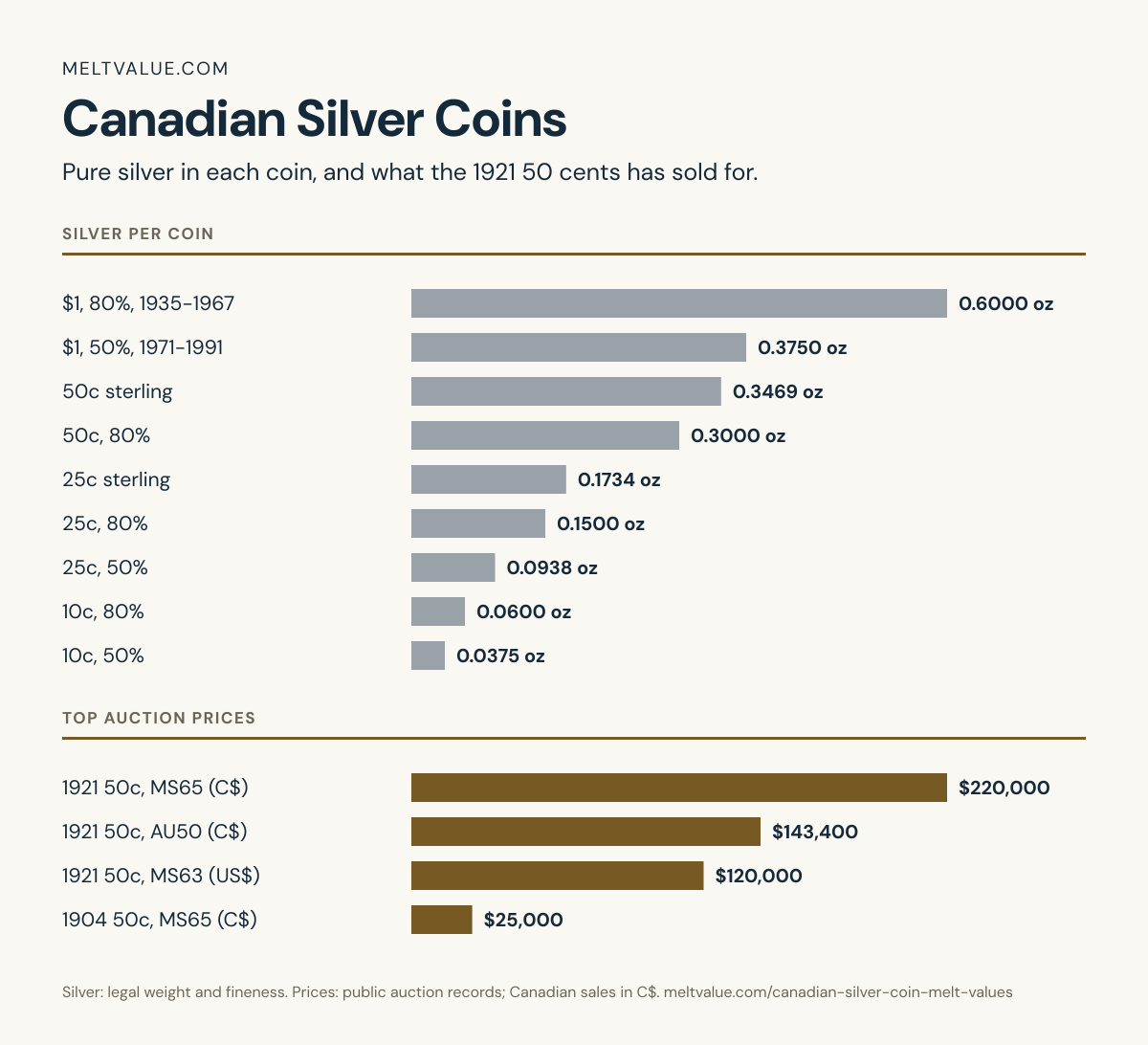
| 25 cents, 80% silver1920-1967, 5.83 g0.1500 troy oz silver | $6.61 |
| 10 cents, 80% silver1920-1967, 2.33 g0.0600 troy oz silver | $2.65 |
| 50 cents, 80% silver1920-1967, 11.66 g0.3000 troy oz silver | $13.23 |
| Silver dollar, 80% silver1935-1967, 23.33 g0.6000 troy oz silver | $26.45 |
| 10 cents, 50% silver1967-1968, 2.33 g0.0375 troy oz silver | $1.65 |
| 25 cents, 50% silver1967-1968, 5.83 g0.0938 troy oz silver | $4.13 |
| 5 cents, sterling1858-1919, 1.16 g0.0346 troy oz silver | $1.52 |
| 5 cents, 80% silver1920-1921, 1.17 g0.0300 troy oz silver | $1.32 |
| 10 cents, sterling1858-1919, 2.33 g0.0694 troy oz silver | $3.06 |
| 25 cents, sterling1870-1919, 5.83 g0.1734 troy oz silver | $7.65 |
| 50 cents, sterling1870-1919, 11.66 g0.3469 troy oz silver | $15.29 |
| Collector dollar, 50% silver1971-1991, 23.33 g0.3750 troy oz silver | $16.53 |
| Silver Maple Leaf, 1 ozBullion, .9999 silver1.0000 troy oz silver | $44.09 |
Live metal value at today’s spot prices. Dealers usually pay a little under melt for common coins.
How to Tell If Your Canadian Coin Is Silver
- Check the date. Dimes, quarters, halves and dollars dated 1966 or earlier are silver. So are 1967 halves and dollars. A 1967 dime or quarter may be 80% or 50% silver.
- Use a magnet on 1968 coins. Some 1968 dimes and quarters are 50% silver and some are pure nickel. Canadian nickel sticks to a magnet and silver does not.
- Count by face value. Every $1 in face value of 1920 to 1967 coins holds 0.6 troy ounces of silver, whether it is ten dimes, four quarters or two halves.
- Look closely at a 1936 quarter. A small raised dot near the bottom of the back marks the rare 1936 Dot variety. Have one checked by a grading service.
- Set aside any 1921 50 cents. Only about 75 survived, so a real one is worth tens of thousands of dollars or more.
What Rare Canadian Silver Coins Sell For
Most Canadian silver trades on its weight. The record prices go to the 1921 50 cents and other rare dates in high grades. Public auction results:
| Coin and grade | Sold for |
|---|---|
| 1921 50 cents, MS65 ICCS2015 | C$220,000 |
| 1921 50 cents, AU50 ICCS2026 | C$143,400 |
| 1921 50 cents, MS63 PCGSAug 2019 | US$120,000 |
| 1921 50 cents, no-reserve auction2019 | C$57,000 |
| 1904 50 cents, MS65 ICCS2015 | C$25,000 |
Canadian sales are in Canadian dollars. The 2015 and 2019 Canadian prices are hammer prices without the buyer’s fee.
Canadian Silver Coin Melt Value Calculator
Pick a coin and enter how many you have. The calculator multiplies the pure silver in each coin by the live silver price.
An 80% silver quarter weighs 5.83 grams and holds 4.67 grams, or 0.15 troy ounces, of pure silver. A silver dollar from 1935 to 1967 holds 0.6 ounces.
Metal value
$6.61
0.15 troy oz of pure silver. Silver $6.61. Dealers buying in bulk usually pay a little under melt.
Canadian Silver Coin Specifications
| Sterling years | 1858 to 1919, 92.5% silver |
|---|---|
| 80% years | 1920 to 1967 (5 cents only 1920 and 1921) |
| 50% years | 1967 and 1968 dimes and quarters |
| 10 cents | 2.33 grams; 0.0600 oz silver at 80% |
| 25 cents | 5.83 grams; 0.1500 oz silver at 80% |
| 50 cents | 11.66 grams, 29.72 mm; 0.3000 oz silver at 80% |
| Silver dollar | 23.33 grams; 0.6000 oz silver at 80% |
How Canada Took the Silver Out of Its Coins
Canada struck its silver coins in sterling, 92.5% fine, until 1919. In 1920 it cut the silver to 80%. The tiny silver 5-cent piece gave way to a nickel coin in 1922.
The 1921 50 cents became the "King of Canadian Coins." Demand for half dollars was light, and only about 28,000 were issued from 1921 to 1929. In 1929 the Mint melted the stored 1921 coins and restruck the silver as new 1929 halves. About 75 of the 1921 pieces survived, some in specimen sets and some sold to visitors at the Mint.
Silver prices climbed in the 1960s. During 1967 the Mint cut dimes and quarters to 50% silver, and in 1968 it switched them to pure nickel. Halves and dollars went to nickel in 1968. Canada still strikes silver for collectors and investors, including the Silver Maple Leaf bullion coin.
How to Sell Canadian Silver Coins
- Sort by date and fineness. Separate sterling, 80% and 50% coins. Dealers price each group by its pure silver.
- Test your 1968 coins. Pull out the nickel ones with a magnet before you sell, so the buyer does not count them as silver or you sell silver for face value.
- Pull out rare dates. Look for 1921 halves and 5 cents, 1936 Dot quarters and 1948 dollars. Sell those to a collector or through an auction.
- Quote by face value. Many buyers price 80% Canadian silver per dollar of face value. Every $1 face holds 0.6 troy ounces.
For Canadian silver dollars by date, see Canadian silver dollar value. Silver coins from other countries are on the world silver coin melt values page.
Sources
- Canadian Coin News: King of Canadian Coins brings $220K: the 2015 C$220,000 hammer price, the 1929 melt and about 75 survivors
- Canadian Coin News: 1921 50-cent sells for $220,000: the MS65 grade and the 1904 MS65 sale at $25,000
- Canadian Coin News: King of Canadian Coins realizes $143,400: the 2026 AU50 sale with buyer’s premium
- Canadian Coin News: King of Canadian Coins tops estimate: the 2019 no-reserve sale at $57,000
- Canadian Coin News: 50-cent silver content: the 1920 drop from 92.5% to 80% silver
- Greysheet: Canada 1921 50 cents: the 11.66 gram weight, .800 fineness and 0.3 oz of silver